During the recent eruption of a national obsession with civility in the wake of Jarod Loughner’s shooting rampage—odd, because his actions had nothing whatsoever to do with civility—it became disturbingly evident that most journalists have only a vague sense of what incivility is. For example, using shooting or death metaphors and imagery are not uncivil. Criticism, even strongly-worded criticism, is not uncivil. Calling lies lies is not uncivil, nor is suggesting bad motives for official actions, if the critic believes that bad motives are involved. The fact that intense and passionate condemnation of an individual’s or a group’s actions angers or inflames others does not necessarily mean that the inciting words were uncivil, or even inappropriate.
fairness
Ethics Hero: Gil Meche
[ Finally reduced to hunt-and-pecking blog posts from an Arlington, VA. Starbucks as the result of a still-ongoing power outage at the Marshall home-office, I apologize for an uncharacteristically quiet day.]
All Kansas City pitcher Gil Meche needed to do to collect $12 million in 2011 was to show up, do his best to pitch—which his ailing right arm would no longer permit him to do—and cash the checks. But despite having an iron-clad contract (the last in a long-term deal he signed as a free agent), Meche decided to retire, thus ending the contract and forfeiting the money. Continue reading
Time to Enforce the Hatch Act on Karl Rove
The Hatch Act is a 1939 law that prohibits the use of federal money to support political causes. It’s an important law that many presidential administrations have nicked, dinged and outright violated, without enforcement or consequences. But a thorough report by an independent federal agency shows that the Bush White House routinely violated the Act by creating a “political boiler room” that coordinated Republican campaign activities nationwide.
The report by the Office of Special Counsel finds that the Bush administration’s Office of Political Affairs, overseen by Karl Rove, served as a virtual extension of the Republican National Committee, developing a “target list” of Congressional races, organizing dozens of briefings for political appointees to press them to work for party candidates, and sending cabinet officials out to help these campaigns. This included helping coordinate fund-raising by Republican candidates and persuading Bush political appointees to help with Republican voter-turnout efforts.The report was based on over 100,000 pages of documents and interviews with eighty Bush administration officials in a three year investigation. Continue reading
To Edit, or Not to Edit: A Blogging Ethical Dilemma
I was just simultaneously reading an excellent, if not particularly revolutionary, article about blogging ethics and checking out the latest comments on the Immortal Tide (with Acti-lift!) Debate. Suddenly I found myself wishing that the author, whose essay concentrated on editing blog posts, had also addressed the issue of editing blog comments.
Unlike some blog platforms, WordPress does not have a feature that allows commenters to review or spell-check their own posts. Despite this, many of the regular commenters here have a better record of avoiding typos than I do, and I have preview and spellcheck features. When they make a spelling or grammatical error (and I notice it), I will fix it for them: WordPress allows me to edit comments. Sometimes a commenter will e-mail me personally and request an edit, and I am happy to oblige.
A while ago, one new commenter whose post was riddled with spelling and grammatical errors accused me of letting her errors stand to make her look unintelligent because she had disagreed with my original post, while I continued to edit comments that were more friendly. In her case, I actually hadn’t read the previous typo-infested comment that she was referring to, and treated her complaint as a request to edit it, which I did. But it was a mess, and I wondered then if it made sense, or was even fair, to turn an inarticulate, careless comment into a clear and persuasive one.
Today I have read several posts on the endless Tide commercial thread from a 15-year-old girl. The post is in text-speak, essentially, without capitals, punctuation or any attention to style. It is a clear comment, however,even if it is obviously the expression of a 21st Century teen. Should I edit her comment to give it more credibility, by punctuating it, for example?
What is an ethical editing policy regarding comments on an ethics blog? The options, as I see them, with their ethical pros and cons: Continue reading
Keith Olbermann: An Ethics Cautionary Tale
 At the risk of being accused of proving the old proverb that when all you have is a hammer, every problem looks like a nail, let me offer the observation that the apparently acrimonious departure of Keith Olbermann from MSNBC, despite being the cable channel’s biggest star, is a cautionary tale about ethics.
The lesson: the absence of respect for the opinions of others, accompanied by a lack of humility and a surplus of contempt for fairness and civility, will doom even intelligent, talented and hard-working individuals to inevitable failure, because they cannot be trusted, not by employers, not by colleagues, not by friends.
This is why ethical values are valued: they are essential to individual success, because they contribute to societal and social success. This is, I believe, the fourth time an Olbermann show has ended like this, and like Bill Murray in “Groundhog Day,” he is doomed to repeat the pattern until he learns how to be a more caring, more trustworthy human being.
I hope he makes it. Keith Olbermann has the ability to help make this a better country, instead of a nastier, meaner, more divided one. I hope he gets another chance, and that this time, he figures out how to use his abundant talents to do it.
Unethical Quote of the Week AND Unethical Apology of the Month: Rep. Steve Cohen
First, the quote:
“I said Goebbels lied about the Jews, and that led to the Holocaust. Not in any way whatsoever was I comparing Republicans to Nazis. I was saying lies are wrong…I don’t know who got everybody’s panties in a wad over this statement.”
—–Rep. Steve Cohen (D-Tenn.), in his initial dismissal of criticism over his rant on the House floor regarding Republican characterizations of the health care bill.
This quote is really remarkable, for it is hard to pack so many kinds of dishonesty into so few words.It’s hard to know where to begin. Continue reading
CNN and John King, Endorsing “Newspeak” and Disgracing American Journalism
And so it begins.
CNN’s John King: “Before we go to break, I want to make a quick point. We were having a discussion about the Chicago mayoral race. My friend Andy Shaw used the term ‘in the crosshairs’ in talking about the candidates. We’re trying, we’re trying to get away from that language. Andy is a good friend, he’s covered politics for a long time, but we’re trying to get away from that kind of language.”
What “kind of langauge”? Oh, you know: vivid language. Metaphors. Similes. Can’t have that on CNN, because, as everyone knows, a completely unrelated use of a cross-hairs graphic on a Sarah Palin campaign map had nothing to do with the shooting of Rep. Gaby Giffords and 19 others, but the media decided to make everyone think it was the fault of the map anyway. So now a news network, which is supposed to convey information, is apologizing for a guest’s use of the word “cross-hairs” in a context that had nothing to do with violence. Continue reading
“Finishing the Hat”: Sondheim, W.S. Gilbert, and Expert Malpractice
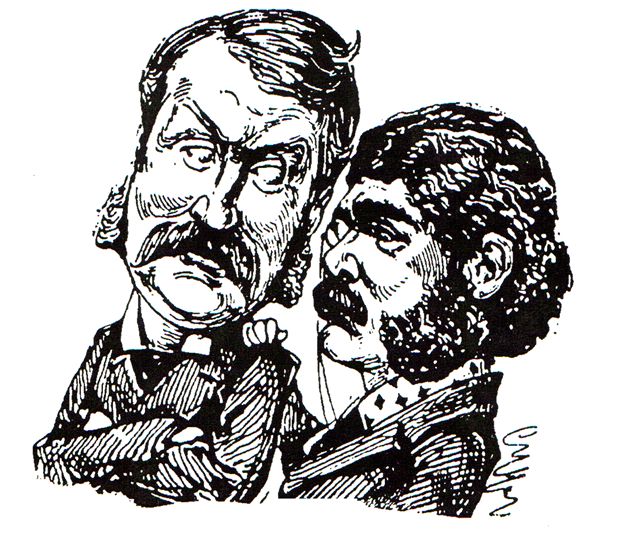
Stephen Sondheim’s “Finishing the Hat” is a fascinating reflection on a remarkable career and the craft of making musicals by the greatest living master of the form. In the course of recounting his formative years, triumphs, failures, and duels with producers, authors and composers, Sondheim also critiques the lyrics of his predecessors, contemporaries and role models—as long as they are dead. In a nod to gentility or cowardice, the only living lyricist he subjects to his expert critiques is himself.
Sondheim is a tough judge, as one might expect from a composer/lyricist who meticulously measures each vowel sound and stressed syllable for maximum effect. He is also, by virtue of both his reputation and technical expertise, an influential one. The lyricists he grades highly in the book, such as Frank Loesser, Cole Porter and Dorothy Fields, are likely to have their reputations burnished by his praise, and those he slams, like Lorenz Hart and Noel Coward, will suffer by comparison. Because of this, Sondheim had an obligation, as a respected expert in his field, to make each case carefully and fairly. To his credit, Sondheim seems to recognize this, and all of his critical discussions of an individual lyricist’s style and quirks include specific examples and careful analysis. We may disagree with Sondheim as a matter of personal taste, but it is difficult to argue with his specific points, because they are backed up by examples, technical theory, and the weight of his authority.
It is therefore surprising and disappointing to see Stephen Sondheim slide into expert malpractice when he undertakes, clearly half-heartedly, a critique of the lyrics of W.S. Gilbert, of Gilbert and Sullivan fame. Continue reading
The Lost Flashdrive and Presumed Consent
“Lose a flashdrive here? Call the Arboretum if you’re one of the visitors in this photo, or phone these guys if they are friends of yours. A flashdrive packed with photos and software has been in our lost-N-found for at least a month — Store manager Lynnea suggested we post a photo from the drive and see if someone cla…ims it. Describe the drive and its contents accurately & provide your postal — we’ll happily return it.”
The Boyce Thompson Arboretum in Superior Arizona recently posted this notice on its Facebook page, along with one of the photographs a staff member took off the lost flashdrive. Obviously the material on the drive is private; just as obviously, the flashdrive is lost. Is the Arboretum within reasonable ethical boundaries to examine and publicize private information without the permission of the flashdrive’s owner to help the owner recover his lost property? Continue reading
For Broadway Patrons, A Bill of Non-Existant Rights
What do Broadway theater-goers have a right to know and expect? The blog Gratuitous Violins has proposed a “Ticket-Buyer’s Bill of Rights.” While superficially reasonable, this manifesto embodies what is wrong with the expectations of consumers in general and theater patrons in particular. “Let’s face it,” the blogger, “Esther”, writes, “the producers are selling a product and we consumers should be able to make an informed purchase.” Okay. An informed purchase, however, does not require being routinely informed of all aspects of the production, particularly when the information is readily available to the responsible consumer.
Here are Esther’s three tenets of the “Bill of Rights”: Continue reading

