When You Consider The Wisdom Of Obama’s Campaign To Destigmatize Felons, Please Also Consider Felicia Menge Kelley

Portrait of a justice-involved individual...

Portrait of a justice-involved individual…

As it attempts to bolster its political support by sucking up to convicted criminals and their families, the Obama administration has been incrementally making it more difficult to distinguish felons from law-abiding citizens, arguing that once they have paid their debt to society, maybe they are no different. HUD, carrying out the Obama administration’s new theory that felons are just plain folks,  has decreed that landlords risk federal investigations if they reject rental applicants based on the applicant’s undisputed criminal record in newly-released guidelines. 

The Justice Department and the Department of Education are now using a euphemism to make convicts and those with rap sheets sound like they have a hobby: the new cover-phrase is “justice-involved individuals.” (Hillary Clinton is apparently a justice-involved individual.)

The problem with all of this is that being convicted of a felony is not like catching a cold, and often provides a strong clue that the individual involved is not quite as trustworthy as the boy scout or girl scout next door. Take, for example, this story:

From the ABA Journal:

A woman with a history of financial crimes in multiple states got a job as an office manager and bookkeeper for a North Carolina law firm, after a background check failed to pick up her earlier convictions under a different name.

That resulted in a loss of more than $150,000 to the firm, Yow, Fox & Mannen, District Attorney Ben David of New Hanover County told the Port City Daily. The firm’s now-former employee, Felicia Menge Kelley, 44, pleaded guilty on Tuesday to one count of embezzlement and was sentenced to a prison term of between 82 and 111 months, the newspaper reports. She will also be required to pay over $145,000 in restitution.

Kelley, who has previously worked for other law firms in the Jacksonville area, was convicted earlier under the name of Felicia Dawn Menge…

But I’m sure she’s just an exception to the rule…and gives a bad name to decent, hard-working, justice-involved individuals. It’s not like they are criminals or something.


Calling Balls And Strikes

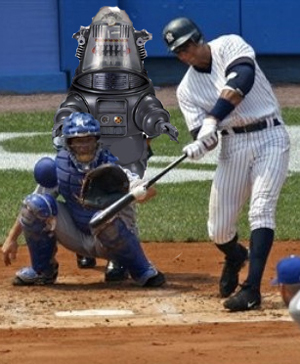
Robot Umpire

Calling balls and strikes in major league baseball has to be mechanized. This is obvious and beyond argument, and the only question is what will finally make the bitter-enders abandon their rationalizations and capitulate to reality.

I last wrote about this in 2012 in a post titled “Umpire Accountability, As the Day Of The Robot Approaches,” following a 1-0 game in which a batter in a position to tie the game was called out on strikes by an umpire named Larry Vanover, who rang him up with three balls out of the strike zone for the final 9th inning out. This particular contest was between two teams that had finished the previous season with one of them edging out the other for the play-offs by a single game, on the last day of the schedule. The pitches called strikes in this particular at bat weren’t even close to being over the plate. You could see that all three were wide with the naked eye as they arrived in the catcher’s mitt; you could see it in the computer graphic on the screen, and after the game, the pitches’ locations were charted to show that they were, in fact, balls. I wrote…

Baseball fans invest too much time and emotion into following the games and their teams to just shrug off results warped by obvious incompetence. The kind of atrocious umpiring demonstrated by Vanover…poses a direct challenge to baseball’s integrity. What will baseball’s leaders do about it?

They have only three choices:

1.They can, for the first time, take public and punitive action against umpires whose poor performance exceeds a missed call or a human mistake, and demonstrates inexcusable incompetence or a lack of professionalism. First time: a stiff fine. Second time: a suspension without pay. Third time: dismissal.I know that the umpires union in Major League Baseball protects its incompetents as zealously as the teachers unions, but baseball has its product to protect.

2. Baseball’s leaders can make a commitment to automated strike and out calling, and cut back on crews to one field umpire to keep order and one booth umpire to read the printouts, watch the TV screen, and study the replays.

3. Baseball can reject integrity and credibility, and continue to let the Vanovers on the field wreck the games and alienate fans.

So far, disgracefully, the sport has chosen #3, but the clock is ticking. Continue reading

A Slap On The Wrist For The Lawyer Who Demanded 65 Million Dollars For A Lost Pair Of Pants

And they weren't even Elvis' pants...

And they weren’t even Elvis’ pants…

There has been a lot of beating up on judges and lawyers lately, on this blog and elsewhere, so what better time to revisit the weird case of foormer administrative law judge and current attorney Roy Pearson, Jr? He was the D.C.  judge who carried on such a vendetta against a dry cleaner because they lost a pair of his pants that it became national news…which is to say, it was discussed on The View and the women made fools of themselves. Not as big fools as the judge made of himself, though.

Pearson claimed that in 2005, the dry cleaners gave him the wrong pair of pants and refused to pay him the $1,150 he demanded as compensation. His suit—his $67 million suit!— against the dry cleaners alleged that the business violated Washington, D.C.’s consumer protection law by failing to comply with its sign promising “satisfaction guaranteed,” which Pearson claimed was unconditional. You know, even if a customer was deranged.

In his testimony in this wacko lawsuit, Pearson argued that “satisfaction guaranteed” meant the dry cleaner was legally obligated to pay a customer who demanded $1,000 for a supposedly lost sweater even if the owners knew they had delivered the correct sweater to the customer.

By that logic, the owner would also have to let the customer have sex with his teenage daughter, if that’s what it took to “satisfy” him. Continue reading

Res Ipsa Loquitur Ethics Quote Of The Day: Law Professor/Blogger/Irony Master Ann Althouse

free-bingo-design

The NYT article tells us that Sotomayor’s remarks were published in the Berkeley La Raza Law Journal and that she also said:

“Whether born from experience or inherent physiological or cultural differences,” she said, for jurists who are women and nonwhite, “our gender and national origins may and will make a difference in our judging.”…

… Judge Sotomayor questioned whether achieving impartiality “is possible in all, or even, in most, cases.” She added, “And I wonder whether by ignoring our differences as women or men of color we do a disservice both to the law and society.” She also approvingly quoted several law professors who said that “to judge is an exercise of power” and that “there is no objective stance but only a series of perspectives. Personal experiences affect the facts that judges choose to see,” she said.

So has Donald Trump refrained from doing a disservice both to the law and society?

—-Ann Althouse, making a slam-dunk point about the hypocrisy of the uproar over Donald Trump’s “racist”suggestion that a Hispanic-American judge might be biased against him.

Althouse and I are right, and almost everyone else is wrong. It’s obvious, and beyond rebuttal on the facts. Althouse has joined me as one who also deplores everything about Donald Trump but who is determined to call out intellectual dishonesty and unfairness in the attacks against him. She also posted this… Continue reading

Ethics Observations On The Donald Trump-“Mexican” Judge Affair

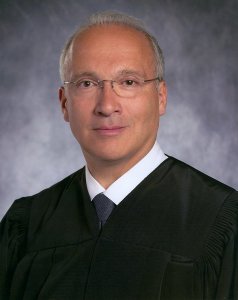
Judge Curial. Funny, he looks white to me...

Judge Curial. Funny, he looks white to me…

“Everybody says it, but I have a judge who is a hater of Donald Trump. He’s a hater. His name is Gonzalo Curial… We are in front of a very hostile judge. The judge was appointed by by Barack Obama – federal judge. [Boos]. Frankly he should recuse himself. He has given us ruling after ruling, negative, negative, negative. I have a top lawyer who said he has never seen anything like this before. So what happens is we get sued. We have a Magistrate named William Gallo who truly hates us..Watch how we win it as I have been treated unfairly. . . . So what happens is the judge, who happens to be, we believe Mexican, which is great. I think that is fine. You know what? I think the Mexicans are going to end up loving Donald Trump when I give all these jobs. I think they are going to love it. I think they are going to love me. . .I think Judge Curiel should be ashamed of himself. I think it is a disgrace he is doing this… It is a disgrace. It is a rigged system…They ought to look into Judge Curiel because what Judge Curiel is doing is a total disgrace. “

This is what Donald Trump said about Mexican-American judge Gonzalo Curial, who is currently presiding over the civil law suit involving now-defunct Trump University. That is all of it, with the rest being general Trump-speak.

The initial reaction in the news media and from the anti-Trump legal commentators (that is, essentially all legal commentators except the ones who have to eat alone at their law school dining rooms) was that Trump’s entire rant that contained the sentiments above were a threat to the rule of law and judicial independence. As I explained here, that was both hyperbole and a double standard.

It also, as I expected, was far too technical a complaint for the average voter to understand or get upset about, even if it had been valid and fair, which it wasn’t. So the anti-Trump forces, which are mighty and legion, decide to shift gears, and rather than attack the statement as a threat to the Constitution, condemn it  as “racist.” It was so racist that Buzzfeed decided that it could get brownie points by pulling out of an ad deal it had made with the Republican Party by professing revulsion at the party’s presumptive nominee’s “racism.”

The news media has now decided that it is just a fact that Trump’s comments about the judge were “racist.” That’s how the topic is being discussed. Nobody looks at the statement that sparked this nonsense: Trump said something racist, and that’s all there is to it.

Except that he didn’t.

I can’t keep track of all of the subsequent statements Trump has made or will make to defend himself. Since he talks like a stream of consciousness novel written by a Red Bull-guzzling cab driver, he may have said or will say something that is more inflammatory than the statement being attacked; remember, the man literally doesn’t know what is going to come out of his mouth until he hears it. For now, I’m going to stick to the statement that started this.

1. He said that Judge Curiel “was a hater.”

2. He implied that he was biased against Trump, and that this was a “disgrace.”

3. He said, in what I am certain was one of those examples where Trump’s tongue got the jump on his brain, that “we believe” the judge was “Mexican.”

4. He said that the system “was rigged,”that Judge Curiel should recuse himself, and that Curiel should be ashamed.

That’s it!

None of that constitutes a “racist” statement. It does not even constitute  a bigoted statement, and it is in no way the magnitude of offense the Democrats, media and Trump opponents are claiming, indeed, stating it to be.

Before I list the ethics touch-points in this disturbing event (the event being a news media lynch mob devoid of proportion or fairness controlling the discussion and misrepresenting a Presidential candidate), let me make this clear, as if I hadn’t already in dozens of Ethics Alarms posts: Continue reading

Ethics Quiz: The Washington Post’s Trump Hair Orgy

Trump Hair

Preface: I believe that it is existentially essential and an ethical duty of citizenship to prevent Donald Trump from becoming President of the United States. I also believe that the news media is obligated to report the campaign objectively and fairly, admittedly something they have increasingly appeared both unwilling and unable to do. For the mews media to elect the President by allying itself to one party is a far more dangerous threat to democracy than, for example, organizations of citizens being allowed to make whatever political statements they choose during the course of a campaign. Democrats like Bernie Sanders don’t see the news media placing its weighty foot on the scale as a problem, because they know where that foot will go: on their side of the scale, hard, like it did in 2008 and 2012.

All signs point to the news media planning to metaphorically stomp on the scale in the coming campaign and justifying it because of Trump. This is also known as “the ends justify the means.”

Today’s Ethics  Quiz continues the Ethics Alarms ongoing inquiry into what ethical journalism standards should be during the 2016 Presidential race.

Late last week, I was somewhat stunned to see the Washington Post Style Section dominated by a feature of the sort the Post usually reserves for holidays, like News Years or Valentines day. Almost the entire front page of the section was devoted to the single topic of ridiculing Donald Trump’s appearance, specifically his hair. Titled “The 100 greatest descriptions of Donald Trump’s hair ever written,” it began in part,

“Here, in the most comprehensive and highly scientific endeavor of its kind, culled from 30 years of news articles, we present the top 100 unique descriptors of the Trump mane, written by journalists or pontificators who secretly fancy themselves poets.”

Among the entries…

9. An ambitious corn dog that escaped from the concession stand at a rural Alabama fairground, stole an unattended wig, hopped a freight train to Atlantic City and never looked back

15. A mullet that died in some horrific accident

62. A dead skunk

70. A dishrag that on closer inspection is alive with maggots

Stipulating that this article appears in the Style Section, along with the comics, movie reviews and human interest stories, your Ethics Alarms Ethics Quiz of the Day is…

Was this orgy of hair ridicule of a Presidential candidate being published in a major newspaper fair?

Continue reading

Ethics Dunce: Santa Clara County Superior Court Judge Aaron Persky

Let’s see if this sentence generates a fraction of the national attention that the so-called “affluenza” sentence did. For this is much, much worse.

Star Stanford swimmer and Olympic swimming team candidate Brock Turner was arrested in the early morning hours of Jan. 18, 2015  when two Stanford graduate students  saw him on the ground, thrusting his hips atop an unconscious, partially clothed woman. They called police; Turner ran, and police chased him down Turner. In trial, Turner claimed that the woman had consented, though police found her unconscious.

The jury didn’t believe him, and convicted Turner of assault with intent to commit rape of an intoxicated woman, sexually penetrating an intoxicated person with a foreign object and sexually penetrating an unconscious person with a foreign object. The usual sentence for sexual assault is six years in state prison. Santa Clara County Superior Court Judge Aaron Persky, however,  sentenced Turner to six months in county jail and three years’ probation. Turner could get out of prison after just three months.

For rape.

I do not find the Judge’s reasoning persuasive. His arguments were.. Continue reading

From “The Ethics Incompleteness Theorem” and “The Ends Justify The Means” Files, The Pautler Case: My Favorite Legal Ethics Dilemma Ever!

"Irena's Vow" Pictured L to R: Maja Wampuszyc, Tracee Chimo, Tovah Feldshuh (kneeling), Gene Silvers

The Sundance Channel was doing a “Law and Order” marathon this week, and I happened to see an episode from 2002 that I had missed. It was based on the Pautler case in Colorado from the same year.

In “DR 1-102,”  Assistant DA Serena Southerlyn (Elisabeth Rohm) deals with a hostage crisis in which a man suspected of bludgeoning two women to death claims he will release his captive, held at knifepoint (above), if he can consult with an attorney. Southerlyn volunteers to enter the scene, and obtains both the hostage’s release and the killer’s  surrender, but only by deceiving him into believing that she is his lawyer, and not a prosecutor working for the police and the State. Although Southerlyn is hailed as a hero, the bar seeks to disbar her, charging her with violating Disciplinary Rule 1-102 (now New York RPC 8.4 d., which prohibits lawyers from lying.  .

Actually, Serena did a lot more than that, as did her model, Mark Pautler, the Jefferson County (Colorado) assistant D.A. whose real life conduct created a legal ethics dilemma that is debated to this day.

On June 8th, 1998, Chief Deputy District Attorney Mark Pautler  arrived at a gruesome crime scene where three women lay not just murdered, but chopped in the skull.  All had died from hit in the head with a wood splitting maul. The killer was William Neal, who had apparently abducted the three murder victims, one at a time, and killed them over a three-day period. Now, police said, he was at another locale, having released three hostages he had held in terror for about 30 hours. Neal left in the apartment a tape recording that detailed all of his crimes, including a fourth murder and rape at gun point.

Neal contacted police at the apartment using his cell phone and personally described his crimes in a three-and-a-half hour conversation. The officer speaking with Neal took notes of the conversation and occasionally passed messages to Pautler and other officers at the scene. A skilled negotiator, she urged the maniac to surrender peacefully. Efforts to ascertain the location of Neal’s cell phone were unsuccessful, and it was feared that if Neal did not surrender, others would die.

Neal made it clear he would not surrender without legal representation. The police did not trust the public defenders office to handle the situation, fearing that a defense counsel’s advice might lead Neal not to place himself in police custody. Pautler also believed that a public defender would advise Neal not to talk with law enforcement. Neal was savvy enough, he felt, that a police officer could not effectively pretend to be his lawyer, so Pautler agreed to impersonate a defense attorney over the phone He told Neal that his name was was “Mark Palmer.”

Though in the ensuing phone conversation Pautler tried to avoid giving direct legal advice, it was clear that Neal believed “Mark Palmer” worked for the public defender’s office and represented him. And the deception worked: Neal eventually surrendered without further incident.

Not surprisingly, the Colorado Bar had problems with Pautler’s conduct. He was charged with violating two ethics rules, the equivalent of the one used in the “Law and Order” episode and also Colorado Rule 4.3, which requires a lawyer to inform an unrepresented party so it is clear that he isn’t representing him, and to give no legal advice other than to get an attorney. They could easily have charged him with violating others. like Rule 1.3, requiring diligent representation (Call me a stickler, but trying to trick your client into surrendering to police isn’t what the rule has in mind), Rule 1.4, which requires a lawyer to keep a client informed (“Oh: I’m really a prosecutor!“), Rule 1.6, Confidentiality (Pautler shared what Neal told him with police; a lawyer can’t do that! ) Rule 1.7, Conflicts of Interest (Ya think?) and Rule 4.1, which prohibits lawyers making false statements of fact, like “I’m here to help you.” Continue reading

CNN’s On-Screen Fact-Check Of Trump Speech: A Major Ethics Foul

trump-cnn-fact-check

 Instapundit’s Glenn Reynolds likes to say that if the mainstream news media didn’t have double standards, it would have no standards at all. As this has rapidly degenerated into “It’s still not ethical to be unfair to Donald Trump day,” I once again have to call an ethics foul on the news media, which is apparently jettisoning all objectivity and fairness sooner in this election than ever before, as it obeys the commands of its progressive masters.

Today, CNN fact-checked Trump with an onscreen graphic that claimed one of the statements in his speech was false as they played the video. In other words, they did exactly what Rep. Joe  (“You lie!”)  Wilson did to Barack Obama in his State of the Union address. Like Wilson, CNN was correct on the facts, but still unethical. The TV audience had a right to hear Trump’s speech as his audience heard it, without simultaneous media attacks and without a negative filter. What’s next, on- screen comments like, “Boy, can you believe this douche bag?”
Continue reading

McDonald’s And The Blind Man: Why Law Is A Lousy Substitute For Ethics

mcdonalds drive-thru

Thirty-five-year-old Scott Magee is blind, and he resents the fact that McDonald’s has a policy denying walk-up customers at the  drive-through window at his local Louisiana Mickey D’s, as well as everywhere else.  The policy, let us stipulate, is objectively reasonable. McDonald’s has a right to designate a window for drive-through customers and to choose not to offer a walk-up service like Dairy Queens. (Come to think of it, I don’t know that DQ has that any more. Does it?)  It also has a right not to subject itself and its drive-though customers to liability for inadvertently hitting stoned fools who stumble over to the window late at night seeking munchies.

Magee and his Jackie Chiles-emulating New Orleans lawyer, however, are suing the burger chain, arguing that its refusal to accommodate non-drivers who are blind is a violation of the Americans with Disabilities Act.

Now a class-action lawsuit, filed last week  in Chicago’s federal court, alleges that McDonald’s has no “concern whatsoever for the accessibility of the late-night drive-thrus to the disabled.”

Oh, thank-you, George H.W Bush!* The ADA has always been an overly broad and mischievous law that endorses and enables the tyranny of the minority. I have often wondered how often all those wheelchair lifts the law forced financially strapped public transportation departments to install in their buses have been used, and what the cost per use is. I am certain it would have been far cheaper for the cities to just pay for cabs to drive the handicapped commuters door to door, but that would have stigmatized them.

Bush caved to the lobbying for  cultural acceptance of the very debatable concept that citizens have a right to force others, including the government, to solve all of their individual problems, and the cost to the rest of society just doesn’t matter. That idea, a really bad one and a slippery slope to boot, has taken hold with a vengeance, the most prominent recent example being the theory that because less than 1% of the humanity faces a dilemma when choosing which bathroom to use, the rest of the public must forego the comforting privacy of gender-segregated bathrooms and dressing rooms. All girls should learn to be comfortable looking at male genitalia, that’s all, says the Charlotte Observer. How did we reach teh absurd point where that proposition can be seen as more reasonable, equitable and  fair than asking transgender Americans  to endure the occasional discomfort of using the “wrong” bathroom so his or her fellow citizens are comfortable? Why is it preferable to launch a divisive and nasty cultural and legal battle over the issue?

Unless Magee’s case gets thrown out of court, and don’t bet on it, all fast food restaurants will be forced to set up and staff walk-up windows, eliminate drive-up windows, or close down their drive-through service when inside service is shut down for the night. (If Scott can’t have that convenience, no one should.) Either over-head will rise for all fast food chains, causing job losses and higher prices, or everybody will lose the convenience of after-hours drive-up service because there is no safe, reasonable, affordable policy that will satisfy Mr. Scott Magee ‘s late night cravings for McNuggets.

Yes, it would have been nice, and ethical, if the owner of the McDonald’s in question played a little ethics chess and worked out a quiet, compassionate way to make Scott feel loved and catered to. It would have been worth it to agree to just deliver Scott whatever he wanted when the munchies struck, even giving him a special number to call. It would also have been ethical–responsible, considerate, fair, proportional—if Scott just planned ahead and got his Big Mac before the place closed it’s doors. A little mutual consideration and flexibility, some sacrifice and concern for others, a willingness to see things from the other side’s perspective, and this could have been avoided. Instead, jobs may be lost, a convenient service may be sacrificed, prices will rise, business will be lost, and all because one blind man feels that the whole world should adapt to his needs, and not the other way around.

Yes, thanks Papa Bush!

Thanks, McDonalds!

And a special thanks to Scott Magee.

I sure hope he enjoys his burger.

It’s going to cost enough.

*In a moment of momentary amnesia and stupidity, I wrongly blamed the ADA on President Carter. I apologize to Jimmy, though I’m certain he was a supporter.  It’s still an overly broad, ethically muddled, pandering law.