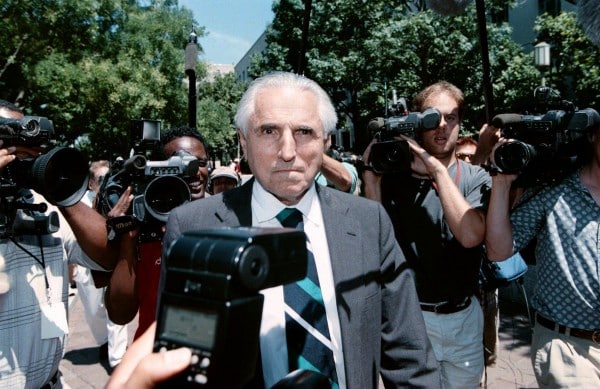
Jake Stein’s Tears

Legendary D.C. lawyer Jake Stein died last week at 94. He was that rarity in Washington and among lawyers, a universally respected attorney who had made few enemies and had few detractors. He was also long regarded as the sage of the profession in D.C., whose thoughtful and erudite essays that closed the bar associations’ monthly magazine, Washington Lawyer, were perhaps the most-read features of the publication.

I was reminded in his New York Times obituary that Stein represented Kenneth W. Parkinson, a former lawyer for President Nixon’s re-election committee, when he was charged with conspiracy and obstruction of justice in the Watergate scandal. Parkinson was the only indicted Watergate figure who was acquitted, and Stein’s skillful defense was considered to be the reason.  His closing argument was made unusually dramatic by Stein weeping as he described Parkinson as a pawn of “confessed perjurers,” and pleaded for the jury to consider his client’s character and the wounds the unjust prosecution had inflicted on it. “Doesn’t a lifetime, where you built it up grain by grain, weigh against that?” Stein asked plaintively.

I wonder: were Stein’s tears real, and does it matter? Continue reading

The Tears of Keith Ellison

The grand drama at Rep. Peter King’s Congressional hearings investigating the radicalization of American Muslims last week was provided by Rep. Keith Ellison, who broke down crying while telling the story of a Muslim-American hero, Mohammed Salman Hamdani, who rushed to lower Manhattan on the morning of Sept. 11, 2001 to assist in rescue efforts, and died in the collapse of the World Trade Center. Ellison said:

After the tragedy some people tried to smear his character solely because of his Islamic faith. Some people spread false rumors and speculated that he was in league with the attackers only because he was Muslim. It was only when his remains were identified that these lies were fully exposed. Mohammed Salman Hamdani was a fellow American who gave his life for other Americans. His life should not be defined as a member of an ethnic group or a member of a religion, but as an American who gave everything for his fellow citizens.

I found the performance odd and vaguely troubling, and now that I’ve thought about it for a few days, I know why. The statement by Ellison, who converted to Islam, and the tears that accompanied it, raise a few ethical issues, beginning with the Ethics Alarms standard, “What’s going on here?” Continue reading