Celebrity vs Fan: The Amy Schumer Affair

Schumer Fan

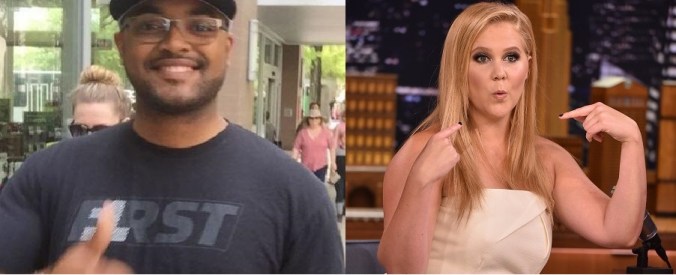
Trendy comedienne Amy Schumer posted this tale of a recent encounter with a selfie-seeking fan on Instagram:

“This guy in front of his family just ran up next to me scared the shit out of me. Put a camera in my face. I asked him to stop and he said ” no it’s America and we paid for you” this was in front of his daughter. I was saying stop and no. Great message to your kid. Yes legally you are allowed to take a picture of me. But I was asking you to stop and saying no. I will not take picture with people anymore and it’s because of this dude in Greenville.”

She included the resulting photo of him above, which

a.) Made him an instant celebrity

b.) Made him an instant target,or

c.) Both.

Later, she “walked the statement back,” as they say in politics, and tweeted,

“I’ll still take pictures with nice people when I choose if it’s a good time for that. But I don’t owe you anything. So don’t take if I say no.”

The smiling young man with the blurry thumb  is named Leslie Brewer. This weekend, he contacted the Fox affiliate in Greenville–apparently everything will be happening in North Carolina from now on—to defend himself, and since conservatives hate Amy Schumer, Fox was eager to give him a forum.  The resulting story, in part: Continue reading

Ethics Quiz: The Aborted No-Hitter

Friday night, Miami pitcher Adam Conley  was pitching a no-hitter against the Milwaukee Brewers with two outs in the eighth inning, meaning that he was just four outs away. A no-hitter—no hits, no runs, for an entire game—places a pitcher name in the  Hall of Fame. It makes him an instant part of sports history. In today’s hyper-celebrity culture, it means interviews and endorsements.

Moreover, the Marlins needed something to make their fans feel better. Dee Gordon, the team’s star second baseman, had just tested positive for steroids and was suspended for 80 games. Nonetheless, Marlins manager Don Mattingly lifted Conley because he had exceeded his pitch count. Though baseball paid little attention to the statistic for 70 years, today teams carefully monitor how many pitches a hurler throws, both to anticipate ineffectiveness, and to guard against injury.

In Conley’s case, he had never thrown more than a hundred pitches in a game, and had topped out at 116. To Mattingly and Marlins pitching coach Juan Nieves, that meant that even on the verge of immortality, Conley had to be removed. Conley was angry, though he said all the right things after the game. Still, knowing the alleged risk to his arm and career, he wanted to try to finish his masterpiece. (The Marlins blew the no-hitter and the shutout in the 9th, though still managed to win 5-3.)

Your Ethics Alarms Ethics Quiz of the Day:

Was removing Conley “for his own good” when he wanted to have the chance at a no-hitter fair?

Continue reading

Watching the Super Bowl Last Year Was Unethical. This Year It Is Indefensible.

superbowl-50

Next year, it will be close to criminal.

The American public can no longer plead ignorance when it comes to supporting, financing and enabling the cynical exercise in human carnage for cash that is known as professional football. Since the last Super Bowl was played, “Concussion” visited the movie theaters, putting in dramatic form the undeniable facts exposed in the documentary “League of Denial.” Both “Concussion’s” director and its star, Will Smith, have stated in interviews that they don’t think they can enjoy watching football any more.Reaching this conclusion should not require the experience of making a movie  about the facts of the deadly concussion epidemic that the NFL blithely promotes, nor months of bringing to life a script describing how players have been misled and lied to in order to keep them sacrificing their bodies, minds and future to the greedy maw of a billion dollar. It should only require logic, humanity, decency, and bit of sacrifice.

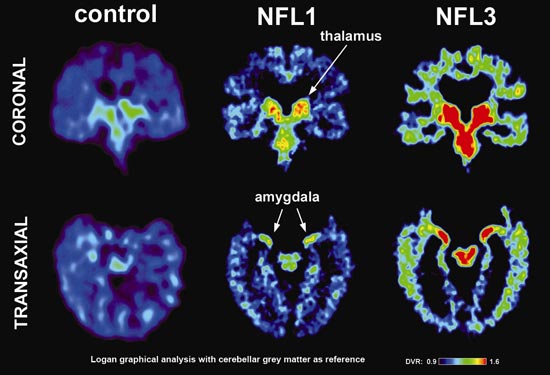
In just the last several days, the casualty list of NFL stars found to have damaged their brains has lengthened significantly.

Former Oakland Raiders star quarterback Ken Stabler’s brain was found to have chronic traumatic encephalopathy or CTE, the concussion-triggered brain disease. A day after that announcement, the late Colts star quarterback Earl Morrall’s brain was found to be similarly damaged.  Stories were published around the same time about former Minnesota Viking linebacker Fred McNeil, who died in November and was also suffering from CTE. He had become a lawyer after his playing days, but began losing his memory and ability to concentrate. He had violent mood swings, and by his mid 40s, had lost his career, his job, his family, and his home. Former NY Giants star and famous broadcaster Frank Gifford died last year: he had chronic traumatic encephalopathy too.

On September 8, former Giants safety Tyler Sash was found dead at age 27 of an accidental overdose of pain medications at his Iowa home.  The results of an autopsy announced at the end of January showed that Sash already had advanced CTE. So did the brain of a 25-year-old former college football player whose brain was discussed in a February article in “Neurology Today.” From the case study:

The case, reported in the January 4 online issue of JAMA Neurology, involved a young man whose cognitive, mood, and behavioral symptoms progressively worsened following a history of 10 concussions incurred while playing football from age 6 till his junior year in college.

The patient completed a neurocognitive battery of tests prior to his death (due to an unrelated cardiac infection) at age 25. Although those tests revealed multiple deficits, and his symptoms steadily worsened for three years after he stopped playing, a consensus panel of clinicians blinded to his pathology report was unable to reach a primary diagnosis of CTE.

“Although CTE was considered,” the report stated, “the lack of delay in symptom onset, his young age, and his family history of depression reasoned against CTE as the primary diagnosis. Consensus members thought that neuropsychological performance, while impaired, did not discriminate postconcussive syndrome or major depression from CTE.”

That pathology report, however, was conclusive for a diagnosis of CTE, based on mild ventricular dilation, hippocampal atrophy, and pathological lesions of hyperphosphorylated tau consisting of neurofibrillary tangles, neurites, and astrocytes around small blood vessels found at the sulcal depths of the frontal and temporal lobes.

It’s not just the NFL that is crippling young men. It’s college football too. Continue reading

How Censorship Takes Root: The Wisconsin Interscholastic Athletic Association Bans Fun

high school fans

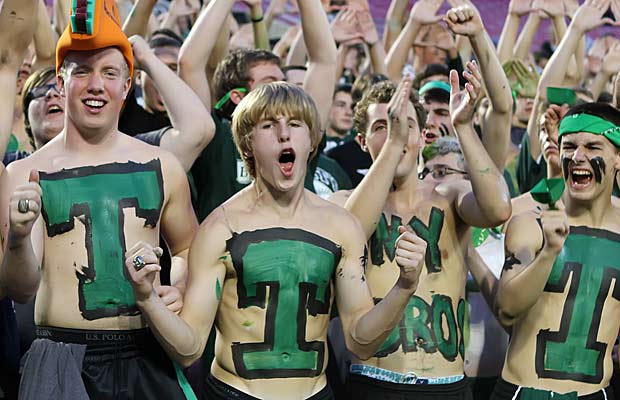
The Wisconsin Interscholastic Athletic Association has commanded students at high school basketball games to stop taunting, mocking or teasing the opposition, which as I recall was the only reason one attends high school basketball games. The WIAA  has published a guide to sportsmanlike activities, and much of it is reasonable and wise. Not its specific prohibitions for fans, however. The content-specific bans are redolent of campus hate speech bans, but even sillier.They do teach future adult citizens the uses of censorship by authorities, however.

Maybe that’s the idea.

Here are the prohibitions on fan speech and conduct (1-23) and also athlete conduct (24-29) that are identified in the guide (I’ve rearranged them a bit), which means that schools not controlling such conduct sufficiently to satisfy their fun-hating overlords risk official sanctions. The inexcusably censorious prohibitions are in red. The overly strict or general prohibitions are in pink. Continue reading

Did You Enjoy Your Pro Football Today? Here’s What You Were Cheering For…

brain_dissect08

From “Frontline”:

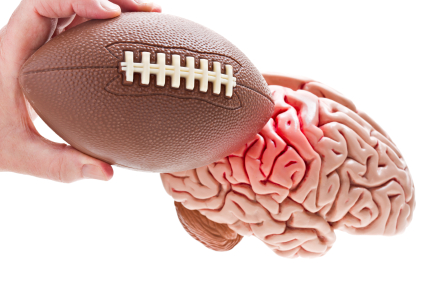
Researchers with the Department of Veterans Affairs and Boston University have now identified the degenerative disease known as chronic traumatic encephalopathy, or CTE, in 96 percent of NFL players that they’ve examined and in 79 percent of all football players. The disease is widely believed to stem from repetitive trauma to the head, and can lead to conditions such as memory loss, depression and dementia.

In total, the lab has found CTE in the brain tissue in 131 out of 165 individuals who, before their deaths, played football either professionally, semi-professionally, in college or in high school.

Any other non-essential industry that carried this much risk of crippling injury and death for its employees would be immediately the object of public protests, activist action, new government regulation and major fines and sanctions. Because of all the money involved and because of an ongoing effort by the NFL to deflect attention from its unconscionable business (there was more uproar over Tom Brady’s suspension than there has been over the concussion scandal), players are still getting brain-injured every Sunday, Monday and Thursday while the crowds cheer, the beer flows and the networks cash in. Parents still steer their kids into playing tackle football, and the carnage continues.

Yes, pro football is an exciting game. Too bad that keeping it exciting kills people, but it does. The game isn’t worth it.

No game is.

I wonder how long it will take for that to sink in?

Fan Ethics Guidance From A Red Sox Fan To Washington Nationals Fans (And Others): Booing Your Manager Is Unethical

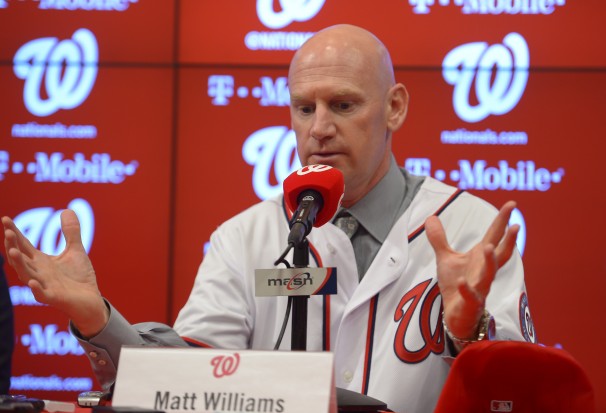
Matt WilliamsOn September 9, following his press conference in the aftermath of a horrible and devastating loss to the New York Mets, the Washington Nationals manager (the reigning Manager of the Year from 2014!), was vigorously booed by a group of fans (the rich ones) in the next-door Presidents Club dining room, who banged on the press conference room’s glass walls. The team was pronounced a shoo-in to the World Series, you see, before the season started, and that loss made it clear, if it wasn’t already, that the Nats probably weren’t even going to make the play-offs.

No doubt about it: Matt Williams, the team’s calm, amiable, incompetent manager, is part of the problem, but he was just as bad last year, just much luckier. (See: moral luck; consequentialism) He was hired with no managerial experience at all, just the experience of being a (pretty good) major league player for quite a while, and the truth is that managing a baseball team requires judgment, tactical expertise, courage, flexibility, facility with statistics and leadership, as well as experience. Williams isn’t bereft in all of these areas, but enough of them to make consistent success as a manager unlikely. Because the boo-attack occurred in front of the press corps and came from the season ticket types rather than the bleachers and beer crowd (“You’re a BUM!!!”), it immediately became a big story in Washington. Today, one of those angry fans wrote an explanation and alleged justification of his actions in the Washington Post.

He wrote in part:

“So, after staying till the bitter end of the latest heartbreaking loss, and after watching Williams wrap up another tedious Q&A filled with a series of cliched answers, a group of mid-30s fans who have been cheering this team from Day 1 had seen enough. A defiant Williams exited the podium, and we booed … we booed hard. It felt good. It felt like Williams needed to hear it — and it felt like the Nats brass needed to, as well…We’ll always support this team, but on a night like that night, sometimes enough is enough. When it takes 54 excruciating pitches to get three outs in a season-killing seventh-inning meltdown, and when the manager has pushed all the wrong buttons since last October, there’s not much else a fan can do…but boo.”

This fatuous non-wisdom comes from Rudy Gersten, an executive director at a public policy organization, and presumably he speaks for his similarly jeering friends, “an ethics and compliance lawyer, an IT project manager, [and ]a construction senior project manager.” Continue reading

Now THAT’S An Unethical Baseball Fan.

WARNING: Click “Cancel” when the clip is over, or you will see a series of unrelated videos of dubious motive. I’m sorry; this is the only YouTube version of the incident.

Let’s list the ways this fan proves he’s a jerk:

  • He doesn’t clear away so the player (Dodgers first baseman Adrian Gonzalez) can make the catch. Technically it isn’t interference if he doesn’t because the ball is officially out of the field of play. But good fan sportsmanship dictates that a fan, even of the other team, should allow the catch to be made.
  • He not only doesn’t clear away, he competes for the catch. This is a fan actively interfering with the game, and treating a souvenir as more important than the game it would be a souvenir of—which means he’s an idiot, as well.
  • Then, after the catch, this guy tries to wrestle the ball out of Gonzalez’s glove…to steal the ball, in fact. As long as a ball isn’t abandoned by a player, lands in the stands, or is tossed to a fan, it belongs to the MLB.
  • In the alternative, as some have argued in his defense, he may not have noticed that he was wrestling with a player in the heat of the moment. I don’t believe that for a second, but let’s say it’s true. Any fan who sits that close to the field in a baseball game is obligated to know what is happening every second. Obligated. This is the Steve Bartman Rule, and you don’t want this to happen...
  • After the incident (I think Gonzalez told him to let go or he’d be very sorry), the guy took a bow. This is the final qualification of a fick.
  • He embarrassed Red Sox fans everywhere. There is nothing wrong with wearing your favorite team’s hat in another team’s park (contrary to the assertion of sportswriter Craig Calcattera and some of his Boston-hating readers), but like any other badge of allegiance, if you are in public and wearing a Red Sox cap, you represent the fan base, Red Sox Nation, as it is called in Boston (unfortunately), and that means that acting like a jerk reflects on more than just you. I just had to point out to a guy on another site (who wrote, “Typical Sux fan”) that the commenter is a bigot.
  • He also embarrassed his girlfriend.

That’s seven, and preserved for posterity.

Oh, by the way, he was kicked out of the stadium.

Good.

The Ethics Alarms New NFL Season Ethics Quote Of The Week: Ex-Football Fan Steve Almond

football-brain-injury-symptoms

“We know, on some level, that a good many of the players we cheer for each Sunday will be revealed as all too human when they wind up battling dementia. But… fans have a whole suitcase full of rationalizations intended to preserve our right to consume, and thus sponsor, this hyper-violent game. “The players know the risks!” we insist. “They get paid millions!” But ultimately, our most effective dodge resides in our willingness to view the game as one big movie.”

Steve Almond, author of “Against Football, in an essay today for the Washington Post titled “Hollywood’s version of the gridiron is just fantasy football
(It hypes violence for the sake of drama — then reassures us everything is okay)”

Perfect timing for this article, a reminder of what fans are really watching and cheering for during the pro football season, which began today.

No, I won’t be watching.

Her’s another chilling quote from Almond’s article: Continue reading

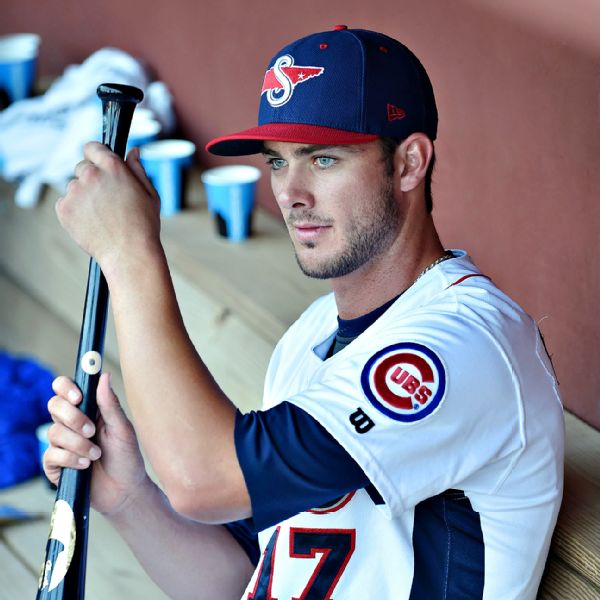
The Phenom, The Agent And The Cubbies: 2015’s First Baseball Ethics Controversy

No, I don’t count Pete Rose.

Kris Bryant, whose day will come.

Kris Bryant, whose day will come.

The lesson of the Kris Bryant dispute is that sometimes the result that seems the least fair is also the right one. Bryant, in case you don’t follow baseball or do not live in Chicago, is the hot Chicago Cubs minor leaguer—what used to be called a “phenom” in the old days—who will not be playing third base for the Cubs when the season opens despite everyone’s agreement that he is not just ready for National League, but ready to star in it. Last week, the young man was assigned  to  the Cubs’ Triple-A Iowa farm team.  Cubs fans are upset. Sports pundits are outraged. Bryant’s agent is furious.

What’s going on here?

A lot.

The MLB  collective bargaining agreement, negotiated and signed by both baseball management and the players union, gives teams control over players for six years before a player can enter free agency and sell his talents to the highest bidder. Thus most young players earn a small percentage of their true market value initially, and, if they are good, hit the jackpot after that. (The average salary in Major League Baseball is $4 million a year). There is a catch, however—and an unavoidable loophole. A full season is defined as 172 days, though the season is 180 days. If a young player is left off the roster until there are fewer than 172 days remaining in the regular season, that season doesn’t count as one of the six years; a player can’t become a free agent mid-season six years later. Before the demise of the reserve system that bound a player to one team until the team released or traded him, there was no reason not to promote a promising minor league star to the big team the second it looked like he was ready. Now, there is a big reason: delaying those few games will give the team an extra year of control, since under the rule, 6 years and 171 games is still just six years. That means an extra year of the player at bargain compensation, and possibly an extra year of the player, since he can fly the coop once the clock has run.

This is not a new issue: players and agents have been complaining about teams doing this for years, but the rules allow it. Since the rules allow it, and since the monetary and competitive benefits of waiting those extra nine days can be huge, there is nothing unfair or unethical about a team taking advantage of the provision. Indeed, it would be irresponsible and a breach of management’s fiduciary duties not to save millions and ensure the extra year of a star’s services. What, then, has made Bryant’s case so contentious?

It’s the Cubs, that’s what. Continue reading

Some Final, Hard Words Before Kick-off

cteliving

I made this comment to the main post on the Super Bowl, and decided that the point is important enough to elaborate on a bit and post here.

I’ve  become depressed talking to people on Facebook and elsewhere about the post. They don’t even pretend to have a real argument. Some fall back on the same rationalizations I explored in the post: one guy on Facebook’s rejoinder consisted of writing, “why worry about this when Congress and the White House are full of liars.” And people “liked” that response, which makes no sense at all.  The rest of the determined Super Bowl fans say, “Yeah, you’re right, but I like football and don’t want to think about it.”  That just is not a rational, ethical response to learning that your support is perpetuating a corrupt system that is exploiting and hurting people. It isn’t.

The NFL is not on the same scale of evil as slavery (yeah, I know, but we need the slaves to keep our lifestyle, so I don’t want to think about it) or the Holocaust (Yeah, but I don’t know any Jews, and the country’s doing well, so I don’t want to think about it) or a daughter-molesting husband (Yeah, but he’s a good provider, and I love him, so I don’t want to think about it). Sure, this is a game, but the process of self-delusion, corruption and passive acceptance of evil is exactly the same. Tell me how it isn’t.

And you know, it takes a lot less sacrifice to stop making it profitable for the NFL to lie and pay young men unto dementia and suicide than it did to reject slavery in the South, or Nazism in Germany, or even for an abused wife to report her husband for raping their daughter…because it is just a game. You can live a very happy life, a full life, a fun life, without the NFL being part of it. It’s corrupting American society and you. Don’t you they see that?

I guess slavery and the Holocaust didn’t have cool commercials, so that’s something…