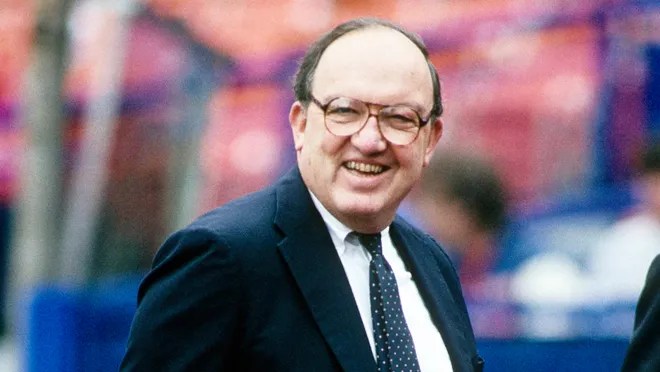
Death of a Baseball Ethics Hero: Fay Vincent (1938-2025)

Fay Vincent, the last real Commissioner of Baseball, has died and attention should be paid.

The post of Commissioner of Baseball was created in the wake of the 1919 Black Sox scandal, with baseball’s future in doubt after the revelation that key members of the Chicago White Sox had accepted money from gamblers to throw the World Series to the vastly inferior Cincinnati Reds of the National League. The desperate owners turned to an austere judge, the wonderfully named Kenesaw Mountain Landis, who accepted the job provided that he had absolute power to act in “the best interests of the game.”

Landis ruled with an iron hand and baseball’s perpetually corrupt, greedy and none-too-bright owners backed off while he was in power, from 1920 until his death in 1944. Landis, in the harsh light of hindsight, is now vilified for not figuring out that keeping blacks out of the Major Leagues wasn’t in the best interests of baseball (or blacks, or sports, or democracy, or society, or the nation), but he proved a tough act to follow nonetheless.

Most of his successors were mere figureheads or knuckleheads, notable more for their non-decisions and bad ones than their actions in the “best interests of baseball.” Ford Frick, one of the longest serving Commissioners, is best known for his foolish insistence that Roger Maris didn’t really break Babe Ruth’s season homer record, a controversy decisively ended in the American League three years ago by Aaron Judge. Baseball collected weenies and fools in the role because the owners wanted it that way.

There were a couple of exceptions. Peter Ueberroth made the game infinitely more profitable and considerably more popular by modernizing its brandingm merchandising, promotion and marketing. Bart Giamatti , following in the fading footsteps of Judge Landis, courageously refused to issue The King’s Pass to Pete Rose, one of the most popular former players in the game, and banned him for gambling. But when Giamatti died suddenly from a heart attack after less than a year as Commissioner, he was succeeded by Fay Vincent, in a sequence a bit like when the Vice-President takes over when a POTUS dies. He had been deputy commissioner under his good friend Giamatti, and the owners of the major league teams confirmed him without qualms as the next Commissioner . They thought he was one of them: a corporate veteran and lawyer who had served in top executive roles for Columbia Pictures and Coca-Cola before Giamatti recruited Vincent as his right-hand man.

Vincent, however, was not what the owners wanted or expected. He was intelligent, courageous, far-sighted, and worst of all, as a passionate baseball fan, he took his job description seriously and literally. He didn’t work for the owners, though they could fire him. His stakeholders were fans and the game itself. Vincent’s vision for the job was reminiscent of the difficult ethical conflict accountants face: businesses hire them and pay their salaries, but their duty is to the public.

Continue reading

Observations On The News That Pete Rose Bet On Baseball As A Player After All

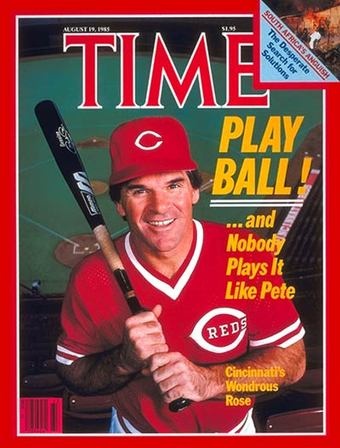
Rose Time cover

The story is here.

To summarize for those new to this story and its various issues:

Because the 1919 World Series fixing scandal nearly toppled the sport, any player, manager or coach who bets on baseball games will be automatically banned from the game for life and from the Major League Baseball Hall of Fame for perpetuity. Pete Rose, the all-time hits leader as a player and a certain Hall of Fame admittee under normal circumstances, was shown to have bet on baseball while a manager, after his playing career. For many years he lied, denying that this was true, then came clean in time to hawk his autobiography.

Rose has always had a lot of sympathy from fans and players, in part because he was such an exciting player, in part because he played with the innocent enthusiasm of a child and  he is a child, at least emotionally, and mostly because it was believed, since Rose insisted that it was true—yes, I know that sounds strange, given Rose’s record of serial dishonesty—that he never gambled on baseball while he was a player.

This season, public sentiment had been building to finally pronounce Rose forgiven. He had even progressed to the stage that some advertisers were using him in TV commercials. Baseball has a new Commissioner, and he had signaled that he would give Rose’s long-standing and ignored petition for reinstatement due consideration.

All of that is gone now, presumably forever.

Some last thoughts on Rose, as with any luck this is the last occasion I will have to write about him: Continue reading

Tales of “The King’s Pass”: Pete Rose and Jeremy Clarkson

King

The King’s Pass has been much in the ethics news of late—Brian Williams, Bill O’Reilly, David Petraeus, Hillary. Let’s review, shall we?

11. The King’s Pass, The Star Syndrome, or “What Will We Do Without Him?”

One will often hear unethical behavior excused because the person involved is so important, so accomplished, and has done such great things for so many people that we should look the other way, just this once. This is a terribly dangerous mindset, because celebrities and powerful public figures come to depend on it. Their achievements, in their own minds and those of their supporters and fans, have earned them a more lenient ethical standard. This pass for bad behavior is as insidious as it is pervasive, and should be recognized and rejected whenever it raises its slimy head.  In fact, the more respectable and accomplished an individual is, the more damage he or she can do through unethical conduct, because such individuals engender great trust. Thus the corrupting influence on the individual of The King’s Pass leads to the corruption of others…

1. The BBC just demonstrated how the King’s Pass should be rejected—with courage and gusto.

Jeremy Clarkson, the main host of the popular BBC auto show “Top Gear,” spent March misbehaving. He got in a shoving match with a producer, verbally abused staff and was recorded trashing the network. When Clarkson topped it off with a physical altercation with a show staffer, the BBC decided not to renew his contract. BBC head Tony Hall said in a statement:

It is with great regret that I have told Jeremy Clarkson today that the BBC will not be renewing his contract. It is not a decision I have taken lightly. I have done so only after a very careful consideration of the facts…I take no pleasure in doing so. I am only making [the facts] public so people can better understand the background. I know how popular the programme is and I know that this decision will divide opinion. The main facts are not disputed by those involved.

The BBC is a broad church…We need distinctive and different voices but they cannot come at any price. Common to all at the BBC have to be standards of decency and respect. I cannot condone what has happened on this occasion. A member of staff – who is a completely innocent party – took himself to Accident and Emergency after a physical altercation accompanied by sustained and prolonged verbal abuse of an extreme nature. For me a line has been crossed. There cannot be one rule for one and one rule for another dictated by either rank, or public relations and commercial considerations… Obviously none of us wanted to find ourselves in this position. This decision should in no way detract from the extraordinary contribution that Jeremy Clarkson has made to the BBC. I have always personally been a great fan of his work and “Top Gear”…The BBC must now look to renew Top Gear for 2016. This will be a big challenge and there is no point in pretending otherwise. I have asked Kim Shillinglaw [Controller of BBC Two] to look at how best we might take this forward over the coming months. I have also asked her to look at how we put out the last programmes in the current series.

The show, without Clarkson, is toast, and Hall knows it. Nonetheless, he had the guts to do the necessary and ethical act: not allowing its indispensable star to abuse his power and popularity . Once Clarkson did that, “Top Gear” was doomed anyway; firing him now just minimizes the carnage. Although Hall has no responsibility to other networks and organizations, his decisive handling of the episode has saved other programs even as it destroys his own. It is a precedent and a role model for employers refusing to allow themselves to be turned into enablers  by stars assuming the King’s Pass works. When they say, “You can’t fire me, I’m irreplaceable! There’s no show without me!”, the response now can be, per the BBC: “If there’s no show without a jerk like you, then there’s no show. Bye!”

2. Once again, Pete Rose is sucking the ethics right out of people’s brains.

Ah, Pete Rose. He was the topic of the first ethics post I ever wrote, way back in 2004. Then, in 2007, he became my first and only Ethics Dunce Emeritus.

The Pete Rose case is simple. Baseball has an absolute, no exceptions rule that demands a lifetime ban of any player, coach or manager who gambles on major league baseball games. Such banned players can’t be hired by major league teams for any purpose, and cannot be considered for Hall of Fame membership., ever, even after they are dead. Everyone in baseball knows why this rule exists—baseball was nearly destroyed in 1919 when gamblers bribed the Chicago White Sox to throw the World Series—and the rule is posted in every clubhouse. Rose bet on baseball while a major league manager, and also bet on his own team. Thus he is banned.

The significance of the fact that he is, as a player, the all-time hits leader and was the face of the game is that it led Rose to believe that the game would never ban him, and that if caught, he would be treated with special leniency. His excellence on the playing field doesn’t mitigate his conduct, or justify minimizing the ban it earned, at all.

The New York Times published a story about Rose’s efforts to get baseball to lift the ban, now that a new Commissioner, Rob Manfred, is in office. You can read the article here, which is remarkable for the many jaw-droppingly unethical arguments put forth by the baseball people the article quotes, contrasted with the occasional quote that shows that a speaker comprehends the concepts of consequences, accountability, and why letting stars break the rules is suicidal to any culture. It would be an excellent ethics exam.

Here are the quotes; my comments follow in bold. Continue reading