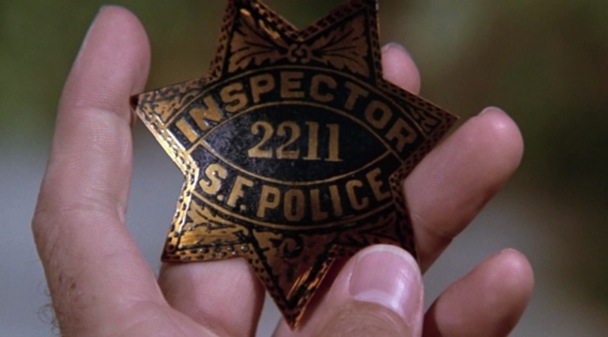
This is Harry “Dirty Harry” Callahan’s badge. Seconds later, he throws it into a river. Lots of other police officers will soon be doing the same.
Yesterday, for the third time in my life, I was the first one on the scene after a fellow human being’s death. This time, it was a very close friend and, though it has little to do with this post, a wonderful man. I had headed out to his home because I was worried: an unusually reliable and conscientious individual, he had missed several appointments the last few days and hadn’t been answering e-mails and phone calls. When I was told about this, I immediately suspected the worst, and sadly, I was right.
His car was outside his house, and though it was mid-day and he was supposed to be somewhere else, I could see that the TV was on. In front of his door, getting soaked in the rain, was a package: it had been delivered there on December 2. I got no response to my bangs on the door. It was time to call 911.
The police responded quickly. I’m not going to name the department, which has an excellent reputation here, and I do not fault the officers, who were diligent and polite, and who set about investigating the scene professionally and quickly. Nonetheless, after a full 90 minutes, after which they could not discern any more than I had before they came, they would not enter the house.
They told me that they could not risk being sued, and that there were elaborate policies and procedures that had to be checked off first. The officers had to track down their supervisor (it was a Saturday), and, they said, more than one official would have to sign off, to protect the department
“He could be drunk; he could be shacked up; he could just want to be alone,” they told me. “The law says his privacy can’t be breached, even by us.”
“But he’s not any of those things,” I said. “He doesn’t do any of those things, and if he were OK, there wouldn’t be a four-day-old package outside.”
“Maybe he took a trip on a whim.”
“He would have called and cancelled those commitments,” I said. “Look, you and I both know that he could be inside, on the brink of death, with every second bringing him closer. The only alternative is that he’s died already. If you won’t do it, let me break in, chase me, and you’ll find him legally as you pursue me. How’s that?”
The police weren’t sold. Finally, after a full 90 minutes, they requisitioned a ladder from a neighbor and were able to see into a second floor window. My friend was visible on the floor, and then they moved quickly, breaking down the door. They were too late by days. They might have been too late by minutes though. All those procedures and policies that forced the police to avoid taking action that in this case, under these circumstances, were prudent and that might have saved a life imperiled.
The lesson is only this: if we cannot trust police to make decisions like this, we obviously are not going to trust them to decide when to fire their weapons. Laws, rules and procedures are rigid, and have to be examined slowly; real life operates in the shadows of uncertainty, among the loopholes, gray areas and ambiguities, and it moves fast. The protests and demands in the wake of the recent police controversies will undoubtedly result in more regulations, policies and laws, but there is good reason to believe that they will also make us less safe rather than more safe, and make it difficult to find reasonable, dedicated, ethical men and women willing to serve as police, a job which, we seem to be deciding, should be subjected to strict liability whether the officer acts too quickly, or not quickly enough—judged, of course, after the results are in. Continue reading
 Ethics Alarms