Monday Ethics Madness, 9/14/2020: Accusations, Crimes And Punishment

On this day, September 14, in 1814, Francis Scott Key was inspired to write the poem that was eventually set to music and, by act of Congress in 1931, became America’s official National Anthem, “The Star-Spangled Banner.” The poem, originally titled “The Defence of Fort M’Henry,” was written after Key witnessed the Maryland fort standing up to furious bombardment by the British during the War of 1812. A lone, tattered  U.S. flag was still flying over Fort McHenry at daybreak, giving rise to the anthem’s most bracing line, “And the rocket’s red glare, the bombs bursting in air, Gave proof through the night that our flag was still there.”

I’ve listened to the Anthem being attacked more or less my whole life—it’s bellicose, it’s too hard to sing, it’s set to the music of a drinking song, it was written by a slave-holder. What matters is that the Anthem, unlike so many others nations’ anthems, has a authentic historical origin linked to an existtential  crisis in our history, and that it eloquently represents the American character and its dedication to hope, perseverance, and resilience. The Star Spangled Banner may be hard to sing, but when a crowd sings it with  passion, or when a singer knocks it out of the park like the late, great Whitney Houston, only France’s Marseillaise can equal it for sheer chills.

The current assault on the Anthem, and the use of it for cheap political theatrics by refusing to stand and convey proper respect for what it represents, is an attack on American history, values and culture. Nothing less.

1. It’s called “paying one’s debt to society.” I have no intense objection to allowing convicted felons to vote once they have served their sentences. I also have no intense objection to banning convicted felons from voting for life. In 2018, Florida’s voters decided to end the disenfranchisement of those convicted of felonies, except for murder and sexual offenses. Then the battle became whether convicted felons should be required to pay all the fines related to their crimes before they became eligible to vote again.

Well, of course. Isn’t that intrinsically obvious? You can vote when you have paid society’s requirements as a punishment for the felony: whether that is time in prison, or time on probation, or a cash fine, it’s all part of the “debt to society.” Pay that debt, and then you can vote.

But Democrats are expert in representing legitimate requirements and safeguards for voting as sinister voting suppression schemes, so in May  a Florida court ruled that requiring convicted felons, many of whom are indigent, to pay court-ordered fines before they could regain the vote was unlawful discrimination, by imposing an unconstitutional “pay-to-vote system.”

What an astoundingly deceitful and dishonest argument! Is requiring people to pay for their groceries a vicious “pay not to starve to death” system? The fines have nothing to do with voting. The fines have to do with completing the punishment for the felonies. Calling the fines the equivalent of a poll tax is clever but deliberately misleading, yet a court bought it. Fortunately, the U.S. Court of Appeals for the 11th Circuit in Atlanta overturned that decision, and ruled that the 2019 Florida law requiring ex-felons to pay their fines before being re-enfranchised was indeed constitutional.

And it is. Continue reading
Ethics Hero : Don Huber

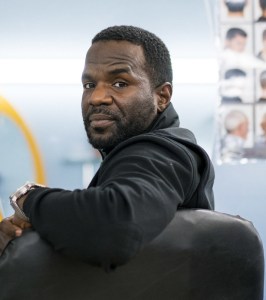
George Williams, finally free and on his way. If only I used barbers...

George Williams, finally free and on his way. If only I used barbers…unfortunately, that requires hair…

Here in Virginia, we are debating Governor Terry McAuliffe’s decision to let felons be jurors and to vote for Hillary Clinton (for whom they are are presumed to have natural affinity, as well as for Governor McAuliffe himself, perhaps), but nobody would begrudge them the chance to be barbers.

That’s what George Williams is about to be: a barber. He just graduated from Tribeca Barber School in Lower Manhattan, and  will soon face state examiners to qualify for his New York barber’s license. He almost didn’t make it.

As he was about to be released four years ago from the infamous  Attica Correctional Facility where he was serving  his two- to four-year sentence for robbing a pair of Manhattan jewelry stores, a gang of prison guards brutally attacked and beat him. Williams had both legs and his collarbone broken, and a fractured eye socket  Doctors placed screws into one leg to hold the bones together.

Disgustingly, prosecutors allowed the guards involved to exchange a guilty plea to a lesser charge for a punishment that included no prison time. Here was their primary penalty: they can’t be prison guards any more. Funny, I would think that would be automatic, plea or no plea, when you beat prisoners half to death.

The story of George Williams’ beating and the ridiculously, suspiciously lenient sentences received by his state-paid muggers was one of the nightmarish Tales From The Dark Side of the Justice System in a front page of a The New York Times story about The Marshall Project. Williams was quoted as saying that he still  headaches and nightmares from the attack but was trying to save the $2,600 barber school tuition to start a new life as a law-abiding tonsorialist.

27-year-old United States Army specialist, Don Huber read the article while stationed in Fort Riley, Kansas. He had been raised in Attica, New York, and had just finished serving nine months  in Afghanistan with the First Infantry Division.

Huber was moved William’s plight and bothered by the bad reputation the incident  gave his community. Huber had gone to high school with one of the guards who beat Williams, but had never met George. Still, Huber organized an online fundraising campaign to raise at least $2,600 to help the ex-prisoner get on with his life. The campaign quickly received $5,800 through more than 70 donations. Continue reading

Virginia’s Governor Restores The Vote To Felons

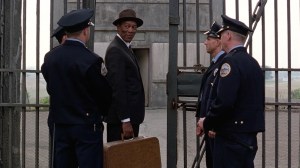
"First thing on my mind, now that I'm finally out of Shawshank, is to register to vote. Then I figure I'll look up Andy..."

“First thing on my mind, now that I’m finally out of Shawshank, is to register to vote. Then I figure I’ll look up Andy…”

Virginia’s Gov. Terry McAuliffe signed an executive order yesterday  that restored the voting rights of 206,000 ex-felons. The order applies to all violent and nonviolent felons who served their sentence. Virginia is one of a minority of states, only ten, that do not automatically restore rights upon completion of a felony sentence and one of only four  that require an application by each individual felon and action by the governor. Because this is an executive order, McAuliffe will have to reissue it every month.

McAuliffe, who is the political equivilent of Prof. Harold Hill in “The Music Man,” issued the predictable triumphal blather, saying from the Virginia Capitol steps after being introduced by a gospel choir,

“We benefit from a more just and accountable government when we put trust in all of our citizens to choose their leaders.It has taken Virginia many centuries, unfortunately, to learn this lesson. But today, we celebrate its truth.”

We get a more just and accountable government when we put trust in those who have proven themselves untrustworthy, eh?

That’s one of McAuliffe’s talents: he can make a measure that isn’t necessarily unethical at all seem like it.

Is it unethical to tell felons that they are banned from voting and running for office for life? It’s a policy choice, that’s all. A state can make lifetime disenfranchisement part of the official price for serious lawbreaking on the theory that felons have shown themselves to be  insufficiently respectful of the laws and society in general, and lowered themselves into the ranks of permanent second class citizens by their own choices and conduct. I won’t say that’s not fair: it depends what one thinks fair is. It’s tough. It signals a high regard for the rights to participate in self-government. Continue reading

Ethics Quiz: The Overly-Trusting Law School

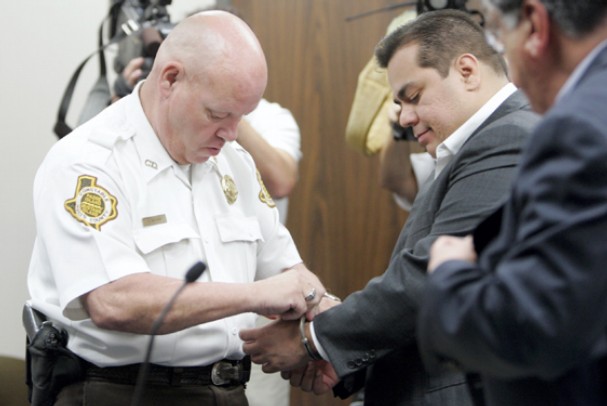
The almost lawyer, learning about the justice system...

The almost lawyer, learning about the justice system…

Mauricio Celis, 42,was expelled from Northwestern Law School, just before he was due to graduate, for not telling the school when he applied that he was a former felon in Texas,  convicted there for falsely holding himself out as a lawyer and also for  impersonating a police officer. Northwestern confirmed that it never asked him to disclose any criminal history, but argued that Celis should have known that his criminal record was material.

The school didn’t check on his background; it didn’t even google him. If it had, it would have learned that Celis was infamous in Texas, and called “The Great Pretender.” A prosecutor called him “the biggest con man in the history of Nueces County.”  He certainly was audacious, opening law offices in multiple cities, raking in fees, using his success as a fake lawyer to raise money for Democrats. Compared to his scam, Northwestern was timid. It just took his money, $76,000, and then expelled him without giving him a diploma.

Your strange Ethics Alarms Ethics Quiz:

Was it ethical for Northwestern to expel Celis?

Continue reading

The Supreme Court Rejects a Bad Argument

The U.S. Supreme Court has turned down the appeal of Massachusetts prison inmates who argued that the 1964 Voting Rights Act guaranteed them the right to vote. Continue reading

Unethical or Dumb? Three Scenarios From The News

Many actions that appear to be unethical at first glance are really just thoughtless, careless decisions by people who should know better. It is only when knowing better is an obligation of their jobs or positions that a foolish mistake becomes unethical, or when it involves willful disregard for basic ethical principles.

Here are three scenarios from the news. Your choices: Dumb, Unethical, or Dumb and Unethical. Continue reading