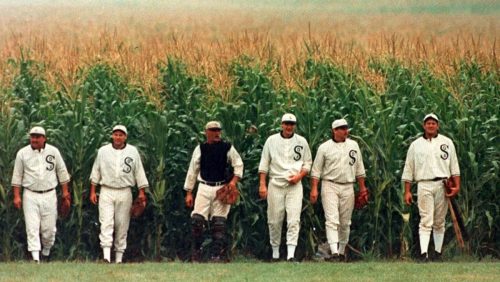
The end of the baseball season is hard for me, although it dovetails nicely into the hell of the holidays. The whitewater rush of our wedding anniversary, Thanksgiving, my birthday, pre-Christmas, Christmas, and New Years, along with the ethics business’s dead income period and resulting Marshall cash flow anxiety at the end of every year pretty much has me distracted until January, and Spring Training starts just six weeks after that. Early November has me in withdrawal, however, so I yielded to temptation and watched the 1989 baseball fantasy “Field of Dreams.” It is also an ethics movie of sorts, exploring the complexities of family, fathers and sons, forgiveness, sacrifice, faith and redemption.
Ethics Alarms has highlighted the annoying ethics problems in two classic films, “White Christmas” and “It’s a Wonderful Life.” Now it’s “Field of Dreams'” turn. Oh, I’m still a sucker for one of the most shamelessly manipulative movies ever, don’t get me wrong. I cannot, and I’ve tried, stop myself from getting choked up when Ray Kinsella (Kevin Costner) says to his incredibly gorgeous hunk of a father (Dwier Brown), long dead but miraculously returned to corporeal form and younger than his son,”Hey, dad? Wanna have a catch?”
See? I got choked up just typing that! (Damn movie.). From an ethics perspective, however, the film makes even less sense than the plot.
I’m going to assume, if you continue reading this, that you’ve seen the film. If you haven’t, see it. Don’t let my jaded observations spoil it. It sure works the first time.
Here are the aspects of “Field of Dreams’ that now drive me nuts.
- Ray Kinsella is a reluctant and unenthusiastic Iowa farmer who lives with his wife, Annie (Amy Madigan), and daughter, Karin (Gaby Hoffman). In the opening narration, Ray explains his estrangement from his father, John Kinsella, who was a baseball fanatic and who idolized Shoeless Joe Jackson, the disgraced star of the infamous Chicago Black Sox, who threw the 1919 World Series. By the end of his father’s life, Ray hadn’t seen his father for years. He is still feeling remorseful for refusing to play catch with his father, because rejecting baseball was a way to hurt his dad.
The Problem: The whole film’s premise (and that of the novel, “Shoeless Joe,” it was adapted from) is based on the popular fiction that Joe Jackson was unjustly banned from baseball for being part of the gamblers’ plot to fix the Series. This is untrue. Jackson accepted a bribe. He did not inform authorities. He knew his seven similarly-bribed team mates were trying to lose. He did nothing to stop them. he allowed the Series to be fixed, the fans to be betrayed and the fame itself to be brought to the brink of destruction. Jackson, who was illiterate and from all accounts appears to have had an IQ of about 85, argued that he tried to win despite taking the bribe. First, the evidence is questionable on that point.Although he batted .375 against the Reds in the series, he failed to drive in a single run in the first five games, four of which the White Sox lost. That’s how you throw games without looking like you’re throwing games. Second, he was making the argument that stealing money from bad people isn’t still unethical. Joe probably believed that, but then he was an idiot.
- . While walking through his cornfield one evening, Ray hears a whispering voice saying, “If you build it, he will come.” He decides, after the voice keeps pestering him, that he is supposed to build a baseball field—with lights!—in his corn field, and that if he does, Shoeless Joe Jackson will return from the dead and play there. Or something. Annie is dubious–ya think?—but lets him do it. After the field is finished and nothing happens for months, we see Ray and Annie going over their financial records:
RAY: How bad is it?
ANNIE: Well, given how much less acreage we have for corn, I’d say we’ll probably…almost break even.
RAY: Jesus.
ANNIE: We’ve spent all our savings on that field.
RAY: So what are you saying? We can’t keep the field?
ANNIE: t makes it real hard to keep the farm, Ray.
The Problem: And I said Shoeless Joe was stupid. NOW they are having this conversation? This is so irresponsible and incompetent, it defies description. Ray has a family. They have a little girl. Spending their savings on Ray’s whim and a ghostly and ambiguous whisper is the ethical equivalent of parents blowing their money on drugs. Through it all, Annie, who proudly styles herself as a Sixties veteran, is relentlessly cheery regarding her husband’s lunacy, and once Shoeless Joe appears on the cornfield diamond she’s all in. What, honey? Another voice is telling you to drive to Boston (from Iowa, remember) and talk famous recluse novelist Terrance Mann ( J.D. Salinger in the novel) to join your fantasy? You want to leave while we are trying to stay out of bankruptcy? Sure, go for it!
At the very least, they could have skipped the lights. None of the 1919 White Sox ever played in a night game; there were none then.
Continue reading →


 Ethics Alarms