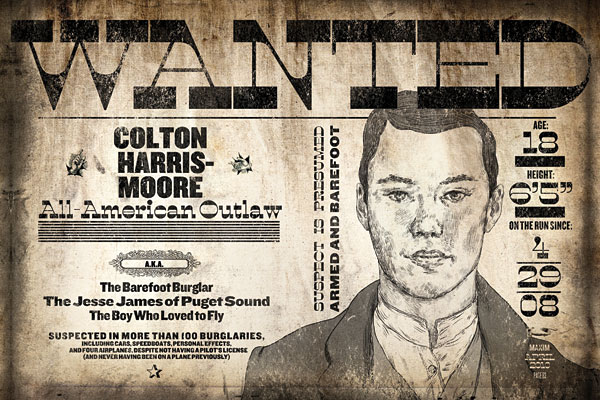
You may remember Colton Harris-Moore, aka “The Barefoot Bandit,” who while still a teen in 2009 went on a wild, two-year crime spree involving more than a hundred burglaries, thefts, and destruction, costing hundreds of thousands of dollars in cash and property, including a plane, a boat, and automobiles. When Harris-Moore was sentenced to six and a half years in prison in 2012 , U.S. Attorney Jenny Durkan said, “The plea agreement makes very clear that he will not profit directly or indirectly nor will he help anyone else to profit from these crimes.”
I’d like to see the agreement. For Harris-Moore has signed a movie deal with 20th Century Fox, “waiving” the rights to his life story in exchange for the film company paying up to $1.3 million toward the $1.4 million he owes as restitution to his victims. Now I’d call this “profiting.” If someone pays what I owe on my mortgage, I benefit. I profit.
I’m sure the argument for permitting this deal, which is the kind most states and the federal government regard as contrary to public policy and prohibit with so-called “Son of Sam laws,” is that Barefoot’s victims are needy and innocent beneficiaries, since it is unlikely that they would ever get much, if anything, in payments from the imprisoned felon. Thus the usual objective of keeping criminals from turning their crimes into cash and celebrity should yield to the greater good.
Today’s Ethics Alarms Ethics Quiz of the Day is…
Should the Barefoot Bandit be allowed to make this deal?
I’ll leave this one to you.
But I’m dubious.
 Ethics Alarms