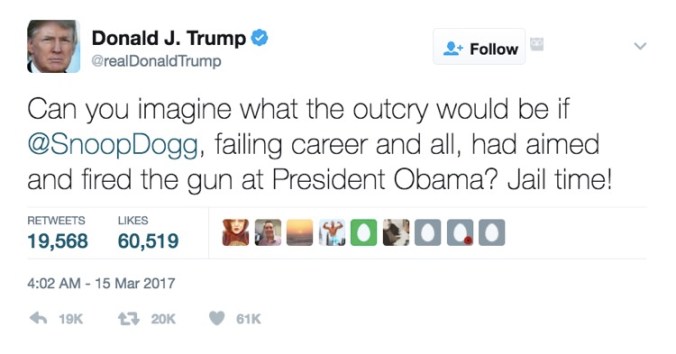
Hip hop artist Snoop Dogg is desperate for some publicity, I guess, so why not troll President Trump? He’s issued a music video of the song “Lavender,” in which a Trump-imitating actor in clown makeup is sort of assassinated by the singer. This is art. It poses no threat to the President. Tasteless? Ugly? Provocative? You decide. Whatever you decide, however, the President’s tweet is factually wrong. Ken White explains at Faultlines:
This is all nonsense…First Amendment analysis isn’t mathematics, but it’s not philosophy, either. The rules, and how they have generally been applied, are knowable. The rules for whether a statement can be taken as a criminal threat against the President have been clear for 47 years, since Vernon Watts talked about putting LBJ in the sights of a hypothetical rifle. The rules governing claims of “incitement” are even clearer. Unless Snoop Dogg’s video was intended to produce, and likely to produce, imminent lawless action, or was intended as and objectively understandable as a sincere expression of intent to do Trump harm, it’s not criminal. Period. This is not a close or ambiguous call.
Correct. Now, as regular readers here know, I have an abundance of tolerance for the President’s tweeting. It’s not dignified, and it undermines his authority and dignity, and it embarrasses the government and degrades the office. Most of the tweets, however, are just stupid.
This one, however, misstates the law, and, as White points out, the President is sworn to protect the laws of the United States. You don’t protect them by misrepresenting them, or by miseducating citizens who are just as ignorant of the law as the President is.
This can’t be put off any longer: if he is going to keep tweeting, the President’s tweets have to be vetted by a lawyer.
“The state has a reason? Yeah, it does. Does it limit free speech? Dramatically. Are there other, less restrictive ways of doing it? We’re not sure, but we think probably. . . . Okay. End of case, right?”
—-Supreme Court Justice Stephen Breyer, during oral argument in the case Packingham v. North Carolina, describing how state laws are traditionally seen by the Court as infringing on freedom of speech.
Lester Packingham was registered as a sex offender in 2002 after pleading guilty to statutory rape with a 13-year-old girl (he was 21). He served his time and probation, and then, in 2010, Packingham posted on Facebook to thank the Lord for a recently dismissed parking ticket, writing, “Man God is Good! How about I got so much favor they dismissed the ticket before court even started? . . . Praise be to GOD, WOW! Thanks JESUS!”
Jesus, however, did not stop him from being prosecuted for that message under a 2008 North Carolina law that prohibits registered sex offenders from accessing social media, on the theory that it gives them access to minors.
Packingham appealed the resulting conviction, arguing that the law violated his First Amendment rights. The Supreme Court accepted the case, which could determine whether access to social media sites like Facebook, Youtube, and others are a fundamental right.
In oral argument this week, observers got the distinct impression that this is where the Court is headed. At least five justices, a majority of the temporarily reduced court, suggested during argument that they would rule against North Carolina and for Packingham , whose lawyer says that more than 1,000 people have been prosecuted under the law.
Reading various reports of what was said, I am stunned by how out of touch everyone involved sounds. The Washington Post story describes Justice Kagan like she’s a web-head because she’s “only” 59. “So whether it’s political community, whether it’s religious community, I mean, these sites have become embedded in our culture as ways to communicate and ways to exercise our constitutional rights, haven’t they?” Kagan asked North Carolina Deputy Attorney General Robert C. Montgomery, who was defending the law.
Do we really have to ask that question today? The law was passed in 2008, which in technology and social media terms makes it archaic. Legislators can be forgiven for not understanding the central role of social media in American life nine years ago, but in 2017, when we have a President tweeting his every lucid thought (and many not so lucid), how can anyone defend the argument that blocking a citizen from social media isn’t an extreme government restriction on free speech? Laws related to technology should all have sunset provisions of a couple years (a couple months?) to ensure that they haven’t been rendered obsolete by the evolving societal use of and dependency on the web, the internet, and new devices. Continue reading →
WASHINGTON (CBS SF/AP) — The Trump administration ramped up its war against the press Friday, blocking several major outlets from a scheduled White House press briefing.The New York Times, the Los Angeles Times, CNN and Politico were among the news organizations excluded from the meeting, reportedly an untelevised gathering with the press instead of the usual on-camera briefing with White House Press Secretary Sean Spicer.
I am not aware of the specific reasons for the action, but:
1. I read the New York Times daily. It is routinely making every effort to present the actions of the Trump Administration in a negative light, often engaging in outright deceit to do it. It is behaving, as it has for years, as a Democratic Party organ.
2. CNN simply teems with anti-Trump hostility, in the tone of panel discussions, in the framing of the news, in the sneers and body language of its talking heads. This is not ethical journalism.
3. Politico is left-biased, but I haven’t followed it closely. The LA Times has conditions for use that I can’t meet. I’m not sure how biased they have been.
4. There is nothing per se unethical about a Presidential administration deciding that a news source it considers untrustworthy, unreliable and allied with groups that want to literally bring it down should be treated accordingly. Competent, unbiased, fair and ethical journalism is not an excessive requirement.
5. The response to Trump’s very clear warning to the news media last week was, “You can’t stop us, and we will be as hateful as we please.” This is his response to that. Hubris has its consequences. After MSNBC’s “Morning Joe’s” co-host Mika Brzezinski ‘s comment this week, some attitude adjustment seems to be mandatory. She said of the President,
“He is trying to undermine the media and trying to make up his own facts. And it could be that while unemployment and the economy worsens, he could have undermined the messaging so much that he can actually control exactly what people think. And that, that is our job.”
No, Mika, actually leaders always lead, which always means trying to persuade the public. That is their job. You job is to keep the public informed without telling them what to think, since as this statement proves, you don’t think all that well. At all.
6. I am surprised that the Washington Post wasn’t shut out as well, especially after a slime job like this story.
7. Would I recommend this action by Trump? No. But it is a defensible response to a real threat to his ability to govern, and an informed democracy. It may not be a responsible or prudent response.
8. The best response would be for journalists to start doing their real job, and report the news fairly and competently without aligning themselves with political agendas.
Part I in this series began with a random choice of a New York Times anti-President hit piece of the day. This is the one of truths that the mainstream media wants to pretend doesn’t exist: the intentionally, relentlessly negative, innuendo-filled reporting regarding the Trump administration, with the goal of alarming the public, undermining its trust in the government, weakening his Presidency, or bringing it down entirely. Just to be up to date, let’s look at today’s front page…and what do we find? “A Back-Channel Plan for Ukraine and Russia, Courtesy of Trump Associates.” The article includes a prominent graphic titled “Donald Trump’s Connections in the Ukraine.” But the article itself, and any research into the individuals shown in the graphic, show no association between Donald Trump and the Ukraine whatsoever. We see…
Andrii V. Artemenko: Ukrainian politician with a peace plan for Ukraine and a file alleging that its president is corrupt.
Felix H. Sater: Russian-American businessman with longstanding ties to the Trump Organization.
Michael D. Cohen: Trump’s personal attorney, under scrutiny from F.B.I. over links with Russia.
Paul Manafort: Former Trump campaign manager with pro-Russian political ties in Ukraine now under investigation by the F.B.I.
There is no evidence or even allegation that Artemenko has even spoken to Trump. Sater was involved in helping businessman Trump seek deals in Russia, and that is all the article tells us about him. Cohen is Trump’s lawyer, and a lawyer’s clients are not “linked” to other clients, unless you think Patty Hearst was “linked” to O.J. Simpson through their mutual lawyer, F. Lee Bailey.
Then there is Manafort, who is not in the Trump Administration, and was fired from the campaign before the election. Back when he was the campaign manager, Politifact did a “check” on him, and found that he had done political consulting work for Ukrainian politicians. Among the international clients Clinton consultant James Carville lists on his website are politicians in Argentina (lots), Columbia, Bolivia, and yes, the Ukraine, that’s just “some” of the them, meaning that some of the others either don’t want to be known or wouldn’t make Carville look good if they were known. Was Hillary Clinton “associated” with everyone on Carville’s client list? (Also a Carville client: the late Senator Ted Kennedy, serial pussy-grabber and un-prosecuted negligent homicide suspect). Of course not, but that’s the degree of “association” with the Ukraine that the Times article pins on the President, once you get past the front page headline and graphic. The photo over the online version of the article even shows President Trump, who is barely mentioned in the substance of the piece at all, except in such references as “Mr. Trump’s lawyer.”
Might all of these “associations”—this use of guilt by association would be too attenuated even for Joe McCarthy–eventually add up to something sinister, and a scandal that involves the Trump administration? Sure, anything is possible. THAT would be news. THAT would belong on the front page. THIS story, however, is a dog’s breakfast of innuendo, speculation, “hmmmm..” and nothing. It is fake news…not fraudulent in its facts, fraudulent in its presentation, placement in the paper and intentional suggestion that what is known justifies suspicion of the President. The defenders of the ongoing journalist attacks on the President continue to argue that fact-based smears and rumor-mongering stories published in major news sources are not “fake news,” and after a story like this, I have to wonder about their honesty too. There is only one way this kind of smoky article makes a front page above the fold.
Now on to the Tweet Heard ‘Round The World. As discussed in Part II, the President was performing a public service when he told the newsmedia to its reporters’ smug faces that they were biased, hateful, incompetent and dishonest. Somebody had to do it. Their supposed “watchdogs” like CNN’s Brian Stelter won’t do it, because he is too busy bashing the President himself while defending his pals.
It would be much better if someone in academia, or a prominent journalist pointed out how terrible a biased and untrustworthy news media is for the nation, but this is the Left’s attempted coup, after all. Try finding an objective authority in academia or journalism. So the leader of the nation, on national television, has to tell the self-congratulatory journalists that they are failing their duty to the nation, which is to inform the public. They see their duty as bringing down a President their Progressive Masters hate. In other words, the President is saying, essentially..
The follow-up tweet elaborated by specifying just how much of a betrayal this is, saying,
The FAKE NEWS media (failing @nytimes, @NBCNews, @ABC, @CBS, @CNN) is not my enemy, it is the enemy of the American People!
Look at this as the second slap. Better yet, look at it as the journalism version of Ronald Reagan slapping the Soviet Union with the well-deserved label, “The Evil Empire.” Many commentators, including former Soviet President Mikhail Gorbachev, traced the beginning of the unraveling of the Iron Curtain to Reagan’s brutal frankness.Continue reading →
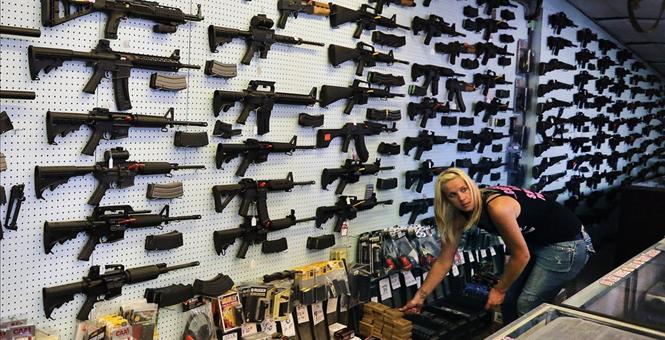
As last year’s flat-out demagoguery about banning gun ownership for citizens placed on the FBI’s no-fly list proved, Democrats will never let the Constitution get in the way of an emotion-based attack on gun rights. A rule implemented by former President Obama after the 2012 Sandy Hook shooting (“WE HAVE TO DO SOMETHING!!!”) would have required the Social Security Administration to report the records of some mentally ill beneficiaries to the FBI’s National Instant Criminal Background Check System. Those who have been deemed mentally incapable of managing their financial affairs — roughly 75,000 people — would have then been prevented from owning guns.
The American Civil Liberties Union and advocates for the disabled opposed the restriction, which was so broadly drawn that an Asperger’s sufferer could have his Second amendment rights taken away. And what, exactly, is the link between not being able to handle one’s financial affairs and violence? Hell, I can barely handle my financial affairs.
Iowa Sen. Chuck Grassley, a leading Republican critic of the rule, said that it was filled with “vague characteristics that do not fit into the federal mentally defective standard” that could legally prohibit someone from buying or owning a gun. “If a specific individual is likely to be violent due to the nature of their mental illness, then the government should have to prove it,” Grassley said
Sen. Chris Murphy, a Democrat from Connecticut where the Sandy Hook massacre occurred, and thus obligated to grandstand regardless of the fact that he’s on shaky 2nd Amendment, 5th Amendment and also Equal Protection ground, declaimed on the Senate floor,
“The [Congressional Review Act] we have before us today will make it harder for the federal government to do what we have told them to do for decades, which is to put dangerous people and people who are seriously mentally ill on the list of people who are prohibited from buying a gun….If you can’t manage your own financial affairs, how can we expect that you’re going to be a responsible steward of a dangerous, lethal firearm?”
Well, I guess nobody in Congress should own a gun either, right, Senator? Continue reading →
Halloween costumes, political correctness, law, privacy, and the Niggardly Principles—this one has it all.
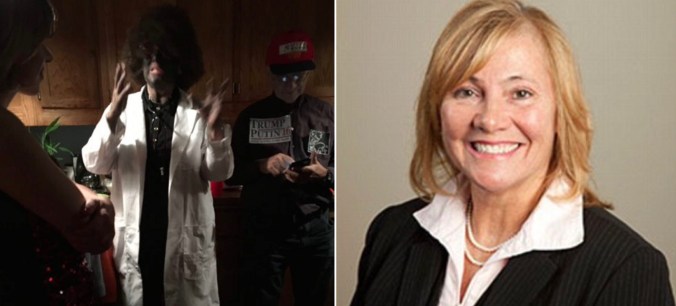
Last Halloween, University of Oregon law professor Nancy Shurtz dressed as Dr. Damon Tweedy, the author of Black Men In A White Coat , as an homage to the African American physician and author. She did this at a Halloween party in her own home. Nobody at the party appeared to misunderstand the gesture or the intent of the costume, in part because she could explain it on the spot, and because they knew that Shurtz was no racist. Shurtz had also told the students who were invited that she would be “going as a popular book title,” hence the blackface, Afro wig, white coat, and stethoscope.The university report on the episode states that Shurtz “was inspired by this book and by the author, that she greatly admires [the author] and wanted to honor him, and that she dressed as the book because she finds it reprehensible that there is a shortage of racial diversity, and particularly of black men, in higher education.”
But as always happens now because there is no such thing as a reasonable expectation of privacy even in one’s own home, reports of Shurtz in costume and make-up got out into the campus at large, and inflamed the predictable outrage. The university launched an investigation that culminated in a critical report prepared by an attorney and the university’s Office of Affirmative Action and Equal Opportunity. Shurtz issued an apology—for her private conduct within her own home that was pounced upon by Political Correctness Furies, since she appears to be one herself-–on November 1. Some of her colleagues on the faculty and many students demanded that she resign, and she may have to yet. Shurtz has been censored and suspended, and is now on paid leave. It being claimed that her wearing the costume–within her own home as a gesture that all agreed was intended as benign and that nobody at the party either objected to or failed to understand— created “a hostile environment” at the school. This is apparently because
“as part of the uproar, students said things of which the administration disapproved: The report specifically notes that students used “other offensive racially-based terminology during class times in the context of discussing this event and broader racial issues.” It related that “some of the witnesses reported that the students’ reactions to the event were racially insensitive or divisive.” And it apparently viewed such statements as relevant to whether Shurtz’s own speech was properly punished.”
The report, meanwhile, concludes that the costume constituted “harassment,” and that her intentions are irrelevant.
(4) news that people want others to think is fake so they can peddle their own fake news.
Did genuine, unequivocal fake news affect the 2016 election—that is, the first kind, the kind peddled by hoax sites like The News Nerd, and the Macedonian junk like the story about the Pope endorsing Trump? There’s no evidence that would suggest or support that. Many voters are naive, gullible, ignorant fools, but still: how many actually changed their votes based on complete fiction? It’s impossible to tell, but stating that this was the case is itself a form of fake news.
Democrats and partisan pundits had been using the “fake news” device to mute the voices of journalists who didn’t follow in lockstep to the mainstream media pro-Democratic march. The IRS scandal, which is real and damning, has been largely ignored by the mainstream news media and called a “nothingburger” in Obama Administration talking points.The assertion that it is a myth that the IRS is using its power to suppress conservative dissent is …..fake news.
Because Fox is the only major news outlet (I do not count the slimy Breitbart websites) that was consistently critical of the Obama administration when it deserved it (and sometimes when it did not), Democrats not-quite-successfully-enough set out to marginalize Fox, calling it “faux news” and pushing the Obama narrative that it wasn’t even a legitimate news source. Obama, in an interview with Rolling Stone (speaking of sources of fake news!), blamed Clinton’s loss in part on “Fox News in every bar and restaurant in big chunks of the country.”
Isn’t that amazing? What gall. It isn’t the fact that the debt (that Obama promised to reduce) is now just short of 20 TRILLION dollars, with Obama adding a record $7.917 trillion to it, it’s that the one news source that actively exposed that fact was available to middle class voters that led to Hillary’s loss. It wasn’t that the Affordable Care Act didn’t let Americans keep their health care plans as Obama repeatedly swore it would, it was that Fox News kept reminding its viewers of that (as the rest of the news media soft-peddled it) , while also publicizing that thanks to the Affordable Care Act, one’s health care insurance was less affordable unless the government was paying for it. It wasn’t that Hillary Clinton had lied about her e-mail tricks for over a year, the problem was that Fox was responsibly reporting that she was lying, unlike CNN, NBC, and the rest.
You know. Fake news.
As part of an organized effort up and down Democratic groups, ranks, allies and media operatives to de-legitimatize Donald Trump’s victory, the definition of “fake news” has been conveniently expanded. The Washington Post published a jaw-droppingly sloppy, partisan piece last week alleging that
The flood of “fake news” this election season got support from a sophisticated Russian propaganda campaign that created and spread misleading articles online with the goal of punishing Democrat Hillary Clinton, helping Republican Donald Trump and undermining faith in American democracy, say independent researchers who tracked the operation.”
The Virginia Court of Appeals took on the case of a man convicted of violating a state law prohibiting displaying a noose with the intent to intimidate, in violation of Va. Code § 18.2-423.2. Actually, Jack Turner did a bit more than that. The noose was hanging from a tree on his property and was on the neck of a dummy appearing to portray a black man. However, the law only prohibits a citizen from displaying a noose in a public place, and this was, his lawyers argued, Constitution-protected speech on private property. Turner was appealing his sentence of five years in prison (all but six months were suspended).
No doubt about it, this was “hate speech”; Turner admitted it. After his African American neighbor reported the display to police, who questioned him about his intent, Turner initially said that the hanging black dummy was “a scarecrow.” When it was pointed out that he had no garden, Turner elaborated by explaining that he was a racist, and “did not like niggers.”
At the trial, one of Turner’s African American neighbors testified that after seeing the hanging dummy he was especially upset when he saw the dummy because nine African-Americans had been killed in the Charleston South Carolina church shooting earlier in the same day. The neighbor’s wife testified that she now feared for her family’s safety. After the incident, the parents no longer allowed their sons to walk past Turner’s house, because, they said, they didn’t know what else a man who hanged such a warning was capable of doing. For his part after he was forced to remove the hanging black effigy, Turner continuously hung a Confederate flag in a window facing his neighbor’s home. Great neighbor.
Hate speech, however, is still protected speech. As the Supreme Court confirmed last session, to be legally prohibited hate speech must constitute a “true threat,” meaning that a speaker means to communicate “a serious expression of an intent to commit an act of unlawful violence to a particular individual or group of individuals,” even where the speaker does not “intend to carry out the threat.” Prohibitions of true threats protect individuals from “fear of violence and from the disruption that fear engenders.”
The Court of Appeals didn’t have to exert itself to find that when a man hangs a noose with a black figure dangling from it within view of his African-American neighbors’ house, it indeed constitutes a “true threat.” The Court found the display, after reviewing the history of lynchings in Virginia and the powerful symbolism carried by Turner’s noose, comparable to a burning cross, Continue reading →
Donald Trump has no character or trustworthiness. Next question?
Oh, all right, in the interests of equity and fairness, I’ll submit The Donald to the same process as I did with Hillary Clinton, though in his case the verdict is res ipsa loquitur. Trump’s lack of ethics and his unfitness to fill the shoes of Washington, Lincoln, Teddy, FDR, or Millard Fillmore is, or should be, self-evident. Those for whom it isn’t self-evident are either ignorant, devoid of values themselves, or intentionally seeking to harm the United States.
I’ve been writing about the awfulness that is Donald Trump since 2005. He was noted for his dishonesty on my Ethics Scoreboard when I called foul on his marketing “various ‘get rich’ products, including tapes, seminars, and “Trump U,” an on-line delivery system for more of the same.” I wrote in part…
There are thousands upon thousands of Americans who started with meager resources and made themselves rich through talent, hard work, creativity, inventiveness, and some luck. …Not Trump. The success of his pitch to the desperate wannabes and clueless is based on their erroneous assumption, nurtured by Trump but not explicitly supported by him, that he can teach them to do what they think he did…make himself rich through hard work and a business savvy. But what Trump is best qualified to teach is how to make yourself richer when you inherit an established business and have millions of dollars plunked into your waiting hands after your Dad has sent you to Wharton.
The fact that Trump doesn’t lie outright about his background but simply allows his marks to jump to the wrong conclusions puts his “get rich like me” marketing efforts in the category of deceit…but deceit is still dishonesty. Trump undoubtedly has useful wisdom to impart about building a successful career; it’s not as easy to stay rich as some people think. Ask most state lottery winners. Still, the most vivid lesson of Donald Trump’s successful campaign to sell himself as a self-made billionaire is the lesson that 19th Century con-man Joe Bessimer pronounced more than a century ago: There’s a sucker born every minute.
So we knew, or should have known, that this was a con artist at least back eleven years. In 2006, I posted on Trump’s misogyny and incivility, writing about the first outbreak of his feud with the equally vile Rosie O’Donnell, and their public name-calling…
Rosie set off the exchange by suggesting on ABC’s “The View” that Trump’s recent assumption of the role of moral exemplar by chastising and threatening to fire the reigning Miss USA for being a party-girl was more than a little ridiculous, given his own well-documented penchant for fast women and extra-marital affairs. Sometimes Rosie’s full of beans, and sometimes she gets it right; this time she was right, but spoiled it by concluding her commentary with some unflattering name-calling. Trump, no girly-man he, immediately said he would sue O’Donnell, and then launched into an extended riff on how unattractive and fat she was, including the charming phrase, “pig-face.” Classy as always, Donald…. Yes, anyone who admires either of these two annoying characters already has a problem, but there is no escaping the fact that both are celebrities, and as celebrities they contribute to establishing cultural norms of civility and conduct. This is especially true of Trump, who despite his low-life proclivities is a successful business executive. Resorting to personal attacks on an adversary’s weight or appearance is disrespectful, unfair, cruel and indefensible. Doing so on national media is like firing a shotgun into a crowd. There are a lot of fat or unattractive women out there, Mr. Trump, who are smart, generous, productive, loving, intelligent people… Golden Rule, anyone? How are we to convince our children not to ridicule the personal traits of others, when those they see as rich, famous and successful do the same openly, shamelessly, and even gleefully?
You can imagine my continued amazement that ten years after writing this rather obvious assessment, without Trump having undergone a complete transformation, and indeed with his conduct and public statements becoming worse rather than better, we are on the eve of a day that may live in infamy as the moment democracy completely failed the United States of America, inflicting on it, and the world, as unstable and unqualified a leader of a great power as history has ever witnessed. Continue reading →
The first Ethics Alarms post about Hillary Clinton ironically enough, in 2009, awarded her an Ethics Hero. (She has two.) “I know, I know. Truth and the Clintons have never been friends,” it began. And, looking back, it was a pretty generous award: all she did was describe how an ethical decision is made, and claimed that was how she decided to accept Obama’s invitation to be Secretary of State. It didn’t prove she actually made the decision the way she said she did, and now, with the benefit of seven years’ hindsight, I think it’s likely that she was lying about it, as usual. Still, it proves that Hillary may know how to act ethically. This distinguishes her from Donald Trump.
Before heading to the voting booth, I decided to review all of the Ethics Alarms posts about Clinton. It is, I think it’s fair to say, horrifying. You can find them all here.
There are unethical quotes of the week and month, Ethics Dunce designations, Jumbos, where Clinton denied what was in clear view to all, and KABOOMS, where the sheer audacity of her dishonesty (or that of her corrupted allies and supporters) made my skull explode skyward. If you have a recalcitrant Hillary enabler and rationalizer in your life, you should dare him or her to read this mass indictment—not that it will change a mind already warped, of course, but because the means of denying and spinning what they read will be instructive, confirming the symptoms of incurable Clinton Corruption.In July of 2015, I responded to complaints—including one from an ethics professor— that I was not objective regarding Mrs. Clinton, that I was picking on her. The response was a manifesto, stating my standards and objectives: Continue reading →



 Ethics Alarms