First Amendment Ethics and the Conundrum of the Despicable Blogger

Attack-blogger Crystal Cox---exercising her rights, jeopardizing yours.

One thing that the public just doesn’t understand about lawyers is that their job sometimes involves fighting for the most despicable people imaginable, because those despicable people have legal objectives they have a right to pursue as citizens, and because the principles underlying the fight are important, even if the particular clients—and often their objectives too–are blights on humanity.

Over at Popehat, Ken has chronicled a classic example, in which First Amendment specialist Eugene Volokh (he of the Volokh Conspiracy) and the Electronic Freedom Foundation are backing blogger Crystal Cox as she appeals a $2.5 million defamation judgment against her, in which an Oregon judge ruled that bloggers did not have the same protection against defamation claims under the First Amendment as journalists do. Cox, of whom I was blissfully unaware until Ken’s post, is clearly the kind of person who is a menace on the internet, lacking basic decency, fairness, scruples and common sense, and yet stimulated by the power that the medium provides her. The signature act that established this for me is revealed by Ken at the top of his post:

“Here’s the most important thing you need to know about blogger and “investigative journalist” Crystal Cox: when she got angry at First Amendment attorney Marc Randazza, she didn’t just register the domains marcrandazza.com and fuckmarcrandazza.com and marcrandazzasucks.com in order to attack him. She registered jenniferrandazza.com and nataliarandazza.com — the names of Randazza’s wife and three-year-old daughter.”

Yup, that’s enough, all right: signature significance. Is there any chance that an individual who would do this even once could be an ethical, reasonable, fair person?  No! Only an unethical creep would even consider such conduct; with a normal person, the ethics alarms would be ringing so loud that they would be paralyzing. Continue reading

Ethics Quiz: What if the Westboro Baptist Church Is Just Kidding?

I know just how you feel, Homer.

This is a unique Ethics Alarms quiz, because I am offering it while having absolutely no idea what the answer is, or even, perhaps, what the right question should be.

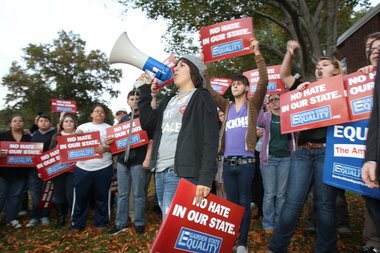
The story you can read here describes the Westboro Baptist Church’s interactions with an openly gay DJ. You will recall that the church’s followers have achieved infamy by loudly protesting on the scene of private funerals for military personnel killed in combat, with “God Hates Gays” being one of their signature protest signs. Yet the DJ, when he visited the group, found them to be friendly, unthreatening, civil and kind. They hugged him. The asked him over for dinner.  The surprised and puzzled writer suggests that the Fred Phelps followers’ act may be a form of First Amendment-testing performance art, sort of like Bill Maher. Maybe they aren’t really hateful after all. Maybe they just act that way!

My Ethics Quiz question for you to consider:

Does the fact that they can be kind, tolerant and accepting in the privacy of their abode make the Westboro Baptist Church protesters less unethical, more unethical, or does it make no difference at all? Continue reading

Well THAT Didn’t Take Long: The Next Step in School Censorship of Student Speech

Huh. You know, I just didn't think it would come from the schools! Well, live and learn...

Ethics Alarms has been steadfast in its position from the very first reports of schools presuming to punish students for what they post online, in their own time, in their own homes. That position is, and will forever be, that this is a gross abuse of power that must not be tolerated, much less encouraged. Every time I have written about this, there have been defenders of the practice. This story, from Minnesota, should convince them of how wrong they are. Continue reading

The Lenahan Effect Meets The Streisand Effect

From the Legal Ethics Forum:

The Lenahan Law Firm in Dallas Texas has subpoenaed Google to release the real name of an anonymous critic who posted an un complimentary online review of the firm’s services. The firm wants to sue the poster for daring to question its performance by writing,

“Bad experience with this firm. I don’t trust the fake reviews here.”

For this perceived insult, the Lenahan firm wants to punish “Ben” to the tune of $50, 000 in damages.

Ironically, the lawsuit, rather than the review, proves to my satisfaction that “Ben” has a point. He was clearly expressing his opinion: it is up to him, and only him, whether he regards the experience of working with the Lenahan firm as “bad” or not. In the complaint, the firm says that the declaration that the positive reviews are “fake” alleges dishonesty and fraud by the firm. Utter nonsense. First of all, the allegation, fair or not, is also obviously an opinion. Second, “Ben” is saying that the reviews are fake, which could mean insincere, among other interpretations. He does not attribute them to the firm. He doesn’t say where they came from. He doesn’t know. Maybe I sent them.

On the screen shot included in the complaint, it clearly says that “0 of 3” people found “Ben’s” review helpful. For that, the firm wants $50,000 in damages, since that zero potential client was driven to another firm with his lucrative business.

Unbelievable.

Over at Popehat, lawyer-blogger (and Ethics Alarms 2011 Ethics Blogger of the Year) Ken has been carrying on a vigorous battle against online censorship of free expression by threats and lawsuits. His current target is a ridiculous faux lawyer who is now threatening Ken for pointing out the error of his ways. In his commentary as well as his various emails to the individual, Ken explains with admirable precision why opinions are not actionable assertions of fact, useful passages that I would recommend to the Lenahan Law firm. The firm’s efforts to bully critics by making an example out of “Ben” also unwisely incur the “Streisand Effect,” the online phenomenon by which efforts to censor information on the web has the perverse consequence of giving it more visibility and influence.

I don’t know if there is a name for the effect—“The Lenahan Effect,” perhaps?—by which a law firm’s willingness to pursue a spurious, unnecessary and excessive lawsuit against a former client for expressing his views about the firm’s work has the perverse effect of showing the world why that client feels the way he does, but that’s what the Lenahan lawsuit against “Ben” does.

That’s only my opinion, of course.

Ethics Hero AND Ethics Dunce: Secretary of the Interior Ken Salazar

U.S. Interior Secretary Ken Salazar scores a rare twin honor: He is an Ethics Dunce and an Ethics Hero in the same week.

Occupier, or just a vistor, Mr. Secretary?

First the good news, the Ethics Hero part.  Salazar has given the National Park Service  30 days to fix the inaccurate, misleading and truncated quotation on the Martin Luther King Jr. National Memorial. He did this after giving the inept King Memorial Foundation plenty of time to do its job. It didn’t, and he took the initiative. Harry Johnson, president of the Foundation, told the AP he wasn’t sure what changes could be made. Well, how about using a real quote instead of a made-up one that makes Martin Luthor King sound like a preening Newt Gingrich?

Chiseled into the monument’s left flank because there wasn’t room for the actual quote is “I was a drum major for justice, peace and righteousness.” What King really said in a 1968  speech was: “If you want to say that I was a drum major, say that I was a drum major for justice. Say that I was a drum major for peace. I was a drum major for righteousness. And all of the other shallow things will not matter.” When Maya Angelou and others complained that the pompous-sounding non-quote make King sound like a boasting egotist (and one speaking from the grave!), the Foundation shrugged and erected the monument unchanged. Continue reading

A Ban on Threatening “Spiritual Injury”: Unconstitutional But Ethical?

There you go, Bill, letting people be unethical again...

Eugene Volokh, a First Amendment  provocateur, notes that Minn. Stat. Ann. § 211B.07 makes it a gross misdemeanor to

“….directly or indirectly use or threaten force, coercion, violence, restraint, damage, harm, loss, including loss of employment or economic reprisal, undue influence, or temporal or spiritual injury against an individual to compel the individual to vote for or against a candidate or ballot question.

The professor opines that the spiritual injury part, at least, is unconstitutional. Interesting.

Prohibiting the interference and manipulation of a human being’s rights of autonomy and self-determination by using threats to compel his voting choices is a legitimate area for the law, because ethics is notoriously inadequate at preventing electoral abuses. It is also an area where the law is an especially blunt instrument, and many conceivable violations of § 211B.07 would seem to risk colliding with free speech. “If you don’t vote for Ron Paul, I’ll never speak to you again!” comes to mind. The threat of “spiritual harm”—“Vote for Mitt Romney, my flock, or I condemn you to Hell!” adds the  free exercise of religion to the mix, particularly when the threat is linked to a position of a candidate that violates religious doctrine.

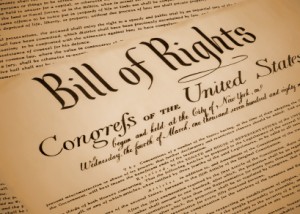
I have no difficulty concluding that any and all threats to force a citizen to vote according to another citizen’s desires are wrongful and damaging to democracy, and should be condemned and discouraged to the maximum extent possible. Ethical though such prohibitions may be, some, like the use of threatened spiritual injury, are impossible under the Bill of Rights.

So threatening to send someone to Hell if they vote for Newt Gingrich—a reasonable result, when you think about it—is unethical, but a law punishing that threat is unconstitutional.

Sorry, Ethics…looks like it’s all up to you!


Ethical Quote of the Week: Boston Judge Frances A. McIntyre

Not speech.

“… while Occupy Boston protesters may be exercising their expressive rights during their protest, they have no privilege under the First Amendment to seize and hold the land on which they sit… ‘Occupation’ speaks of boldness, outrage, and a willingness to take personal risk but it does not carry the plaintiffs’ professed message. Essentially, it is viewed as a hostile act, an assertion of possession against the rights of another. The act of occupation, this court has determined as a matter of law, is not speech. Nor is it immune from criminal prosecution for trespass or other crimes.”

Suffolk Superior Court Judge Frances A. McIntyre, in a 25 page decision lifting the temporary restraining order that has blocked Boston officials from forcibly dismantling Occupy Boston’s  encampment by declaring that mere occupation does not constitute “speech” within the First Amendment.

Well, of course.

Occupying property, public or private, and preventing rightful owners or those who should also have access to do likewise is hostile, and has been from the beginning. “Boldness, outrage, and a willingness to take personal risk” pretty much defines all the Occupy movement has been able to communicate clearly, its more substantive positions being a matter of some dispute, or changing according to tactical needs.

Too many municipal leaders, their political biases and yellow streaks showing, have been reluctant to make this obvious and necessary point in order to toady to hard-left voting blocks and cynical Democratic operatives who think the Occupiers bolster the class warfare theme that seems to be the agreed-upon 2012 electoral strategy. But as public annoyance with the endless occupations wore on (and the novelty wore off), the yellow streaks worked against the demonstrators. They are going to have to find some other way of “speaking” besides sitting around.

A well-reasoned, articulate and rational position would be nice.

Introducing the Munroe Rule: “If You Teach, Don’t Denegrate Students Online; If you Denigrate People OnLine, Don’t Teach”

Viki Knox fans

I want to thank Viki Knox, the  Union Township (N.J.) high school teacher who decided to proclaim her condemnation of gays on Facebook, for making it possible for me to re-use much of an earlier post. This saves me a lot of thought and time.

That one involved Jerry Buell, a veteran high school teacher who was suspended indefinitely earlier this year by Lake County, Florida’s Mount Dora High School for posting an anti-same-sex marriage rant on his Facebook page.  In his post, prompted by New York’s decision to legalize gay marriage, Buell said that the news made him want to throw up, that gay marriage was “a cesspool,” and that homosexuality was a sin. Knox went Buell one better, going to the heart of the matter by declaring that homosexuality is a sin that “breeds like cancer” and describing it as “perverted.” She also wrote:

“Why parade your unnatural immoral behaviors before the rest of us? I/we do not have to accept anything, anyone, any behavior or any choices! I do not have to tolerate anything others wish to do.” Continue reading

Ethics Quiz: Who is the Most Incompetent Elected Official—the DA Who Doesn’t Care If A Convicted Prisoner Is Really Guilty, Or The Assemblywoman Who Doesn’t Know About The First Amendment?

California Assemblywoman Fiona Ma. " First Amendment? Where the heck did THAT come from?"

For this weekend’s Ethics Alarms quiz—the blog’s 2000th post!—I am asking readers to help me determine the Incompetent Official of the Week, when two unusually qualified candidates are running neck and neck.

Candidate A is McLennan County (Texas) District Attorney Abel Reyna:  Defense attorney Walter M. Reaves has filed a motion asking for DNA testing as part of his efforts to exonerate Anthony Melendez, currently serving a life sentence for the 1982 slayings of three teenagers in Waco.  Reaves says the test is needed because DNA analysis was not available when Melendez was convicted, and Melendez still maintains that he is innocent. D.A. Reyna, however, opposes the test. Why? He argues that such testing shows a lack of faith and support of the jury system, and what the jury has decided usually ought to be free of such post-trial attempts to discredit the verdict.

In other words, the D.A. believes that it is better to honor the jury system by letting an incorrect verdict stand than to use newly available scientific evidence to set an innocent man free.  Continue reading

Coercive Indoctrination in the Schools: Unethical, Regardless of the Content

A German language teacher at Western Hills High School in Fort Worth, Texas sent 14-year-old honors student Dakota Ary to the principal’s office for telling a classmate that he believes “homosexuality is wrong.”

Ary was then suspended as punishment. Homosexuality isn’t wrong,, but the school was.

Ary, who was raised in a church that believes homosexuality violates God’s laws, has a right to believe whatever he chooses to, and also has a right to express those beliefs as long as he doesn’t denigrate fellow students or incite violence or a disruption. There are words for schools punishing students for their beliefs, and among those words are “indoctrination,” “coercion,” brain-washing,” and “unethical.” Continue reading