This Will Not End Well…

I know I have written about this general phenomenon before, but my sense of urgency is increasing.

Today, while walking Spuds on a gorgeous, sunny, breezy Northern Virginia day, I saw two young boys sitting near a field under a tree, They looked to be 10 or 11, maybe older. I watched them for almost 20 minutes: I was fascinated. They were within a foot of each other, and never said a word or looked up…from their smart phones.

The internet is the most stunning example of a technological development having unanticipated and in many ways devastating effects on society and culture at least since radio, yes, I think even more television. A close second, however, is the cell phone.

I remember as a kid the constant refrain from my parents was that it was a beautiful day and that I should go outside and “play” instead of watching TV. I’m pretty sure I watched more TV than most kids then, but I also did a lot of stuff outside with my friends. And we talked to each other—about our parents and siblings, our neighbors, cool things we had read, yes, TV episodes, movies, the Red Sox, girls, school, and our dreams. We even talked about politics. It is amazing how many groups of children and especially teenagers I see hanging out but not saying a word to each other, because they are texting, or following social media, or staring at little screens for other reasons.

I was trying to imagine “Stand by Me” with cell phones. All of those adventures, intimate conversations, fanciful exchanges and the rest wouldn’t happen today. Gordy and his pals would just stare at their “devices” and never get to know each other at all. They would have shallow friendships, shalllow experiences, and grow up to be shallow adults.

One of the half-completed posts that has been sitting stalled on the EA metaphorical runway for years has been an essay on life competencies. No doubt about it: mastering new technology is one of those crucial life skills, but so is learning to communicate verbally, recognize a person’s moods and body language, and to learn to function and thrive “unplugged.” For all their many advantages, the cell phones that dominate our children’s attention—and ours, but that’s another set of issues—are crippling them. They are growing up lacking the ability to reason with each other, argue, inspire, learn, flirt—so much more.

I would advocate parents forcing their kids to surrender phones when they leave the house “to play,” but modern parents are terrified that a phoneless child will be preyed upon by the evils that lurk outside. I would advocate limiting smartphone time, or making minors settle for actual phones and not wield mini-computers, but that horse has left the barn too.

This is a social pathogen, and one would think it could be flagged as such and dealt with. I have no idea how we can do that now. One of the Ethics Alarms mottoes is “Fix the problem!” What the consequences will be if we don’t, I am incapable of prognosticating.

But they won’t be good.

A Popeye: The Mystery Word

It was 11 am, and having dropped my wife off for a physical therapy session and skipped breakfast, I decided to indulge my self in a guilty pleasure: a McDonald’s sausage biscuit. Say what you will about Mickey D’s: their sausage biscuits beat Jimmy Dean’s, and don’t tempt me to talk about the 7-11 barely-edible version.

So I waited in the Drive-Thru line at the nearest branch (the one that only occasionally get its orders right), and when I finally reached the speaker, made a quick and simple request: “A hash browns and sausage biscuit, please. That’s all.”

A woman said in an impenetrable accent, “Sorry, no biscuit. Just [????].” I had no clue what she was saying. It sounded like “eh.” “Pardon me? Could you repeat that?,” I asked. “No biscuit. Only [????].” Well, I had already decided to cancel the order, since the whole point was the item that wasn’t available, but as a matter of principle, I was damned if I was going to leave without knowing what the mystery word was.

Continue reading

Addendum To “An Ethics Conflict Conundrum: The Fraudulent Friend”

Apparently my choice of words confused some readers when I wrote that once “The Ethicist’s” inquirer in this post was made aware of a serious fraud (and an ongoing one) perpetrated by a close friend, she had become an accessory after the fact. That’s a legal term of art and I was careless to use it in nontechnical context. Almost no one is ever charged as an accessory for not blowing the metaphorical whistle, but the woman nonetheless shared responsibility for the harm done by the ongoing fraud by knowing about it, having the ability to stop it, and not doing so, thus letting it continue.

The duty she breached was an ethical one, not a legal one. As I said, I should have been clearer.

I am reminded of a personal experience that might clarify the issue further. I may have even related this story in another post; if so, I can’t find it, and it is worth repeating.

A lawyer friend contacted me for advice. He had been meeting with a client at the client’s home, and overheard, in the kitchen, a loud argument between his client and his wife culminating in what sounded like a hard punch in the face, the woman crying out in pain, and someone falling on the floor. My friend said he had said nothing, but was increasingly bothered by what he heard.

Continue reading

Morning Ethics Warm-Up, 3/31/2018: The Baseball-Trained Rifleman, The Hockey Hero Accountant, And Some Other Stuff That’s Just Annoying…

http://www.youtube.com/watch?v=xbAfEfBUuyw

Good morning!

1. “The Rifleman” and “Fix the problem.” I recently was interviewed by a graduate student in organizational leadership and ethics. One thing we discussed was how popular culture in America once dedicated itself to teaching ethical values and ethics problem-solving, especially in shows aimed at young audiences. This is not so true any more; indeed, popular culture models unethical conduct at least as often today.

I told my interviewer about recently watching an episode of “The Rifleman,” the early ’60s TV Western about a single father raising his young son while being called upon to use his skill with a rifle to fight for civilization in the harsh frontier.  In the episode, hero Lucas McCain (played by the under-rated Chuck Connors) had to deal with an old friend, now an infamous outlaw, who had come to town. (The ethical conflict between personal loyalty and an individual’s  duty to society was a frequent theme in Westerns.) Lucas was a part-time deputy, and at the climax of the episode, his friend-gone-bad is prepared to ride out of town to escape arrest for his latest crime. Lucas tells him not to leave, and that if he tries to escape, Lucas will have to let his custom-made rifle settle the matter, as usual. (Peace-loving Lucas somehow managed to kill over a hundred men during the run of the series.)  Smirking, his friend (Richard Anderson, later known as the genius behind “The Six Million Dollar Man”), says that he knows his old friend is bluffing. For Lucas owes him a lifetime debt: he once saved “The Rifleman’s” life.  You’re a good man and a fair man, the villain says. “You won’t shoot me. I know you.” Then he mounts his horse , and with a smiling glance back at “The Rifleman,” who is seemingly paralyzed by the ethical conflict, starts to depart. Now his back is all Lucas has to shoot at, doubling the dilemma.  You never shoot a man in the back, an ethical principle that the two officers who killed Stephon Clark somehow missed. We see McCain look at his deadly rifle, then again at the receding horseman. Then, suddenly, he hurls his rifle, knocking his friend off his horse. The stunned man is arrested by the sheriff, and says, lamely, as he’s led away. “I knew you wouldn’t shoot me.”

I love this episode. It teaches that we have to seek the best solution available when we face ethics conflicts, and that this often requires rejecting the binary option presented to us, and finding a way to fix the problem.

Of course, it helped that Chuck Connors used to play for the Dodgers, and could hurl that rifle with the accuracy of Sandy Koufax.

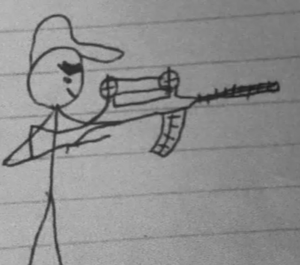
2. Here we go again! Now that anti-gun hysteria is again “in,” thanks to the cynical use of some Parkland students to carry the anti-Second Amendment message without having to accept the accountability adults do when they make ignorant, dishonest, and illogical arguments in public, teachers and school administrators are back to chilling free speech and expression by abusing their students with absurd “no-tolerance” enforcement. At North Carolina’s Roseboro-Salemburg Middle School, for example, a 13-year-old boy in the seventh grade was suspended for two days for drawing  a stick figure holding a gun.

I drew pictures like this—well, I was little better at it—well into my teens. It’s a picture. It isn’t a threat. It isn’t anything sinister, except to hysterics and fanatics without a sense of perspective or proportion—you know, the kind of people who shouldn’t be trusted to mold young minds. “Due to everything happening in the nation, we’re just being extra vigilant about all issues of safety,” said Sampson County Schools’ Superintendent Eric Bracy, an idiot. How does punishing a boy for a drawing make anyone safer? It makes all of us less safe, by pushing  us one step closer to government censorship of speech and thought.

Then we have Zach Cassidento, a high school senior at Amity High Regional School in Connecticut who was suspended and arrestedarrested!—for posting a picture of his birthday gift, an Airsoft gun, on Snapchat. He was not charged, but was suspended for a day from school….for posting, outside of school, on his personal account, the picture of an entirely legal toy gun (It shoots plastic pellets: my son has several of them).

The people who do this kind of thing to children in violation of their rights as Americans are the same people who cheer on David Hogg while signing factually and legally ridiculous petitions. They should not be permitted to teach, and this kind of conduct ought to be punished.

Where is the ACLU? For the organization not to attack these abuses is an abdication of the organization’s mission. Continue reading

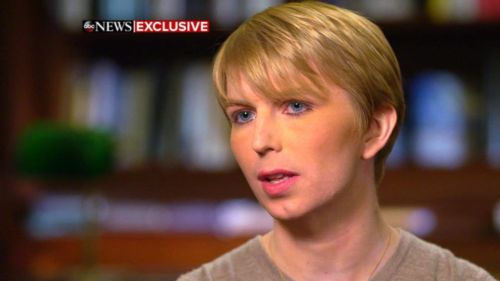
The Lesson Of The Harvard-Chelsea Manning Fiasco

I often point out to my ethics classes that when the ethics alarms don’t sound, one can make decisions that result in ethics zugswang, which is the hopeless bind where there are no ethical solutions, only unethical ones. Then the only practical objective left is damage control: determine which course  is the least unethical. An ethical result is no longer possible. It was precluded forever by the original ethics failure.

I can’t think of a better example of this process than the Kennedy School’s botched appointment of Chelsea Manning as a ” visiting fellow.” It was an incompetent, foolish, reckless decision that a half-wit should have known would cause an ugly and unnecessary controversy. What was the school thinking?

I can only speculate. Either the school was looking for “buzz’—it got that all right— , or was trying particularly odious progressive virtue-signaling to the anti-war crowd that still hangs out around Harvard Square clutching their love beads, or most indefensible of all, was giving a gratuitous nod to the current transgender fad. Whichever it was of these, it should have been obvious that the choice was a terrible idea, and it says a lot about the school’s leadership and procedures that nobody in a position of influence shouted, “Wait, are you kidding? Chelsea Manning?  She’s a convict and a felon who leaked secret information to enemies of the United States!” Manning, as I noted in the Morning Warm-Up covering the story, isn’t a scholar, a deep thinker, or a stable or a trustworthy individual. Selecting her was bound to upset other more qualified teachers at the school as well as any American not partial to traitors, and it did. It also devalued every previous fellow at the Kennedy School, by demonstrating that being a Kennedy School fellow wasn’t a credential signifying special talent or admirable qualities. Not if Chelsea Manning qualified, it wasn’t.

The fury over the appointment erupted so vigorously in public, and, I suspect, even more vigorously behind the ivy-covered doors in Cambridge (my mother spent most of her working life at the University, and ended it as Asst. Dean of Housing: the Marshalls know how Harvard works), that the reversal wasn’t as big a surprise to me as it seems to be to some. Nonetheless, the criticism levied by many has justification. Wrote Jonathan Turley, for example,

“The only thing worse than Harvard’s Kennedy School of Government appointing Chelsea Manning as fellow was the school’s withdraw of the fellowship…My concerns are not really focused on Manning but the danger of universities tailoring its academic programs to public opinion. I have written extensively about the hostile environment for conservative speakers on campus. Invitations have been withdrawn due to opposition groups and protests. This case is even more concerning because it was a formal invitation to join the program as a fellow. The invitation and then the withdrawal leave total confusion as to the purpose and academic content of these fellowship positions. Harvard appears to have carefully avoided any principled ground in both the appointment and the withdrawal.”

Continue reading

My Verizon WiFi Ethics Dilemma

ProEthics (and our home, where it resides) is in Alexandria City, in Northern Virginia. We are dependent on the internet, but cannot get the high-speed variety, Fios, from Verizon, our provider. This has significant business and personal consequences: for one thing, it means that I can’t load video commentary on Ethics Alarms as I have wanted to do for years. For another, Verizon’s DSL service, at least mine, sucks. Lately it has been kicking out many times every day, sometimes after only being up for a few minutes.

We have called Verizon many, many times, in various states for fury,  to ask when  Fios will be available. The answers are scripted and vague, made to sound like the service will be available imminently. Nothing changes, however. Alexandria isn’t Hooterville: there are many businesses, and the residents would be a prime market for high-speed internet.

What’s going on here? Continue reading