Today is Super Bowl Sunday, as you know unless you live in a cave. I quit watching all football after the CTE scandal made it clear to me that this is a deadly sport and that the people who make money by paying young men millions to cripple themselves are ethics villains who deserve to spend eternity standing in a boiling lake of guacamole.
I was never that jazzed about football as a game anyway, and knew that the NFL was the most ethics-free sports organization in existence even as the NCAA worked hard to catch up. In addition to being a mob game on the field and off, it requires no intellectual engagement at all and the values it teaches are few. Later today I will post on Chuck Klosterman’s recent claims that the game is doomed, to which I will only note now by writing, “Good!”
I like all games and most sports. I believe that there are seven special games that everyone should learn to play because they all require special skills that are useful in other spheres of life, and teach ethical values as well. Those are, in no special order,
Go
Poker
Bridge
Diplomacy
Dungeons and Dragons
Scrabble, and
Chess
I will save what each offers us ethically for another essay or six. However the last, which arguably should be first, is the immediate topic here. They used to teach chess in Soviet schools; perhaps they do still. It’s a wise policy. If Americans spent the time they spend watching football playing chess instead, this would be a far healthier country with infinitely stronger critical thinking and life competence skills.
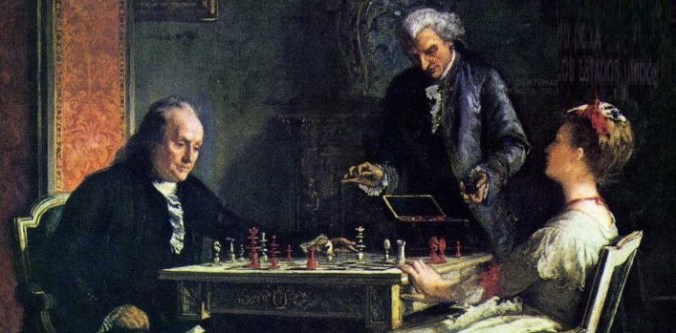
I recently learned that our smartest, quirkiest and most versatile Founder, Benjamin Franklin, was a chess enthusiast. Ben was the ultimate polymath and didn’t have the time or dedication to master a single pursuit that is necessary to become a great chess player. Heck, I don’t understand how he had time and energy to accomplish 25% of what he did in his life. Nevertheless, Ben did take the time to write down his thoughts about the game in the following essay, in which he proposes principles of chess ethics.
I offer it to you now as an alternative to gathering black marks on your soul by supporting the NFL and its sponsors today. Here’s Ben…
The first part of the title above ought to be self-evident. Far too many universities operate as sports franchises with a few academic courses offered on the side. This, despite the fact that most athletic departments lose money despite TV revenue, ticket sales, etc. Even average (by intercollegiate standards) athletes are likely to get a full ride: tuition and fees, room and board.
And that’s not counting NIL (name, image, and likeness) deals which often run well over $100,000 a year for even average players in a major sport at a Division I school. High-end programs in football and basketball get bowl games or in-season (or pre-season) trips to tournaments in exotic locales. The best student physicist at the school might get travel money to a conference or something like that, but there’s not going to be a lot of hanging out on the beach on someone else’s dime, much less a tuition waiver and a six-figure income.
NIL also means that at least some elite athletes in football and basketball are shopping their services to the highest bidder. Every time a star player enters the transfer portal and moves to a different university, the accusations pour forth from the new school’s competitors that they’re “buying players.” Some of those allegations are simply sour grapes; many (most?) aren’t. Of course, the practice has existed under the table for decades, but NIL has certainly exacerbated the problem.
Then, there are the tutors, the luxurious housing, and other forms of special treatment. A goodly number of athletes, of course, wouldn’t be accepted at Duke or Stanford, or even at the University of Northern South Dakota at Hoople (extra credit if you get that reference), if they didn’t have a jump-shot or some equivalent skill in another sport.
Bolenciecwcz, the dim-witted football star of James Thurber’s “University Days” (1933) who finally is able to name a mode of transportation after professor and fellow students alike prompt him to say “train,” is a satirical construction, of course, but satire works only if there is the ring of truth. And I suspect the scandal at the University of North Carolina a few years back is more likely the tip of the iceberg than an anomaly.
I’ve had a number of students in my classes who actually were the “scholar-athletes” the NCAA pretends anyone with an athletic “scholarship” is. There was the multi-year all-conference tennis player who was also a fine student and an excellent actress (she got a graduate degree and now works for one of the country’s leading regional theatres), the middle-distance runner who missed the Olympic team by a fraction of a second and did quite well in my non-major class, the starting safety on the football team who asked for permission to miss class because he would be interviewing with one of the nation’s top med schools (he got in).
But there are plenty of examples in the other direction, as well. There was the basketball player who couldn’t write a coherent paragraph about literally anything. There was the football player who complained about his grade in an acting course because he had nothing in common with the character I’d given him in a scene; the character was complaining to his professor about his grade. (Sigh.) Another football player whispered disgusting sexual advances to one of the women in an acting class when I was working with other students. (He came to regret that.)
My… erm… “favorite,” though, was the star football player who missed about a half dozen more classes than department policy allowed. There were three hour-exams in the course: he got a D on one and failed the other two. He didn’t write either of the required short papers, and he got something like a 31 on the final exam. He subsequently showed up at my office, position coach in tow, to protest his failing grade because one (yes, just one) of his absences should have been excused. His excuse: he was in court… being convicted of an E felony. (Sigh.)
All that said, it would be easy to make a case that athletes, especially those in sports other than football and basketball, are the most exploited students on campus. Unless, like LSU gymnast Olivia Dunne, what you’re selling is that you look great in a bikini or a miniskirt, you’re not going to get as good an NIL deal as the backup quarterback does. Plus, most sports require that you’ll play more than a dozen or so games; baseball and softball, for example, generally have about 50 games in a regular season. That means, among other things, more road games, and that means more travel, more time out of class, etc.
[I was going to write a brand new post pointing out why watching the Super Bowl (and the ads of the NFL’s unethical accessories) was unconscionable, but then I remembered how many times I’ve written similar pieces, and constantly going over the same unethical territory is eating away at my joie de vie—“my twinkle,” as Cosmo Kramer would say. Cant have that, so here is a previous post on the theme from 2019.
It is remarkable to me that the near death of Damar Hamlin mid game less than two months ago has essentially vanished from the sports pages aftera brief flurry of “why do we cheer on this mayhem?” pieces before the NFL’s play-offs started. The big concern seems to be whether President Biden is snubbing Fox News be refusing to give a mid-game Super Bowl interview (which is supposedly a “tradition”) or Fox News is snubbing President Biden. In any event Joe’s not being interviewed, though a chat with someone who is cognitively damaged during the game might do some good by reminding viewers what they are cheering.]
Let me say something good about the New York Times: not all of it’s editorials are repetitious attacks on President Trump, just most of them. Last week editorial board member Alex Kinsbury persuaded his colleague to let him used the space for an opinion both ethical and irrefutable. A quick summary: Football is maiming its players, the NFL doesn’t care, and if you watch the Super Bowl and support its sponsors, you’re complicit.
But then you knew that, right? At least you know it if you’re been coming here for any length of time.
Recalling a hard hit on Patriots star Rob Gronkowski, Kinsbury writes, “As the sound of the hit faded into a commercial break, I realized with absolute certainty that I couldn’t watch football anymore. There aren’t enough yards to gain or Super Bowl rings to win that are worth the cost.”
True. What took you so long? He continues by reviewing the well-publicized data:
The first research into the link between football and traumatic brain injury was published in 2005. Since then, the science has become impossible to ignore. In 2017, The Journal of the American Medical Association published the results of the autopsies of the brains of 111 deceased former N.F.L. players, whose relatives gave their bodies up for study. The group was not a random sample, yet 110 showed signs of chronic traumatic encephalopathy, or C.T.E., a degenerative brain disease linked to concussions. Research published in November estimated that a minimum of 10 percent of all professional football players would develop C.T.E. at some point in their lives.
10% is wishful thinking, even for the players who can still think. Continue reading →
Kurt Streeter, the New York Times’ uber-woke, progressive sports columnist, had the nerve to post a column this week headlined, “We’re All Complicit in the N.F.L.’s Violent Spectacle.”Uh-uh, no sir, not me, baby. I have always found pro football repulsive and barbaric, and for many years have worked here and elsewhere to ensure that the NFL is accountable for crippling and killing its players for profit, which is what it does. A single player for unknown reasons goes into cardiac arrest mid-game this week, and suddenly people are discovering what a sick, unethical sport professional football is? “My prayer, aside from seeing Hamlin leave that Cincinnati hospital able to live a fruitful, productive life, is that we never watch a single snap of an N.F.L. game the same way again,” Streeter intones. Oh Kurt, you’re so sensitive. You won’t watch it the “same way,” but you’ll keep earning money covering it, won’t you? Continue reading →
The 2022 baseball season starts tomorrow; the Boston Red Sox will play the New York Yankees. This will elevate my mood and lessen my stress until the ned of October, absent unforeseen disasters. It will also provide yet undetermined fodder for ethics posts, for baseball is and ever has been an ethics cornucopia with relevance to the rest of the culture and society. I’ve often considered starting a baseball ethics blog—there isn’t one— but even fewer people would read that blog than this one.
1. The Times spreads misinformation about the Wuhan virus while accusing a doctor of spreading misinformation about the Wuhan virus. Apparently the news media fearmongering about the pandemic will never end. In a front page article earlier this week, the Times told readers that the virus and its close family members have “now killed nearly one million people in the United States.” That’s an inflated figure, how much so we may never know. It does not distinguish between those who died from the virus and those who died with the virus” to the CDC, which set out to maximize fear of the infection so the government could take liberty-squelching measures and get away with it. The next day, the Times had another front page article that provided clues to the previous article’s deliberate deceit: “Covid and Diabetes, Colliding in a Public Health Train Wreck.“ A married couple both got the virus; the woman recovered easily, the man is now confined to a wheelchair. He has diabetes, and the article tells us ” several studiessuggestthat 30 to 40 percent of all coronavirus deaths in the United States have occurred among people with diabetes.” Other studies find that that being obese my triple the likelihood of death during the pandemic. Here is the photo from the article:
I find the comparison with how the news media handled AIDs in the 80s fascinating. AID crippled the immune system, and sufferers were often killed by opportunistic infections that they would have fought off before acquiring the HIV virus. Yet these people were always described as AID victims, and their names added to the list of those who had perished “from” AIDS. But when a Wuhan virus infection adds to the health risks of diabetes or obesity, it’s the virus that gets credit for the death—because that’s what the the new media wants the public to fear. Continue reading →
Only the soothing tones of Johnny Nash could calm me down after this morning’s ordeal, and it hasn’t worked yet.
I set out with my wife to get her to a rather urgent doctor’s appointment at an office we had never been to before. I should have been forewarned knowing it was in Manassas (those who know Northern Virginia know what I mean.)To make a long, horrible story short, we never got there. The exits on Route 66 suddely skipped five numbers. There was a sign for Exit 47 A, which was also for 47 B without saying so. The construction everywhere made navigation impossible. After missing the right exit, detours and construction mad it seemingly impossible to get on 66 going the other way, The Google map directions were wrong. The GPS installed in the car refused to take the street number, and dumped us in no-man’s land. Naturally, everyone we talked to at the doctor’s office professed ignorance at how to get there. After wandering in the wilderness for two hours, we gave up. Then the last staffer at the doctor’s office said, “Oh, when you come back, don’t use Exit 47 like all the directions say. Use 44. That takes you right to our door and avoids all the construction.”
NOW you tell me that?
The over-arching goal of ethics is to make life easier and more pleasant for everyone else. If you work or live in a locale that is difficult to get to or find the first time, you warn people.
1. Welcome “Impeachment or Removal Plan U”! Well, not really welcome. Not really a removal plan either. Plan U is based on Section 3 of the Fourteenth Amendment, which was being thrown around as a way to punish Senator Hawley and Cruz for doing what Democrats had done every time this century a Republican had won the Presidency: challenge the electoral vote. When Republicans do it, you see, it’s an insurrection. Then teh second that word escaped their lips, coup-minded Democrats hit themselves in the forehead with teh palm of their hands, “I could have had a V-8!” style, and said, “Wait a minute! How did we let this get by us when we were trying to devise a way to get rid of Trump without winning an election! It was there all the time!” Then, choosing to ignore the fact that you can’t “get rid of” someone who’s already gone, this became the latest of 21—yes 21!—bogus anti-Trump plans. (I haven’t added it to the list yet. Give me a break.)
Let U stand for “Unbelievable!”
Section 3 provides:
“No person shall be a Senator or Representative in Congress, or elector of President and Vice President, or hold any office, civil or military, under the United States, or under any state, who, having previously taken an oath, as a member of Congress, or as an officer of the United States, or as a member of any state legislature, or as an executive or judicial officer of any state, to support the Constitution of the United States, shall have engaged in insurrection or rebellion against the same, or given aid or comfort to the enemies thereof. But Congress may by a vote of two-thirds of each House, remove such disability.”
Law profs Seth Tillman and Josh Blackman soberly analyze the theory here, saying in conclusion,
“…it is not clear that the House managers seek to disqualify Trump under the Impeachment Disqualification Clause, as well as under Section 3. The sole article of impeachment is opaque on this point. It references Section 3, but we think it is only referenced in the context of efforts to define a substantive impeachable offense. We expect that President Trump’s counsel will argue that the text of the House’s single article of impeachment does not give him fair notice that he faces Section 3 disqualification. Once again, the House’s rushed drafting may determine the fate of the Senate impeachment trial.”
That. and the fact that the impeachment was based on literally nothing.
2. Now this is a weird ethics movie…“The Killing of a Scared Deer, the 2017 film now on Netflix, raises a “Sophie’s Choice”-style ethical dilemma with solution that looks ridiculous but has at least surface validity if you can accept the premise: the character who has to make the choice is dealing with some kind of a curse.
3. Is it incompetent to employ a strategy that nobody knew was incompetent? Statistical analytics now show that the traditional football strategy of punting usually makes no sense. Now, college and professional teams are going for a first down when once they would have kicked the ball away.
Punting has become far less prevalent in recent years. NFL teams punted an average of 3.7 times per game during the 2020 regular season, the lowest figure in recorded pro football history. Teams averaged 4.8 punts per game as recently as 2017, a rate that had held more or less steady since the mid-1980s but has declined in each of the last four seasons….The sudden decrease in punting comes over a decade after the football analytics community began decrying the punt as a counterproductive strategy, particularly in short-yardage situations near midfield or when trailing late in a close game. It doesn’t take much number-crunching to realize that if the average offense gains 5.6 yards per play (the 2020 rate), not only should a team be able to pick up a yard or 2 on fourth down, but it should also be wary of gifting the ball to an offense capable of marching right back down the field 5.6 yards at a time.
The traditions and conventional wisdom in sports and other activities, wrong, counter-productive or silly though they may be, don’t indicate incompetence until data, changed conditions or experience indicate that they don’t work. Now it seems obvious that punting is usually foolish, just as baseball finally learned that sacrifice bunts were dumb except in very special situations. But when a culture accepts conventional wisdom and it it is embedded in that culture, one cannot call it incompetence to stick with tradition, unless and until there is access to information proving the accepted practice to be folly.
4. A reminder: Yahoo! and other news sources have reported that “Over 408,000 Americans have died of COVID-19 as of Thursday.” That’s false. It is the essence of fake news. As Ethics Alarms had noted repeatedly, over 408,000 Americans may have died WITH the virus, but there is no question that they all did not die OF the virus. I am still waiting for a well-publicized estimate of how many of those deaths were not super-seniors, cancer patients, or others who may well have died anyway. This is something we have a right to know.
5. A plea for a double standard from Joe. Associated Press reporter Zeke Miller asked President Biden if the vaccination goal was “high enough,” since “that’s basically where the U.S. is right now.” Biden responded with pique, although he did not call Miller a pony-soldier, saying, “When I announced it you all said it wasn’t possible. Come on, give me a break, man.” It’s a fair request, but if there was ever an instance when any journalist from a non-conservative news organization gave Biden’s predecessor a break, please refresh my memory. I can’t think of one. Besides, Biden is already getting one ” break” after another, as Mediate notes in a recent post titled, “Media Begins Biden Presidency With Overt Fawning and Flattery.”
6. Hank Aaron has died. The legitimate baseball career home run champ (I do not count Barry Bonds) was 86. He represented the very best of baseball ethics on and off the field throughout his career unlike the icon whose homer total he bested (Babe Ruth had no peer as a player, but had the ethics of a ten-year-old his whole life), and the miscreant who passed him by cheating, Bonds. The Hammer was always being over-shadowed by someone: Willy Mays, a contemporary, was more gifted and charismatic; Ernie Banks was more lovable, Roberto Clemente was never had a chance to grow old. Henry Aaron just did his job every day, seldom missing a game due to injury, leading the National League in various seasons in batting average, homers,runs, hits and RBI. Aaron only won one Most Valuable Player Award (in 1957, when his Braves won the pennant), but over his 23 year career, he proved more valuable than almost all of his contemporaries.
[Notice of Correction: I originally wrote that Hank never won an an MVP. Thanks to LoSonnambulo for the correction.]
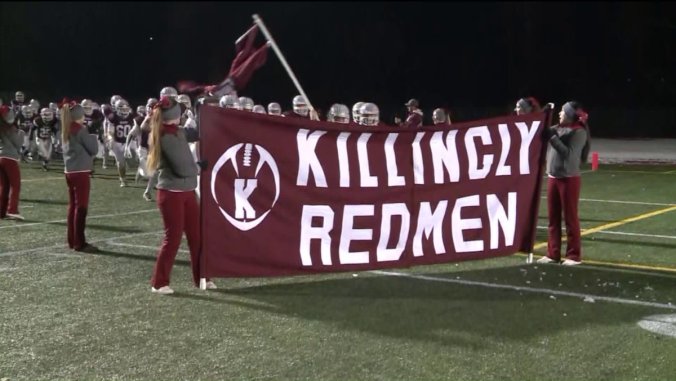
In Killingly, Connecticut, the local high school’s mascot has long been a Plains Indian, and its athletic teams have been called the Redmen. Then, in 2019, the Nipmuc Tribal Council across the state border in Massachusetts complained that the name and mascott were offensive. [There’s an interesting discussion of the association of the color red with Native Americans here.] Once the complaint was made, other Native American groups decided, “Yeah! We’re offended too!” along with usual gang of offended-by -proxy political correctness zealots. (Does this all sound familiar? It should.)
As typically happens in such situations, the people in charge decided to take the path of least resistance—this is how political correctness and expression suppression take hold, as you know–and in July, the Killingly school board voted to eliminate “Redmen” and the mascot and change it to “Redhawks.” It’s just a name, right?
Well, not this time. The uproar was so great that restoring “Redmen” became an election issue. Supporters of the old name and mascot took control of the school board in the November 2019 election. However, while the new members had enough votes to eliminate the “Redhawks” name, they couldn’t muster enough to restore “Redmen.” “There is no mascot at this point,” said Craig Hanford, the new Republican board chairman, and he sent the dispute to a committee.
Fans of the football team, it was reported, shouted “Go Redmen!” during games during the rest of the season, wore Redmen jerseys and hats, and told anyone who asked that there was nothing racist about the name. One fan wore the grammatically perplexing sweatshirt, “Born a Redmen, Raised a Redmen, Will Die a Redmen.” Continue reading →
The Denver Bronchos last second win over the San Diego Chargers last weekend was one more game decided by a controversial pass interference call. That rule, with which the NFL has been tinkering and which is now complicated by a video review system, is becoming increasingly controversial this season. Wrote Times football columnist Ben Shpiegel,
[E]very week across the N.F.L.’s vast empire one player interferes with another before a pass arrives — and goes unpunished for it. In these moments, when yellow penalty flags remain lodged in officials’ pockets, aggrieved coaches weigh emotion against reason: Do they challenge the non-call, hoping that by sheer luck it will be overruled by the new video review mechanism? Or do they stew on the sideline, red flag pocketed, and resign themselves to the unlikelihood of a reversal?…After 12 weeks of wasted challenges and lost timeouts, of inconsistency and obfuscation, the league’s erratic application of the defined standard for overturning an on-field decision — “clear and obvious visual evidence” — has made the football masses yearn for simpler times, such as when no one knew what constituted a catch. Over all, through Week 12, 15 of 77 reviews of pass interference were overturned, though nearly half of those reversals — seven of 15 — were initiated by the officials in the replay booth, who are responsible for challenges in the last two minutes of the half… The questionable calls have dented confidence in a mechanism ostensibly intended to restore it after a mess of an N.F.C. championship game, in which Rams cornerback Nickell Robey-Coleman, without consequence, walloped Saints receiver Tommylee Lewis before the ball arrived.
The dilemma isn’t restricted to football. In any sport where an official’s judgment plays a big role in game results, the interjection of technology and the universal broadcast of games has created an integrity crisis. Before multiple camera angles and the possibility of replays, umpires and referees could blow a crucial call and nobody would be the wiser, or at least would be able to prove that the game was decided by a non-player’s botch. Now, bad calls are there, on a big screen, then the internet, for all to see over and over. The Luddite argument that missed calls are the “human element” and “part of the game” made sense when there was nothing to be done about it. It is ridiculous now. Continue reading →
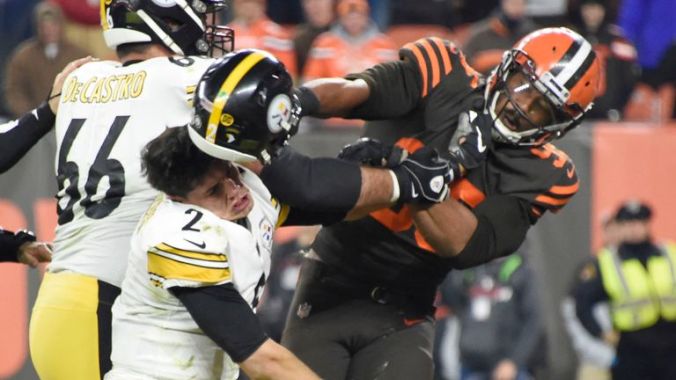
As if the game itself, legally played, weren’t enough to cause its players brain damage, in a Thursday Night televised pro football game this week Cleveland Browns defensive end Myles Garrett ripped the helmet off Pittsburgh Steelers quarterback Mason Rudolph and clubbed him in the head with it. The league acted swiftly, suspending Garrett for the rest of this season, including the playoffs should the Browns make them, and reinstatement is by no means assured.
Good.
This is the longest suspension for an on-field incident in NFL history. I can find no fault with Garrett’s apology, Level One on the Apology Scale, issued before the sentence came down. He said, Continue reading →




 Ethics Alarms