Brain Freeze Ethics and Rick Perry

In a moment of awkwardness that is sure to get as much attention and YouTube views as the donkey bray that knocked Howard Dean out of the 2004 presidential race, Gov. Rick Perry insisted in last night’s GOP candidates debate that it was crucial to eliminate three government agencies (he meant “departments”) and couldn’t come up with the third. “Oops,’ he said sheepishly, after he had done a credible impression of Monty Python’s “Spanish Inquisition,” which could never quite recall all of their “methods.”

Perry’s brain freeze isn’t likely to improve his standing, though anyone inclined to be fair should be wary of declaring a sudden attack of aphasia conclusive proof that Perry is unqualified to be president: just try re-capturing that elusive word or name on the tip of your tongue when you are in front of an audience, not to mention national television. It has happened to me more than once, and I suspect that anyone who does much public speaking or performing watched Perry’s crash last night with instant horrible memories of similar experiences best forgotten.

But this morning on CNN, Perry’s response to a question about his flub did disqualify him for national office. He was obviously appearing on the morning news show for damage control, and planned what his response would be to the inevitable question. And what was Perry’s plan?

Duck responsibility, and blame everyone else.

“Well, I wasn’t getting any help from either side…” were the first words out of the Governor’s mouth. Continue reading

Ethics Hero: Robert Downey, Jr.

Superhero on the outside, Ethics Hero on the inside.

Show business Ethics Heroes are about as rare as credible presidential candidates; after all, Hollywood is one of two environments where the ethical culture is even more warped and cynical than Washington, D.C. (The other: the Columbia drug cartels.) Yet a genuine Ethics Hero emerged at the 25th annual American Cinematheque Award gala, when honoree Robert Downey, Jr., now a major star and industry power player, threw his prestige and influence behind a genuine industry pariah, Mel Gibson, in an act of kindness, gratitude, and reciprocity.

After Downey accepted his award before a cheering crowd of important performers and artists, he unexpectedly devoted his moment in the spotlight to recall how Mel Gibson, when Downey’s career had been devastated by habitual substance abuse and Gibson was a megastar, constantly supported him, encouraged him and refused to give up on him, though the Hollywood community had. The “Iron Man” star explained how Gibson, in 2003, gave Downey a starring role in “The Singing Detective,”  which had been developed for Gibson himself, because nobody else would give the troubled actor another chance.  Gibson even paid the insurance premiums for Downey, because the studio would not accept the risk of hiring him, given his history of drug addiction and legal problems. All  Mel asked in return, Downey recalled, was that Downey resolve to help out the next actor who had hit bottom and had no friends in the Town Without Pity. Continue reading

Major League Baseball, Forgivability, and List Ethics

Unforgivable?*

Bleacher Reports is an enjoyable sports website, and it gives opportunities to aspiring writers and bloggers, some of whom are quite talented.  In addition to typical opinion pieces and reporting, the site has a fondness for lists, often trivial to the extreme, like “The 50 Ugliest Athletes of All Time.” The titles are all misnomers, because there is almost never any criteria given for the choices or their relative ranking. An accurate title would be, “The Fifty Athletes I Think Are The Ugliest.”  And of course, who cares? (Don Mossi, by the way, was the ugliest athlete ever, no matter what anybody says.)

A recent list, however did bother me. It is called “The Fifty Most Unforgivable Acts in Baseball History,“ and much of the problem with it lies in the title itself. If you are going to write about history, there is a duty perform diligent research, even for a silly online list. Misrepresentations online have a large probability of misleading people.  The title is a misrepresentation, like “The 50 Ugliest Athletes,” but unlike that list, there is some harm done. The list isn’t close to complete; it isn’t consistent; it isn’t well-researched. I’d bet that the author, Robert Knapel, wrote it off the top of his head.  Anyone who looked at the list and assumed, as the author represents, that these are truly the low points—“the dark side,” as the author puts it—of major league baseball would be seriously misinformed.

There are unequivocally, probably universally recognized incidents and events that are infinitely worse that most of the items on the list.  Just a  few samples: Continue reading

Ethics Hero: Ameneh Bahrami

Ameneh Bahrami, now, and then

Ameneh Bahrami, the Iranian woman whom a spurned suitor blinded and hideously disfigured with acid,  had her long-awaited opportunity for both revenge and culturally-sanctioned justice today.  She watched a doctor prepare to put several drops of acid in one of Majid Movahedi’s eyes as his court-ordered punishment for maiming her. Then, at the last moment, she waived her right to have him blinded, as Movahedi, who had repeatedly asked her to marry him before responding to her rejections by throwing acid the young woman’s face, wept in gratitude.

The story of Banrani’s insistence on the full retribution available to her under Islamic law had spurred human rights protests around the globe. In the end, with all of Iran watching on live television, she decided on mercy instead of revenge. Continue reading

Custer, Gettysburg, and the Seven Enabling Virtues

Sometimes the Enabling Virtues will save an army, and sometimes they’ll get you killed.

July 3, 1863 was the date of Pickett’s Charge, when Confederate General Robert E. Lee ordered a desperate Napoleonic advance against the Union line at Gettysburg in what has come to be a cautionary tale in human bravery and military hubris. The same day marked the zenith of the career of George Armstrong Custer, the head-strong, dashing cavalry officer who would later achieve both martyrdom and infamy as the unwitting architect of the massacre known as Custer’s Last Stand.

Custer’s heroics on the decisive final day of the Battle of Gettysburg teach their own lessons, historical and ethical. Since the East Calvary Field battle has been thoroughly overshadowed by the tragedy of Pickett’s Charge, it is little known and seldom mentioned. Yet the truth is that the battle, the war, and the United States as we know it may well have been saved that day by none other than undisciplined, reckless George Armstrong Custer. Continue reading

Newt Gingrich: Ethics Victim…Ethics Miscreant…Walking, Talking Ethics Lesson

The Ethics Lesson

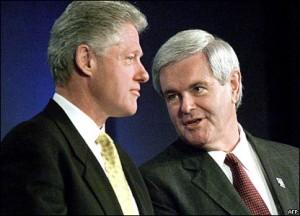
I’m glad Newt Gingrich is in the presidential race, however foolishly and futilely. He is perhaps the perfect illustration of how a potential political leader’s private personal conduct is not only relevant to assessing his fitness to lead, but predictive of it. What makes Newt especially useful in this regard is that he is a Republican, and all the Democrats who are going to be sneering at his candidacy will have to square their attacks on his character with their indignant claims in 1998 that Bill Clinton’s adultery, sexual harassment and lies were irrelevant to his leadership—and they weren’t truly private or personal.  Similarly, Newt will be helpful to some of my ethically-addled trial lawyer friends who have argued that John Edwards is still a trustworthy lawyer, despite his betrayals of his dying wife, his family, his supporters and his party.

Of course private conduct is relevant to judging a leader, especially when private conduct shows an individual to be dishonest, disloyal, cowardly, ruthless, selfish and cruel—like Newt. Cheating on two wives and leaving both of them when they were battling health crises isn’t a mistake, or a coincidence, or a misunderstanding; it is a pattern, and a symptom. You can’t trust Newt. You can’t rely on Newt. You can’t believe Newt. Ask his ex-wives, and eventually, I am quite certain, his current one.

Today conservative talk radio is abuzz with Gingrich’s frenzied efforts to sooth the conservative faithful after he attacked Rep. Paul Ryan’s budget reforms over the weekend. What??? You mean Newt Gingrich stabbed a political ally and  fellow party stalwart in the back without warning? Who could have seen that coming? Oh, only everybody: You can’t trust Newt. You can’t rely on Newt. You can’t believe Newt. Ask his ex-wives. Continue reading

Manny Post Script: The Signature of a Jerk

Manny Ramirez, the now-retired ex-baseball slugger, provoked the predictable responses from the media and fellow players in the wake of his sudden retirement after being notified that he would be the first major league player to face a 100 game suspension for failing a mandated PED test (that’s “performance enhancing drugs” for all of you who don’t know who Barry Bonds is), because no player had ever been caught TWICE before.

Everyone was in agreement that this meant: Continue reading

Manny Ramirez’s Perfect Exit

The most unethical baseball player since the Black Sox

From  Major League Baseball:

“Major League Baseball recently notified Manny Ramirez of an issue under Major League Baseball’s Joint Drug Prevention and Treatment Program. Rather than continue with the process under the Program, Ramirez has informed MLB that he is retiring as an active player. If Ramirez seeks reinstatement in the future, the process under the Drug Program will be completed. MLB will not have any further comment on this matter.”

Perfect. Perfect.

Manny Ramirez was an impressively talented baseball player with discipline of an untrained Irish Setter, and the selfishness of a six-year-old. Throughout his career, he was a textbook example of the management fallacy known as the star principle, in which an extremely talented individual is allowed to break the rules and defy an organization’s culture in direct proportion to his perceived value. Continue reading

Unethical Quote of the Month: Newt Gingrich

“There’s no question at times of my life, partially driven by how passionately I felt about this country, that I worked far too hard and things happened in my life that were not appropriate. And what I can tell you is that when I did things that were wrong, I wasn’t trapped in situation ethics, I was doing things that were wrong, and yet, I was doing them. I found that I felt compelled to seek God’s forgiveness. Not God’s understanding, but God’s forgiveness. I do believe in a forgiving God. And I think most people, deep down in their hearts hope there’s a forgiving God.”

Former Speaker Newt Gingrich, preparing for a presidential run by attempting to explain and apologize for his serial marital betrayals, the most spectacular of which was visiting his first wife while she was in the hospital recovering from cancer surgery to announce that he was divorcing her to marry his mistress. Then he cheated on his second wife, the former mistress, with a member of his staff. He ditched Mistress #1, Wife #2, for Mistress #2, who became Wife #3. This is why he needs a forgiving God, or at least a forgiving electorate.

Newt’s defense now is that he felt so passionately about his country that it caused him to dump his cancer stricken wife (so much for all that “in sickness or in health” stuff), and later, while he was leading a party that was making the case that a U.S. President shouldn’t be having on-the-job sexual encounters with interns, using his staff and appointees to cover it up, and lying about it under oath in court, to commence a second extra-marital affair of his own. This, naturally, helped let President Clinton wiggle of his well-earned impeachment hook, and also helped cement the socially destructive public perception that 1) everyone cheats on their spouses, so it’s okay, and 2) you can’t trust any of our elected leaders.

Thanks for nothing, Newt.

God is welcome to forgive you; I won’t. You are obviously untrustworthy. Once cheating on a spouse may be a mistake; cheating on a second spouse is a behavior pattern. If a politician who likes to invoke God will lie to and betray two women who he swore, before God, to take “’til death us do part,” not to mention his children, I see no reason to assume that he won’t betray voters who has never met, loved, or lived with.

God’s forgiveness is irrelevant to the central issue of whether New Gingrich has the reliability of character and core values to justify entrusting him with great power. As his self-serving quote demonstrates, he does not.

But good luck with God, Newt.


The Prince, The Sex Offender, and the Ethics of Friendship

Prince Andrew with one of his friend's victims in 2001

The ethics of friendship is complicated.

President Bush claimed to be friends with Vladimir Putin. F.D.R. once said that Josef Stalin was his friend. President Obama was famously friendly with dubious characters like Rev. Wright and William Ayres.

History is full of heroes and near-heroes who had infamous friends, though the extent of the often friendship is difficult to know. Sammy Davis, Jr. and Elvis were supposedly buddies with Richard Nixon. Bill and Hillary Clinton were close friends with Dick Morris. Wyatt Earp was a life-long friend of “Doc” Holliday; Andrew Jackson may have been friends with pirate Jean Lafitte, who helped him win the Battle of New Orleans. We simultaneously celebrate loyal friends, and yet we also judge people by the company they keep. Should we condemn individuals who have friends with serious character flaws or a history of unsavory acts? Or should we admire them for sticking with their friends when everyone else is turning against them? Continue reading