Re: Obama’s NSA Speech—Ralph Lopez Is Right. So Was James Otis. So Why Aren’t More Liberals, Progressives And Democrats…Wait, Didn’t I Just Write This?

James-Otis-Quotes-1A political writer from the alternative media wrote a clear, well-researched, pretty much irrefutable 0p-ed for the Digital Journal , crystallizing an issue that should have been obvious all along. The NSA’s incursions on the privacy of U.S. citizens are a bright line violation of the Fourth Amendment, one of the bulwarks of American individual rights. Yesterday, President Obama rationalized and embraced those unconstitutional acts and policies. The writer, Ralph Lopez, is angry and outraged. Why isn’t everybody?

In particular, why isn’t the very same group that compared the less obtrusive Patriot Act measures imposed by the Bush administration to “1984” and fascist regimes screaming bloody murder? That group would be, in case you’ve forgotten, liberals, progressives and Democrats. The technical terms for this are “hypocrisy,” “absence of integrity,” “dishonesty,” “blind loyalty,” “misplaced priorities,” and “foolish.” The technical term for the consistent Republicans who support the NSA’s over-reach is “wrong.”

Unfortunately, Lopez’s piece is burdened by a ridiculous title (“Should Obama be tried for treason after his NSA speech on Friday?,” indicating that either Lopez or his headline writer has been infected by the signature delusion of this President and his enablers—that giving a speech is the same as doing something), but its main points are as solid as granite:

  • “The language of the amendment, which embodies the sentiment in Patriot speeches of the American Revolution that “a man’s house is his castle,” is beautifully crystalline in clarity as all the Founding Fathers’ declarations were. The Fourth Amendment guarantees:

“The right of the people to be secure in their persons, houses, papers, and effects, against unreasonable searches and seizures, shall not be violated, and no Warrants shall issue, but upon probable cause, supported by Oath or affirmation, and particularly describing the place to be searched, and the persons or things to be seized.”

“In modern times, electronic communications such as emails and telephone calls have been held to be an extension of a person’s “papers and effects,” from a time when the only non-verbal communication was written letters, i.e. “papers.” This means, quite simply, that all private communications of private citizens are none of the government’s damned business, unless it can show “probable cause” that they involve a crime, and the government can prove it to a judge. In the real world judges already tend to give wide latitude to police and prosecutors who are convinced they have “probable cause,” a fairly low standard which might consist of a mere hunch based on the most circumstantial of evidence, like a man rooting around in a dumpster where, the day before, the cops found a cache of drugs.” 

In his speech yesterday, the President said, …in an extraordinarily difficult job, one in which actions are second-guessed, success is unreported and failure can be catastrophic, the men and women of the intelligence community, including the NSA, consistently follow protocols designed to protect the privacy of ordinary people. They’re not abusing authorities in order to listen to your private phone calls or read your emails.”

Really? They are collecting private data that can allow them to do that when and if they choose, and that is a violation of the Fourth Amendment. Continue reading
New York’s Stop And Frisk Ethics Train Wreck

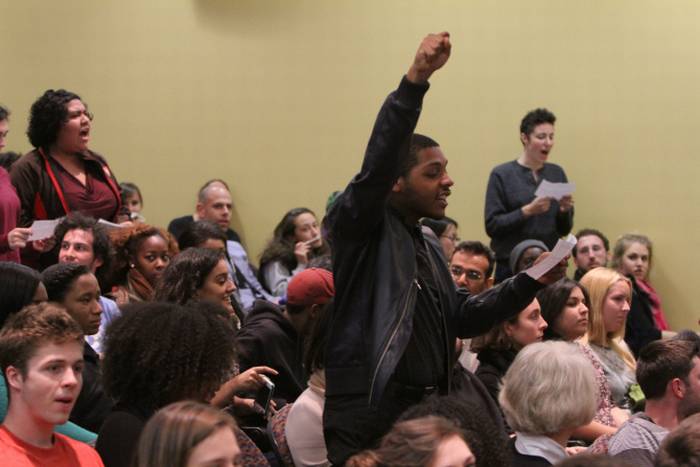
Free speech, Brown University style.

Free speech, Brown University style.

On the CBS Tom Selleck drama “Blue Bloods,” fictional New York police commissioner Ryan (Selleck) must deal with a court-mandated monitor to prevent police abuse of the city’s stop-and-frisk tactics. The show might as well just sketch out its season following parallel developments in the real stop-and-frisk drama in the city, which has already taken some strange twists and turns and is bound to take others. It is now officially an Ethics Train Wreck, involving questionable ethical conduct by police, the city government, a former mayor, Fox News, a judge, college students, and an Ivy League college: Continue reading

Ethics Dunces: The Wall Street Journal Editors

nsa-wiretap-eagle_0There may be good arguments to support that massive trolling of Verizon Business phone records by the NSA revealed yesterday, but so far, the justifications are either disingenuous, rationalizations, or leaps down the slippery slope. None exemplified this better than the Wall Street Journal, in its editorial defending the recently revealed surveillance. My favorite paragraph:

“The critics nonetheless say the NSA program is a violation of privacy, or illegal, or unconstitutional, or all of the above. But nobody’s civil liberties are violated by tech companies or banks that constantly run the same kinds of data analysis. We bow to no one in our desire to limit government power, but data-mining is less intrusive on individuals than routine airport security. The data sweep is worth it if it prevents terror attacks that would lead politicians to endorse far greater harm to civil liberties.”

Hmmm.

  • “The critics nonetheless say the NSA program is a violation of privacy, or illegal, or unconstitutional, or all of the above.” “The critics?” Can someone honestly say that taking my personal and private phone communications data without my knowledge or consent is not a violation of privacy?  To argue that is the definition of Orwellian. “We’re not violating your privacy, we’re just secretly examining your private communications.” Oh. Continue reading

Well THAT Didn’t Take Long: The Next Step in School Censorship of Student Speech

Huh. You know, I just didn't think it would come from the schools! Well, live and learn...

Ethics Alarms has been steadfast in its position from the very first reports of schools presuming to punish students for what they post online, in their own time, in their own homes. That position is, and will forever be, that this is a gross abuse of power that must not be tolerated, much less encouraged. Every time I have written about this, there have been defenders of the practice. This story, from Minnesota, should convince them of how wrong they are. Continue reading

What Would Happen If, While Submitting To a TSA Search, You Started Singing “The Piña Colada Song”?

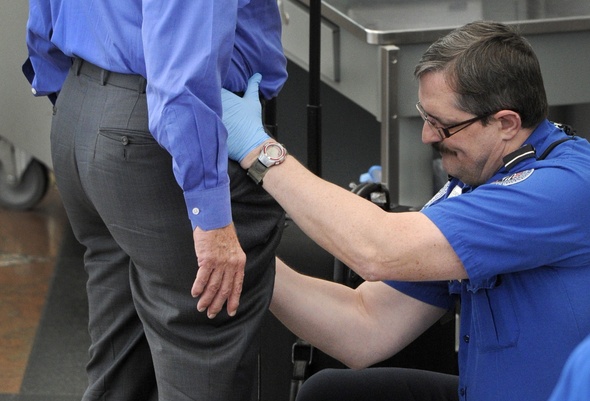
"Would you cut the comedy please? I'm trying to feel you up!"

A retired Air Force Lt. Colonel apparently was arrested at a TSA airport checkpoint after she refused to stop reciting the Fourth Amendment of the Bill of Rights (“Searches and Seizures”) while she was being screened. You can read her account here.

I’m not going to jump on the bandwagon of the various commentators from both sides of the political spectrum who are leading condemnation of the incident. My interest is in the ethics of the encounter and its subsequent reporting, as I do not see this as an example of official abuse and suppression of rights.

I object to much of how the Department of Homeland Security and the TSA has handled airport screening policy since 2001, as I discussed in this post and elsewhere. I agree that the public should not meekly accept what it regards as unjustified intrusions on their privacy, dignity and health, and that complaining, petitioning the government, putting pressure on elected and appointed officials and leveling criticism in various forums is a necessary and reasonable response. Nevertheless, the episode described in the accounts of this arrest has been mischaracterized. It was a situation in which TSA agents were placed in an impossible situation for the purpose of generating third-party indignation. The woman engaging in the protest also targeted individuals who can only be called innocent parties, the TSA screeners. They have a job, they have procedures to follow, and they have to follow them. They also have a lousy job, having to brush up against the privates of strangers while being glared at or verbally abused.

My question, as with many protests, is, “What was the objective here?” To be as annoying as possible? To cause a scene? To let everyone in the vicinity know that the woman objected to the procedures? To come as close to interfering with the screening process as possible without justifying an arrest? To get her name in the papers? To delay her fellow passengers, most of whom just want to get through the vile process and make their flights?

Or to get arrested? Continue reading

A Psychic Ethics Train Wreck in Liberty County

Surprise: her anonymous tip is not credible.

I have been remiss in not discussing a recent Ethics Train Wreck that occurred two weeks ago, a fiasco that occurred in Liberty County, about an hour from Houston, Texas.

A self-professed psychic who calls herself Angel called police and told them that she had a vision that a mass grave containing the dismembered bodies of children was on the property where Joe and Gena Bankson lived. She also described some of the features of the property. That was enough for the Liberty County Sheriff’s Office, which armed itself with a search warrant and cadaver-sniffing dogs and converged on the home,  along with a mob of reporters and two news helicopters. As the police dug holes, somebody jumped the gun, and soon cable news stations flashed alerts that up to 30 bodies had been found.

There were no bodies. Continue reading

The Strange, Unethical Saga of Junius Puke

Junius Puke

This week seems to mark the end of a perfect storm of ethical misconduct that almost drowned a young student in legal persecution for the non-crime of exercising his First Amendment rights. An insufferable and humorless bully with a professorship collided with an irresponsible prosecutor wielding an unconstitutional law, and it has taken eight years to undo the carnage.

A man named Junius Peake was an economics professor at the University of Northern Colorado,  who due to his parody-inviting name and undoubtedly also the character traits that he was soon to display so prominently, found himself being lampooned in a student satire blog called “The Howling Pig.”  The editor-in-chief of the blog was facetiously identified in the newsletter as the obviously fictional “Junius Puke,” who was portrayed with an outrageous photograph of Professor Peake altered to include sunglasses, a different nose,  a Hitler-esque mustache, and, on occasion, Kiss make-up and a Gene Simmons tongue.  Junius Puke, with tongue. “Junius Puke” wrote prose like this:

“This will be a regular bitch sheet that will speak truth to power, obscenities to clergy, and advice to all the stoners sitting around watching Scooby Doo. This will be a forum for the pissed off and disenfranchised in Northern Colorado, basically everybody. I made it to where I am through hard work, luck, and connections, all without a college degree. Dissatisfaction with a cushy do-nothing ornamental position led me to form this subversive little paper. I don’t normally care much about the question of daycare since my kids are grown and other people’s children give me the willies.” Continue reading

Final Ethics Verdict on TSA’s Feel-Up Pat-down

I was flying this week, and the security procedures were smoother than ever. Now I am certain that my molestation at check points last year was unethical, and have sufficient evidence to conclude that it was based on government incompetence and willful disregard for my comfort, dignity, and rights.  I am also wondering, more than ever, if the ardent, supposedly liberal defenders of the indefensible feel-up pat-downs have learned anything about the dangers of blind government obeisance and partisan loyalty. I hope so.

The saga so far: Continue reading

E-mails Aren’t Private? Oh-oh…

The Eleventh Circuit Court of Appeals has ruled in the case of Rehberg v. Paulk that one who sends an e-mail has no “expectation of privacy” in its content, once it is sent to a third party—-and that third party can even be the internet service provider. Which means, in essence, that e-mails aren’t private any more, if this ruling stands.

Here you have a good example of how courts can re-define formal ethical standards on multiple planes with a few words. This means that one of the most influential Federal Courts has given the green light to any government agency or employer who chooses to read your e-mails. It may well be that lawyers who send documents containing confidential client information have breached their duty to protect confidences. It means that if your room-mate reads confidential messages on your laptop without your permission, the law says its your fault, not his.

This is the point where ethics, manners and the Golden Rule becomes more important than ever. The court case may change the law, and it may be legal to read other people’s e-mails without permission, but it’s still not right.

For an excellent scholarly dissent from the Eleventh Circuit’s ruling by Prof. Orrin Kerr, see his argument on the Volokh Conspiracy.

[Many thanks to Prof. Monroe Freedman whose post at the Legal Ethics Forum alerted me to both the case and Prof. Kerr’s critique.]