France And Ireland Remind Us Of Two More Reasons To Be Proud And Grateful To Be An American…

News Item:

France sought to keep a computer hack of frontrunner Emmanuel Macron’s campaign emails from influencing the outcome of the presidential election, with the electoral commission warning on Saturday that it may be a criminal offence to republish the data. Macron’s team said a “massive” hack had dumped emails, documents and campaign financing information online just before campaigning ended on Friday and France entered a quiet period, effectively forbidding politicians from commenting on the leak.

Polls have been predicting that Macron, a former investment banker and economy minister, is on course for a comfortable win over far-right leader Marine Le Pen in Sunday’s election, with the last surveys showing his lead widening to around 62 percent to 38.

…The election commission, which supervises the electoral process, warned social and traditional media not to publish the hacked emails lest they influence the vote outcome…

“On the eve of the most important election for our institutions, the commission calls on everyone present on internet sites and social networks, primarily the media, but also all citizens, to show responsibility and not to pass on this content, so as not to distort the sincerity of the ballot,” the commission said in a statement on Saturday.

“The commission stresses that publication or republication of these data…could be a criminal offence,” it said.

That’s right: withholding information from the voters because they can’t be trusted to be fair and discerning about what is relevant to their vote and what isn’t is to preserve “the sincerity of the ballot.” This is how they reason in countries without guaranteed freedom of speech, and freedom of the press. Florian Philippot, deputy leader of Le Pen’s National Front party, tweeted “Will Macronleaks teach us something that investigative journalism has deliberately kept silent?” Good question. Continue reading

France’s Unethical—And Really, Really Stupid— “Burkini” Ban

burkinis

I’ve received several inquiries requesting an  Ethics Alarms analysis of the current controversy roiling France, namely the so-called Burkini Ban.  Muslim women had been wading into the French Riviera surf wearing “burkinis,”  body-covering swimsuits designed to be compliant with the Islamic faith , and one resort  town after another, fifteen in all including Cannes and Nice, declared them illegal. The women entering the water wearing such attire have been ticketed for not “wearing an outfit respecting good morals and secularism.”

Well, I try not to spend much time here writing about the obvious. The ban is unethical. In the U.S., such laws would be over-turned before the arrested women’s bathing suits were dry, since the meaures violate both the First Amendment and the Equal Protection Clause of the Constitution. It should be obvious that the ban is unfair, as it is sexist, directed against one religion, and makes no sense whatsoever.

Sometimes I wonder if the French quite get this ethics thing. This is an example.

Both conservatives and many liberals in France support the ban. The conservatives, in addition to wanting to punish Muslims for recent Islamic terrorist attacks, claim  to be upholding France’s core principle of “secularity,” enshrined in the nation’s constitution. Liberals argue that the Islamic strictures against women exposing any part of their bodies in public are misogynist, patriarchal, and “regressive,” so the bans defend the rights of women…by preventing women from wearing what they choose to, observing their own religion, and taking a swim.

You see what I mean about not quite grasping the whole “ethics” thing? The equivalent argument in the U.S. would be if feminists argued that sexy bathing suits be banned because they objectified women, even when the women wearing them felt like being objectified. The Burkini Ban is, to be blunt, idiotic. Continue reading

The Washington Post’s Ethical Unethical Accurate Stupid Tone-Deaf And Dangerous Headline

Go ahead, keep deriding "the people." Can't do any harm...

Go ahead, keep deriding “the people.” Can’t do any harm…

The big problem with the “elites” that conservatives and Trumpeteers keep demonizing is that they insist on acting and talking as if they are exactly as insolated and contemptuous of “the masses” as they are accused of being. Witness this headline on the Washington Post website, on the Wonkblog column:

Headline Post1

Talk about walking into a haymaker! This headline went viral on the conservative media and social media, with such comments as, “Know your place, peasants!” and  “Stand aside and pay attention to your betters!” As with many such incidents, the headline signals that some ethics alarms aren’t functioning in high places. How could this headline make it to the web without anyone seeing it and thinking, “Whoa! Hold it! That sure sounds like (another) call to authoritarian government, and this is the major paper in the Capital of what is supposed to be the cradle of liberty! We can print that, and if we think it, we have to be a lot more clear about what “some things” are.” What does it tell us that nobody had that thought at the Washington Post?

This is the realm of headlines, which, like internet memes and bumper stickers and Twitter posts, are not safe for expressing complex ideas, and should not be used by competent journalists to do so. Ultimately, in a representative democracy, the people do decide such things indirectly, by electing their representatives and punishing them with their votes if they don’t make decisions the public finds competent and beneficial. The Post web headline asserts an ugly and arrogant dichotomy between “the people” and what, their rulers? The intelligentsia? The aristocracy? The 1%? Journalists? Since trust in our institutions are at a dangerous low point, this is a mind-blowingly stupid thing to print, and plays directly into the hands of the anti-establishment hucksters like Trump and Bernie. Continue reading

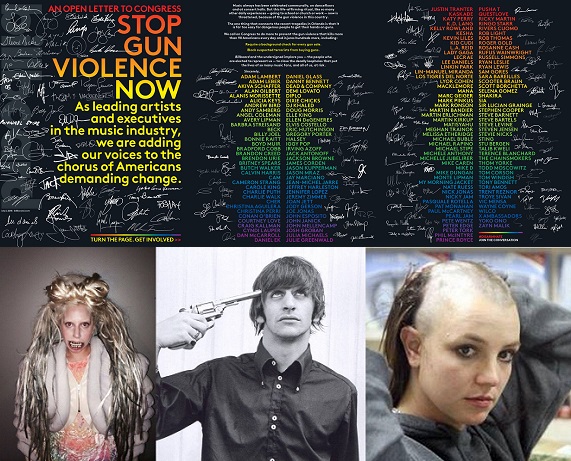
Ethics Dunces (All-Star “Shut Up And Sing ” Edition): Cher, Lady Gaga, Britney Spears, Billy Joel, Paul McCartney, Jackson Browne,Nick Jonas, Sia, Zayn Malik, Barbra Streisand, Beck, Questlove, Pusha T, Ringo Starr, Sting, Ricky Martin, Lin-Manuel Miranda, Selena Gomez, Stevie Nicks, Michael Bublé, Melissa Etheridge, Trent Reznor, Kesha, Katy Perry, Tony Bennett, Yoko Ono…

Billborad letters

A couple hundred famous singers and musicians have banded together to sign a fatuous and misleading “open letter” to Congress dictating U.S. gun policy. The letter which is being used as a publicity gimmick by Billboard (and the stars, of course), reads:

As leading artists and executives in the music industry, we are adding our voices to the chorus of Americans demanding change. Music always has been celebrated communally, on dancefloors and at concert halls. But this life-affirming ritual, like so many other daily experiences—going to school or church or work—now is threatened, because of gun violence in this country. The one thing that connects the recent tragedies in Orlando is that it is far too easy for dangerous people to get their hands on guns.

We call on Congress to do more to prevent the gun violence that kills more than 90 Americans every day and injures hundreds more, including:

  • Require a background check for every gun sale
  • Block suspected terrorists from buying guns

Billboard and the undersigned implore you—the people who are elected to represent us—to close the deadly loopholes that put the lives of so many music fans, and all of us, at risk.

The letter is many things:

1. It is scaremongering nonsense. Gun deaths are way down, and the odds of any citizen being killed in a mass shooting is beyond minuscule. Based on 2015 statistics by the broadest definition, you have a 0.00000143% chance of getting killed in a mass shooting. These wealthy and privileged people, who often have bodyguards (with guns) have much less of a risk than that. Nothing is “now threatened.” We are safer from gun violence now than five years ago, ten years ago or 20 years ago. Continue reading

A “When Ethics Alarms Don’t Ring” Case Study: The Angouleme International Comics Festival Thinks Announcing the Wrong Award-Winners Is Funny

http://www.youtube.com/watch?v=nmqAjr0xs04

In December, comedian Steve Harvey inadvertently announced the wrong winner of the Miss Universe Pageant on live, national TV. It was horrible. He then had to correct his mistake, the wrongly crowned Miss Columbia had to be uncrowned, and everyone except the sadists in the audience felt awkward and embarrassed. Harvey sincerely apologized, more than once.

How anyone could be aware of that fiasco, which received world-wide attention, and conclude that it would be hilarious to do the same fake-winner bit intentionally is beyond my small mind to comprehend. Such individuals would have to have their ethics alarms installed backwards, or buy them from the Bizarro World of Superman Comics. Yet the organizers of the Angouleme International Comics Festival this tear decided exactly that: “Let’s announce the wrong winners! It will be great!

The ceremony began with the MC, comedian Richard Gaitet,  announcing that“This will be the shortest ceremony in history, because all we want to do is drink and dance!” He then presented all nine awards in rapid succession, including the Fauve d’Or, the biggest award of the show, to Arsène Schrauwen, by Olivier Schrauwen. Then two women appeared and announced that the awards just handed out were fake, and they presented the real awards to completely different artists. The “winners” who just accepted their prizes in the exhilaration of pride and recognition, were as stunned as Miss Columbia.

The audience reaction, meanwhile, was exactly as you, I or any sane person would expect. Nobody laughed. Everyone felt that the targets of the practical joke had been abused. “We were all happy, we had tears in our eyes, and then we were humiliated,” said Sam Soubigui of Komikku, one of the publishers whose book won a “Faux Fauve” (fake prize). Another publisher who accepted a phony prize had already relayed the news of the honor to the writer and artist of the book that “won,” and then had to call them back and explain. One editor whose comic won a “Faux Fauve” left the auditorium in tears when she realized it was fake.

The condemnation of the stunt on social media was swift and unanimous. The organizers of the festival thought this was an appropriate response (courtesy of the French to English Google app, further translated by me from the typical gibberish these programs often create): Continue reading

“The Longest Day,” Darryl F. Zanuck, D-Day, And Us

title_longest_day_bluray

Today is June 6, the anniversary of the Allies’ invasion of Normandy, the audacious military strike that changed the course of history. I’ll be interested in seeing how it’s commemorated this year, 71 years later, especially by the news media. A lot of Americans under the age of 40 know almost nothing about it, or worse, the values it represents to the United States.

Fortunately, there is an easy and entertaining way to teach a young American about what happened on this day 71 years ago. That is to have him or her watch “The Longest Day,” producer Darryl F. Zanuck’s epic film based closely on historian (and sole credited screenwriter) Cornelius Ryan’s 1959 book. (You can get it at Amazon, here.)I usually find understanding military battles nearly impossible; written accounts completely confound me, and few movies about any battle make a serious effort to explain the tactics and strategy without reducing the facts to pablum. (I remember how much my father, who fought in the Battle of the Bulge, detested the big budget movie of the same name, which he found outrageously sloppy, and which he summarized as “Henry Fonda won the war.”)

Not “The Longest Day,” however. Since seeing the movie with my father as a kid, I have learned a lot about what was left out, but the movie is remarkably clear and accurate about what happened and why without being either too detailed or too simplistic. It’s also just a great, inspiring movie.

That we have “The Longest Day” is entirely due to the courage of one of Hollywood’s most dynamic, flamboyant and successful studio moguls, Darryl F. Zanuck. The original producer of the adaptation of Ryan’s book (which is terrific ) gave up on the project when 20th Century Fox refused to allow him an adequate budget. Zanuck, who was still producing films but no longer ran the studio he had built,  bought the rights, and was determined to do the story, the event, and the men who fought the battle justice by mounting a production almost as ambitious as the invasion itself. Continue reading

On Its 100th Anniversary: Remembering The Great War’s Christmas Truce Of 1914

christmas-truce-1914-H

On December 7, 1914, as the horrible, pointless, world-disrupting “War to End All Wars”  was only five months old, Pope Benedict XV suggested a truce for the celebration of Christmas. The governments of the battling nations rejected the idea, but in the days leading up to  Christmas and after, many of  the soldiers in the trenches of this ugly conflict took the Pope’s advice.

On December 20, Germans soldiers in some areas took in British wounded from the no man’s land between the warring armies. A German soldier reported on December 22 that both sides had been heard singing Christmas Carols in the trenches. German troops arriving into the lines had begun bringing Christmas trees, and some men placed them on the parapets of the fire trenches. Then, on Christmas Eve, many German and British troops serenaded each other across the lines. Allied soldiers reported that sometimes their singing was accompanied by German brass bands. Then, Christmas Day, 1914, some of the German soldiers left their trenches and  carefully approached Allied lines, shouting“Merry Christmas” in French and English. Allied soldiers climbed out of their trenches, and shook hands with the men who had only recently been trying to kill them. Some even exchanged exchanged gifts of cigarettes and and food. There were even instances where soldiers from opposing sides played soccer: in England, one organization is holding a match next week against a German team to commemorate such contests. Continue reading

Ethics Hero, Thanksgiving Division: Scott Stuckey, Manager of Atlanta’s Omni Hotel

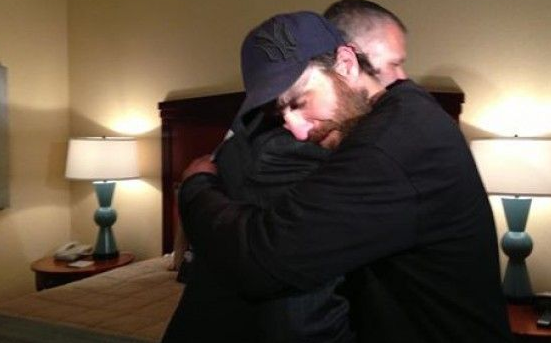
Scott Stuckey gets hugged by a grateful non-criminal Joel Hartman was homeless and surviving in Atlanta by dumpster diving, but when he found a lost wallet with the owner’s identification and credit card inside, he was determined to do the right thing. The wallet obviously belonged to a tourist, so the 36-year-old man checked the hotels in downtown Atlanta until he found out that the tourist (from France, for a conference) was staying at the Omni Hotel.

After Alanta’s Omni manager Scott Stuckey saw the surveillance video of Hartman—who looked as destitute as he was— turning in the wallet to the hotel’s  security guards, he decided that a reward was in order.  Hartman had given them a fake name, so it took some effort to track the shy good Samaritan down. Stuckey and his staff searched for a week, leaving messages with other homeless people that the Omni wanted to thank the man who recovered its guest’s stolen wallet. Eventually Hartman heard about their quest, and showed up at the hotel. He was shocked at what Stuckey had planned for him. Hartman was told that he would be the Omni’s guest in a luxury room through the Thanksgiving holiday with complimentary room service. The hotel also  gave him $500.

I think the gesture by Stuckey and the Omni was kind, appropriate, and in keeping with the spirit of the holiday….but: Continue reading

Comment of the Day: “Ethics Hero Emeritus: Henri Salmide, 1919-2010”

Henri Salmide

Henri Salmide, Hero: Unknown in the US, and only barely recognized in Germany or France. Greatly appreciated on Ethics Alarms, however.

German visitor Reinhard Gross sent me a useful clarification on the 2010 Ethics Alarms tribute to Henri Salmide, who as a German soldier in World War II saved the French port of Bordeaux by defying orders to blow it up and blowing up his German superiors instead. You can read the post on Salmide, an Ethics Hero Emeritus, here, and his New York Times obituary here. It’s an inspiring story, and if you are not familiar with Salmide, you should be.

Salmide lived the rest of his life as a French citizen in Bordeaux, and until late in life was seldom noted for his heroic act in France, so strong was the bias against him as a former German soldier. I asked Reinhard what the attitude in Germany was toward Salmide, and his Comment of the Day was the response. It also provides some insight on the the long and painful process the German culture must work through, as the German people come to terms with the dark Nazi period, when their society and its values were so horribly warped, with such tragic consequences for Germany and the world.

Here is Reinhold Gross’s Comment of the Day on the post Ethics Hero Emeritus: Henri Salmide, 1919-2010…and I thank him for reminding me of Henri Salmide’s courageous and ethical act: Continue reading

Ethics Dunce: France

France

France doesn’t seem to comprehend it yet, but it is embarking on an uncharted and dangerous journey by installing a leader whose lifestyle argues for the irrelevance of marriage.

Valérie Trierweiler, the partner of France’s newly-elected president François Hollande, is being referred to world-wide as France’s new, and unmarried, “First Lady.” She seems like a serious, admirable professional, and there are certainly benefits to any nation by having a woman of substance, intelligence and talent at or near the top of that country’s public figures. I know very little about Hollande, but I am assuming that he is qualified for the difficult job he is undertaking, and that he, like Trierweiler, are mature adults who have every right to structure their personal relationships however they please. That assumption, however, requires the omission of the duties of leadership from the calculation. Leaders cannot make personal decisions based only on their own needs, but must make those decisions while acknowledging an immutable and long-proven fact: leaders have a disproportional, almost frightening power to influence, shape and change a culture, and the more successful and popular  leaders are, the greater that power is. Continue reading