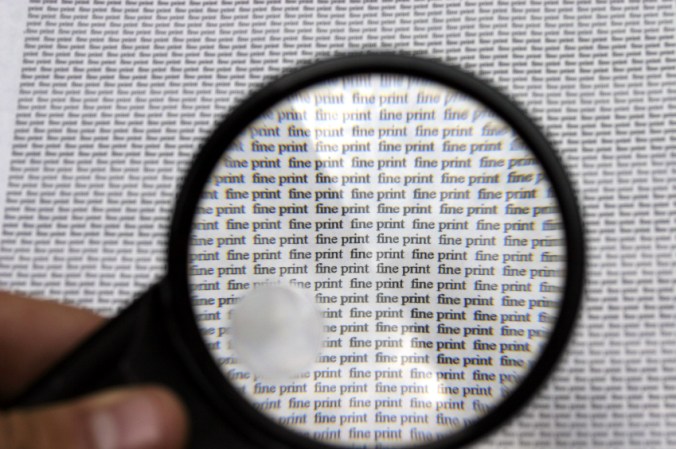
Ethics Alarms Encore: “The Unethical Fine Print Game”

The following  post from 2017 became relevant today when I prepared to comment on  a story last week on Politico: 

Passengers and their survivors won a $265 million court settlement with Amtrak after a 2015 derailment in Philadelphia killed eight people and injured hundreds more. But if such a crash happened today, the victims would not be able to sue. That’s because of a clause the passenger rail line quietly added to its ticket purchases in January, which forces disputes into arbitration with no right to go before a judge or jury.

The change is bringing objections from consumer advocates, who note that it covers scenarios ranging from ordinary ticketing complaints up to wrongful death, and even includes minors who had the tickets purchased for them. And it could soon get Congress’ attention. The language has flown under the radar so far, but may burst into view when the House Transportation Committee holds a hearing on Amtrak next week.

“It is one of the most anti-consumer and passenger clauses I’ve ever seen,” said Julia Duncan, senior director for government affairs at the American Association for Justice, which represents trial lawyers.

I realized that the post I was preparing to write was already written. Here it is, with a addition. [Some other posts on the topic of fine print—yes, it’s a perpetual source of annoyance for me— can be found here.] Continue reading

The Unethical Fine Print Game

I am on record as believing that lawyers who intentionally assist their clients in burying unconscionable, unenforceable or unfair terms in standard contracts, usually in fine print, are unethical, and engaging in a professional violation of the Rules of Professional Conduct. I’ve offered several seminar hypotheticals on the topic to make my point, and have never encountered a lawyer who had a good defense for the practice. Usually the best they can come up with is “everybody does it” or “but it’s legal!” Of course, the bar associations are on their side, not mine, because, well, everybody does it. That’s a proverbial can of worms the bar associations don’t have the guts or integrity to open. What else could it be but unethical, however, when a client company says, “Make sure you bury this provision saying that they have no recourse if we cheat them in the fine print!” and the lawyer says, “But that’s unenforceable!” and the client says, “Yeah, but they won’t read it before signing, and when we point out that they did agree to it, maybe it will scare them off,”  and the lawyer shrugs and says, “Whatever you say! It’s your contract”?

WiFi companies are especially egregious in this regard. As an effort to show itself as above the field and avoiding the unethical industry practice, a British WiFi company, Purple, ran  a social science experiment, inserting language in its standard contract that obligated consumers to clean toilets at festivals and clear sewer blockages.  22,000 people signed up anyway. The contract stated–in fine print—that its signatories would be legally required to perform 1000 hours of community service, including, but not limited to, “cleaning toilets at festivals, scraping chewing gum off the streets” and “manually relieving sewer blockages.”

The gag clause was inserted in the company’s terms and conditions for a period of two weeks, “to illustrate the lack of consumer awareness of what they are signing up to when they access free WiFi .” Purple also offered a prize to anyone who actually read the terms and conditions, and found the “community service clause.” Only one person won it. Continue reading

“Free Wi-Fi” And Journalism’s Flagrant Untrustworthiness

http://www.youtube.com/watch?v=rmx4twCK3_I

You’ve probably memorized that State Farm TV commercial where the woman tells her friend that she believes everything on the internet because it has to be true, and introduces her “French model” date—a grotesque geek wearing a belly pack who can barely manage “Uh..Bonjour!”—whom she met on the internet. Well, last week we were treated to a lesson in how the mainstream media, even its most prestigious and trusted members, are about as trustworthy as her date.

None other than the exalted Washington Post breathlessly reported last week, in a front page story, that “the federal government wants to create super Wi-Fi networks across the nation, so powerful and broad in reach that consumers could use them to make calls or surf the Internet without paying a cellphone bill every month…If all goes as planned, free access to the Web would be available in just about every metropolitan area and in many rural areas.”

The story was stunning and worrisome–Why is the government competing with private enterprise? How can it undertake such a sweeping discretionary initiative with the Treasury deep in debt? Wait, what??—and rapidly spread all over the 24-hour news media, including cable, radio and the internet (Uh..Bonjour!). It is there still, largely uncorrected. The story, meanwhile, was essentially untrue, a mistake. Yet as of yesterday, it was still being reported and argued about as fact on such respectable and trusted websites as Salon, Reason, UPI, Business Investor, The Daily Caller, NPR and many more. The Post, meanwhile, has still not published a clear and prominent retraction, and the reporter who wrote the erroneous story is still spreading misinformation. Continue reading