My Field of Dreams

Yesterday, an Off-Broadway musical closed that I launched on its remarkable run nearly 12 years ago. The show had productions in four states, D.C. and London; it had over 450 performances; it became the cornerstone of one very talented (and very nice) actor’s career, and an important opportunity for several others. It gave a dear friend immense pleasure, satisfaction and recognition in the final decade of his life, and probably saved my theater company from bankruptcy. Most important of all, perhaps, is that it entertained thousands of people. If I got bopped by a trolley tomorrow, the show would undoubtedly stand as one of the major accomplishments of my entire strange, eclectic, under-achieving life.

And yet…feeling good about the unlikely saga of the show, now that it has finally (probably—it has risen from the dead before) seen its last audience, takes considerable effort for me, and has from the beginning. My satisfaction is more intellectual than emotional, because I know that I personally benefited less from the show in tangible ways in proportion to my contribution to it than anyone else involved. Although I restructured the script, re-wrote, added and cut lines, wrote new lyrics to one song and added two others to the show, including the finale, I’m not credited as a co-auther. I own no part of the property, and never received a dime in compensation. Those closely connected with the original production know all of this, but the extent of my role in the creation and success of the show has been invisible to audiences for over a decade. Continue reading


Mirlande Wilson Is My Favorite Ethics Dunce of All Time!

When we last left Mirlande Wilson, she was claiming, improbably, that although she had bought Mega Millions lottery tickets for her workplace pool at McDonald’s, the ticket she bought giving her over $250 million in jackpot winnings was hers alone.

This made her an Ethics Alarms Ethics Dunce. Now she says she has lost the ticket. This opens so many possibilities, all with their own ethical implications:

  • She is lying, and never had the ticket, meaning that she is willing to make her co-workers think she cheated them to try to pull off an audacious scam. Dishonest and shameless.
  • She did lose the ticket, but it was the pool ticket, and she is lying about that part of it. In this case, she was spectacularly irresponsible to lose a ticket worth millions to the persons who collectively bought it. And a liar. Dishonest, careless, greedy, irresponsible and untrustworthy.
  • She did buy the ticket with her own money, and did lose it, and is just telling the truth, hoping to get a little sympathy. In that case, she deserves some. But buying a ticket for a mega-jackpot and losing it is still prima facie evidence that you shouldn’t live alone, or be left in the presence of pointy objects. Honest, careless and pathetic.
  • She bought the ticket with the pool’s money, and knows that she won’t find it and can’t get the cash. She’s saying that the lost ticket was hers alone, hoping that her fellow workers won’t feel as terrible as she does, since it would be pretty terrible to gor back to a fast food job when you know you should be joining country clubs. She’s trying to spare them. Yes, that must be it. Noble, kind, and self-sacrificing.
  • She bought the ticket with the pool’s money, and knows that she won’t find it and can’t get the cash. She’s saying that the lost ticket was hers alone, hoping that her fellow workers won’t try to kill her. Irresponsible, careless, dishonest, but understandable.

I can’t wait to see what happens next.

Ethics Dunce: Mirlande Wilson

"Share? Why should I share?"

Mirlande Wilson was part of a lottery pool formed in the Maryland McDonald’s where she works, and claims that she bought one of the three winning tickets that will split the $640 million dollar Mega Millions jackpot. But Wilson told the New York Post that although she did take part in the pool, she bought the winning ticket on her own and has no intention of splitting the winnings. A co-worker who took part in the pool dispute’s Wilson’s story and says Wilson was given additional money late Friday night to buy extra lottery tickets before the Mega Millions drawing.

Why are people like this? Yes, I know, greed…still: does winning a fortune have to turn people into utter, irredeemable jerks? Continue reading

Ethics Lessons of the Great Lotto Betrayal

Let's see how many friends you can buy now, Amerigo...

After more than a year and a contentious trial, a New Jersey jury has unanimously determined that hard-hat worker Americo Lopes cheated five co-workers out their fair shares of $38.5 million in lottery winnings. Each was awarded a $4 million share. The evidence presented in the trial was mostly circumstantial, and the case came down to what the jury believed, whom they trusted. Go figure: they chose not to believe the man who organized a lottery pool with his co-workers, collected their money and bought New Jersey lottery tickets with it routinely, and then, when he found himself with a winning ticket in the Mega-Millions game…

  • Didn’t tell any of the group.
  • Claimed he was going on leave to have surgery,
  • Quietly quit without returning,
  • Claimed that the winning ticket was bought with his personal funds, not the pool’s,
  • Argued that none of the men were friends of his and
  • Reportedly said at one point, “With all that money, I can buy new friends.”

Gee, who wouldn’t believe such a terrific guy? Continue reading

Tales of Moral Luck: The Snake, the Testicle and the Lousy Friend

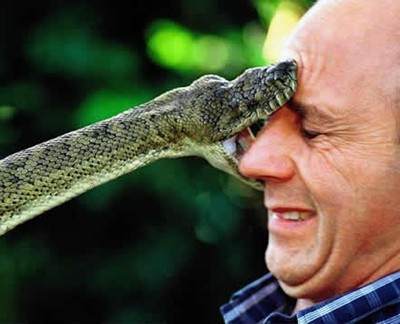
"Heck, sure, pal, I'll suck the venom out of your face--what's that? You were bitten WHERE????"

Irish tourist Jackson Scott was engaged in a necessary bodily function while vacationing in the Australian outback, when he was bitten—on the testicle.  The biter was a tiger snake, and its venom can be fatal.

Panicked, Scott begged his camping companion, Roddy Andrews to suck the venom out. Roddy, however, said, “Ewwwww!

Also, “No.”

But he drove Scott in a race against time to the nearest hospital, where doctors administered an antidote in time, barely, to save Scott’s life. Continue reading

To Jon Stewart, Ethics Hero: I’m Sorry I Doubted You.

Impossible conflict of interest? No problem!

I’m also glad that I waited before posting my article labeling Stewart, the much-revered cultural force who chairs Comedy Central’s satirical news hour, “The Daily Show,” an Ethics Dunce for wimping out in his initial tepid take on the Rep. Weiner scandal.

Stewart is a good friend of the sexting, lying New York Congressman, and for most comedians, leaving a high-profile friend in trouble off of their comic hit-list would not only be acceptable, but admirable. A comedian only has the obligation to be funny, and if he  chooses to be funny without slicing up a close friend in crisis, that just makes him a kind and loyal friend. Stewart, however, can no longer claim to be just a comedian. He has built a reputation as a truth-teller, leaning to the left, perhaps, but still willing to skewer idiocy, corruption, hypocrisy and dishonesty whenever and wherever they surface in current events. This means he is trusted, and that he has a duty to make  his audience laugh while displaying integrity, fairness, wisdom and good judgment. It’s a high standards to meet, but it is also the one Stewart set for himself by reaching it again and again. Continue reading

The Prince, The Sex Offender, and the Ethics of Friendship

Prince Andrew with one of his friend's victims in 2001

The ethics of friendship is complicated.

President Bush claimed to be friends with Vladimir Putin. F.D.R. once said that Josef Stalin was his friend. President Obama was famously friendly with dubious characters like Rev. Wright and William Ayres.

History is full of heroes and near-heroes who had infamous friends, though the extent of the often friendship is difficult to know. Sammy Davis, Jr. and Elvis were supposedly buddies with Richard Nixon. Bill and Hillary Clinton were close friends with Dick Morris. Wyatt Earp was a life-long friend of “Doc” Holliday; Andrew Jackson may have been friends with pirate Jean Lafitte, who helped him win the Battle of New Orleans. We simultaneously celebrate loyal friends, and yet we also judge people by the company they keep. Should we condemn individuals who have friends with serious character flaws or a history of unsavory acts? Or should we admire them for sticking with their friends when everyone else is turning against them? Continue reading

Unethical Quote of the Week: The White House

“Any suggestion that this was an insult to the United States is just flat wrong.  As Lang Lang has stated before, he plays this song regularly because it is one of his favorite Chinese melodies, which is very widely known and popular in China for its melody.  Lang Lang played the song without lyrics or reference to any political themes during the entertainment portion of the State Dinner. He simply stated the song’s title and noted it was well known in China.”

White House Spokesman Tommy Vietor, arguing that Chinese pianist Lang Lang’s  playing of a Chinese  song that referred to Americans a “jackals” at a White House dinner was as innocent as the day is long.

The song was well-known in China all right—well-known as an anti-American song. Continue reading

China’s Secret White House Insult

Lang Lang, the Chinese pianist who played for guests the White House State dinner on Jan. 19 honoring Chairman Hu Jintao, apparently regaled the crowd with an unfamiliar melody (to the Americans) that was really a famous anti-American propaganda song from the Korean War, the theme  to the movie “Battle on Shangganling Mountain.”  Continue reading

Michael Palmer’s Ethics No-Brainer

Physician/novelist Michael Palmer is something of the new Michael Crichton, though unlike the eclectic late author of “Jurassic Park,” Palmer generally restricts himself to medical thrillers. He is promoting his latest novel, “A Heartbeat Away,” with a series of “ethics brainteasers,” as he called them in a recent Twitter post. Here is the latest, which he posted on his Facebook page and asked fans to discuss:

“What if a close friend confides to you that he/she has committed a heinous crime and you promise that you’ll never tell. However, you soon discover that an innocent person has been accused of the crime and is possibly facing significant jail time. You plead with your friend to give him/herself up, but he/she refuses and reminds you of the promise. What should you do? What if the if jail time was only a few months? What if the sentence was death?” Continue reading