Comment of the Day: “The Ethicists, Backing Judge Walker and Gay Marriage, At An Unacceptable Price”

The motion to vacate Judge Walker’s ruling on Proposition 8 has been filed, you can read it here. Since the original post, I have detected some cracks in the formerly near-united front of legal ethicists and journalists deriding Walker’s critics. Some of them are finally, grudgingly, admitting that the Judge might not have handled his potential conflict so well after all, and that the motion is not a frivolous, anti-gay outrage as they originally labelled it.  The most rickety of the rationalizations put forth on Walker’s behalf, advanced by some his most respected defenders, is that he had no obligation to reveal his own sexual orientation by disclosing his domestic arrangement because of its intimate and private nature. Yet the judge voluntarily disclosed it after his decision was in the books, raising a rebuttable presumption that his original silence was to avoid suggestions of conflict, not out of a desire for privacy.

First time commenter Jada adds her Comment of the Day to the discussion: Continue reading

The Ethicists, Backing Judge Walker and Gay Marriage, At An Unacceptable Price

"Oh, all right...as long as we like the decision."

Thanks to the Judge Walker controversy, now have proof that the best legal ethicists in the nation are human. I suppose that’s something.

My colleagues in the legal ethics field are arguing—decreeing, really— that Judge Vaughn Walker’s decade-long same-sex relationship didn’t need to be disclosed before he ruled against Proposition 8 (California’s voter-approved gay marriage ban) because, they say, it created no reasonable doubts about his impartiality. Coincidentally, they also really, really like his decision. But then, so do I. Continue reading

Judge Walker Was Wrong

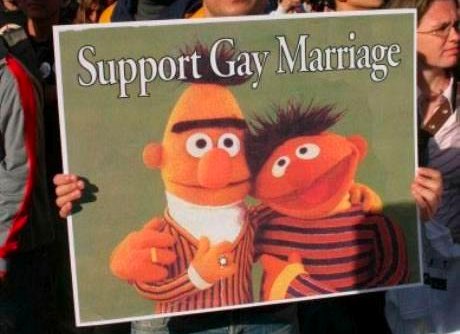
Now that we know about Bert, should Judge Ernie have recused himself?

Judge Vaughn Walker, the Federal District judge who a year ago ruled California’s Proposition 8, which banned same-sex marriages, unconstitutional, was wrong. No, not about the law, which is pretty clearly unconstitutional: his opinion was fair and well-reasoned, and is likely to be upheld on appeal. Walker was ethically wrong in his handling of the delicate issue of his own sexuality, which had raised a controversy about his objectivity and ability to be impartial.

Two weeks ago, following his retirement from the bench, Walker publicly disclosed for the first time that he has been in a same-sex relationship for the past ten years. This changes the analysis regarding the propriety of his ruling on Perry v. Schwarzenegger. Walker had long been rumored to be gay; supposedly “everybody” knew he was gay. My position, as well as that of many others considering the arguments of anti-gay marriage opponents that he should recuse himself, was that sexual orientation could not and should not create a presumption of bias, any more than gender, age, race or marital status. Continue reading

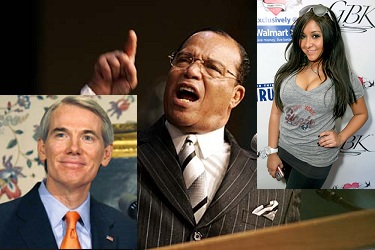
Ethics Quiz: Farrakhan, Snooki, Senator Portman, and University Speaker Ethics

Pick your poison!

Your Ethic Quiz question for the weekend: Which of these is the most unethical choice to speak at a University?

Your choices:

A. Nicole “Snooki” Polizzi, the over-the-top trashy break-out star of the bottom-of-the barrel cable reality show “Jersey Shore,” hired for $32,000 by Rutgers University to address students. Continue reading

Boseman v. Jarrell: A Gay Mother Tries to Use Legal Discrimination To Her Advantage

Julia Boseman and Melissa Jarrell were domestic partners in Wilmington, North Carolina, and always wanted to raise a child together. In May of 2000, they decided to make their dream a reality, and began the process of having a baby. They decided that Melissa would do the child-bearing, but Julia would be equally involved in the process in every other respect. They  chose an anonymous sperm donor together after researching and discussing various options. They jointly attended the medical session necessary to conceive their child and to administer proper prenatal care. Julia read to the gestating child in Melissa’s womb and played music for him; she also cared for Melissa during her pregnancy and was present at the birth. Melissa and Julia jointly chose their son’s first name, and agreed that he should have a hyphenated last name composed of their surnames. In every way, they behaved publicly and privately as the parents of the child, introducing him into their respective extended families.

But North Carolina refuses to recognize same-sex marriages, so in the eyes of the state, Julia was not legally a parent. To remedy this obstacle, she sought and received a court order adopting the child without severing her partner’s legally recognized parental rights. Officially, their child now had two, same-sex parents. Then the couple split acrimoniously, with the acrimony greatly magnified when Melissa sought to limit Julia’s contact with her son.

Julia sued, arguing that she was the child’s parent as much as Melissa. Continue reading

Ethics Dunce: Carl Paladino

Carl Paladino now says he is a big supporter of gay rights, which in his case means that despite the fact that he considers their sexual orientation “invalid,” he still feels that, l ike child molesters and criminals, they deserve basic Constitutional rights…except gay marriage, of course.

The GOP candidate for governor of New York chose a day just barely removed from a series of vicious attacks on gay men, and just a couple of weeks after a gay Rutgers student was humiliated into suicide by a cruel “prank,” to proclaim to a gathering of Hasidic Jews that he does not want children to be “brainwashed into thinking that homosexuality is an equally valid and successful option,” and criticized his opponent, Andrew  Cuomo, for marching in the city’s Gay Pride parade, saying,”I didn’t march in the Gay Pride parade this year. My opponent did. And that’s not the example that we should be showing our children and certainly not in our schools.” But Mr. Paladino isn’t homophobic; oh no!  He just thinks  children should be taught that they shouldn’t hang around with gays, like, you know, lepers, winos, and cannibals. Continue reading

Perry v. Schwarzenegger: Choosing Ethics Over Morality

Predictably, Judge Walker’s decision in Perry v. Schwarzenegger striking down California’s voter approved Proposition 8 has infuriated foes of gay marriage, who have condemned his opinion as judicial activism, a rejection of democratic process, and an agenda-driven farce. Walker himself is being attacked for having a conflict of interest, because he is widely believed to be gay himself. (The belief that a gay judge cannot rule objectively on the issue of gay marriage while a straight judge can is itself an expression of bias.) This is not surprising. What is surprising, at least to me, is that the only substantial argument critics of the opinion can articulate is based on the exact proposition Walker rejected in his opinion: that laws should be able to prohibit conduct based on morality and tradition alone, without quantifiable and verifiable reasons relating to the best interests of society. By insisting that a California law that would withhold a fundamental right—marriage—from a class of Americans must justify itself with reason rather than tradition, Judge Walker ruled that it is ethics, not morality, that should govern American law and justice. Continue reading

Ethics Quote of the Month: Judge Vaughn Walker

His opinion declaring the voter-approved ban on same-sex marriages in California unconstitutional is here.

The opinion really begins on page 110. Opponents of the opinion are calling it “judicial activism,” “overturning the will of the people,” and “ruling by fiat.” Don’t buy it. The judge logically, fairly and appropriately explains why withholding the basic right of marriage from same-sex couples is a violation of essential values and American principles of ethics and law. Forget about the pundits and the spin: read what Judge Walker wrote.

Ethics Dunce: George O. Wood

George O. Wood, general superintendent of the Assemblies of God, was one of a more than a hundred Christian leaders who signed the  “Covenant for Civility”, a statement with the admirable purpose of encouraging respect, moderation and tolerance as citizens debate contentious political and social issues. Now Wood has withdrawn his name from the petition….because he doesn’t want his name on the same piece of paper as those who disagree with him on contentious social and political issues.

“The problem is the tent that has grown so large on the signatures of this that they are including people who are supportive of gay marriage and abortion rights,” explained a spokesman for Wood’s church, the nation’s second largest Pentecostal group. “He says that he cannot be a part of signing a document that includes people who are taking a viewpoint in their own issues that are clearly contradictory to the moral teachings of Scripture.”

Ah.

Wait a  minute…What???

I don’t think Mr. Wood quite understands this respect and civility stuff. Respect other points of view, as long as they agree with yours? Use moderation in words, but display utter disdain for others in your actions? Why the heck did he sign this petition in the first place?

Now he’s doing the cause of civility a favor: getting George O. Wood’s name off the petition only strengthens it. Now somebody needs to send it to him to read. On second thought, never mind; he doesn’t respect the names on it enough to have the courtesy to consider it.

Outing the Judge

“Judge Being Gay a Nonissue During Prop. 8 Trialsays the San Francisco Chronicle headline…outing the judge in the Proposition 8 trial as gay.

If it the judge’s sexual orientation is a non-issue, why does the paper believe it is ethical to reveal it? Continue reading