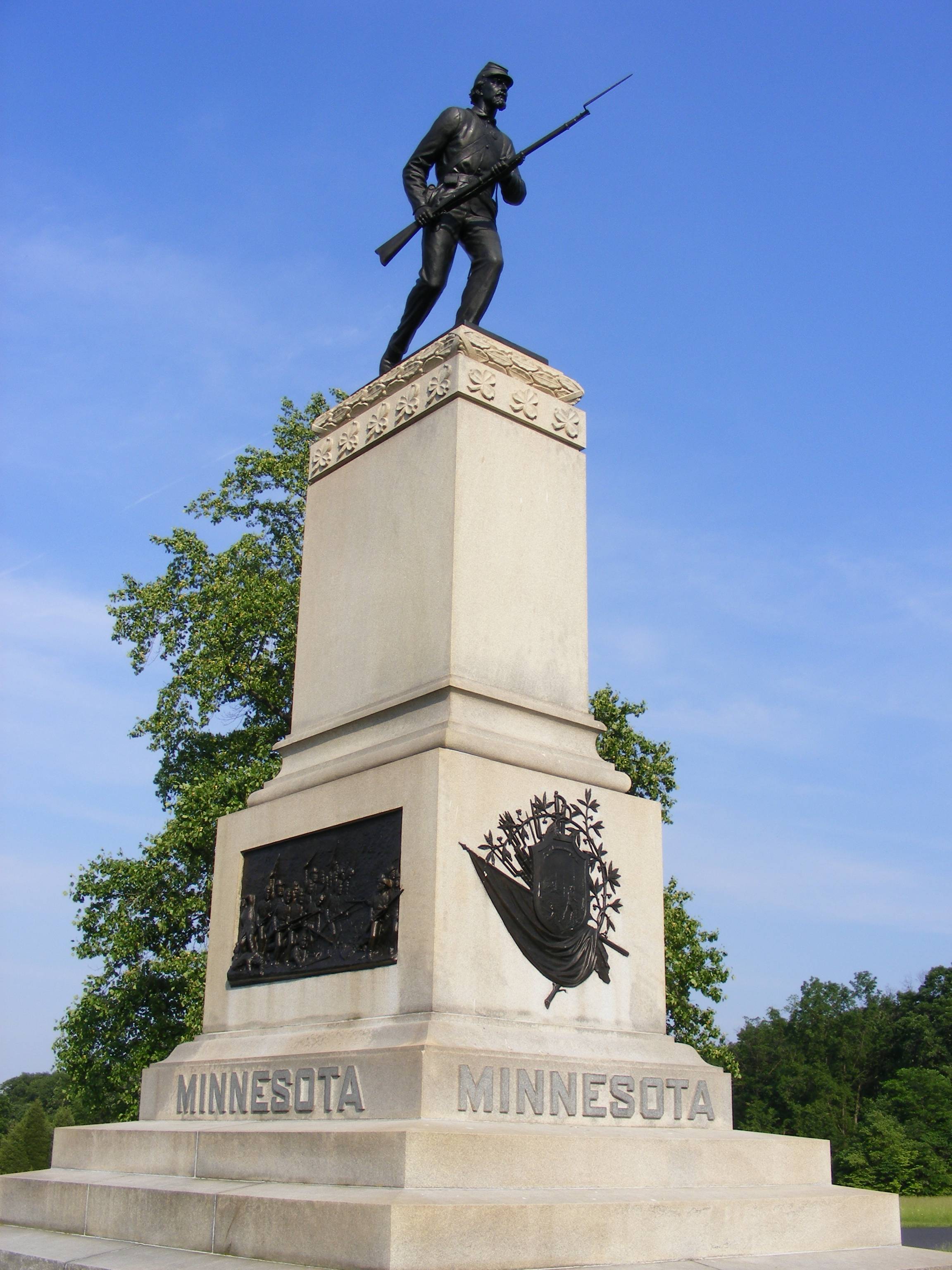
“On the afternoon of July 2, 1863 Sickles’ Third Corps, having advanced from this line to the Emmitsburg Road, eight companies of the First Minnesota Regiment, numbering 262 men were sent to this place to support a battery upon Sickles repulse. As his men were passing here in confused retreat, two Confederate brigades in pursuit were crossing the swale. To gain time to bring up the reserves and save this position, Gen Hancock in person ordered the eight companies to charge the rapidly advancing enemy. The order was instantly repeated by Col Wm Colvill. And the charge as instantly made down the slope at full speed through the concentrated fire of the two brigades breaking with the bayonet the enemy’s front line as it was crossing the small brook in the low ground there the remnant of the eight companies, nearly surrounded by the enemy held its entire force at bay for a considerable time and till it retired on the approach of the reserve the charge successfully accomplished its object. It saved this position and probably the battlefield. The loss of the eight companies in the charge was 215 killed & wounded. More than 83% percent. 47 men were still in line and no man missing. In self sacrificing desperate valor this charge has no parallel in any war. Among the severely wounded were Col Wm Colvill, Lt Col Chas P Adams & Maj Mark W. Downie. Among the killed Capt Joseph Periam, Capt Louis Muller & Lt Waldo Farrar. The next day the regiment participated in repelling Pickett’s charge losing 17 more men killed and wounded.”
On July 2, 1863, in Gettysburg, Pennsylvania, 262 Union soldiers in the First Minnesota Regiment rushed—which apparently specialized in desperate fighting-–to throw themselves into a breach in the Union line at Cemetery against a greatly superior force, knowing that they were almost surely to die. 215 of them did, but the regiment bought crucial minutes that allowed reinforcements to arrive.
It is perhaps one of the most inspiring of the many acts of courage that day, the second day of the battle that changed the course of the Civil War. I first wrote about the sacrifice of the First Minnesota five years ago, here.
Let’s try to remember.
(A recommendation: Sometime between July 1 and the Fourth ever year, we always watch Ted Turner’s excellent film, which also has one of my favorite film scores. It helps.)
 Ethics Alarms