Ethics Hero: The Boston Red Sox

Hold onto this one, Derek.

They can’t play baseball very well right now, but the Boston Red Sox*, my home town team, currently in last place in the American League East, knows how to make an ethical and generous gesture of respect and gratitude.

It has been largely forgotten now, but pitcher Derek Lowe was a big disappointment to the Red Sox during the regular 2004 season, barely winning as many games as he lost and pitching to a high earned run average. In the play-offs and World Series, however, Lowe was as good as good as a starting pitcher could be, going 3-0 and winning the clinching games of both the team’s stunning comeback play-off series win over New York and it sweep of St. Louis to win Boston’s first World Championship since 1918.

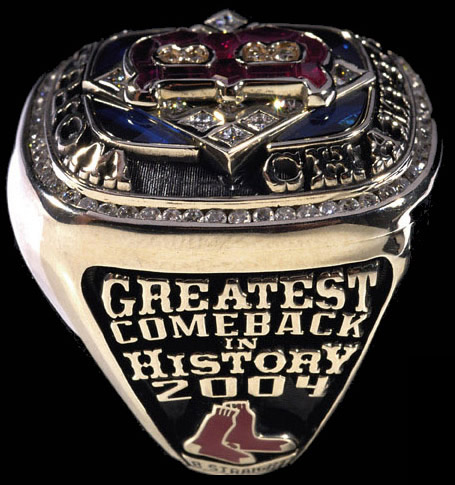
Tired of Lowe’s inconsistency and unpredictability (he had a reputation of partying too hard, especially on road trips), the Red Sox let him leave as a free agent after the 2004 season. Since 2004 he has been for the Atlanta Braves what he often was for Boston: a sometimes brilliant starting pitcher with a deadly sinkerball, and for the Red Sox, a distant memory. Last season Lowe’s home was robbed, and among the more than $90,000 of baseball memorabilia that was stolen was his Championship ring from that 2004 season. His insurance covered the monetary loss, but the ring, Lowe’s personal symbol of his key role in a Historic sports event, was lost forever.

Last week, when he was in Boston with his latest team, the Cleveland Indians, Lowe beat the Red Sox as a starting pitcher, and later received a message from the Red Sox owners that they wanted to give him something. Then John Henry, Larry Lucchino and Tom Werner, the trio of tycoons who have owned the team for a decade,  personally presented him with a 2004 World Series ring to replace the one that was stolen from his Florida home. Continue reading


Comment of the Day: “Ethics Chess Lesson: The Tale of the Kidney and the Ungrateful Boss”

New commenter Christine has a valuable personal experience to relate, as an individual who donated a kidney to a stranger herself.  The main thrust of her post covers a topic that I have written on before but did not mention in this case, though I should have. Someone who performs a kind and generous act counting on rewards, copious thanks and gratitude, is  doing it for the wrong reasons. The act itself is all that matters. Certainly, gratitude is the right way to respond to generosity, but an act done in anticipation of personal benefits isn’t really altruistic. It is opportunistic. This is a cliché to be sure, but true nonetheless: the generous act must be its own reward.

Here is Christine’s Comment of the Day on the post, Ethics Chess Lesson: The Tale of the Kidney and the Ungrateful Boss.

I want to also commend Christine for following the comment policies, which many of the new visitors here who commented on this post did not do. I prefer full named on posts, but I only require that I am informed of  every commenter’s real name and have a valid e-mail address within a reasonable time of their first submitted comment. One way or the other virtually all of the regular commenters here have managed to do this, and it makes a difference, even in my responses. I regard such commenters as collaborators , not just marauders, and most of the time, I treat them accordingly:  tgt, Steven, Lianne, Margy, Glenn, Tim, both Michaels, Karl, Neil, Karla, Rick, blameblakeart, Barry, gregory, Eric, Curmudgeon, Eeyore, Julian, King Kool, Joshua, Jay, Tom, Bill, Danielle, Elizabeth, Patrice, Ed, Bob, The Ethics Sage and Jeff…I know there are others.   Thanks to all of you for letting me know who you are.

Now, Christine: Continue reading

“Pay-What-You-Can” Ethics

A live performance of Jules Feiffer's "Little Murders" at a regional theater in Arlington, Va. that holds "pay-what-you-can" performances over the periodic objections of its artistic director, me.

Toronto Star ethics columnist Ken Gallinger does a pretty good job today answering a query from a financially strapped theater-lover who feels guilty about attending “pay-what-you-can” professional stage productions. “…My husband says paying less than full fare takes advantage of the theatre company. Technically, we could pay the ticket price; we still have access to credit. And there are things we could cancel…What do you think?” asks the inquirer.

Gallinger explains the benefits to the company of not having a sea of empty seats facing the actors, and also how discount tickets have promotional value to theater companies. All true: the theater companies wouldn’t offer “pay-what-you-can” if they didn’t think it was in their companies’ long term interest. There are other benefits that Gallinger doesn’t mention. For example, the increased audience size still contributes to the average audience statistics that a non-profit company can use to seek advertisements and to argue for community foundation grants.

Even this wouldn’t cover the topic, however. “Pay-what-you-can” and other discount ticket programs are essential if theater companies are going to meet their own ethical obligations to the community, and if live theater is going to survive at all. The ticket prices at most large, established regional theaters are, in a word, unconscionable. Justifiable perhaps, since live theater costs more to produce than can be paid for by box office receipts, but still unconscionable. Continue reading

An Ethical Holiday

I’m going to concentrate on trying to make the beginning of the holiday water-slide (which always starts on November 23, my wedding anniversary—this is our 31st, as I was married when I was 13) as memorable as possible, so unless something earth-shattering occurs, Ethics Alarms will be at status quo until sometime tomorrow. In the meantime, I want to wish all of you a very happy Thanksgiving.

Like many holidays, Thanksgiving is firmly rooted in ethics. One doesn’t have to be religious to acknowledge the fact that we have much to be grateful for, even in difficult times personally, nationally, and culturally. Gratitude is closely linked to modesty, humility and proportion in the hierarchy of values. American tradition urges us never to be satisfied with things as they are, but we should always be humbled by the fact that there are so many ways things could be far worse. There is no better time to begin a personal tradition of kindness and generosity toward others to last the year, or a lifetime.

In Southwest Washington, D.C., a section of town plagued with poverty, crime and violence, convenience store owner Ephrame Kassayegave out 375 turkeys as gifts to the community, in thanks and recognition of their loyalty. He said he was grateful for his patrons, and wanted to show it. That’s what Thanksgiving should mean, and that’s why it isn’t just a way-station between Halloween and Christmas. If nothing else, we all have each other in our families, communities, nation and world to make our lives richer, and if one day on the calendar helps remind us of that when we are feeling angry, anxious, envious and sad, it’s a day well spent. Life’s worth the trouble. Pass it on.

Have a wonderful Thanksgiving, everybody.

Ethics Hero: Robert Downey, Jr.

Superhero on the outside, Ethics Hero on the inside.

Show business Ethics Heroes are about as rare as credible presidential candidates; after all, Hollywood is one of two environments where the ethical culture is even more warped and cynical than Washington, D.C. (The other: the Columbia drug cartels.) Yet a genuine Ethics Hero emerged at the 25th annual American Cinematheque Award gala, when honoree Robert Downey, Jr., now a major star and industry power player, threw his prestige and influence behind a genuine industry pariah, Mel Gibson, in an act of kindness, gratitude, and reciprocity.

After Downey accepted his award before a cheering crowd of important performers and artists, he unexpectedly devoted his moment in the spotlight to recall how Mel Gibson, when Downey’s career had been devastated by habitual substance abuse and Gibson was a megastar, constantly supported him, encouraged him and refused to give up on him, though the Hollywood community had. The “Iron Man” star explained how Gibson, in 2003, gave Downey a starring role in “The Singing Detective,”  which had been developed for Gibson himself, because nobody else would give the troubled actor another chance.  Gibson even paid the insurance premiums for Downey, because the studio would not accept the risk of hiring him, given his history of drug addiction and legal problems. All  Mel asked in return, Downey recalled, was that Downey resolve to help out the next actor who had hit bottom and had no friends in the Town Without Pity. Continue reading

Ethics Dunce: The American Cancer Society

According to the Foundation Beyond Belief, a secular charity “funded by atheists, freethinkers, and humanists,” the American Cancer Society has rejected its offer to raise up to a half million dollars for cancer research through the American Cancer Society‘s Relay for Life program. The ACS declined to allow the Foundation to field a national relay team, though every other non-profit that has applied has been allowed to participate.

Talk about “beyond belief”: I have a hard time accepting this story as true, though it is being reported by respectable sources. Why wouldn’t the Society, whose mission is to help those with cancer, including helping them by finding a cure, turn down any group’s generosity, as long as its donation wasn’t going to be raised through illegal means? Bank of America, CitiBank, Goldman Sachs, Wal-Mart and other companies whose reputation is hardly without tarnish are among the ACS’s listed donors…and as we know, a lot of the people who run these companies worship Mammon, not God. Continue reading

Unemployment Check Ethics: “The Ethicist” Gets It Right

I regularly check the competition, and “The Ethicist,” Ariel Kaminer, has been solid lately. This past week, she avoided falling into a trap that I am certain her predecessor, Randy Cohen, would have charged into.

The questioner asked Kaminer whether it was unethical “for a relatively wealthy person” to receive unemployment checks, even if he or she met  the requirements. Moreover, “Is the answer different in times like the present, when government resources are extremely strained?” Continue reading

Ethics Quiz: Is It Wrong For A Rescuer To Sue The Victim He Rescued?

"OK, Princess, you'll get my bill for this rescue in five to seven business days."

On March 11, 2009, Mark Kinkaid and David Kelley were riding in Kinkaid’s truck when they saw a detached bumper, headlights and all, lying in the middle of Rt. 23.  Smoke was rising up from the highway embankment,  and the two men concluded that someone was in trouble. The truck stopped, and they got out, hopped a barbed-wire fence, made their way down the steep highway embankment, where they saw a flaming Hummer. Theresa Tanner was trapped inside, screaming for help. They forced their way into the vehicle, pried a door open and pulled Tanner out. She was injured and burned, but after weeks in intensive care, survived.

Now Kinkaid and David Kelley are suing Tanner, claiming that the crash was her fault and that she is liable for the injuries they sustained in rescuing her. They have filed a lawsuit asking for damages of at least $25,000 each. “All I know is that I am not the same man I used to be,” says Kelley, a 39-year-old truck driver and father of five, who says the heavy smoke and fire that day damaged his lungs so that he can’t carry a laundry basket up the three flights of stairs in his home.

The law provides a rationale for such a lawsuit. “The precedent is clear: danger invites rescue … and if you’ve acted recklessly or negligently and someone gets hurt rescuing you, you could be in trouble,” says Stan Darling, a tort law specialist. A well-established principle known as “the Rescue Doctrine” holds that if someone is in peril because of their own negligence or recklessness, an injured rescuer can recover damages if he acted reasonably and can prove that his injuries were caused by the rescue attempt.

That’s the law, however. This is ethics, and your Ethics Quiz today is:

Is it ethical for a rescuer to sue the person he rescued? Continue reading

Ethics Hero: Barry Bonds

I never thought it could happen.

The four words above rank near the top of my list of “Things I Will Never Think, Feel, or Write,” somewhere between “I love the New York Yankees” and “I’m skipping the ethics seminar because I don’t want to miss the finale of “Dancing With The Stars.”

Former San Francisco Giants slugger Barry Bonds has arranged to pay the college tuition for the children of Bryan Stow, the San Francisco Giants fan who was beaten into a coma outside Dodger Stadium on Opening Day. Both of his children are currently in grade school. By the time they are ready for college, it is estimated that the average tuition will be only slightly less than the national debt.

Barry can afford it, of course, but that is irrelevant. There is no way to spin this into anything but a profoundly kind and generous act of compassion toward a stranger. Bonds did not announce the pledge, or send out a press release. It was not an effort to bolster his public image in the wake of his recent conviction for misleading a federal grand jury regarding his use of steroids. He was not trying to change anyone’s opinion of his baseball controversies, and it is unlikely to. Bonds was just doing something extraordinarily generous, for a man and a family who have been struck by a terrible and senseless tragedy. Stow family attorney Thomas Girardi revealed yesterday that Bonds made the pledge to Stow’s son and daughter after visiting the family in the hospital on April 22. Bonds has said nothing about it.

I have been very critical of Barry Bonds’ conduct for many years, and there is much to criticize. None of that should reduce the praise and admiration due to him for this extraordinary act. Barry Bonds is an Ethics Hero. That’s all there is to it.

What happened on “Dancing With The Stars” last night?

Is Corporate Philanthropy Unethical? No, But It’s Important to Ask the Question

I gather not very many readers sample the links on Ethics Alarms, which is a shame. They contain a lot of different approaches to ethical issues, from many philosophical approaches. Well, heck…I use them , which is really what they are here for. One of the more original thinkers represented among the various sites is Jason Christopher Cockrell, author of The Worst-Case Scenario. It appears that he has abandoned blogging, which is a shame, but his last post, at the end of 2010, was full of surprises. In it, he offered an argument against corporate charity, something I have never heard anyone criticize on any level, except to say that there isn’t enough of it.

The theory behind corporate philanthropy is that it is a win-win for everyone involved. The corporation enhances its public reputation and visibility, improving employee moral and making investors proud to hold stock. Society benefits from substantial contributions that support everything from cancer research to Sesame Street to regional theater. It is hard to imagine what the charitable landscape would look like without corporate philanthropy, but the thought of eliminating it is sufficient to give any professional fundraiser hives. I know—both I and my wife were development officers for many years. Continue reading