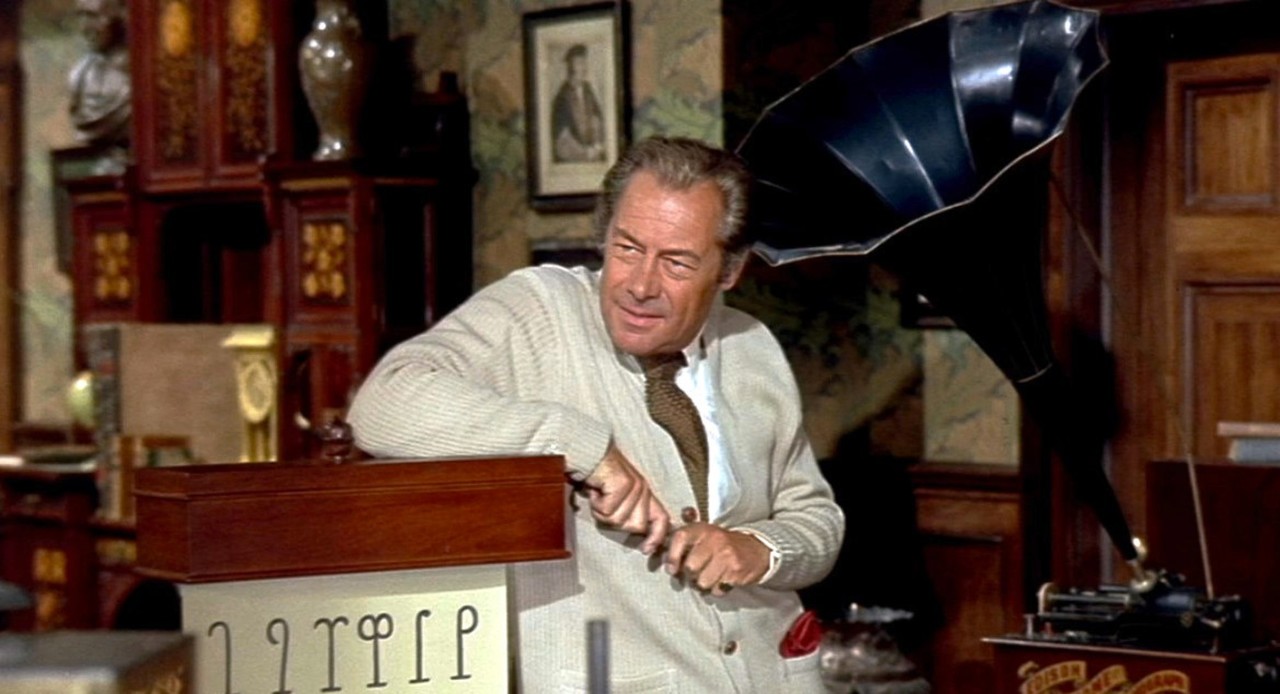
Say Howdy To The Latest Addition To The Rationalizations List: #1D, Higgins’ Misconception”

Higgins

The title of Rationalization 1D comes from literature, specifically George Bernard Shaw’s 1912 drama, “Pygmalian,” better known today for its musical adaptation,”My Fair Lady.” The moment when Shaw’s obnoxious and misanthropic antihero Henry Higgins defines his rationalization occurs in Act 5; Alan J. Lerner lifted it almost verbatim for his book of the musical. Arrogant speech expert Higgins, having been rebuked by Eliza, the flower girl whom he taught to speak like an upper-class British woman to win a bet, for his cruel and uncivil conduct toward her says in his defense,

HIGGINS. … If you come back I shall treat you just as I have always treated you. I can’t change my nature; and I don’t intend to change my manners. My manners are exactly the same as Colonel Pickering’s.

LIZA. That’s not true. He treats a flower girl as if she was a duchess.

HIGGINS. And I treat a duchess as if she was a flower girl.

LIZA. I see.

HIGGINS. Just so….The great secret, Eliza, is not having bad manners or good manners or any other particular sort of manners, but having the same manner for all human souls: in short, behaving as if you were in Heaven, where there are no third-class carriages, and one soul is as good as another.

I immediately thought of this exchange when Gov. Andrew Cuomo of New York, in his rambling denial of multiple sexual harassment and sexual assault allegations, proclaimed his innocence (His victims don’t understand him!) by arguing that as a red-blooded Italian he’s just wired to be physically demonstrative, and treats everyone the same way.

Continue reading

Casting Ethics: A Black Joan Of Arc?

Sure, why not?

From Playbill:

Manhattan Theatre Club has announced a Broadway revival of “Saint Joan” by Nobel Prize and Oscar winner George Bernard Shaw with direction by Tony winner Daniel Sullivan. Heading the cast as the famous heroine will be Condola Rashad, fresh off her Tony-nominated performance in “A Doll’s House, Part 2.”

Superficially, at least, the casting of Rashad, an African American actress, as the famous “Maid of Orléans,” the French teenager who gained political and military power as a self-proclaimed messenger of God and who was burned at the stake, would seem like precisely the kind of stunt non-traditional casting that I have condemned by subjugating the intent and art of a playwright to affirmative action and virtue-signaling. However, this is not a legitimate objection to this casting choice, and in fact the upcoming Broadway production is as close to a perfect example of how creative casting can enliven a production and deepen its ability to make an audience think.

Joan of Arc, of course, was not black. Nor was she Swedish, though Ingrid Bergman played her memorably enough in the most famous Hollywood version of  Shaw’s play, She also didn’t speak English, and certainly not Shavian English. She spoke French. Ethnicity, race and color are not part of Shaw’s drama, however, nor are they relevant to what Joan of Arc did in life, and what she meant to her nation, its history and our shared Western culture.

How many public schools teach anything about Joan of Arc? How many U.S. students graduate completely ignorant of the historical Joan, not to mention Shaw’s version? Yet hers is one of the most remarkable stories in recorded history.

Joan of Arc was born around 1412, the daughter of a tenant farmer, Jacques d’Arc, from the village of Domrémy, in northeastern France. She was illiterate, as were most  of her class and gender, but also was indoctrinated into the teachings of the Catholic Church by her mother.  France was engaged in what we now call the Hundred Years’ War with England, and England had France by the throat.  A forced  treaty in 1420 disinherited  Charles, French crown prince, and England’s King Henry V—there’s a famous play about him, too– was made ruler of both England and France. Upon his father’s death, Henry VI succeeded him as king in 1422. At this point England occupied much of northern France, and many in Joan’s village, Domrémy, were forced to abandon their homes under threat of invasion.

Thirteen year-old  Joan began to hear voices in her head. Today we think the cause was tinnitus, but she was certain God was assigning her the mission of  saving France by defeating the English, and installing Charles as its the rightful king. Joan took a vow of chastity, as part of her bargain with God; this allowed her to reject a marriage her father arranged for her when she was 16.

Around this time, Joan traveled by herself to  Vaucouleurs, a nearby stronghold of those loyal to Charles. With her faith and her persuasive claim of being a holy messenger, she attracted a small band of followers who were convinced her sudden appearance was the the result of a popular prophecy coming true, and that she was destined to save France. Joan cut her hair short and dressed in men’s clothes to make an 11-day journey across enemy territory to Chinon, where the crown prince’s palace stood. She met with the young man, and convinced him that she was the Real McCoy (they didn’t use that phrase in France, of course)  by allegedly telling him things only God would know. She also  promised Charles that she would see him crowned king at Reims, the traditional site of French royal investiture, and asked him to give her an army to lead to Orléans, then under siege from the English.

Charles granted her request. Think about this for a bit. A strange teenage girl, dressed like a boy and claiming to hear voices, meets with the leader of a nation at war and convinces him to put her in charge of an army.

Amazing. Continue reading

The Perplexing Ethics Of Shorts In Courts

Interestingly, the words aren't necessary. The tee shirt is enough.

Interestingly, the words aren’t necessary. The tee shirt is enough.

The New York Daily News thought it was newsworthy that a North Carolina judge objected to a man appearing in court for a hearing dressed in a tee shirt and shorts. “Why are you going to show up to court dressed like that based on these charges?” the judge asked. Not getting what she felt was an appropriate response, she postponed the hearing. The offense involved was a particularly horrific one:Matthew Deans, 28, of Wilmington, N.C.,was charged with two misdemeanor counts of death by vehicle and two other charges in connection with the crash. He is free on $10,000 bail while awaiting trial.

On May 23, Deans’ commercial box truck allegedly ploughed into the back of the car belonging to Hadley and Gentry Eddings,, who were stopped at a traffic light. The Eddings’ 2-year-old son was killed in the crash, and an infant delivered by emergency ceasarian section in the hours after the wreck died as well.

For reasons that are not germane to this post, I’ve been in court a lot lately. When I was taking criminal defense cases, I carefully monitored the in-court attire of my clients, emphasizing that it was crucial for them to display respect for the judge and the system, as well as appropriate appreciation of the seriousness of the offenses charged. Almost without exception, defendants appearing in court today are in casual, often sloppy attire. This shows the stupidity of those appearing, the incompetence of their attorneys, and irresponsible upbringing, schooling and socialization. Continue reading

Unethical Pundit of the Week: The Daily Beast’s Dana Goldstein

I try not to consider political punditry unethical, except when the opinion rendered is unusually dishonest, misleading, uncivil, or unfair. Unfortunately, the current ideological blood sport fostered and nurtured by such outlets as Fox New, MSNBC, the Daily Kos and Breitbart, and carried on by such commentators as Ann Coulter and Frank Rich, make it increasing difficult to follow my own guideline. Occasionally there pieces so outrageously unfair that they make me angry, and those are ethically perilous: emotion is not conducive to balanced analysis. Usually I pass. The recent screed of Dana Goldstein on The Daily Beast, however, has to be condemned.

I just hope I can get through the process of explaining what without becoming furious.

It is entitled “Is Jan Brewer Anti-Immigrant Because She Didn’t Go to College?,” earning an ethics red flag right off the bat for intentionally equating Arizona’s anti-illegal immigration law with being “anti-immigrant,” which it is not.  Continue reading