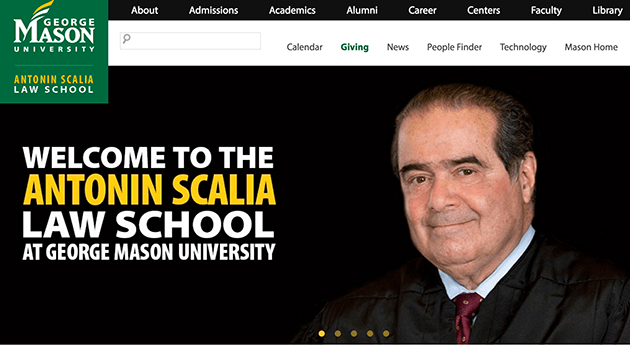
Summary: On March 31, George Mason University announced that it was changing the name of its law school, which has rapidly risen from marginal status into respectability in the last few years, to the Antonin Scalia School of Law. The reason: a 30 million dollar contribution from the Charles Koch Foundation, a.k.a. the Koch Brothers and an anonymous donor, who made the name change a condition of his or her generosity. This occurring while the various controversies over Scalia’s legacy and the Supreme Court’s deadlock since his passing were still raging guaranteed indignation from many quarters, including many students and graduates of the law school. The internet and social media communities, meanwhile, having the emotional maturity of fifth graders, concentrated its efforts at snickering over the new school’s acronym, which could be ASSoL, and the Twitter handle, #ASSLAW.
The resulting embarrassment led the school’s Dean to announce that the name of the school was being altered to “Antonin Scalia Law School.”
Comments:
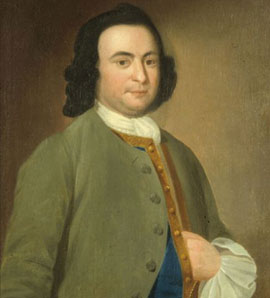
1. Ethics Alarms had a recent post expressing dismay at the willingness of baseball teams to sell the identity of their ballparks to corporations. This is much worse. George Mason is perhaps the most unjustly forgotten of all the Founders, as he was largely responsible for there being a Bill of Rights in our Constitution The fact that George Mason University and its law school has been slowly rising in prestige and visibility had helped to remedy the unjust obscurity of a historical figure to whom every citizen and the world owes a debt of thanks. George Mason’s honor, however, was considered expendable once the school’s leaders knew the price that using the law school for ideological propaganda could bring at a time of sharp partisan division.
2. Rich people have a right to use their money to make others do things that they shouldn’t or normally wouldn’t want to. The issue is whether there are ethical limits to the kinds of actions and conduct money should be used to buy. Rich families have used their assets to defeat true love, paying unsuitable suitors to leave without explanation. Desperate celebrities have accepted checks to debase themselves on reality shows. Judas was paid to betray Jesus Christ. Where does using one’s millions to induce a university to betray its duties to alumni and students, as well as other donors and the memory of a crucial American patriot, fall on the spectrum?
3. Was George Mason University obligated to accept 30,000,000 dollars under these conditions? Should money supersede all other considerations for an educational institution? No, and no. Allowing the school to be turned into a billboard for conservative jurisprudence did more than simply alter the name. It altered the perception of the law school, the meaning of its degrees, its public image and its ability to attract a wide range of students from diverse backgrounds. If the school’s leadership didn’t comprehend that, it was a stunning example of institutional incompetence and irresponsible decision-making.
4. If the school’s leadership did comprehend the gravamen of the name change and allowing partisan tycoons to bend the school’s management to their will, then the decision was even less defensible. There was an absolute obligation to consult with the stakeholders in this trade-off: students, alumni, and donors. Failing that obligation constituted a stunning breach of trust. Continue reading
 Ethics Alarms