More Interview Ethics: Janet Mock Ambushes Piers Morgan

janet_mock_piers_morgan_1_16x9_1600

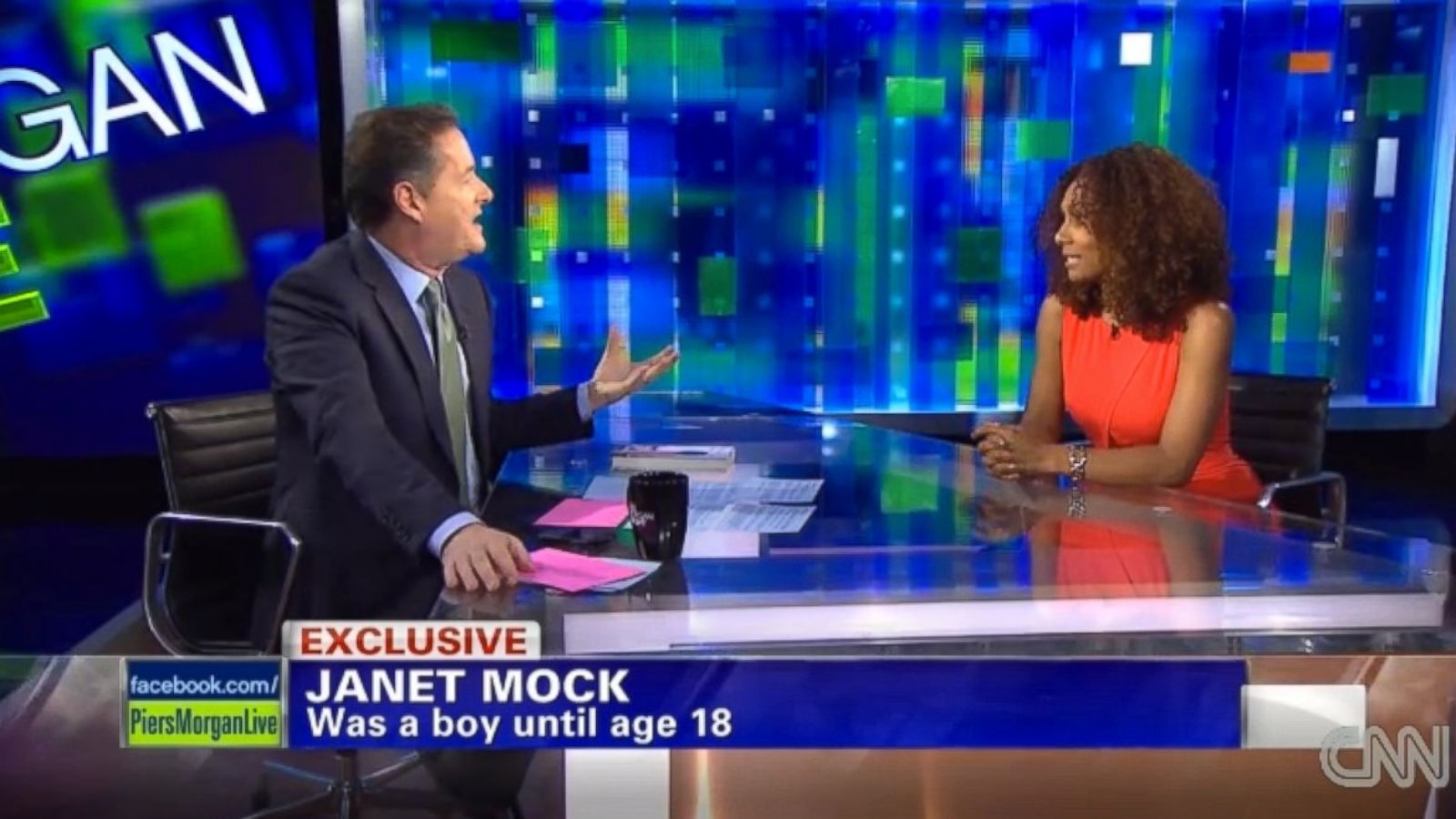
Piers Morgan, CNN’s imported British tabloid reporter turned Larry King replacement, invited trans author and activist Janet Mock on his show to promote her new memoir, “Redefining Realness: My Path to Womanhood, Identity, Love & So Much More.” As I watched the interview (because of Mock and not Morgan, who makes my skin crawl), I was struck by how far such interviews have come since David Susskind would invite transgendered individuals on his PBS show—this was classy, remember—and essentially hold them out as freaks. Morgan was respectful and supportive, though the sensationalist aspect was still there but muted: the text under Mock during her interview read “BORN A BOY,” and “was a boy until age 18,” which are, though accurately describing how most CNN viewers would understand Mock’s journey, over-simplified and counter to how Mock describes herself.

Mock seemed happy, Morgan seemed gracious. Then Mock went on Twitter and Buzzfeed to pronounce Morgan a clueless, ignorant, biased jerk.  He was, shockingly, “trying to do infotainment” Mock said. Morgan’s show is the epitome of infotainment, and everybody knows it. She criticized him for “sensationalizing” transgender people while neglecting a substantive discussion about her book. The sales of Mock’s memoir depend on its sensational aspects, again, as she and her publisher well know. Mock accused Morgan of asking the same kinds of embarrassing questions about body parts and boy friends that non-trans people are inevitably curious about. Well, of course he did…because that’s what his audience is curious about.

None of this was communicated to Morgan either before, during, or after the interview. Morgan, who is no Sam Rubin, was incensed, and struck back via Twitter, since that is the forum where Mock chose to publicly attack him. In various tweets and exchanges he called Mock cowardly, “churlish,” and shameful, and criticized her allies as well, as she successfully brought down the progressive hoards on Morgan’s head. The same week, he invited her back to on the show along with a panel so he could defend himself while assailing her conduct. You can read the transcript of that show here.

What’s going on here? Continue reading

Ethics Quiz: “The Penniless Girl” And The Yechhh! Competition

"Hey...I'm cute, without shame, ambitious, mean...I could be a reality TV star!"

“Hey…I’m cute, without shame, ambitious, mean…I could be a reality TV star!”

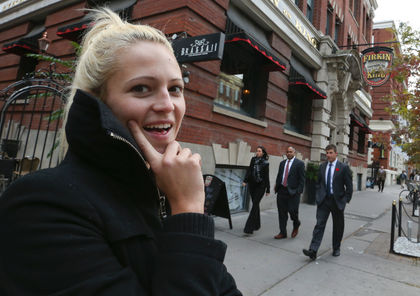
Actress Erin Wotherspoon, 24, lives in Toronto and has an unusual avocation. As she describes it on “A Penniless Girl, Bad Dates and Plenty of Oysters”,

“I’ve got a pretty face & a pretty extensive urban spoon wish list…We all know that getting what you want in life can be tough. Which is why I’ve decided to let someone else finance my dreams. My dream? To eat in pretty restaurants without costing me a penny. You had me at Elk Tartare, lost me at chin strap. Follow me to learn who I screw over, bang and love as I navigate Toronto’s diners, drive-ins & dives.”

Yes, as breezily chronicled on the Tumblr blog, Erin entices unenticing, lonely and hopeful men to feed her at Toronto’s best eateries, then dumps them unceremoniously once the bill has been paid. As her mission statement above demonstrates, she doesn’t see anything wrong with this, despite the fact that it is dishonest, cruel, manipulative and a straight-up violation of both Kantian ethics (don’t use people) and the Golden Rule, as well as a pure as crap example of an ends justifies the means life philosophy. Are some of Erin’s escorts using her as well, essentially buying faux affectionate companionship for the cost of some elk tartare? Oh, surely. Such individuals use their affluence to sully the dignity and integrity of others for a price. The fact that one is being unethical in his dealings with another who is also unethical—mutual users, mutual corrupters—is no justification.

Now, as someone—maybe even Erin—could have predicted, a U.S. reality show producer wants to make a star out of her, and it appears that we may soon be able to watch Ellen dupe wannabe sugar daddies into delicious and free meals weekly.Then she can give an interview to GQ and explain why gays are sinners.

Your Ethics Alarms Ethics Quiz as 2013 winds down to an ethically depressing finale:

Who is more unethical: “the Penniless Girl” or the TV executives who want to make her rich and famous?

For me, it’s an easy call: the reality show purveyors are much worse than Erin. Selfish, deceptive, exploitive conduct is wrong and more harmful to society the more of it we get. Reality shows and the other ways the United States and its media reward terrible conduct—CNN giving Eliot Spitzer his own show, MSNBC doing the same with Al Sharpton, Fox employing sleazy (but famously sleazy!) Dick Morris, and the radio shows for the likes of Ollie North and G. Gordon Liddy come to mind, and now I’m nauseous again—make being unethical (or drunk, or stupid, or pathetic) a ticket to stardom, and even a desirable career path. It isn’t only reality shows, of course. It’s Republicans cheering Phil Robertson as if what he said wasn’t offensive; it’s Joe Wilson getting boat-loads of contributions off of shouting “You Lie!” at the President of the United States; it’s Tom Delay and Kim Kardashian getting gigs on “Dancing With The Stars” for being indicted and making a sex tape, respectively; it’s Kanye West, Miley Cyrus and other pop “sensations” receiving dawn to dusk publicity and inflated recording sales by behaving badly. We stifle liberty and expression by organizing boycotts against those whose conduct is objectively or subjectively offensive, but to reward them for it is courting cultural suicide, and turning the usual process of establishing healthy societal standards upside-down and inside out.

________________________________

Pointer: Fark

Facts: Toronto Sun, Tumblr

Graphic: Toronto Sun

Is It Ethical To Take, Display and Publish Photos Of Sleeping Sunbathers Without Their Permission?

That’s what Tadao Cern did for his his art project, entitled Comfort Zone, to “explore how different surroundings can affect people’s behavior and inhibitions.”

When someone takes a photo of you in such circumstances, you suddenly find yourself in a gallery in front of  a giant photo of this, while your husband busts a gut:

Sunbather art

Of course it’s not ethical!

If you need some more hints as to why, read the tags below.

________________________

Pointer: Althouse

Source: The Guardian

Ethics Dunce: Virginia Democratic Lieutenant Governor Candidate Ralph Northam

Democratic Party candidate Ralph Northam cannot possibly lose the Virginia Lieutenant Governor race today; in fact, he should win by a landslide. His Republican opponent, African-American minister E. W. Jackson, is so conservative he makes his running mate, gubernatorial candidate Ken Cuccinelli, look like Saul Alinsky, and I’m only exaggerating a little bit. From the pulpit, he has made statements that sound like they were ghosted by Pat Robertson in one of his crazy moods, like when he seemed to be suggesting that children with birth defects were being punished for their parents sins. Jackson doesn’t believe in evolution, thinks that government programs have done more harm to blacks than slavery, and could fairly be described as homophobic.

Still, he is a citizen, a candidate and a human being, so when he offered his hand to his soon-to-be victorious opponent Northam following a TV debate, there was only one decent, civil, ethical, statesmanlike response for Northam: take it, and shake it. That is traditional, civilized, and polite, and for Northam to do what he chose to do instead—ignore Jackson and his hand and snub the Republican, refusing even to look him in the eye—on live TV, no less!— shows him to be an arrogant, unmannered, uncivil jerk of the breed that has brought American politics, government and discourse to a new low. Continue reading

The Klan’s Birthday Cake, Individual Boycotts And The Ethics Of Refusing to Give Service To Jerks

"Happy Birthday to You! Happy Birthday to You! Happy Birthday, Dear Racists..."

“Happy Birthday to You! Happy Birthday to You! Happy Birthday, Dear Racists…”

[UPDATE: Apparently, the “news story” that prompted this post is a fake. In that case, I want to thank the hoaxers for  inadvertently sparking a useful discussion—nothing in my post is dependent on the factual nature of the story. I wasn’t the only one fooled, and I originally noted the links on reliable sites. On the other hand, to hell with people who plant fake stories that are not obviously tongue in cheek or satirical: it’s a despicable practice, and abuse of the web, and right down there with public vandalism and creating computer viruses as unforgivable public conduct. I apologize to readers here for misidentifying a false story as true, but I’m not the unethical jerk involved. If anyone knows who that is, please forward their names. I have some choice words for them.]

As I wrote the first time I stuck my ethics big toe into this kind of controversy, I am conflicted over the current trend of forcing certain kinds of service providers to serve customers they just don’t feel like serving. I have consistently come down on the side of the rejected customer, even when the service, as in the case of bakeries and photography salons, edges perilously close to art. I think I am there still, but my resolve is weakening. I think. Let’s look at this again, in the context of the kind of recent case that always eventually occurs when one sits on the slippery slopes.

A three judge panel of a Georgia appellate court recently ruled in favor of Marshall Saxby, the Grand Wizard of a local KKK chapter, after he sued a local bakery for refusing to bake a cake for the KKK chapter’s  annual birthday party. Elaine Bailey, who owns Bailey Bakeries, said she rejected the Klan its activities violated her religious beliefs, and Saxby claimed that Bailey’s refusal of service discriminated against his religious beliefs.

The difficulty with making an ethical call on this case and others like it (and sort of like it, arguably like it or a little bit like it) is that the crucial question in ethics analysis, “What’s going on here?” cannot be answered with certainty or clarity. There are ethical arguments and ethical principles, on both sides, making the issue an ethical conflict (rather than an ethical dilemma). In an ethical conflict, we must prioritize among important ethical principles that are opposing each other.

Let’s answer “What’s going on here?” in some of the various ways this case allows, as if only one of these ethical principles were in play: Continue reading

Ethics Dunces: The Los Angeles Dodgers

The Los Angeles Dodgers clinched the National League West regular season championship last night by beating their divisional rivals, the Arizona Diamondbacks. Traditionally, when such moments occur away from the winner’s home park, they are celebrated with a happy mob scene around the pitcher’s mound and then a retreat to the clubhouse, where campaign and revelry reign.

But not in the case of the 2013 Dodgers. Seeing the inviting swimming pool that is a unique center field feature of Chase Field, the giddy Dodger team jumped the fence and splashed into the pool to celebrate. The Arizona Republic, in an editorial today, accurately expressed the reaction of the Diamondback fans and community:

“In the interests of good sportsmanship, here’s to the 2013 National League West Division champs.Congratulations are in order. Even to a bunch as classless as the Los Angeles Dodgers, the first players not wearing Diamondbacks uniforms to celebrate a championship by diving into the Chase Field pool. Informally, the Arizona Diamondbacks management had asked their Dodgers counterparts, should their lads clinch the division at Chase Field, to kindly celebrate in the clubhouse until the fans cleared out. For safety’s sake. Well, the Diamondbacks got their answer. Effectively: We got some “safety,” for you. Right here….” Continue reading

Cher’s Ethics Tweets

Lan 159

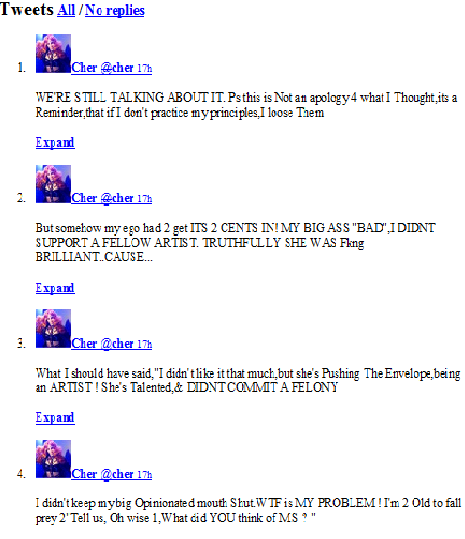
Earlier this week, Cher used her interview with USA to take some well-aimed pot-shots at Miley Cyrus’s universally loathed “twerking” antics on the MTV Awards show. She said of Cyrus

“”I’m not old fashioned. She could have come out naked, and if she’d just rocked the house, I would have said, ‘You go, girl.’ She could have come out naked, and if she’d just rocked the house, I would have said, ‘You go, girl.’ It just wasn’t done well. She can’t dance, her body looked like hell, the song wasn’t great, one cheek was hanging out. And, chick, don’t stick out your tongue if it’s coated. If you’re going to go that far, then think about it before you do it.

These are wise words from a veteran and proven performing star to a young one on the way up, or heading for a crash. Essentially, Cher is stating the principles of professionalism: whatever you do, do it right, do it well, and respect your constituency. Cher has the bona fides to offer such an opinion since she has stretched the lines of sexual propriety on stage more than once, but it was always used as an additional enhancement on the way to her “rocking the house.”

The legendary pop diva was apparently surprised that her comments became a one-day sensation on the gossip websites and cable entertainment shows, and  had second thoughts about them, which she communicated in a couple of tweets to the Twitterverse. In Cher-ese, they are all about ethics:

Chers Tweets

Translation: Continue reading

Ethics Mega-Dunce: The First National Bank in Wellston, Ohio

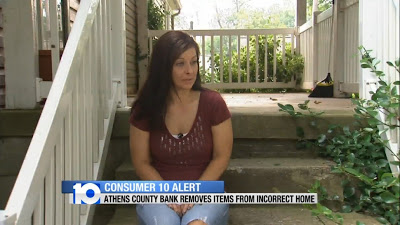
Katie Barnett, the victim.

Katie Barnett, the victim.

As I cull the news to find good topics for ethics discussions, the single thought that goes through my mind most frequently is this: “What is the matter with people?”  This is often followed by “How do people get this way?” and later, “What can we do with them?”

Most ethical decisions are not brain teasers. They are strikingly obvious, unless you are determined to do wrong, an evil super-villain, or were raised in a barn. How people of influence without a serious head injury can make the horrible decisions they do is one of the mysteries of the age, along with the fate of Judge Crater, the elusiveness of Bigfoot, and the continuing popularity of Jimmy Kimmel.

Imagine, for example, that you run a bank. The Three Stooges wannabes who you sent to repossess a home get the address wrong (the lawn hadn’t been mowed, so they “just assume”), and they trash the wrong house. They remove possessions, losing some, auctioning off others, damaging the rest. The innocent owner of the home comes to you and points out that your contractors screwed up outrageously, a fact that is beyond rebuttal. She presents you with a good faith estimate of the property that was lost—never mind the trauma of having her home emptied by strangers and the fact that she has had to live elsewhere for two weeks. What do you do?

If you are the president of the First National Bank in Wellston, here’s what you do, because you have a non-functioning ethics alarm and more than a few screws loose in other places besides: you reject her assessment, and try to low-ball her on the amount.

“What is the matter with people?”

“How do people get this way?” Continue reading

Travel Ethics: Of Restroom Horror, Furious Apes and Dying Canaries

horrified_look

Perhaps with the sole exception of running into Larry Craig, my biggest fear in airport restrooms is encountering a bathroom stall that appears to have been last used by one of the baboons of the Kalahari. Why, in the name of humanity, would there ever be a reason for someone to leave a toilet seat dripping in urine, or the floor in front of the toilet covered and piled high with soaked and soiled toilet paper, or the toilet bowl filled with something that looks like it was deposited by an incontinent yak? Who among my civilized-appearing fellow travelers is secretly engaging in the manners of an Australopithecus? What ‘s the matter with these people? Continue reading

Food Network Thought Crimes

[Now that is a headline I never conceived of having to use.]

"Love your cooking, Paula, but that joke you laughed at in 1996 means that you're racist scum. Rot in Hell."

“Love your cooking, Paula, but that joke you laughed at in 1996 means that you’re racist scum. Rot in Hell.”

Paula Deen, Southern cuisine star of the Food Network, has been fired because of the public uproar after she admitted in a law suit deposition that she had, on occasion and in the past, used the term “nigger” and tolerated racist jokes. This outburst of honesty (she was under oath at the time) apparently justifies social network hatred being directed her way in waves, and Jake Tapper, on CNN (WHY do I keep watching CNN?) conducting an inquisition this afternoon in which he asked third parties whether formerly using “the N-word” means Deen is a racist.

I don’t give two hoots about Paula Deen or her career. I watch the Food Network about as often as I watch MSNBC or YES.  She has always seemed more than a little bit silly and dim to me, and the reasons for her popularity elude me. But if there are many Americans who grew up in the South when Deen did who never used “nigger” and who never laughed at a racist joke, I’ll be shocked. That isn’t a “everybody does it” excuse. That is a “stop condemning people who reflected their narrow culture until they gained some perspective and wisdom” explanation. My father grew up in Kentucky in the 20’s and 30’s. Do I think he would have answered a deposition the same way Deen did? I sure do, and if one percent of those attacking Deen now possess sufficient integrity, honesty and essential fairness to be worthy of licking my Dad’s combat boots, I’ll be even more shocked. Dad is hardly the only admirable individual who spoke this way in his younger years. During his successful campaign for the U.S. Senate in Virginia, former Democratic Senator and war hero (and my classmate) Jim Webb bravely admitted that he had also used “nigger” when he was younger, and that crucifying his Republican opponent, George Allen, for similar, long-past indiscretions was unfair. He was right about Allen, and his  defense applies to Deen as well. Continue reading