Comment Of The Day: “Depressing Ethics Notes From The Education Apocalypse, Part I”

In his Comment of the Day on today’s post about various graduation-related ethics stories, JutGory provides a veritable feast of delicious ethics morsels. It all began when he sent me an email suggesting as an ethics quiz candidate the story involving the student who had ChatGPT write the speech he submitted for approval to high school officials, intending all the while to sandbag them and deliver a different speech he knew they would never approve. I gratefully used the item but not as a quiz, judging it too easy: the Ethics Alarms position would be that using artificial intelligence to write anything one is supposed to write unassisted is unethical. Jut followed up with this COTD teeming with related ethics conundrums.

***

When I submitted #4, I asked if it might be an ethics quiz whether using ChatGPT to write the address.

You asked if I was being tongue in cheek.

The answer was not entirely. When I sent the e-mail, I had not finished thinking about the issues. Here were things I was mulling over:

1) Having AI write a speech for you is not as bad as a lawyer using it to write a brief.

2) It is certainly not as bad as the bait and switch in the other ethics breach he committed.

3) It was still deceptive to propose a speech you had no intention of giving; so was the wrong thing committed in the proposal of the speech, or in the drafting itself, or both?

4) It would not be plagiarism to give the speech because you are not really copying anyone.

5) This reminded me of the ownership issue of the photo taken by the monkey (you covered this); if you put in the parameters to ChatGPT, how much of the product can you claim as your own (because ChatGPT can’t really copyright it (Can it? Does it?)?

6) It also reminded me of the artist who entered an AI painting into a competition (again, covered here) and there were no restrictions on such submissions in the contest.

After I sent the e-mail, I concluded it was wrong but primarily based upon the dishonesty. Actually using ChatGPT to draft an address raises some of these other issues and the answer fits somewhere in the middle of that mess that I laid out.

Follow up question: would it be even worse if he had ChatGPT draft his negative address, as well? Does he get any credit for actually writing the address he gave? (That’s a little tongue in cheek, but still an appropriate question in this context.)

___________________

I’m baaaack….to offer my answers to the (let’s see) eight enumerated issues and the two follow-up questions at the end:

1. Rationalization #22.

2. Ditto.

3. Using any speech to deceive was the ethical breach, regardless of how it was written.

4. I agree. It’s not plagiarism, just as submitting a paper sold by a term paper mill isn’t plagiarism.

5. I expect this issue to be litigated sooner or later.

6. I wrote about that one, too. In that case, the program used can fairly be called just an artist’s tool, absent either a rule that prohibited it, though an ethical entrant would have checked with organizers before submitting the art for a prize. In this case, there is no question (is there?) that the student knew a speech written by a bot would be rejected.

7. No. The substituted speech was unethical from the first word: it couldn’t be made more or less unethical by the means of its production. I suppose the content could have made the speech more unethical, if, say, it were obscene or racist, or revealed national security secrets.

8. No. You don’t get credit for not doing something unethical.

What A Fine, Fine Role Model This High School Principal Is…If The Idea Is To Graduate Short-Cut And Rationalization Addicted Students Who Try To Tap-Dance Their Way Out Of Trouble!


Abby Smith, a graduating student at Parkersburg High School in West Virginia, noticed something vaguely familiar about  the speech given by the school’s principal, Ken DeMoss, at her graduation last week. Later, she went home and looked for a video of a speech actor Ashton  Kutcher (formerly the goof on “The 70s Show,” the goof who succeeded Charlie Sheen on “Two and a Half Men,” and the guy who took over froim Bruce Willis when Demi Moore decided she wanted a husband with hair) gave at the 2013 Kid’s Choice Awards. Then she edited DeMoss’s speech and Kutcher’s together, and posted them on YouTube.

There’s no doubt about it, as you can see above. The principal ripped off the speech.

Some might say that what Smith did was mean and unnecessary. No, it was responsible, essential, and gutsy. Students are taught in school, or are supposed to be,  to do their own work, a lesson especially hard to convey when the internet makes plagiarism  easy to do and hard to detect. The distinction between being inspired by another person’s creative output, using it as a foundation for an original work, borrowing phrases and ideas (with attribution), and, in contrast, stealing intellectual property and presenting it as your own, is a crucial one for students to understand. When a role model, a school administer, flagrantly does what the school must teach students not to do, and worse, does this  in front of students, and even worse than that, does it in the course of a speech about the virtues of hard work, such cynicism, laziness, and cheating must not be allowed to pass unnoticed, and I hope, unpunished.

After he was caught, “Kenny” issued this epicly horrible statement, incorporating rationalizations, unethical apologies, multiple logical fallacies, a Jumbo and, of course, lies: Continue reading

Most Unethical Principal Of The Year? Maybe. Dumbest Unethical Principal Of The Year? Definitely

Principle Stenner giving David McCullough's speech. You can't see that his pants are on fire from this angle...

Principle Stenner giving David McCullough’s speech. You can’t see that his pants are on fire from this angle…

[NOTE: the original post’s headline ended with the creative word, “defeinitely,” I know not why. My demon proofer caught it yesterday, but I just read his alert. I’m sorry.]

Principal Mark Stenner delivered the commencement address for the May 22 graduation ceremonies for West Boca High School. It may have sounded faintly familiar to some of the those in the audience; after all,  Massachusetts’ English teacher David McCullough gave virtually the same speech to the class of 2012 at Wellesley High School.  That speech went viral on YouTube with more than 2.5 million views. Known as the “You Are Not Special” speech, it got McCullough, the son of Pulitzer Prize-winning historian David McCullough, a book deal. Principal Stenner repeated this famous, extensively circulated speech almost word for word,  never mentioning McCullough. He did make slight word changes and altered locations examples when necessary, but it was the same speech, and the plagiarism was noticed almost immediately.

Stenner still insisted that he didn’t  plagiarize the address . “I liked his idea. I should have said this was in part taken from him, ” he said. “In part,” in this case, means cutting some of the original, but including  details like referencing  ‘batty Aunt Sylvia” and the “maternal caped crusader,” and citing the same philosophers as McCullough, like Sophocles and Thoreau, but not crediting the man who wrote almost every word of the speech.
Continue reading

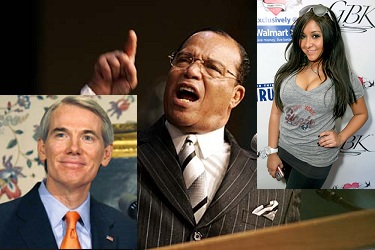
Ethics Quiz: Farrakhan, Snooki, Senator Portman, and University Speaker Ethics

Pick your poison!

Your Ethic Quiz question for the weekend: Which of these is the most unethical choice to speak at a University?

Your choices:

A. Nicole “Snooki” Polizzi, the over-the-top trashy break-out star of the bottom-of-the barrel cable reality show “Jersey Shore,” hired for $32,000 by Rutgers University to address students. Continue reading