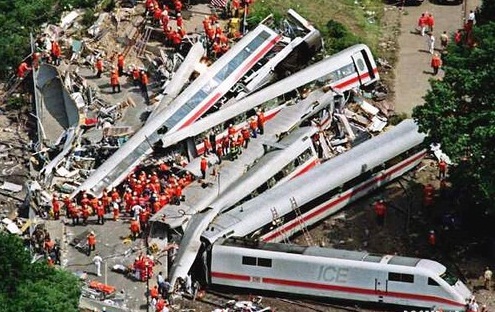
The Freddie Gray Ethics Train Wreck: If Protesters Really Want Justice, Then They Have To Stop Making Justice Impossible

Maybe it's all the same train wreck after all....

Maybe it’s all the same train wreck after all….

Yes, the mysterious death of Freddie Gray from injuries he sustained while in the custody of the Baltimore police has now become a certified Ethics Alarms Ethics Train Wreck. That honor was guaranteed once Baltimore’s mayor started stumbling over her words and meaning and then blaming others; when looters and rioters began burning down stores and a seniors home; when the finger-pointing began and when shameless Republicans started politicizing the riots, notably Texas Congressman Bill Flores (R-TX) who somehow reasoned that the Baltimore riots prove the dangers of gay marriage.

Most of all, a train wreck rating was guaranteed once the African-American activist response to Gray’s murder, inflamed by incompetent handling of the incident by the Baltimore police department, exactly followed the script of the Ferguson Ethics Train Wreck. Gray’s death was pronounced a murder and the police response a racist cover-up before all the facts were known or even knowable. Never mind: “Black Lives Matter” signs were paraded on the streets, and columnists and news reporters began telling the story as if Gray was—not might have been, not probably was, but was—just another in the long line of young black men murdered by the police. After all, we had the recent Walter Scott shooting, captured on video, to justify a presumption of racism and murder.

But a presumption of racism and murder, absent proof, is never justified. It isn’t allowed in court, and it isn’t ethical out of court. Never mind: that’s where we now are with Freddie Gray and Baltimore. Maybe this isn’t a new Ethics Train Wreck. Maybe it’s just the Ferguson Ethics Train Wreck, just rolling on.

As with Mike Brown (and Trayvon Martin’s death) , the underlying narrative of the protests over Freddie Gray’s death appears to be less certain than it originally appeared. The Washington Post reports that a prisoner who was in the police van with Freddie Gray says he could hear Gray “banging against the walls” of the vehicle, suggesting that Gray  “was intentionally trying to injure himself.” The prisoner’s statement is contained in an affidavit that’s part of an application by the police for search warrant seeking the seizure of the uniform worn by one of the officers involved in Gray’s arrest. If that account has any credibility at all, it could result in a prosecutor’s legitimate refusal to indict any officers. Continue reading
Observations On The ACLU And “Grand Juror Doe’s” Power Play

Juror Doe now, but trying to become a household name...

Juror Doe now, but trying to become a household name…

In a move that tarnishes the reputation of the ALCU and reveals the deep ideological bias in its ranks, the Missouri chapter of the esteemed organization has encouraged a Ferguson grand juror to sue in order to end the lifetime ban on grand  jurors revealing what occurs during proceedings, allowing the juror to become a media star and, presumably, undermining the credibility of the deliberations that resulted in no indictment against Officer Wilson for his fatal shooting of Michael Brown.

Observations:

1. Grand jury proceedings have to be confidential, or the system will not work (yes, it worked as well as it possibly could have in Ferguson.) Secrecy prevents those who are being investigated from interfering with witnesses and otherwise tampering with and attempting to corrupt the investigation. It protects witnesses who might be reluctant to testify if they believed their comments would be made public. It decreases the likelihood that one who is about to be indicted by a grand jury will flee and thereby avoid being brought to trial on those charges. It also protects innocent individuals whose names may be implicated in a grand jury investigation but who will never be indicted.

2. The prohibition on participants in grand jury proceedings revealing what occurs there is not a restriction on free speech any more than a government employee being prohibited from revealing national security information. This is a necessary restriction based on due process and the functioning of the rule of law, and grand jurors agree to the prohibition as a condition of service.

3. The ACLU is grandstanding for its progressive, civil rights zealot fans and contributors. This is an irresponsible case: if it prevailed, the justice system would be thrown into chaos.

3. If even one grand jury is able to have the ban on secrecy lifted, every grand jury will labor under the fear of those involved that jurors will speak to the media and reveal harmful details. I will be shocked if the ACLU lawsuit succeeds. I think it is a frivolous suit, and a violation of legal ethics Rule 3.1 that prohibits such actions.

4. The grand juror who is seeking the lifting of the ban has arguably already revealed more than he is allowed to do legally under the law, which prohibits disclosing “matters occurring before the grand jury.”

5. The supposed explosive revelations the juror wants to expand upon are nothing at all, just ignorant and biased complaints that have already been thoroughly explored and debated by legal experts. The likes of progressive website Think Progress falsely represents the juror’s views as “significant” because progressives so, so desperately want to prove that Michael Brown was executed by a racist cop who was corruptly exonerated by a biased prosecutor. But as Gertrude Stein said of Oakland, there is no there there.

Here are Grand Juror Doe’s “concerns”: Continue reading