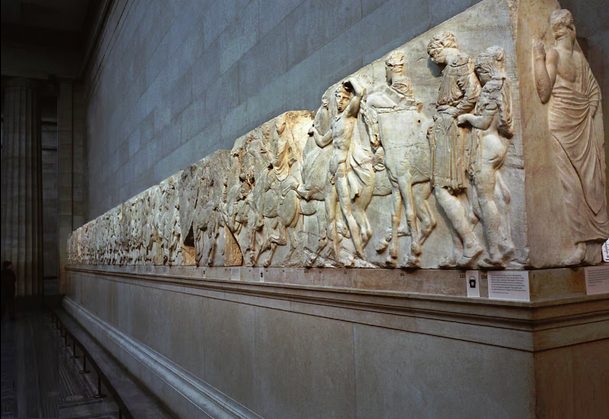
Last week, Ethics Alarms confidently presented the ethics verdict that it was high time—more than high time, in fact—for the British Museum to finally return the so-called “Elgin Marbles” to Greece. As the priceless art was literally ripped off the Parthenon, I didn’t think the question justified an ethics quiz. I still am unconvinced by the arguments that the Brits should hold on to their ill-gotten gains, but I am the grandson of a Spartan, after all. There were several excellent comments asserting ethical grounds for the British position; this one was outstanding.
“In the early 1800s, Lord Elgin, a British aristocrat, shipped to England treasures of Greek antiquity that he had strip-mined from Greece, including the carved frieze panels that had decorated the Parthenon. Supposedly this was done with the permission of Turkey, which was then ruling Greece, which is like your home invaders giving neighbors permission to take the art off your walls…”
There is a little more to it than that:-
– On the legal maxim of “nemo dat quod non habet”, of course the Turks couldn’t convey title. But they didn’t, they offered a quitclaim, as it were; they removed themselves from obstructing.
– As regards any original owners, there simply weren’t any left. The last remaining ones were ended by rounds of persecution of pagans, centuries earlier.
– As far as any generic claims of common heritage of western civilisation go, and those claims only go for want of better (there being no direct heirs), what better place to put the items than in a museum furthering that common heritage? Are the British somehow less heirs of that than are the Graeculi? Particularly considering how much safer the items were in that museum(those not taken have suffered horribly from war, corrosion, and what not). And, of course, the very word “museum” proclaims that furthering that common heritage.
Now, none of that conveys title to the British Museum, but adverse possession in the years since does – adverse, in that no better claimant came forward. Just as today’s Greeks feel an understandable connection to these items, as they do to the Lions of St. Mark’s, so too do today’s British – and as today’s Venetians do to the Lions of St. Mark’s. They are as intertwined with the histories of each place as of the other.
The Solomonic solution would be to sand blast the items to the condition of those not taken if any effort to transfer them were ever made. But I expect the Sir Humphreys will loudly assert ownership while underhandedly arranging a loan in name only with no means of foreclosing, just as they have with foundational documents that ought to have remained in British archives. That would satisfy none but the Sir Humphreys.
My mother stole a piece of the Parthenon. She was Greek, my father and she were visiting Athens, and when no one was looking (including my father) she scooped up a 1 x 8 inch chuck of white marble by the ruins and smuggled it home, where she displayed it on her fireplace mantle. My sister and I were horrified when we learned what the piece was, and plotted various ways to have it returned without getting our aged mother prosecuted. When they moved from Arlington, Mass. to Arlington, Va, the item just vanished, or so Mom said. (We didn’t believe her.) It was never seen again.
I think about this family scandal whenever I think of the seemingly endless dispute over the Elgin Marbles.
In the early 1800s, Lord Elgin, a British aristocrat, shipped to England treasures of Greek antiquity that he had strip-mined from Greece, including the carved frieze panels that had decorated the Parthenon. Supposedly this was done with the permission of Turkey, which was then ruling Greece, which is like your home invaders giving neighbors permission to take the art off your walls. The “Elgin Marbles” were sold to the British government and became among the most valued artifacts in the collection of the British Museum in London. As my mother’s son, I know they were among my top three favorite exhibits when I first visited, along with the Rosetta Stone and Paul McCartney’s handwritten draft of the lyrics for “Yesterday.”
Well, Greece has been asking for the Elgin Marbles back for over two centuries now, and if the museum has a leg to stand on in keeping them, it pretty much comes down to that hoary (and not exactly true) line, “possession is 9/10s of the law.” However, recent decades have seen a cultural shift as Western colonization and imperialism have acquired a bad reputation. Many museums are returning such looted treasures to where they were created and, I believe, belong. Why, then, haven’t the Elgin Marbles been sent back to Greece as its government demands, urges, and begs?
Today is my wife’s birthday. All we can do to celebrate is to be together, and be grateful that we found each other, and are still together, a miracle of chaos theory in so many ways. She is, and will always be my inspiration, my rock, my balance, the one who constantly keeps me from spinning out of control, and the love of my life.
1. Pandemic ethics and religion. It’s unfortunate when religions misbehave during catastrophes:
The Pope made the fatuous comment in an interview that the pandemic offers an opportunity to slow down the rate of production and consumption and to learn to understand and contemplate the natural world. “We did not respond to the partial catastrophes. Who now speaks of the fires in Australia, or remembers that 18 months ago a boat could cross the North Pole because the glaciers had all melted? Who speaks now of the floods?” the Pope said. “I don’t know if these are the revenge of nature, but they are certainly nature’s responses.”
Whatever that’s supposed to mean. Maybe it sounds better in Italian.
Yesterday, I turned on the TV only to see a live broadcast from one of the evangelical mega-churches, packed to the rafters, nobody wearing masks or practicing social distancing.
About 44 percent of likely voters in the United States see the coronavirus pandemic and economic meltdown as either a wake-up call to faith, a sign of God’s coming judgment or both, according to a poll commissioned by the Joshua Fund, an evangelical group run by Joel C. Rosenberg, who writes about the end of the world, and conducted last week by McLaughlin & Associates, pollsters for President Trump and other Republicans.
David Jeremiah, a pastor who has been one of President Trump’s informal evangelical advisers, asked in a sermon recently if the coronavirus was biblical prophecy, and called the pandemic “the most apocalyptic thing that has ever happened to us.”
No, it’s really not. This “end of days” stuff is either hysteria from the ignorant whose knowledge of world and U.S. history begins in 2008, or it’s worse, deliberate scare-mongering by church leaders to goose membership. Yes, I know a recent earthquake in Utah even shook the Salt Lake Temple so hard that the golden trumpet fell from the angel Moroni’s right hand. That is exactly as significant a portent of the Apocalypse as Chris Sale having Tommy John surgery.
In other words, incredibly significant.
After I get this post up, I think I’ll go watch “The Omen”—the good one, with Gregory Peck. Continue reading →
I had a friend in college named David, a talented musician and a funny guy, who one regaled me with his new theory of how to be a success and eliminate anxiety and stress in the bargain.
“See, we make ourselves miserable and guarantee failure by setting our goals impossibly high,” he said. “The secret to a happy, successful, care-free life is to set one’s goals extremely low. Last week, I was depressed because I had aimed at attending all my classes, writing 50 pages on my thesis, and finishing my reading assignments. I didn’t come close to accomplishing this, and I was miserable and guilty as a result.”
“Then I had an epiphany! Today I set my goal, my only one, as putting on my shoes and socks,” David explained. “That was it, the whole thing. Look! I did it! And it’s only noon!” He laughed and skipped away, not a care in the world.
I’m pretty sure he was kidding. Yet the Obama Administration, and its increasingly zombie-like, denial-motivated supporters, appears to have adopted this approach to leadership. Continue reading →
This morning, on CNN, I managed not to change the channel as I usually do when Soledad O’Brien is on the screen. It was a mistake. The long-time CNN anchor is as low as newscasting can sink short of MSNBC when it comes to smugly-biased commentary, and unlike some of MSNBC’s lefty warriors, O’Brien is just not very bright. This doesn’t keep her from visibly wincing, rolling her eyes or winking at the supposedly simpatico viewer when she thinks her opinion is superior to someone she is interviewing, as unprofessional a habit as I have ever seen. She has a job because, I suppose, she is pleasant to look at and exudes confidence, though it is confidence unsupported by any actual skill, insight or knowledge. Continue reading →
Greek food, America! Better get used to it, becuase we'll have to swallow what the Greeks are swallowing we can't find some leaders with courage.
Failure is now all but ensured by the so-called Super Committee, a gimmick designed by our leadership-averse President and his pathetically inept legislative counterparts in Congress (both parties, now) to provide themselves with bi-partisan political cover when they again ducked their obligation to solve the nation’s fiscal mess. For those of you who, like me, have wondered how Greece and Italy could reach their current miserable status when the fiscal disaster now facing them was obvious years ago, the answer is plain. They tolerated a fatal combination of selfish interest groups, pampered and lazy voters, and elected leaders who distorted, dithered and ducked their duties, until it was too late. And that is exactly what happening here.
There is no need to waste invective on the committee itself, which is beneath contempt. What they have come to was predictable, and I, along with many others, predicted it. But the predictions still did not have to come true, if, for example, these hostages to toxic ideologies really cared about the country as much as keeping the power to ruin it, or if President Obama hadn’t calculated that his best chances of re-election would be to let the committee founder with him being able to claim no role in its betrayal. rather than to do his job—leading–and try to make sure it succeeded at the risk of failing himself…again.
Betrayal is the word that I use, and that is what it is. Continue reading →
This is perhaps the ethical equivalent of shooting fish in a barrel (which, come to think of it, isn’t very ethical), since Rep. Conyers has been displaying his rank incompetence in word and deed for decades (he was first elected in 1964). It was Conyers, after all, who during the health care reform bill debate last year not only admitted that he hadn’t read the bill, but ridiculed the notion that anyone would expect a House member to read such a complex, wide-reaching piece of legislation before voting for it. I might suggest that the Congressman is suffering the mental ravages of age, but a) that would be age discrimination and 2) he doesn’t deserve an excuse. He’s always been like this.
Conyers is also a powerful and high-ranking member, so his special brand of cluelessness is neither harmless nor cute. It is useful, however, at least to Republicans looking for the perfect example of the proverbial Democratic Congressman who only knows one way to govern: spend as much money as possible in ways that will line the pockets of constituents and thus guarantee re-election. The Republicans would like the public to believe that all Democrats are like this, which isn’t true. The fact that at least one Democrat is like this, however—not only like this, but candid and proud about it—makes the stereotype much more credible.
President Obama’s bi-partisan commission on cutting the deficit has come up with its draft recommendations, and they are fair, balanced, obvious, and, inevitably and unavoidably, flawed. Despite the flaws, everybody gets hurt, as everyone deserves to be when we elect a series of profligate and irresponsible leaders who spend more money than the nation has, on too many dubious projects and policies.
Personally, it would kill my already struggling personal finances dead: I’d have to sell my house, for one thing, at a lower value than it has now. Are the recommendations perfect? Surely not. They address the problem, however, and it is a problem that 1) has to be addressed 2) has to be addressed quickly and 3) will never, ever be addressed sufficiently if left to the usual corrupt legislative process, where it will sliced to pieces by lobbyists and turned into more pork, more lies, and another 3000 page bill that nobody reads before voting on it.
If Americans were responsible, honest, fair and genuinely concerned about America’s future prosperity and strength, we would just buckle down take deep breaths, and agree to make the sacrifices necessary to put the nation back on the road to fiscal health. But we won’t, will we? Continue reading →
[TV is full of reruns these days, and sometimes I am grateful for them, for it gives me a chance to see episodes of favorite shows I had missed for some reason or another. Back in early March, I posted the following essay about the origins of America’s current crisis of trust in our government, and how it might be cured by our elected leaders. Since then, the crisis has deepened, and as I was doing some routine site maintenance, I reread the post. It is still very timely (unfortunately), and since far fewer people were visiting Ethics Alarms in March, I decided to re-post it today, with just a few minor edits. I promise not to make this a habit. Still, trust is the reason why ethics is so important in America: if there is a single post of the more than 700 I have written here since October 2009 that I would like people to read, this is it.]Continue reading →
The Fourth of July is less than 60 days away, and communities are looking hard at their budgets. The signs are ominous. This doesn’t seem like the right time to be throwing big parties.
This week, the Alexandria Chapter of the American Red Cross announced that it was canceling the Waterfront Festival, a summer community celebration with fireworks that it had sponsored since 1981. “We decided that responding to a fire in the middle of the night was a much better use of our resources,” said a local Red Cross’s executive director. Indeed. The total costs of the event totaled close to a quarter-million dollars. In times of financial stress, and even in better times, a service organization using resources and volunteer time to throw a community party of such magnitude seems irresponsible.





 Ethics Alarms
There is a little more to it than that:-
– On the legal maxim of “nemo dat quod non habet”, of course the Turks couldn’t convey title. But they didn’t, they offered a quitclaim, as it were; they removed themselves from obstructing.
– As regards any original owners, there simply weren’t any left. The last remaining ones were ended by rounds of persecution of pagans, centuries earlier.
– As far as any generic claims of common heritage of western civilisation go, and those claims only go for want of better (there being no direct heirs), what better place to put the items than in a museum furthering that common heritage? Are the British somehow less heirs of that than are the Graeculi? Particularly considering how much safer the items were in that museum(those not taken have suffered horribly from war, corrosion, and what not). And, of course, the very word “museum” proclaims that furthering that common heritage.
Now, none of that conveys title to the British Museum, but adverse possession in the years since does – adverse, in that no better claimant came forward. Just as today’s Greeks feel an understandable connection to these items, as they do to the Lions of St. Mark’s, so too do today’s British – and as today’s Venetians do to the Lions of St. Mark’s. They are as intertwined with the histories of each place as of the other.
The Solomonic solution would be to sand blast the items to the condition of those not taken if any effort to transfer them were ever made. But I expect the Sir Humphreys will loudly assert ownership while underhandedly arranging a loan in name only with no means of foreclosing, just as they have with foundational documents that ought to have remained in British archives. That would satisfy none but the Sir Humphreys.
Continue reading →