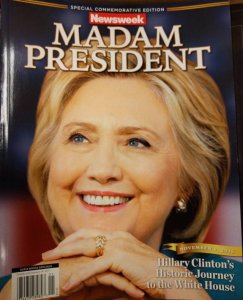
Dewey Wins!
1. Ugliest moment of election night: Trump’s assembled chanting “Lock her up!” as the electoral victory approached.
2. Anti-Trump bias made the entire journalism profession and punditry class incompetent, forming an almost impenetrable echo chamber that assured its smug occupants and Democrats that Hillary Clinton literally couldn’t lose. “Bias makes you stupid” is a frequent refrain here, and I cannot think of a more powerful example.
In a terrific if rueful article in Slate, Jim Newell writes of how the whole Democratic establishment convinced itself that Hillary couldn’t lose:
I think of the lawmakers, the consultants, the operatives, and—yes—the center-left media, and how everything said over the past few years leading up to this night was bullshit…Think of how wrong the entire national media conversation was—and yes, I contributed my fair share—about how the Republicans were being torn apart as a party. I prewrote a piece Tuesday afternoon, to be published in the event of the expected Clinton win, pushing back against both myself and other members of the media, arguing that Democrats and Republicans were both in existential trouble and that, in the short-term context of a decaying political system, Republicans might even have the edge…This was wrong. Republicans don’t have a slight edge over Democrats in a decaying political system. Republicans are ascendant.
The whole point of experts and analysts is that they use facts and objectivity to cut through rationalizations and bias. If they can’t or won’t do that, they are useless. They are frauds. Here’s the Washington Post’s media columnist, Margaret Sullivan, who proves elsewhere in the essay, even as she writes about bias, that she is still a partisan to her core:
To put it bluntly, the media missed the story. In the end, a huge number of American voters wanted something different. And although these voters shouted and screamed it, most journalists just weren’t listening. They didn’t get it.They didn’t get that the huge, enthusiastic crowds at Donald Trump’s rallies would really translate into that many votes. …It would be too horrible. So, therefore, according to some kind of magical thinking, it couldn’t happen.
Journalists — college-educated, urban and, for the most part, liberal — are more likely than ever before to live and work in New York City and Washington, D.C., or on the West Coast. And although we touched down in the big red states for a few days, or interviewed some coal miners or unemployed autoworkers in the Rust Belt, we didn’t take them seriously. Or not seriously enough….We just kept checking our favorite prognosticating sites and feeling reassured, even though everyone knows that poll results are not votes.
The news media anti-Trump bias might have even lost Hillary the election, not just by outraging the public–it was so, so blatant–but by deceiving the Democrats. Clinton didn’t bother to campaign in Wisconsin, so convinced was she that voters there would blindly follow the party, as usual. The state was one of the big victories for Trump.
Yes, bias has made U.S. journalism incompetent, stupid, self-satisfied and useless. It will take more than one fiasco to reform it—if it can be reformed. I hope it can because democracy doesn’t function well with an untrustworthy newsmedia, Continue reading
 Ethics Alarms