Wine For Winos In San Francisco

San Francisco spends $5 million a year on a so-called “managed alcohol program,” giving homeless alcoholics beer,wine and shots of vodka to “manage” their addiction. This deranged program has been running for four years without getting much media attention. I suppose so many other things are being mishandled in this rotting city that this one slipped under the radar. The theory underlying program is designed to minimize the amount of alcohol homeless people drink to control their addiction. It would be starnge indeed if this were a legitimate approach, since medical professionals make it very clear that drinking any alcoholic beverage (or mouthwash) makes recovery from alcoholism impossible, and “maintenance drinking” is ultimately a failed and often fatal strategy. Alcoholism is a progressive disease as well, so the longer a drunk is drinking, the more damage alcohol does to his or her body.

In the most woke-ravaged city in North America, nurses typically serve the homeless drunks the the equivalent of of one or two drinks three to four times a day, either a shot of vodka or other liquor, a glass of wine, or 12 nearly a pint of beer. The taxpayers of San Francisco must truly be brainwashed to tolerate seeing their hard-earned dollars going to pay for drinks for winos, killing them slowly at the city’s expense.

The only responsible way to get alcohol addicted street people out of the metaphorical gutter and on the way to recovery and a productive, happy life is to put them in a rehabilitation program, monitor their recovery, and take satisfaction from the relative few who will go on to live addiction-free lives. Giving them just enough alcohol to keep them dependent as their liver fail isn’t merely futile and misguided, it’s cruel.

The Student and the Homeless Man: A Cautionary Ethics Tale

Or, “Why It’s Unethical to Behave in Defiance of Reality.”

Or, “Why the old saw ‘the road to hell is paved with good intentions’ is constantly being affirmed.”

Or, “Why progressive wishcraft keeps blowing up in society’s metaphorical face”

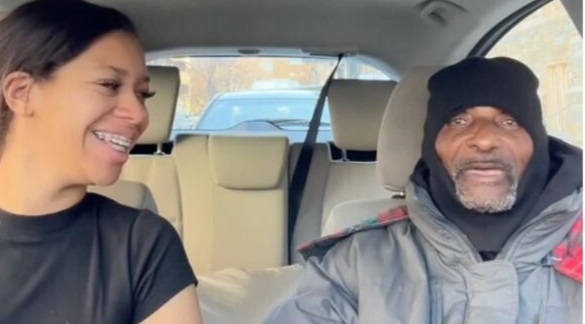
Sanai Graden (left), a University of California at Berkeley senior (presumably you know what that means) was hit up by a homeless man as she visited Washington, D.C. He said his name was Alonzo, and told her he had just been diagnosed with prostate cancer. The sympathetic young woman paid for his medication at CVS. She also got him a hotel room for the night. Sanai was a TikToker , and told her followers that she needed to raise money for Alonzo, whom she called “Unc.” Soon she bought Alonzo, aka. “Unc,” a cell phone, and put him up in a hotel for a week.

Awwww. How Christian! How kind! How progressive!

Her video became a Tik Tok sensation, with millions of views. Graden started a GoFundMe account, and it quickly raised more than $400,000. Her legion of followers multiplied: one admirer set up a GoFundMe for her that eventually raised over $26,000.

Isn’t that a nice story?

Then a report from local D.C. TV station Fox 5 revealed that “Unc” was Alonzo Hebron, 64, a long-time criminal who numbered among his convictions one for a violent assault on a homeless woman. In another, he stabbed a man in the neck with a screwdriver. Donors started asking for their money back.

Continue reading

The Crime That Can’t Be Charged: Humiliation And Harm For Money

http://www.youtube.com/watch?v=Ua5gCe_I09I

I hate this topic with a passion. It has come up often: the exploitation of desperate attention-addicts in celebrity reality shows, dwarf-tossing, the ancient pastime of paying geeks and the deformed to present themselves for public ridicule and dehumanizing treatment, and more. The problem is that the phenomenon is indistinguishable from other, societally-approved examples of paying individuals to harm themselves or be humiliated for our entertainment. Pro football, of course, harms more human beings in one game than all the dwarf-tossing since the beginning of time. Child actors are harmed for money, and often they don’t even get the proceeds, or give meaningful consent.

Every example I can imagine feeds directly into the vile Rationalization #22. The Comparative Virtue Excuse: “There are worse things.” The problem is that all of those worse things are legal, and likely to remain so. Yes, there are worse things than paying a drunk to dance like fool in exchange for a few dollars to buy his next drink, like paying young men millions of dollars to pound their brains into jelly. That’s our national pastime!

And yet—how can a society tolerate this? From the AP...

LAKEWOOD, N.J. (AP) — Police in New Jersey say no charges will be filed after a stranger paid a homeless man $5 to pour coffee on himself twice. Police say that’s because Ronald Leggatt consented even though he was embarrassed. The 65-year-old tells the Asbury Park Press he let a stranger videotape him pouring coffee on his head on Monday in Lakewood because he needed the money….

I wish I had a solution. I’d like to know the name of the scum who did this, but then what? Post his name for vigilante justice? I would argue that there is no valid consent when an individual agrees under duress and desperation, but then what is society saying—that a man can’t exchange a humiliating act for money he desperately needs? Continue reading

From The Pot Obsession Files, Or “If The Only Tool You Have Is A Hammer, Every Problem Looks Like A Nail, You Morons”

stoned-santaI hardly know how to begin describing how–what? Sad? Dumb? Irresponsible? Satisfying because all my predictions about how legalizing marijuana will screw up society in all sorts of ways is coming true?–this story is.

Denver nonprofit Cannabis Can gave away a thousand free, pre-rolled marijuana joints to the homeless and anyone else who wanted one on Christmas Eve. This was all for a “good cause,” of course —raising awareness about homelessness and getting people to donate  money to buy several RV’s and provide restrooms and showers for destitute. And getting the homeless high, because making everyone in the U.S. high or wanting to get high  is the most important thing in the world to the marijuana obsessed.

“‘Cannabis can make a difference,’ is kind of what we’re standing for,” said Nick Dicenzo, proud founder of Cannibis Can, nicely illustrating the verbal dexterity one is capable of once you’ve had a couple of joints before breakfast for a decade or so. “A lot of the people we spoke with really were just like, ‘if I had regular access to a shower, and a haircut my life would be so much better – I’d have so much more opportunity’,” Dicenzo continued.. I wonder how many of those homeless were on the streets in the aftermath of drug abuse and addiction. I wonder how many would have enough money to buy a suit, or rent a room, if they hadn’t blown so much money on drugs, or gotten themselves fired for showing up stoned for work. Continue reading

The Ethics Verdict on the Homeless Hotspot Project

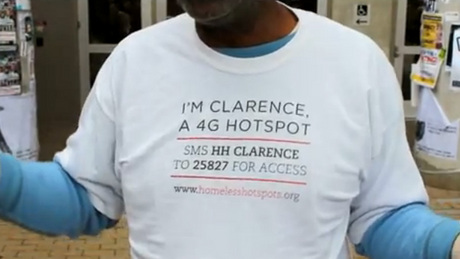
BBH Labs, the innovation unit of the international marketing agency BBH, hired members of the Austin, Texas homeless population to walk around carrying mobile Wi-Fi devices, offering high-speed Internet access in exchange for donations. Thirteen volunteers from a homeless shelter were hooked up to the devices, given business cards and put in shirts with messages that designated them as human connections. “I’m Rudolph, a 4G Hotspot” read the label on the homeless man on the New York Post’s front page with the lead, “HOT BUMS!

The Walking Hotspots—now there’s a new horror series for AMC when they run out of zombies— were told to go to the most densely packed areas of the South by Southwest high-tech festival in Austin, Texas, where the technology trend-devouring conventioners often overwhelm the cellular networks with their smart phones. Attendees were told they could go up to a Homeless Hotspot and log on to his 4G network using the number on his T-shirt. A two-dollar contribution to the homeless man was the suggested payment for 15 minutes of service. BBH Labs paid  the wired-up homeless $20 a day, and they were also able to keep whatever customers donated.

What BBH called its “charitable  experiment” ended yesterday with the conference, and with all participants seemingly thrilled. The “Homeless Hotspot” gimmick got nationwide publicity, thirteen homeless men made some money, and conference participants got great connectivity…so why were so many people upset? Continue reading

Ethics Hero: Pastor Thomas Keinath

Rev. Keinath on holiday, under the overpass

Thomas Keinath is the pastor at Calvary Temple in Wayne, New Jersey, a so-called mega-church with a 2,000-plus seat sanctuary in an affluent community. It was time for him to take some vacation time, so he did. And what did he do?

Keinath spent his week off living with the homeless in the very un-affluent community of nearby Paterson, New Jersey. During the day, he wandered through the streets along with desperate, sick and destitute. At night, he stayed with them as they built fires to keep warm in freezing cold,  and slept with them, under a bridge, surrounded by discarded hypodermic needles.  He wrote down the life stories of the people he met, so he could learn from their life stories.

“I needed to understand what they were experiencing, and I needed to feel their pain.  How could I bring help or healing to the streets if I did not know what their needs are?” the pastor told reporters. Continue reading