Judge Walker Was Wrong

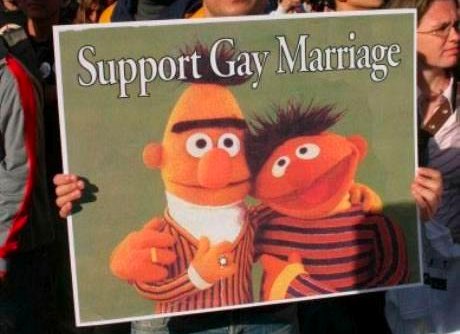
Now that we know about Bert, should Judge Ernie have recused himself?

Judge Vaughn Walker, the Federal District judge who a year ago ruled California’s Proposition 8, which banned same-sex marriages, unconstitutional, was wrong. No, not about the law, which is pretty clearly unconstitutional: his opinion was fair and well-reasoned, and is likely to be upheld on appeal. Walker was ethically wrong in his handling of the delicate issue of his own sexuality, which had raised a controversy about his objectivity and ability to be impartial.

Two weeks ago, following his retirement from the bench, Walker publicly disclosed for the first time that he has been in a same-sex relationship for the past ten years. This changes the analysis regarding the propriety of his ruling on Perry v. Schwarzenegger. Walker had long been rumored to be gay; supposedly “everybody” knew he was gay. My position, as well as that of many others considering the arguments of anti-gay marriage opponents that he should recuse himself, was that sexual orientation could not and should not create a presumption of bias, any more than gender, age, race or marital status. Continue reading

Perry v. Schwarzenegger: Choosing Ethics Over Morality

Predictably, Judge Walker’s decision in Perry v. Schwarzenegger striking down California’s voter approved Proposition 8 has infuriated foes of gay marriage, who have condemned his opinion as judicial activism, a rejection of democratic process, and an agenda-driven farce. Walker himself is being attacked for having a conflict of interest, because he is widely believed to be gay himself. (The belief that a gay judge cannot rule objectively on the issue of gay marriage while a straight judge can is itself an expression of bias.) This is not surprising. What is surprising, at least to me, is that the only substantial argument critics of the opinion can articulate is based on the exact proposition Walker rejected in his opinion: that laws should be able to prohibit conduct based on morality and tradition alone, without quantifiable and verifiable reasons relating to the best interests of society. By insisting that a California law that would withhold a fundamental right—marriage—from a class of Americans must justify itself with reason rather than tradition, Judge Walker ruled that it is ethics, not morality, that should govern American law and justice. Continue reading

Ethics Quote of the Month: Judge Vaughn Walker

His opinion declaring the voter-approved ban on same-sex marriages in California unconstitutional is here.

The opinion really begins on page 110. Opponents of the opinion are calling it “judicial activism,” “overturning the will of the people,” and “ruling by fiat.” Don’t buy it. The judge logically, fairly and appropriately explains why withholding the basic right of marriage from same-sex couples is a violation of essential values and American principles of ethics and law. Forget about the pundits and the spin: read what Judge Walker wrote.

A Despicable “Outing” In Minneapolis

Once again we visit the always despicable practice of punitive “outing,” when gay activists, gay advocates, or the generally self-righteous decide that some individual deserves to have private matters, that he or she has an absolute right to keep private, made public. This particular instance is especially notable, because it involved an especially odious brand of unethical investigation, followed by a series of arrogant rationalizations by the offending party that would make a good, if easy, pop quiz in an ethics exam.

Lavender Magazine, a biweekly for Minneapolis’s gay and lesbian community, reported that an outspokenly anti-gay local pastor attended meetings of Faith in Action, the local affiliate of Courage, an international program of the Catholic Church that offers support for people who want to remain chaste despite same-sex attraction.
As a result of the report, the pastor was placed on leave by his church, which is looking into the matter. Continue reading

Ethics Quote of the Week

“Some, including the archbishop, have argued that by providing health care to a gay or lesbian spouse we are somehow legitimizing gay marriage. Providing health care to a gay or lesbian partner — a basic human right, according to Church teaching — is an end in itself and no more legitimizes that marriage than giving communion to a divorced person legitimizes divorce, or giving food or shelter to an alcoholic legitimizes alcoholism.”

—–Tim Sawina, former chief operating officer of Catholic Charities, in a letter protesting the Washington D.C.-based organization’s recent decision, dictated by Archbishop Donald W. Wuerl, to eliminate health benefits for all new employees’ spouses in response to the legalization of same-sex marriage in D.C.

Even if one is inclined to be sympathetic to the Catholic Church’s plight in the gay marriage issue, as it finds itself locked into a centuries-old moral code that declares homosexuality a sin while the world steadily rejects the premise as ignorant, cruel, and wrong, the Catholic Charities decision is indefensible. It is especially brain-melting to try to justify such a decision by a charitable social service organization. Continue reading

Ethics Trumps Morality: Ending “Don’t Ask, Don’t Tell”

Almost lost in the din of President Obama’s defiant State of the Union address was his promise to finally end “Don’t ask, don’t tell” as military policy. There is no ethical argument against this long overdue move. It has always been a policy based on the political expediency of politicians afraid to do the right thing.

“Don’t ask, don’t tell” is unethical. The law treats gay Americans in a biased and discriminatory manner, reinforcing negative stereotypes and the irrational fears. It also hurts the military and the nation by robbing it of able soldiers and military personnel. Continue reading

Ethics Notes: Santa, the Senate, and Snow

Some random thoughts on ethics matters as I try to simultaneously finish the Ethics Alarms 2009 Best and Worst lists and deal with a series of bad extension cords running up my Christmas tree…

Continue reading

Showdown at Brookstone: An Ethics Train Wreck

Thanks to the enterprising employees at Brookstone, that odd chain that sells expensive gadgets for tasks that aren’t that important anyway, Ethics Alarms now encounters what has all the signs  of a genuine Ethics Train Wreck. Ethics Train Wrecks are situations where one unethical act sets off a chain reaction of bad judgment and rash behavior, and by the time all the carnage is over, anyone who was near the event, and those who tried to make sense out of it or clean it up, end up looking bad and arguing with each other. Recent Ethics Train Wrecks include the Valerie Plame affair and the Prof. Gates arrest. President Obama won’t get involved in this one (I hope!), but it has it all: gender, religion, workplace relations, law, Fox News. Continue reading