Integrity Check For Fox As Another Bill O’Reilly Fib Surfaces

Wags say Bill's next book will be titled "Killing Credibility"...

Wags say Bill’s next book will be titled “Killing Credibility”…

Now another Bill O’Reilly misrepresentation of the facts has come to light, mandating action by Fox News management if it doesn’t want to appear guilty of being even less concerned with the integrity of its product than the mainstream media is with theirs.  After all, Brian Williams is no longer on the air. So far, Fox is resisting. Its  operative rationalizations are:

1. Bill’s not an anchorman, like Brian Williams, but a pundit. My response: He poses as a truth-teller and calls himself a reporter and a journalist.

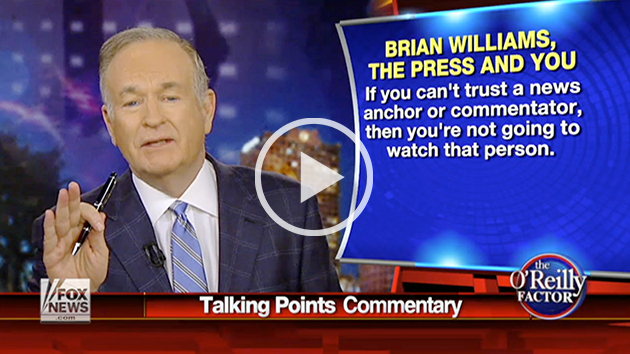
2. These are nit-picky, minor factual variations, not outright fabrications as in Williams’ case. My response: Yes, Williams’ were worse, and there were more of them. So what? O’Reilly should be held to the standard he articulated quite well while covering the Williams situation: if you can’t trust “an anchor or commentator,” he isn’t worth watching.

3. The whole controversy was the result of an ideological hit job by angry liberals who wanted to take down a conservative talking head in retribution for the most popular left-biased network anchor being hounded off the air by conservatives. My response: Yup. So what? Fox needs to be professional and insist on the integrity of its product, whatever the motive that drove O’Reilly’s exposure.

As Ethics Alarms discussed a few days ago, Mother Jones and its ideological assassin David Corn published a piece accusing O’Reilly of repeatedly telling his audience that he had been in a “combat zone” during the Falkland Islands war, and sometimes leaving the impression that he was on the battlefield in the Falklands. The truth appears to be that O’Reilly was in a scary riot that occurred after the war itself, in Argentina. Unlike Williams, then, O’Reilly accurately described the incident, but intentionally mischaracterized its nature. (A riot, even a riot prompted by a war, is not a “combat zone.”)

I wrote: “Are you surprised? I’m not. O’Reilly has a lot in common with Williams—an addiction to self-glorification,  a monstrous ego, and an unseemly desire for celebrity.” Thus I’m not surprised that a second example of Bill spinning his own exploits has surfaced. From The Daily Beast:

In 1977, O’Reilly was a 28-year-old TV reporter in Texas investigating the assassination of John F. Kennedy. O’Reilly wrote in his 2012 book Killing Kennedy that he was knocking on the door of a CIA asset with ties to the Kennedys and the Oswalds when he heard the asset shoot himself to death. Pretty dramatic, but it’s entirely false, says Jefferson Morley, a former Washington Post editor and author of JFK assassination book Our Man in Mexico. O’Reilly is heard on phone calls obtained by Morley telling an investigator that he would fly to Florida from Texas the next day to cover the suicide.

It’s harder to argue this one away than the Falklands enhancement: it’s a Brian Williams-style fabrication, and it’s in print. (The Smithsonian has reportedly pulled O’Reilly’s best-seller from its book stores now, because it regards the whole book as suspect. Funny: I always regarded this amateur history exercise as presumptively unreliable.) He has also repeated this fictional version of the facts on the air.

There should be no debate. Fox News exists because of conservative conviction that the mainstream media news networks were biased and could not be trusted. Fox is obviously biased, but it can’t give an organizational pass to intentional fabrication and maintain any credibility at all, especially when the liar in question is, like Williams at NBC, the 800 lb. gorilla of the organization. If O’Reilly survives because he’s a ratings champ while NBC, though kicking and screaming, properly jettisons its own gorilla, then Fox is exposed as a journalistic fraud (which many people are convinced it is anyway.) Continue reading
What’s Really Wrong About The President Refusing To Say That Islamic Extremists Are Islamic Extremists

(Other than the fact that it’s ridiculous, of course.)

war_is_peace

Not THAT again…

As far as preventing terrorist organizations from destroying civilization is concerned, the proposition being repeatedly made by Republicans that “you can’t fight something if you can’t accurately describe it” is also ridiculous. Obama can call ISIS Late For Dinner if he wants to, and still take effective steps to contain the group and others. I can’t remember ever experiencing such a long and intense debate over what something should be called, unless you count the Republican insistence that water-boarding isn’t torture after decades of the United States saying otherwise  in legal documents, treaties and places where English is spoken, That, however, was obviously deceitful wordplay to get around the law, lawyering at it’s worst. This is something else…but what is it?

Yesterday, poor Department of Homeland Security Secretary Jeh Johnson did the rounds of the Sunday morning talk shows, and was asked to explain the Administration’s weird rhetorical line in the sand repeatedly. Presumably he was prepared beforehand, yet the best he could do was probably the version he came up with on Fox News, saying on the topic:

” [T]he thing I hear from leaders in the Muslim community in this country is, “ISIL is attempting to hijack my religion. Our religion is about peace and brotherhood and ISIL is attempting to hijack that from us.” And they resent that. Most victims of ISIL are, in fact, Muslims. So it seems to me that to refer to ISIL as occupying any part of the Islamic theology is playing on a — a battlefield that they would like us to be on. I think that to call them — to call them some form of Islam gives the group more dignity than it deserves, frankly.”

Wait..what? That’s it? So this is meant to, like, hurt their feelings? Why not go whole hog, and call them “Smoosh-Face Poopy-Heads,” then, or something similar? We’re officially denying what everyone knows to be true because moderate Muslims don’t like sharing a religion with the radicals, so to be nice, were speaking Fantasy rather than English? Continue reading

Ethics Audit: Write Your Own Obituary

The late, brave James Rebhorn

The late, brave James Rebhorn

It makes little sense, as I am backed up by about 30 rich ethics stories with more arising every hour, it seems, to publish this now, as it has languished forgotten in my files for almost a year. Yet I was watching “My Cousin Vinnie”—if it’s on TV, I’ll watch it every time—and I remembered that this was there, so I went to my computer files and read it again.

James Rebhorn was in the movie, you see. He was a good, solid, successful, working actor,  one of those familar and anonymous performers like Whit Bissell, whose face you recognize from hundreds of movies and TV shows playing fathers, doctors, bureaucrats, Congressmen, never in roles very large or central to the plot, always credible and well. In “Vinnie,” he played the prosecution’s expert witness on cars and tires before Marrissa Tomei stolethe movie. He’s the slimy Secretary of Defense who gets fired in “Independence Day;” he was Claire Danes’ father on “Homeland,” until he died last year.

James Rebhorn was a year older than I am today when he lost his 20 year battle with melanoma. Before he died, Rebhorn wrote his own obituary. It’s not a confessional or a stunt: it’s a genuine obituary, though it slights most of the career achievements that appeared in his obituaries published online and in various newspapers. I wonder, though, what he learned from the exercise. Having to write your own obituary must be terrifying, but perhaps only slightly more terrifying than writing it at all. What has your life amounted to? Who has made a difference in your life?  What are you proud of, and what really mattered in your life? What have you learned, and what do you regret?

And what will you never, never write down for all to read, because it’s just too painful to read yourself? Continue reading

The Brian Williams Ethics Train Wreck Welcomes Bill O’Reilly and Fox News…And Maybe Mother Jones?

oreilly-site-630px

“The O’Reilly Factor’s” Bill O’Reilly has been one of the Right’s attack dogs on the Brian Williams fiasco, not that anything he has argued is undeserved or incorrect. He has stated, clearly and without exception, that no lying anchors, reporters or commentator can be trusted by viewers, and thus should not be watched. Now the uber-leftist magazine Mother Jones has published an impressive report that seems to show that O’Reilly himself has repeatedly exaggerated his own combat reporting experience over the years, in his case, during the Falkland Islands conflict when he was a CBS reporter:

[F]or years, O’Reilly has recounted dramatic stories about his own war reporting that don’t withstand scrutiny—even claiming he acted heroically in a war zone that he apparently never set foot in.

O’Reilly has repeatedly told his audience that he was a war correspondent during the Falklands war and that he experienced combat during that 1982 conflict between England and Argentina. He has often invoked this experience to emphasize that he understands war as only someone who has witnessed it could. As he once put it, “I’ve been there. That’s really what separates me from most of these other bloviators. I bloviate, but I bloviate about stuff I’ve seen. They bloviate about stuff that they haven’t.”

 Fox News and O’Reilly did not respond to multiple requests for comment.
I’m convinced; I think O’Reilly’s failure to respond, and Fox’s as well, strongly suggest that O’Reilly’s guilty of at least one instance (Williams, we now know, has many)of the kind of exaggeration that brought him down, and that Fox, like NBC, has been unprofessionally incurious about their top-rated on-air personality’s puffery.

Observations:

1. If Mother Jones’ writers (David Corn and Daniel Schulman) are correct, and the research looks thorough, then O’Reilly is obligated by his own words to take himself off the air. If he does not, then he will have branded himself a fraud and a hypocrite.

2. To the Mother Jones writers’ credit, they don’t accuse Fox’s head bloviator of hypocrisy, because he isn’t, yet. Nothing he has  said regarding Williams and journalism  isn’t true. He has not been unfair to Williams. Based on what Bill has said, if Mother Jones has him dead to rights, then he must concede that viewers can no longer trust him either, and he has made it very clear what needs to happen. If O’Reilly doesn’t abide by his own stated principles, then he’s a hypocrite. We shall see.

3. If Corn and Schulman are right, then Fox News would have to handle O’Reilly much as NBC has dealt with Williams, but one hopes faster and less hesitantly.

4. Are you surprised? I’m not. O’Reilly has a lot in common with Williams—an addiction to self-glorification,  a monstrous ego, and an unseemly desire for celebrity. I’ve caught him fudging to artificially enhance his resume, as when he refers to himself as a Harvard alumnus. O’Reilly got a Masters degree in Public Administration at the Kennedy School of Government, so he’s technically correct, but I’m certain most of his viewers never heard of the Kennedy School, and think that he means the college. I have it on good authority that Harvard grads who feel the need to broadcast their connection to the school are widely regarded by other Harvard grads as pompous, insecure jerks. Bill’s undergrad degree is from Marist College in Poughkeepsie, New York, and he earned his journalism degree from Boston University, an excellent school.

5. This is good investigative journalism. It also wreaks of a deliberate “you took one of ours down, so we take one of yours”  hit job by Mother Jones. A fundraising pitch for the Democratic Party popped up while I was reading the piece: this was opposition research. Corn, who also broke the unethically taped Romney comments about the “47%”, would never expose Williams or any other reliably Obama-guarding network talking head, because  he, and Mother Jones, don’t care about lying journalists who advance The Cause. Of course, I doubt anyone on Fox would expose false statements by George Will or Charles Krauthammer. Is there no media outlet that just cares about promoting honest journalism and trustworthy broadcasters?

6. I expect the mainstream media to be much more aggressive and unsympathetic, with all the Williams “false memories’ rationalizations magically absent, if the Mother Jones story hold up. After all, it’s O’Reilly, Fox News, and conservatives. No mercy for those bastards.

7. I wonder if Joe Scarborough was behind this…

I was on Bill’s show (about Beyonce’s lip-synching at the Inauguration), and he was wonderful to me. I got positive feedback from the appearance, and he said they would look for opportunities to have me back.

Well, that’s the end of that gig…

Update: Bill’s response, to The Blaze, is here. He says it all a lie, stands by his previous statements, calls the story  a politically motivated hit piece (it is, but that doesn’t mean it can’t be accurate), and calls Corn a moron. That’ s Bill. I hope he can back it all up.

_______________________

Facts: Mother Jones

Life Imitates Saul

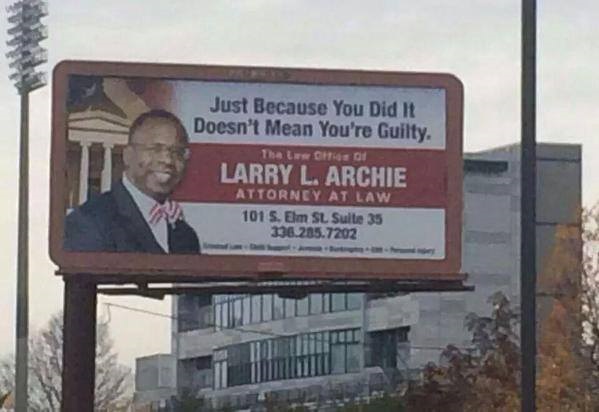
Lawyer Billboard

 The billboard ad of North Carolina lawyer Larry Archie has drawn a lot of attention in the state and on legal ethics forums.

Some observations:

1. I was a little late seeing “Breaking Bad” ( I tend to avoid show with drug dealers as heroes) so I didn’t see the obvious connection between the popular AMC show’s cynical, unethical and effective slime-ball lawyer Saul Goodman, played by Bob Odenkirk, and last year’s jaw-dropping—but funny!—video ad for the services of Pittsburgh criminal lawyer Daniel Muessig.

2. This is why we ignore popular culture at our peril….and I think the legal profession needs to stop laughing and start worrying. People really do think Saul who is a criminal lawyer, is typical, and bar associations are doing very little to dissuade them. This is irresponsible, dangerous, and stupid. The profession has a duty to educate the public about how lawyers are supposed to act and why, and if it whiffs on that obligation (as it has for about the last hundred years) public respect for the justice system will continue to drop. Continue reading

A Presidents Day Celebration (PART 3): When The Going Got Tough

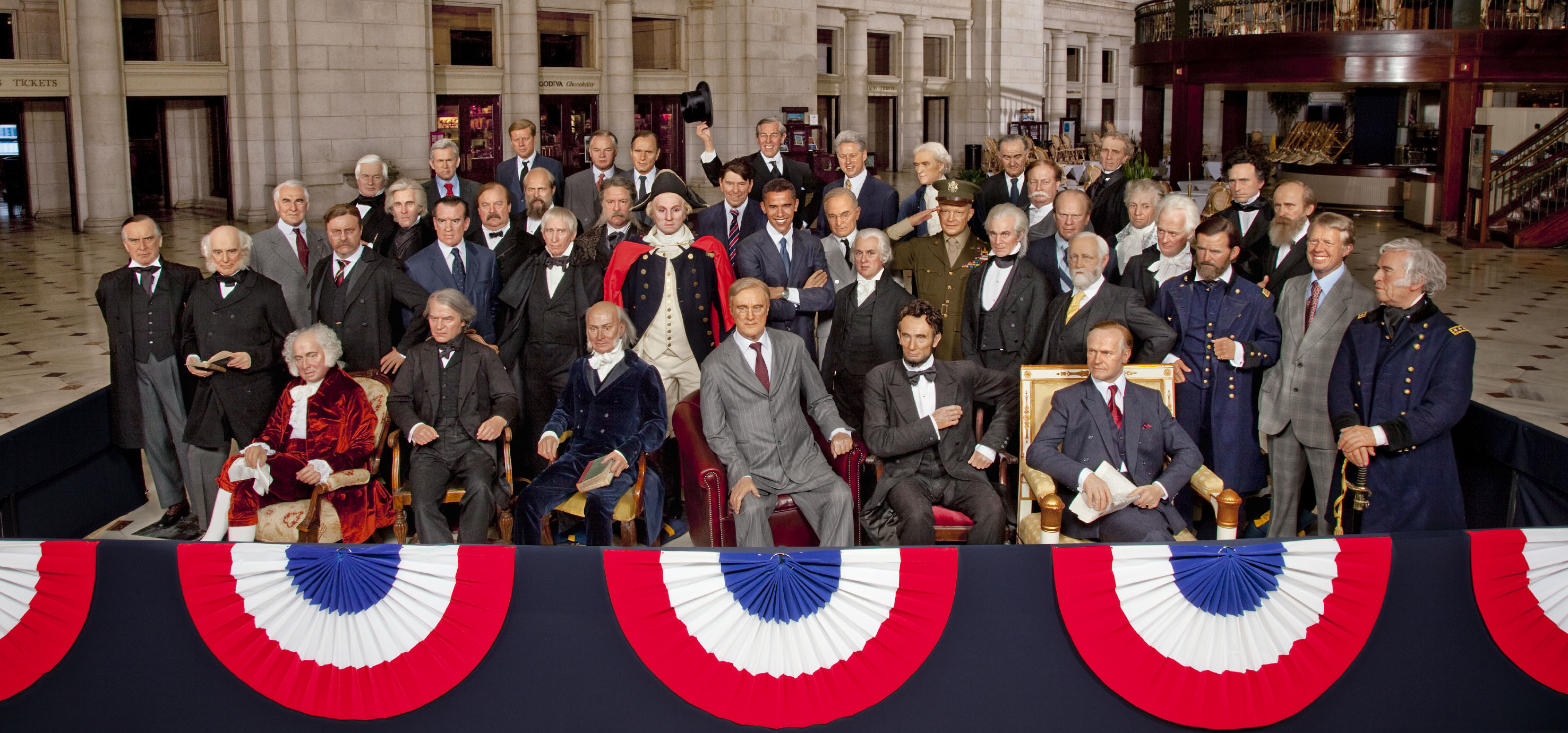
 presidents.

The Presidents really get interesting now, as a political leadership culture in the U.S. matures, the stakes of failure become greater, and technology, labor upheaval, expanding big business and greater influence on world affairs transforms the Presidency into truly the toughest job on earth.

Grover Cleveland

grover

Another one of my favorites, Cleveland was known for telling the truth ( he as called “Grover the Good”), but he participated in one of the most elaborate deceptions in Presidential history.

As explained in historian Matthew Algeo’s 2011 book, “The President Is a Sick Man,”  President Cleveland noticed an odd bump on the roof of his mouth in the summer of 1893, shortly after he took office for the second time. (Cleveland is the only President with split terms, the hapless Republican Benjamin Harrison winning an electoral college victory that gave him four years as the bland filling in a Cleveland sandwich.) The bump was diagnosed as a life-threatening malignant tumor, and the remedy was removal. Cleveland believed that news of his diagnosis would send Wall Street and the country  into a panic at a time when the economy was sliding into a depression anyway, and agreed to an ambitious and dangerous plan to have the surgery done in secret. The plan was for the President to announce he was taking a friend’s yacht on a four-day fishing trip from New York to his summer home in Cape Cod. Unknown to the press and the public was that the yacht had been transformed into a floating operating room, and a team of six surgeons were assembled and waiting.

The 90 minute procedure employed ether as the anesthesia, and the doctors removed the tumor, five teeth and a large part of the President’s upper left jawbone, all at sea. They also managed to extract the tumor through the President’s mouth while leaving no visible scar and without altering Cleveland’s walrus mustache. Talking on NPR in 2011, historian said,

“I talked to a couple of oral surgeons researching the book, and they still marvel at this operation: that they were able to do this on a moving boat; that they did it very quickly. A similar operation today would take several hours; they did it in 90 minutes.”

But the operation was a success. An artificial partial upper jaw made of rubber was installed to replace the missing bone, and Cleveland, who had the constitution of a moose, reappeared after four days looking hardy and most incredible of all, able to speak as clearly as ever. How did he heal so fast? Why wasn’t his speech effected? He endures doctors cutting out a large chuck of his mouth using 19th century surgical techniques and is back on the job in less than a week? No wonder nobody suspected the truth.

Then, two months later, Philadelphia Press reporter E.J. Edwards published a story about the surgery, thanks to one of the doctors anonymously breaching doctor-patient confidentiality. Cleveland, who in his first campaign for the White House had dealt with Republican accusations that he had fathered an illegitimate child by publicly admitting it, flatly denied Edwards’ story, and his aides  launched a campaign to discredit the reporter. Grover the Good never lies, thought the public, so Edwards ended up where Brian Williams is now. His career and credibility were ruined.

Nobody outside of the participants knew about the operation and the President’s fake jaw until twenty-four years later, after all the other principals were dead except three witnesses.  One of the surgeons decided to  publish an article to prove that E.J. Edwards had been telling the truth after all.

This is a great ethics problem. Was it ethical for Cleveland to keep his health issues from the public? In this case, yes, I’d say so. Was it unethical for the doctor to break his ethical duty? Of course. Was Edwards ethical to report the story? Sure.

The tough question is: Was Cleveland ethical to deny the story and undermine the reporter’s credibility? I think it was a valid utilitarian move, and barely ethical: it was better for the nation to distrust one reporter than the President, especially when his secret was one he responsibly withheld, and his doctor unethically revealed. Continue reading

The Little Blue Jon Stewart Caboose On The Brian Williams Ethics Train Wreck

Blue Caboose

I’ve stopped updating the passenger list on the rapidly slowing Brian Williams Ethics Train Wreck. Essentially it’s all biased and unethical journalists outing themselves and not being honest or sufficiently self-aware to realize it.

Bulletin: Brian Williams being exposed as an untrustworthy journalist isn’t a “tragedy” for anyone but Brian Williams and NBC’s bottom line, and he was no more a “giant” of broadcast journalism than Joe McCarthy was a “giant” of the U.S. Senate. He was a fraud, and his exposure and fall was a good thing, as exposures of frauds always are. His demise (he isn’t coming back, and NBC should stop the speculation and just say so) does serve as a useful trap for similarly unethical and biased journalists, like TIME’s Joe Klein, who made no sense at all while bemoaning the treatment of Williams in an interview on Fox News, first using a straw man argument:

“I think that we’re living in an era where the ferocity of the prosecution is much greater than the severity of most of these crimes.”

No one’s alleging any “crimes,” Joe. Journalists who are paid huge contracts to deliver the news in a professional and trustworthy fashion can’t be allowed to stay on the air. Absent the “ferocity,” Williams would still have his job today, because news organizations value their profit over integrity and ethics. Plenty of people don’t care if journalists are ethical or not, and can’t tell the difference. If critics don’t make their legitimate complaints strongly enough, the majority’s apathy prevails.

Then Joe went for the rationalizations, this time, #19 and #20:

“And all of us make mistakes. All of us do make mistakes.”

Someone explainsignature significanceto Joe Klein, because Williams’ helicopter fable was a perfect example of it, as I surmised from the first report of the episode. Yes, good journalists make mistakes, but ethical and trustworthy journalists don’t make mistakes like that, even once—telling a false story about being in one helicopter under fire when the reporter was really in another. Sure enough, we have since learned that Williams made up lots of stories that upon examination could not have been true (Joe apparently wants to ignore all that), like seeing bodies floating in the French Quarter after Katrina, like claiming that he was imbedded with elite SEAL team that took down bn Laden. They weren’t doubted at the time because we didn’t know Brian Williams was a serial liar then. “Mistakes” are not the issue. Moreover, Williams’ “false memory” defense, complete with “experts” sent out to the media to explain this phenomenon, was also a lie, and a carefully devised one. His other false reports, slowly becoming known like the endless trail of Bill Cosby victims, prove it.

Next for Joe: euphemisms. Continue reading

Brian Williams Ethics Train Wreck Update: David Brooks’ Ethics Confusion

Huh?

Huh?

David Brooks’ New York Times op-ed column decrying the widespread criticism of Brian Williams’ serial lying show us that Brooks himself is frighteningly confused regarding such basic ethical values as accountability, trust, trustworthiness and accountability. That’s good to know, don’t you think? Now the question is why anyone in their right mind would care what such an ethically muddled political and cultural analyst thinks about anything.

Yesterday, the Washington Post revealed yet another example of Williams’ fabulism: his bizarre story about roaming gangs at the local Ritz Carlton in the wake of New Orleans’ devastation by Katrina. Never mind, argues Brooks: the problem isn’t with Williams, it’s with his critics.

Brooks’ New Times column begins with a strange, exaggerated and unethically inclusive first paragraph about how  fame drives people to wrongdoing. “The desire for even more admiration races ahead. Career success never really satisfies. Public love always leaves you hungry,” he writes. “Always?” Who is he talking about, himself? The famous people being described here are emotionally and spiritually unhealthy famous people–addicts to fame, narcissists, desperate hostages to celebrity. I have no doubt that Williams fits that description,  but many prominent, accomplished and celebrated people do not. They are known as “trustworthy.” Having impugned many thousands of well-adjusted pubic figures past and present to lay the groundwork for an “everybody does it” defense of Williams (EDI is running neck and neck with the other favorite rationalization being used by Williams enablers: “It’s not the worst thing.”), Brooks attacks anyone not famous who resents being lied to:

“The barbaric part is the way we respond to scandal these days. When somebody violates a public trust, we try to purge and ostracize him. A sort of coliseum culture takes over, leaving no place for mercy. By now, the script is familiar: Some famous person does something wrong. The Internet, the most impersonal of mediums, erupts with contempt and mockery. The offender issues a paltry half-apology, which only inflames the public more. The pounding cry for resignation builds until capitulation comes. Public passion is spent and the spotlight moves on.”

This paragraph is astounding, and embarrassing too. Someone violates a public trust, and the public has the audacity not to trust him any more! What barbarism! Is Brooks even passing familiar with the concept of accountability? Not on the evidence of this drivel, he isn’t. An honorable man or woman in a position of trust who so publicly disgraced himself as Brooks has should immediately and voluntarily resign. Once, long ago, that was the natural, traditional, expected and required response to such a scandal, but this was in the days when celebrity and power was not so frequently accompanied by greed. Williams is paid about ten millions dollars a year, and that’s apparently too much to give up merely to demonstrate integrity, remorse and acceptance of responsibility for wrongdoing, especially when there are allies like Brooks out there ready to shift the blame.

There would be no need to purge someone who has proven themselves untrustworthy in a high position of trust if the individual would be accountable and courageous and purge himself, as he (or she—I’m looking at you, Kathleen Sibelius) is obligated to do. How can Brooks not understand this? The offender offers a “paltry apology,” and Brooks blames the public for correctly concluding that such an offender doesn’t understand the seriousness of what he did, isn’t really sorry, and will do it again. So the “pounding cry for resignation builds until capitulation comes.” Yes, David, that’s the way it’s supposed to work. This isn’t barbarism. This is civilization. This is enforcing standards. This is ethics, this is accountability.

Brooks doesn’t comprehend any of it, apparently:

“I do think we’d all be better off if we reacted to these sorts of scandals in a different way. The civic fabric would be stronger if, instead of trying to sever relationships with those who have done wrong, we tried to repair them, if we tried forgiveness instead of exiling.”

We’d all be better off if we let people who lie to us stay in the position that will allow them to keep lying to us? Continue reading

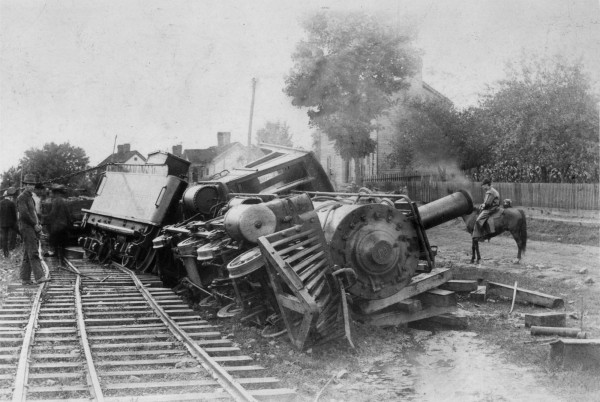
The Brian Williams Affair Is Now Officially An Ethics Train Wreck

trainwreck6

…and almost all the passengers so far are journalists.

An Ethics Train Wreck is an episode involving unethical conduct that rapidly exposes ethical flaws, if not an outright lack of ethics, in a steadily widening group of participants, commentators and stake-holders and even victims. The Brian Williams Ethics Train Wreck, like most of them, could have been averted early in the  journey, if, for example, NBC had immediately acted responsibly and suspended Williams when the facts of his 13-year-long fable about being in a wounded helicopter over Iraq were exposed by Stars and Stripes. It did not however, and now NBC executives have First Class seats after apparently knowing about Williams’ lies and doing nothing. It is Williams’ colleagues and compatriots in journalism, however, who are rapidly filling up Coach. In doing so, they are demonstrating that even some of the most famous names in the field have the under-developed ethical instincts of an 11-year-old, and that when substantive ethical analysis is required, they resort to rationalizations. This is discouraging, if not surprising. For example:

Bill Moyers.

Here is liberal lion and lengendary PBS commentator Bill Moyers  on Twitter:

Moyers-RS

That’s the depth of analysis we get from Moyers: flat out Rationalization #22, Comparative Virtue, #2, The “They’re Just as Bad” Excuse, and  “Everybody does it.” So what counts most in “journalism excellence” to this multiple Peabody Award winner isn’t that a journalist tells the truth, but that he doesn’t lie about the things Moyers cares about.

Piers Morgan

The ex-CNN talk-show host, whose credentials as an ethical and trustworthy journalist are, well, non-existent, penned a sarcastic attack on Williams’s critics called “Do we want to tar and feather Brian Williams or let him be the BETTER journalist this ‘scandal’ will make him? And trust me, I’ve been there.” As you can see, his argument begins with a straw man, and a cheaply made one at that: No, we don’t want to tar and feather Brian Williams, we just don’t think liars should be paid millions to tell the nation what happened in the world when he can’t be trusted to be truthful about what happened to him. It goes on to mass a pile of juvenile rationalizations, all of the Biblical rationalizations for example, which is a terrific example of someone projecting his own highly dubious career onto every other journalist. Yes, Piers, we get that someone with your dubious past would have trouble being taken seriously “throwing stones” at another journalist’s ethics, but not everyone is you. Then Morgan repeatedly says that Williams is being pilloried because he isn’t perfect [ #19 “Nobody’s Perfect!” and #20. The “Just one mistake!” Fantasy], and this is so unfair because he’s wonderful and should be given a break [ a classic #11. The King’s Pass, The Star Syndrome, or “What Will We Do Without Him?” and #38. The Miscreant’s Mulligan or “Give him/her/them/me a break!”] Continue reading

The Ethics Scandal Is No Longer About Brian Williams. It’s About NBC, And Journalism

"Uh, do you think we should say something to Brian?"

“Uh, do you think we should say something to Brian?”

Yesterday Brian Williams announced that he was removing himself temporarily as anchor of the NBC nightly news broadcast, as NBC revealed that it was conducting an independent investigation, which certainly sounds like eyewash to me (and others.) The ethics issue, however, has expanded rapidly to the point where Williams’ fate—and at this point, I think he’s doomed—is almost incidental to the larger broadcast and news media ethics issues involved.

Maureen Dowd and others have revealed that NBC executives had been well aware that Williams was, to put it kindly in Dowd’s terms, “inflating his resume” and yet declined to stop it. In other words…

…they were aware he was lying to the public, which means that

…they were aware that he lies in public, which meant that

…their face, voice, anchor and head of their news division was a liar, indeed perhaps even a pathological liar, meaning that

…Williams was unquestionably  untrustworthy, and

…a constant risk to misinform the audience, and

…they still didn’t remove him because his ratings were good and he was making money for the company.

Continue reading