The Strange, Strange Case Of The President’s Uncle: Why Trivial Lies Matter

Bill Clinton now seems to suggest that he was joking in the infamous interview back in 1993 when he claimed that he “didn’t inhale.” Yeah, that’s some comic delivery you had there, Bill. The moment seemed to encapsulate Clinton’s remarkably generous definition of truthfulness, and for the rest of his political career to date, it has proven to be an accurate predictor.

What has always seemed notable about Clinton is that he will lie when he doesn’t have to, about matters large and small. It is the trivial, pointless lies, in fact, that really inform us about a public figure’s truthfulness. A normally ethical individual, in a crisis and a moment of panic, might speak a falsehood, as all of us might and probably have. People with integrity, however, don’t resort to lies as a first option.

That is why yesterday’s puzzling story about President Obama’s uncle is insignificant in itself, but very significant as the nation and the public reaches a verdict–and such verdicts are almost impossible to overturn—regarding the trustworthiness of this leader and his government. The Washington Post relates: Continue reading

Martin Bashir Resigns From MSNBC

You can read details here.

Well, It's about time.

Well, It’s about time.

It has been about two weeks since MSNBC talking head Martin Bashir said, on the air, not spontaneously but reading from a script, that Sarah Palin deserved to have someone shit in her mouth. I have previously commented on the incident and its aftermath here, here, here and here, which is more than Bashir is worth.

Briefly…

  • Bashir should have been fired. That would have asserted that MCNBC had standards of civility and professionalism. This suggests it has none, at least when a conservative is the one being abused on the air.
  • He should have been fired immediately. Late is sometimes better than never, but it is also significant when a network, faced with an employee who engages in objectively outrageous conduct that doesn’t merely cross the line, but pole vaults across it, appears to be pondering, as in, “Hmmmm. How bad is it, really, when a host suggests that someone hold down a former vice-presidential candidate and defecate in her mouth? Tough one! What’s your take, Lou?”
  • Bashir’s producer and editor should have been disciplined, if not fired as well.  Continue reading

Comment of the Day: “Ethics Quiz: The Kidneys of Orlac”

But first, a last act of altruism...

But first, a last act of altruism?

The presumptive winner of the annual Ethics Alarms award for “Commenter of the Year” in 2013, texagg04has delivered a Comment of the Day expanding the topic of the post regarding a condemned prisoner in Ohio who wrangled a postponement of his execution so he could donate his organs to relatives. Here is  texagg04’s  take on “Ethics Quiz: The Kidneys of Orlac.” I’ll have some comments at the end.

“First, a murderer or other capital criminal being held responsible for his or her conduct seems to be in conflict with the same individual being allowed to display charity when you say they  forfeited their freedom, all of it, with their commission of a  capital crime. I’m not so sure it should be viewed from that angle.

Punishment serves a variety of purposes. Some petty crimes receive punishment designed to compensate, as best as can be, the victim – the victim being dead, capital punishment does not serve this purpose. Some crimes are of an anti-social nature, and the apt punishment seeks to rehabilitate or reconcile the perpetrator to the community. Capital crimes are so heinous that we have determined that the perpetrator must be completely cut off from society, through their death. In this case, the punishment does nothing for the victim OR for the criminal; the punishment is designed solely for the benefit of society.

If the criminal wishes to donate his/her organs to (what we must assume is to salve their own conscience – even though we can, probably, cynically assume is just a delaying tactic), we should not care one bit. They are gaining no material benefit from the community, nor are they engaging in any direct interaction with the community – so the act of cutting them off from the community as part of the punishment is still complete. Continue reading

Ethics Poll: The Amityville Kidney

"Wait---you're going to put THAT  inside me???"

“Wait—you’re going to put THAT inside me???”

In the comments to the post The Kidneys of Orlac, Texagg04 raises a fascinating angle that I had not considered. I have previously written, regarding state regulations that do not require realtors or sellers to disclose that a grisly murder or six occurred on a property, that a purchaser has the right to know about such conditions that may bother him personally, and that regardless of the laws involved, there is an ethical duty inform  a potential purchaser know that he is buying the site of the Amityville Horror (for example). Texagg04 suggests..

“Much like real estate agents ought to reveal that a house had a grisly murder in it, I’d submit that recipients of organ donations of this kind should get to be informed of the donor’s convictions.”

Hmmm. I’m not so sure. One of the reasons for my views about the death houses is that they may be difficult for the uninformed buyer to sell later if the home’s history is known or becomes well known. Also, there are always alternatives to buying a particular house—given a choice between the site of a murder and a similar house with no such history, I might opt for the latter—I’ve seen too many of the “Paranormal Experiences”  and “The Grudge” movies, I guess. But with donated organs, the options are more limited. Maybe not telling the recipient that he has the heart of the Green River Killer is the fair and kind thing to do.

Let’s vote!

Ethics Quote Of The Month: Dr. Jonathan Gruber

“We currently have a highly discriminatory system where if you’re sick, if you’ve been sick or [if] you’re going to get sick, you cannot get health insurance. The only way to end that discriminatory system is to bring everyone into the system and pay one fair price. That means that the genetic winners, the lottery winners who’ve been paying an artificially low price because of this discrimination now will have to pay more in return. And that, by my estimate, is about four million people. In return, we’ll have a fixed system where over 30 million people will now for the first time be able to access fairly price and guaranteed health insurance.”

—– Dr. Jonathan Gruber of MIT, an economics professor who is among the designers of the Affordable Care Act, a.k.a Obamacare. He was interviewed by NBC’s Chuck Todd regarding the troubled law’s problems.

lottery

Could it be that the act of getting involved with this administration turns even non-politicians into deceivers and liars? For an economist to talk so deceitfully and manipulatively is distressing. He, of all people, certainly knows how insurance works, and has to work. The insurance company accepts, in essence, wagers from its insured, in the form of premiums, that they will “win” by incurring health care costs that require more funds more than the accumulated “wagers.” The insurance company gambles that it will “win” by the insured remaining relatively healthy, so that the premiums (and whatever investment income they generate) exceed what the company has to pay in medical costs for that individual. The only way a company can keep providing insurance is to win more bets than it loses.

Saying that an insurance company is “discriminating” (in the unjust and biased sense) when it refuses to  accept a wager that is virtually certain to win is like saying that a poker player is engaging in discriminatory conduct by refusing to play with a new player who brings a royal flush to the table with him. It is not discrimination to refuse to lose money, and Gruber knows it. But  like an expert liar, as I must presume he is, he plants a false definition of discrimination at the beginning of his discussion and then treats it as an agreed-upon description of what is occurring. Not selling something to a customer who can’t afford a fair price is not discrimination, and refusing to gamble with someone who is assured of winning is also not discrimination. But discrimination is something that everyone regards as wrong, unfair, and unlawful, so that is how the lawful operation of insurance companies is framed by this clever, learned, dishonest man.

I no longer trust Dr. Gruber, nor should you.

His statement is of additional interest, however, because it starkly defines the unique Progressive definition of “fairness,” by his repeated use of lottery imagery to describe the fact that some people, through no fault of their own, have fewer advantages than others, while those others, often through no virtue of their own, have more resources and opportunities. Progressives regard this as inherently wrong and unfair, and so unfair that it must be remedied by obtrusive government interference. The rest of America regards this as “life.” Continue reading

Three Case Studies In Ethics Obtuseness: The Sheriff, His Victim, And The Hollywood Loudmouth

Hear-No-Evil-See-No-Evil-Speak-No-Evil

These Ethics Dunces  don’t get it, and probably never will.

There is nothing quite as frustrating as the ethics offender who receives a clarion lesson in response to the wrongful conduct, and completely misses the point:

Case Study #1 : Alec Baldwin

The serial loudmouth actor, who alternates between banal progressive nostrums and outbreaks of public violence, verbal abuse and denigrating slurs, was inexplicably addressing a gathering of ServiceSource International Inc. employees in the aftermath of his suspension by MSNBC for calling a photographer a “cocksucking fag” and getting caught on video in the process (the network was trying to make sure the actor understood that it was harmful to have one of its show hosts denigrate a strong demographic slice of their viewing audience, and that in the future he should confine his outbreaks of vile language to calling for conservatives to be defecated in and upon). ServiceSource CEO Michael Smerklo, having already booked Baldwin, said that Baldwin’s  insult to  gays created  one of the toughest decisions in his career. Hmmm… pay Alec Baldwin lots of money to impart his wisdom to a tech firm’s employees, or spend the money on something more worthwhile, like, say Cheetos. Wow. What a quandary. And why did the CEO think that Baldwin’s wisdom was worth imparting? CBS says: Continue reading

Op-Ed Columnist Kathleen Parker, Case Study: Why A Truthteller Can’t Be A Weenie

You are so NICE, Kathleen! Now please find a another job where that's an asset.

You are so NICE, Kathleen! Now please find a another job where that’s an asset.

“I tend to be generous with the benefit of doubt,wrote Kathleen Parker, the mildest of conservative Washington Post columnists, in a recent effort at punditry. That’s an understatement, but then, understating is what Parker does. She also excels at writing equivocal near-condemnations that end up in pretzel form and stuck in dead-ends of ambiguity when clarity is called for.

This makes her very useful to the mainstream media, which like to present the illusion of balance while rigging the game. When I see her on a Sunday morning “roundtable” as one of the conservative voices recruited to spar with sharp, aggressive, no-holds barred progressives like Kathleen van der Heuvel  or Van Jones (and a left-biased moderator), I know that the discussion will make any uninformed viewers believe that the truth consists of the midpoint between progressive spin, and Parker smiling and raising her eyebrow. She is, in short, a weenie. A nice weenie, to be sure, but when your job is battling in the marketplace of ideas, unyielding politeness, measured words, and the insistence that all sides have merit—which is often, indeed usually true–results in shorting her side, and giving the contest to the combatant with no such reticence about full-throated advocacy. Parker isn’t wrong. Parker is incompetent at her job, as it has evolved. Thus when she accepted a co-hosting gig in a CNN “Cross-Fire” clone as the Right commentator to Eliot Spitzer’s Left, he completely dominated her (he was also a bully and a boor in the process) until Parker left the show, frustrated and humiliated.

I was horrified recently to discover that Parker had written a column about the President’s non-apology apology that tracked closely with mine (posted the following day), because I dreaded  Ethics Alarms readers concluding that I was cribbing from her. Her column was also notable for its theme, which was signaled by its opening sentences: Continue reading

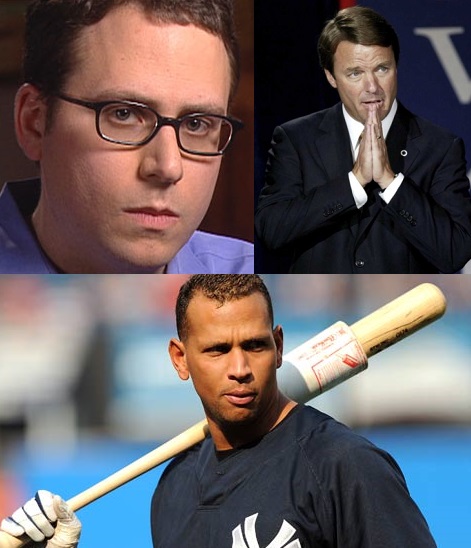
Why Is A Lying Journalist Not Fit To Practice Law, When A Lying Presidential Candidate Is?

Question: Which two men are fit to practice law? (It's a trick question...)

Question: Which two men are fit to practice law? (It’s a trick question…)

The Wall Street Journal Law Blog muses on an issue that has troubled me for a long time: the fact that the legal profession allows people to keep practicing law whose conduct would have kept them out of the profession had it occurred before they were lawyers.

The reason for the current examination is the apparent inconsistency of disgraced New Republic journalist Stephen Glass continuing to fight and uphill battle (and, I think, doomed) to be admitted to the California bar, while lying scum-of-the-earth John Edwards still has his law license and is opening up a new practice in North Carolina. I wrote about Glass here, and Edwards here.

In the Journal piece, estimable legal ethicist Stephen Gillers opines that the different standards applied to Glass and Edwards are paradoxical,  with the law grads entering the profession being held to more stringent ethical standards  than a veteran attorneys. “If anything, you might say it should be the opposite,” he says.

Especially if the veteran lawyer is a high-profile, national figure who makes every other lawyer want to crawl under a rock… Continue reading

Ethics Dunce: Alec Baldwin’s Employer, Whomever It May Be; Currently, This Means MSNBC President Phil Griffin

When MSNBC journalists attack!

When MSNBC journalists attack!

How is it that the old saw goes? “Fool me once, shame on you; Fool me twice, shame on me; Fool me 3,256 times, I’m an idiot”? Something like that.

Actor Alec Baldwin has proven by his actions and words, over and over again and beyond a reasonable doubt, that he is a foul-mouthed, hair-pin tempered bully with poor impulse control and the flattest of learning curves. I could list the impressive number of incidents that he has been involved in making that statement beyond debate, from a leaked phone voice message of him verbally abusing his daughter, to his tirade against a airplane stewardess who dared to ask him to abide by the rules of the air and stop playing a game on his Iphone, to obnoxious tweets that have led him to suspend his account more than once. Lately, his specialty has been hurling anti-gay slurs at photographers. Baldwin has been in the public eye for decades, and knows how celebrity works, but either doesn’t care, or can’t help himself. He has also paired his atrocious behavior with the outspoken progressive tirades and half-baked opinions of a man who is nowhere as smart as he seems to think he is.

The latter, of course, has saved his career from one way ticket to Mel Gibsonville. As gay conservative-turned-liberal blogger Andrew Sullivan wrote after Baldwin’s latest fiasco, Continue reading

Thank You: The Obamacare Defenders Give Us Rationalizations #36 and #37

37

With so many excuses, euphemisms, desperate justifications and outright denials flying around in print, online and over the airwaves in these fevered days of the Affordable Care Act debacle, it was inevitable that the Ethics Alarms rationalizations list would benefit. Sure enough, the Obama faithful and the Obamacare hopeful have alerted me to not one but two serviceable and popular rationalizations that I had missed.

Your refusal to be honest to the public and yourself is sad and wrong, guys, but at least you’re enriching the ethics resources on the blog.

The first of the new additions, #36, comes from a recent Obamacare column by Eugene Robinson. I was curious how Robinson, who would probably not abandon his support of the President if Mr. Obama was caught torturing kittens, would spin the current mess, and he didn’t disappoint. After somehow managing to describe relatively accurately what has transpired to date without either being critical of the President or explicitly exonerating him,  Robinson wrote:

“Transforming the health-care system was never going to be easy.”

Marvelous!

“Nobody said this would be easy” can be an appropriate morale booster when a difficult challenge is proving more challenging than expected, and when unexpected obstacles cause new and daunting problems. Following the carnage of a totally botched task, however, where there is no new problem, just the realization that those tackling it are incompetent beyond belief, and have failed in minimally meeting their duties of diligence, care, and process for a mission that they and everyone else knew was risky and hard, “Nobody said this would be easy” is just a cynical deflection of responsibility and accountability, and a dishonest one.

The issue isn’t how difficult solving the health care problem is. The issue is how lousy the plan was that was sold as a solution to this difficult problem, how it was falsely represented, and how it has been ineptly, carelessly, and unforgivably managed. Robinson’s ploy is changing the subject at its most blatant. A surgeon who is supposed to cut out a cancerous tumor but who amputates the patient’s healthy leg instead dare not comfort the patient by saying, “Now, we both knew that battling this cancer wouldn’t be easy.” Yes, but the patient certainly was justified in assuming that the doctor wouldn’t make the battle harder by being a careless nincompoop. Thus the new entry…

36. The Maladroit’s Diversion, or “Nobody said it would be easy!”  Continue reading