When The Going Gets Tough, The Tough Get Unethical, As A School Board Ponders The Profits of Child Labor

child laborWe learn about how seriously our institutions take their ethics when money gets scarce. States suddenly decided that ol’ devil gambling wasn’t so bad after all, once they realized that lots and lots of poor, desperate people without a lot of mathematical skills would fork over billions they needed to buy food with or save to move out of the ghetto in the hope of becoming a tycoon. I’m sure as soon as states realize that their legislators don’t have the guts to make the wealthy and powerful pay for lousy schools, more and more of them will get into the drug dealing business, like Colorado, and let the lives, families and businesses destroyed by the inevitable results of legal pot and cocaine become collateral damage.

Somewhere in between those irresponsible and cynical policy decisions way come ideas like this one, from the Prince George’s County Board of Education (in Maryland.) There is a new proposed policy in the perpetually corrupt Washington D.C. neighbor to make all work products created by teachers or students the intellectual property of the County, not the individual who created it: Continue reading

Artistic License, History, and Lincoln’s Green Socks

Of course, some historical fabrications are harmless.

Of course, some historical fabrications are harmless.

Several well-placed critics are taking “Lincoln” screenwriter Tony Kushner to task for what they believe are unethical misrepresentations of fact in the much-praised, and supposedly scrupulously accurate film. He, on the other hand, is annoyed. Kushner counters that unlike in history books where a historian gives a well-researched “a blow-by-blow account,” it is reasonable and ethical for a screenwriter to “manipulate a small detail in the service of a greater historical truth. History doesn’t always organize itself according to the rules of drama. It’s ridiculous. It’s like saying that Lincoln didn’t have green socks, he had blue socks.”

I’m going to spare Kushner lawyerly word-parsing and not hold him to “a greater historical truth,” though I suspect that in his hands (he is a skilled political propagandist as well as writer), we would not be pleased with what that license would bring. A politically sympatico film director named Oliver Stone, for example, thought it served a greater historical truth to present completely fictional evidence that Lyndon Johnson was complicit in John F. Kennedy’s assassination, even though Stone’s vehicle, “JFK,” was marketed as a veritable documentary on the “truth” of the Kennedy assassination. Let’s just say that Kushner feels that in a work of entertainment and drama, strictly accurate representation of all historical facts is impossible and unreasonable to expect or require.

I agree. But there is a big, big difference between the ethics of showing Lincoln wearing the wrong color socks, and representing a highly dubious story as fact to denigrate the reputation of a probable hero, as James Cameron did in “Titanic” when he showed First Officer William Murdoch taking a bribe to let a passenger on a lifeboat ( fantasy), shooting a passenger (pure speculation), and committing suicide (denied by a fellow officer under oath at the inquest). Continue reading

Tricking Yourself Into Being More Ethical

Cracked 5 waysOver at Cracked, the website that excels at developing clever factoid lists and debunking conventional wisdom, they have posted a list of “5 Scientific Ways To Trick Yourself Into Being A Good Person.”

Uh-huh. As usual for this site, the headline is just a bit overstated. “Trick” is a misleading word here: most of the devices involve the phenomenon of priming, which basically means that we are more ethical the more something focuses our attention on the ethical implications of what we are doing. By Cracked’s definition of “trick,” Ben Franklin’s morning and evening questions are tricks.

Skepticism is also warranted because we are just getting summaries of studies, and brief, non-technical, non-critical ones at that. It is impossible to know what extraneous factors might have polluted the results, or what biases the researchers brought to their research. Social science research is notoriously fallible and subject to design flaws, particularly regarding sample size. Such research is also prone to confuse cause and effect. I am especially dubious of #2 on the list, “Washing Your Hands Makes You Less Prejudiced.” Yes, researchers found that those who chose to use sanitary wipes on their hands when given the option during a flu epidemic scored better after doing so than those who declined to sanitize when they were asked to answer a survey designed to measure prejudice. I think it is a logical stretch to conclude that the act of ridding their hands of germs washed away the subjects’ biases; it is more likely that those who were more considerate of people around them, as indicated by their interest in sanitizing their hands during a flu outbreak, were also the most empathetic, tolerant and unbiased to begin with. That result isn’t nearly as startling as the claim that handwashing magically heals one’s prejudices, but Cracked apparently needed something to fill out a list of four.

It’s still an interesting article, even though ethical conduct takes a lot more cognitive effort than “tricks.”. You can read the whole thing here.

Judge Ken Anderson: A Judge With An Ethical Obligation To Resign

Ken Anderson

Regret isn’t enough.

Ken Anderson has been a Williamson County (Texas) district judge since 2002, but in 1987  he was the district attorney who prosecuted Michael Morton for fatally beating his wife to death. Morton was convicted and served 25 years in prison before DNA tests proved he was innocent. (This is yet another triumph of The Innocence Project.) Another man has been arrested for the murder of Morton’s wife Christine, as well as a second woman he allegedly killed in similar fashion while Morton was behind bars.

Last week, a five day hearing examined Judge Anderson regarding his conduct in the case, in a special court of inquiry to determine whether he engaged in criminal wrongdoing as well as unethical prosecution. Among the questions raised was why Anderson never divulged to Morton’s defense team a police report that Morton’s neighbors had said that they saw a suspicious man walking into the woods behind the Morton home shortly before the murder, and why Morton’s three-year-old son’s statement that “a monster,” not his father, beat the child’s mother to death was similarly withheld. On the stand enduring five hours of questioning, a tearful Anderson could only say that he didn’t remember not turning over the evidence to the defense, while defense attorneys adamantly insisted that they never received it. The hearing also revealed that Anderson kept his lead investigator from testifying at trial, when his testimony would have ensured that the child’s statement and the report about the stranger were raised in court, as well as allowing defense attorneys to cross-examine the investigator regarding his peculiar theory of the case.The theory, which was subsequently endorsed by DA Anderson, was that Morton become homicidal after his wife fell asleep when he sought to have sex with her, and donned his scuba wet suit so his son wouldn’t know it was him beating her to death. Continue reading

The Red Caboose On The Penn State Ethics Train Wreck Arrives: The Paterno Family’s Report

1-train-wreck-kari-tirrell

To understand what the Joe Paterno’s family’s report (released on Feb. 10) regarding the late Penn State football coach’s culpability in the Jerry Sandusky child abuse cover-up means, one has to understand what lawyers do, and why it is completely ethical for them to do so, as long as their role isn’t misrepresented by them or their clients.

Lawyers exist to allow non-lawyers to have access to a legal system that is (needlessly) complicated and technical, and to provide their legal training, analytical skills and advocacy abilities to their clients’ legal and legitimate needs and objectives. A lawyer who interposes his or her own opinions, judgments and desires on the client without being asked to do so is, in most cases, behaving unprofessionally and unethically. This is an essential principle to grasp, and yet the vast majority of the public do not grasp it. Nonetheless, without the partisanship a lawyer brings to the attorney-client relationship, regardless of whether a client is rich or poor, altruistic or venal, kind or cruel, we would all be slaves to the laws we supposedly create ourselves, through the machinery of a republic.

An independent investigation of the Penn State administration’s failure to stop serial child molester Jerry Sandusky from harming young children found that iconic football coach Joe Paterno was at the center of the school’s misconduct and the catalyst for it. The investigation was performed by Louis Freeh, a lawyer, a former prosecutor, a former federal judge, and once the head of the F.B.I.  His charge was to find out what happened and who was at fault—not to nail Paterno or anyone else.  It was an independent investigation, with no dictated result. Don Van Natta, a sportswriter whom I supposed should not be expected to understand such distinctions, writes,

“If the Freeh report was a prosecutor’s relentless opening statement that delivered devastating, far-reaching consequences, the Paternos’ rebuttal is a defense attorney’s closing argument brimming with outrage and fury.”

Wrong, wrong, wrong. The Freeh report was not a work of advocacy in an adversarial setting, but akin to a judge’s objective decision after reviewing the relevant and available facts. The Paterno family report, in contrast, is a work of advocacy, like a brief arguing an appeal to overturn a judicial decision against a lawyer’s client. The charge given to Freeh in his investigation was to find out what went wrong and why. (It began with the assumption that something did go wrong, which was reasonable, since a child predator had somehow managed to roam the Penn State campus for decades, including a ten-year period after he had been seen sexually assaulting a child in a Penn State shower.) Freeh was not told to get Penn State off the hook, or to pin as much as possible on Joe Paterno. The authors of the Paterno family report, however, were charged with the task of rebutting and discrediting Freeh’s report in order to rescue Joe Paterno’s reputation and legacy. It is an advocacy memorandum, like the torture memos and the recent Justice Department justification of the killer drone program. Continue reading

Now THIS Is Hypocrisy: Jack Lew Edition

cayman-islandsI know it pains many of you to hear it, but integrity has not been one of President Obama’s evident virtues, and the nomination of  his Chief of Staff Jack Lew to replace Timothy Geithner as Secretary of the Treasury is a particularly vivid example. The nomination demonstrates either hypocrisy or dishonesty (or both) no matter how one chooses to look at it.

This has nothing to do with Lew’s qualifications for the job: I’m certain he is sufficiently qualified, and is as likely as anyone else to help lead the nation through the fiscal wilderness, which is to say “not very.” The problem with Lew’s nomination, in the context of the President’s integrity, is two-fold. Although Obama and his campaign’s successful strategy was to demonize Mitt Romney as a grasping and venal corporate raider who accumulated big corporate bucks while doing little of value, Jack Lew’s resume includes receiving a $945,000 bonus in January 2009 after a short time working at Citigroup, which was in the process of collapsing financially and seeking (and receiving)a massive taxpayer bailout.  Obama also made hay during the campaign by implying there was something shady about Romney’s investments in Cayman islands-based institutions. Jack Lew. meanwhile, oversaw Cayman island investment funds while at Citigroup. In his 2008 campaign, Obama took special aim at one of them known as Ugland House, and a Senate hearing on the subject designated it as a facilitator of tax evasion. Jack Lew had investments in the Cayman islands, and, like Mitt Romney, had them with Ugland House. Continue reading

Chris Dorner Capture Reward Ethics

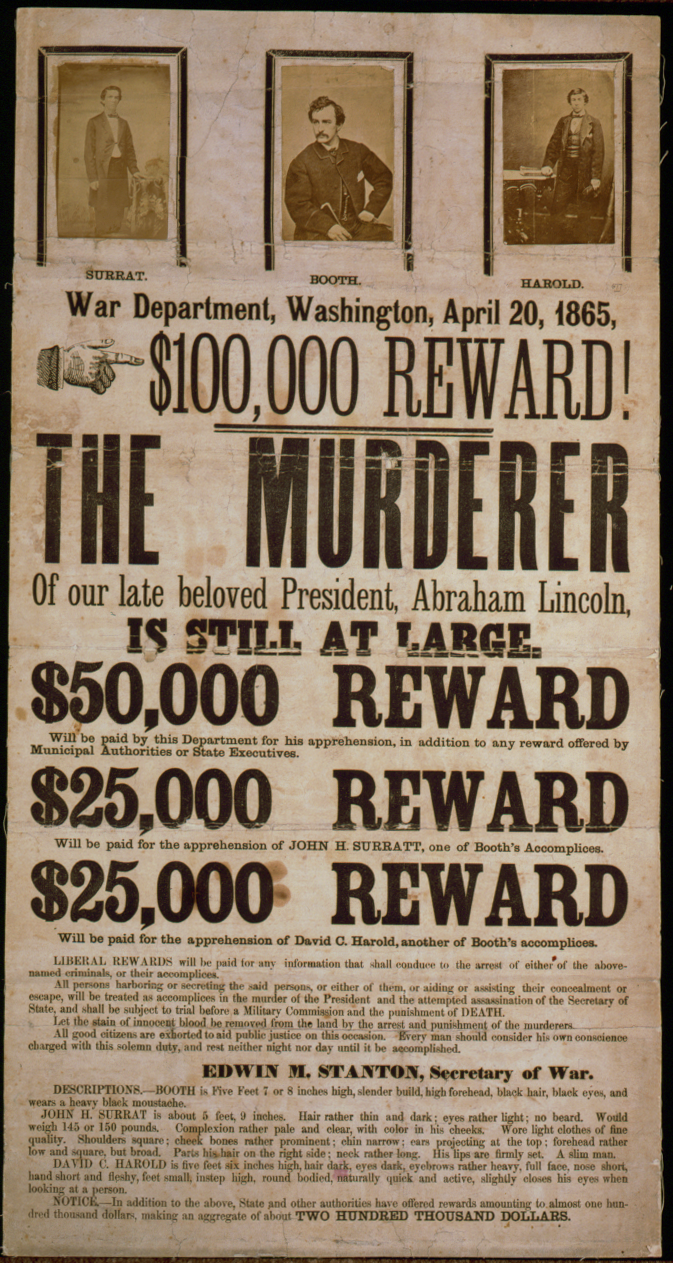
John_Wilkes_Booth_wanted_poster_colourThe gossip site TMZ often has horrible ideas, but for once it has come up with a horrible idea that is worth discussing seriously.

Several citizens provided information that led to renegade killer Chris Dorner being trapped and ultimately killed in a stand-off with police. This should put them in line for three rich rewards offered for information leading to the end of Dorner’s rampage, but TMZ identified catches in all three:

 “The Mayor of L.A. announced a $1 million reward — funded by private groups — for information leading to the “capture and conviction” of Dorner.  Big problem — technically speaking, Dorner must be both captured AND convicted to trigger the reward. The L.A. City Council offered a $100,000 reward for information leading to “the identification, apprehension, and conviction” of Dorner.  Again … no conviction.  City Council sources tell us there’s already a disagreement between the Legislative Analyst and the City Attorney over how to interpret the reward language. And finally … the L.A. County Board of Supervisors offered a $100,000 reward for information “leading to the capture of Christopher Dorner.”  One source at the Board of Supervisors tells TMZ,  “Dorner was cornered but not captured.”

Could TMZ possibly be correct? Would the offerers of these rewards weasel out of their obligations, citing the fact that Dorner burned to death before he could be captured and convicted?

Legally it’s possible, but barely. Ethically, it would be unfair and a breach of public trust. Pragmatically, it would be stupid beyond all imagining. Continue reading

Ethics Dunce: Melowese Richardson, Ohio Poll Worker

Melowese Richardson

Melowese Richardson

Melowese Richardson, Ohio poll worker, doesn’t understand why she’s being investigated for voter fraud. Oh, she voted at least twice, no doubt about that, and she doesn’t deny it: According to Hamilton County records, Richardson’s absentee ballot was filed on Nov. 1, 2012 along with her signature. Later, she told an official she also voted at a precinct polling place because she was afraid her absentee ballot would not be counted in time. Double voting is something of a family tradition, for Richardson’s granddaughter, India Richardson, also cast two ballots in November, her first time as a voter. Melowese sees nothing wrong with any of this, or this either: absentee ballots for Montez Richardson, Joseph Jones and Markus Barron all came from Richardson’s Whetsel Avenue address, were received by the board the same time as Richardson’s, and the handwriting on all four of them was similar. Continue reading

Slow Loris Ethics: Great, Now Even The Smithsonian is Hyping!

Slow Loris

If we can’t even trust the Smithsonian not to lie to us, what hope is there?

The February issue of the Smithsonian magazine arrived, full of articles about origins and evolution. I immediately gravitated to the essay about komodo dragons, whose bite, as those of you who have been bitten by one know, is poisonous. In a colorful sidebar to the main article was a smaller note about the wide range of other animals that poison their victims, titled “Pick Your Poison.”

“The komodo dragon may be the newest addition to the elite corps of predators that kill with chemistry, but the venomous world is already more diverse than people realize,” it began. The note was illustrated by photos of a duck-billed platypus (owner of a leg spur with a poison gland that gives the thing quite a kick); the tiny Pacific cone snail, which can kill a human; the black mamba, the snake that had a co-starring role as an assassin in “Kill Bill, Part 2,” and…a slow loris???

The little, big-eyed, furry, cute Asian primate is venomous? That was a surprise. The article included no details, just noting that the slow loris was the only “venomous primate.” I managed to pass along this information as fact to my wife and two friends before bedtime (it takes so little to excite me these days!), and this morning dived into the web to learn the details of the slow loris’s poison. What I discovered was even more shocking than the original note. The Smithsonian magazine was hyping, and badly at that.

To begin with, there is a difference between venomous animals and poisonous ones. “Venomous” means that the creature injects toxin into its prey, through a sting, a bite, or other means. “Poisonous” means that the animal carries some kind of toxin that the prey ingests, absorbs or inhales, occasionally fatally. The Smithsonian article ignores this distinction for sensational purposes, as the title “Pick Your Poison” suggests. But the slow loris, which is definitely not venomous,. and  it isn’t really poisonous either. Continue reading

If Only The Profession Was This Strict AFTER Admitting A Lawyer To The Bar…

No, surprisingly in light of last week's revelations from Cambridge, the applicant who cheated on her bar exam did NOT go to Harvard. I'm as stunned as you are!

No, surprisingly in light of last week’s revelations from Cambridge, the applicant who cheated on her bar exam did NOT go to Harvard. I’m as stunned as you are!

One of the legal profession’s ethics anomalies is that its character standards for entering legal practice are far more unforgiving than the standards for keeping one’s license to practice after being admitted. For while John Edwards continues to be a North Carolina lawyer in “good standing,” an Ohio bar applicant was held to lack the requisite good character to be a trustworthy lawyer (Ohio Supreme Court opinion here) because of the following set of facts.

When Jasmine Shawn Parker of Covington, Kentucky was taking the Ohio bar exam, a test monitor reported that she had continued to write for up to 30 seconds after “time” was called on a set of two exam questions, and then again for 45 to 60 seconds on two sets of two exam questions. The Board of Bar Examiners investigated, and asked Parker’s tablemates about their observations or her actions, if any, after time had been called. They reported that Parker had continued writing for maybe a second or two past the declared deadline on Day 1 of the exam, and on the second day, had continued to write past the stopping point “long enough to get at least two lines of writing on paper.” As a penalty after these findings, the Ohio Board of Bar Examiners gave Parker no credit on the exam question with the highest point value. Never mind: Parker’s score was high enough to pass the bar exam anyway. Her alleged cheating, however, led the Board of Commissioners on Character and Fitness to recommend her license be denied, with the opportunity to reapply.  Continue reading