Ethics Dunce: Glenn Kessler, Washington Post “Fact Checker”

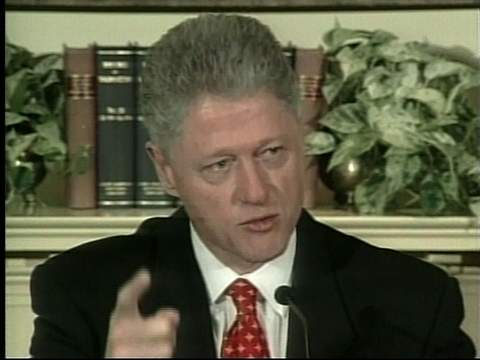
President Clinton, in a famous "true but false" moment. No Pinocchios, Glenn?

It pains me, it really does, to make Glenn Kessler, the Washington Post’s “Fact Checker,” an Ethics Dunce. He is one of the best of an often incompetent breed that, as exhaustively and repeatedly shown by Wall Street Journal blogger James Taranto, frequently defines “fact” as “the way we see it.” Kessler is notable for at least trying to keep his political biases out of the equation, and generally does an outstanding job.

His most recent column, however, took on President Obama’s repeated use of the statistic that the U.S. uses 20% of the world’s energy but only has 2% of the world’s oil reserves. Kessler correctly points out that the statement is confounding:

“…But measuring the U.S. consumption against its proven oil reserves makes little sense. Europe, with the exception of Russia, Kazakhstan and Norway, has virtually no oil reserves. Japan, a major consumer, has zero. China’s oil reserves are about half the size of the United States. In fact, in the relative scheme of things, the United States is relatively blessed with proven oil reserves — and, given the U.S. technological advantage, also with potentially large resources of oil yet to be tapped.

 “That’s why we said the president is using “non sequitur facts.” It would make much more sense to note that the United States has just 4.5 percent of the world’s population and yet we consume 20 percent of the oil, which is a finite resource, in order to urge Americans that we need to have greater energy efficiency. But in the context of higher gas prices — which is how the president often uses these figures now — it just is not logical to compare consumption to “proven oil reserves.” This is a lowball figure that does not begin to describe the oil known to be within the U.S. borders.” Continue reading

Comment of the Day: Time To Retire Editorial Cartoons—With Gratitude

Cartoonist and frequent combatant on Ethics Alarms Barry Deutsch did not disappoint—I was counting on a strong reply from him—in commenting on my post about political cartoonists. And I think he has me convinced. I think what I should have suggested, rather than advocating sending newspaper political cartoonists to the trash bin of history (soon to be followed by newspapers themselves), is that editors exercise some discretion over when an editorial cartoon, even by a respected cartoonist, just doesn’t meet editorial standards.

Here is Barry’s persuasive and educational Comment of the Day on the post Time To Retire Editorial Cartoons—With Gratitude:

“Oh, how could I possibly resist this thread?

“1) At his best, Tom Toles is a wonderful cartoonist, elegant and with an incredibly distinctive style. But he hasn’t been at his best for years. The particular cartoon you’re talking about — which can be seen here, if anyone’s curious — is an embarrassment.

“The problem with that Toles cartoon isn’t that it takes a side, or that it paints with a broad brush; many good cartoons do both those things. The problem is, it’s painfully stupid.

“2) There are good political cartoonists doing interesting work, but they’re mostly not found in mainstream newspapers.

“3) Even the best political cartoonists tend to produce more mediocre than great cartoons.

“4) It’s a very, very rare reader who can recognize the artistic merit of a political cartoon that they strongly disagree with politically.

“5) The economic base has fallen out from under political cartooning; every year, fewer and fewer newspapers support a staff cartoonist, and those that remain are seeing their incomes and outlets shrinking. And no one’s yet found a business model for political cartooning to thrive on the web.

“As a result, the most talented new cartoonists usually aren’t going into political cartooning, because they want to be able to eat and pay rent.

“6) Some of the most interesting political cartoonists have gone so far away from traditional political cartooning that no one even recognizes what they’re doing as political cartooning. See, for instance, Joe Sacco, who does journalism in comics form; his second book on Palestine, “Footnotes In Gaza,” is one of the best books about life in Gaza anyone’s done, in prose or comics.

Time To Retire Editorial Cartoons, With Gratitude

The nuanced subtlety of Pulitzer Prize winning Herb Block. Translation: "Nixon's a crook." Brilliant!!!

All right, hear me out. I love cartoons. I used to aspire to being a cartoonist. I have good friends who are cartoonists, and I know there are cartoonists who are strong contributors to Ethics Alarms. But for many years it has appeared to me that editorial cartoons have become an increasingly archaic form of commentary, one that misinforms the public and contributes to the venom and lack of nuance in public discourse.

Cartoons, by their very nature, deal in caricature, exaggeration and extremes for metaphorical and humorous effect. The practical effect of this, however, is that the opinions expressed through cartoons are also “supported” in a manner that would be outrageous in a written opinion piece. I know: you can’t hold a cartoon to the same standard as an op-ed. Fine—then don’t put it on the editorial pages. Continue reading

“Luck,” Causation, and the Complex Computation of Mixed Motivations

Was it good luck, or bad luck?

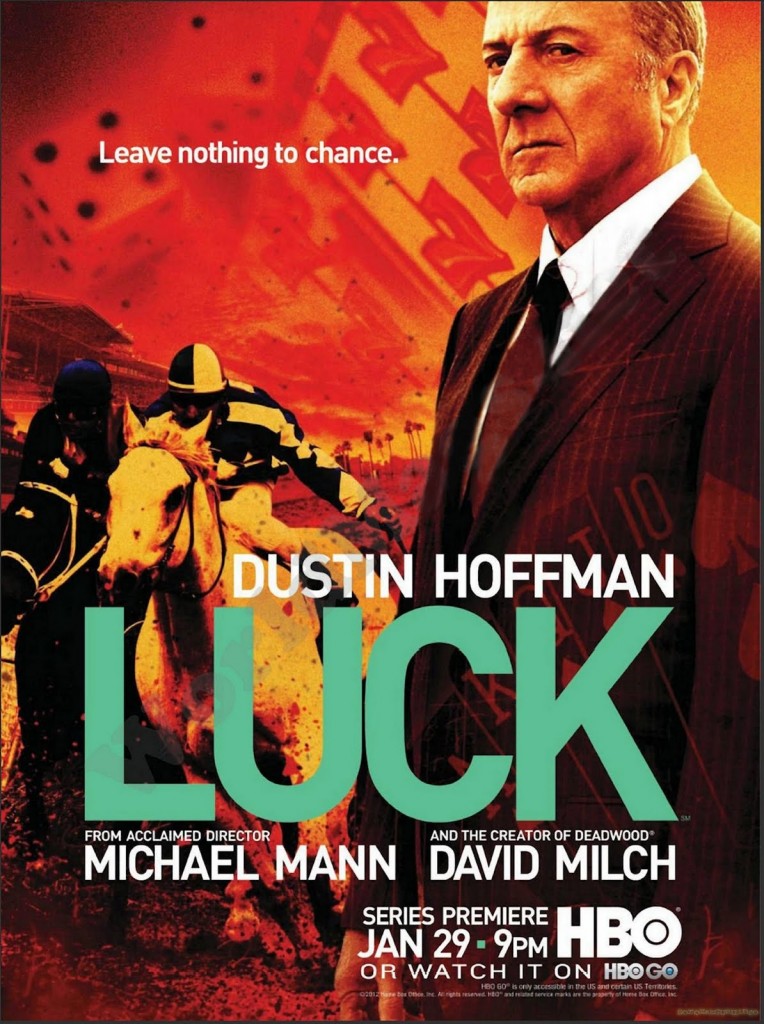
HBO has announced that it is cancelling “Luck,” its well-reviewed series about corruption in the sport of professional horse-racing. Why? Well, that’s an interesting question.

The immediate impetus for the decision was the death of a one of the horses used in the series. It was the third horse to die, so the announcement took the form of a sensitive and humane decision based on concerns for the animals. “While we maintained the highest safety standards possible, accidents unfortunately happen and it is impossible to guarantee they won’t in the future,” HBO’s statement said. “Accordingly, we have reached this difficult decision.”

I was initially impressed, but a couple of things about the move, which seemed uncharacteristically ethical by show business standards, bothered me. “Luck” was much-praised but low-rated, despite a cast headed by Dustin Hoffman and Nick Nolte and a production team headed by respected film director Michael Mann. Though it had been renewed for a second season, some felt that the renewal was dictated by a corporate decision not to embarrass its Hollywood royalty. Continue reading

White House “Ethics”: Obamacare Justifies The Means

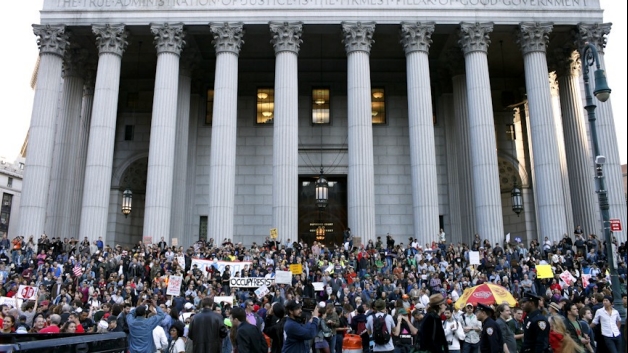
Supreme Court protests: pointless when anyone else organizes them, unethical when the White House organizes them.

I was stunned by the news reports of the White House organizing pro-Obamacare demonstrations outside the Supreme Court, and then found myself stunned that I was stunned.

It should have been obvious to all, which includes me, that President Obama and Democratic supporters of Obamacare were so determined to pass this mess that it stopped mattering to them long ago what democratic and constitutional principles were nicked, warped, distorted and violated in the process. This should be obvious regardless of whether one likes the final product (as if anyone knows what that really is, even today—principle nicked: transparent government).

The final bill was passed with a series of legislative maneuvers that had never been mustered all in the support of one controversial bill (principle warped: process and representative democracy); it was built on an expansion of Congressional power the is either unconstitutional or a frightening slippery slope (principle distorted: individual freedom); the individual mandate was (and is) simultaneously sold to the public as not being a tax while argued to the courts as one (principle violated: honesty and integrity), the Congressional Budget Office’s verdict was obtained using accounting tricks and deceitful projections (principle nicked: fairness); and misrepresentation was the norm on both sides of the debate (principles violated: respect for the public; candor, transparency and honesty). Now that the President is already campaigning for re-election and the health care law remains his signature accomplishment—if you consider it that and not a fiasco—the White House has made it clear that, while it may not be fair to say it will stop at nothing to save it, what it won’t stop at to protect the measure is a damning indictment of its integrity.

From the New York Times, one of the few non-conservative media sources to cover the story: Continue reading

Actor Ethics: Welcome to Colombia!

Yes, Sarah Bernhardt was probably unethical too. Actors!

I just blacklisted an actor, at least as far as my theater company is concerned, and I feel badly about it, because I don’t like banishing artists even when they deserve it. This individual did deserve it, however.

I held auditions a couple of months ago for a very difficult and complex production requiring special talents and a large cast. The turn-out was excellent, and the quality of talent was superb, with the actors obviously excited about the project. Since the script needs to be tailored to individual performers, the fear of an actor dropping out after being cast was especially strong (the maxim in the theater community is “cast early, cast often…”), so I took the unusual step of asking every auditioner who had a good chance of being cast to be honest about their commitment to the show. “If you want to be considered for this project,” I said, “I need to have your assurance that you are serious about it and will not tell me, after we have decided to cast you, that you have changed your mind. The show is like a big jigsaw puzzle, and casting you will affect whether we cast other actors, not just in your role but in roles that interact with yours. And I definitely do not want to cast someone who is going to turn around in a week or a month and say, ‘Sorry, I got a better offer.’ This is a commitment, and if we are committing to you, I need to know that you are committing to us.”

When the offers went out, a few actors nonetheless refused. One had just learned that she needed to seek more lucrative employment because her husband had been laid off; another had union problems. Over the next several months, there was another major loss, as an actress whom I had cast even before auditions—right before the delivery of her first child—told me that parenthood was more involving in reality than she had predicted when she committed to jumping into a major role so soon. I had thought this might happen, and, frankly, now felt that she was making the right decision.  I told her: “As a director, I was happy to let you be irresponsible for the benefit of my show, but as a parent, I’m glad your priorities are straight.”

The other day, however, one of the actors who had gladly accepted a role sent our producer a terse e-mail saying:

“Unfortunately, I can no longer do the show.  Thank you so much for all your help with everything; I’m very sorry for the inconvenience.” Continue reading

Ethics Quiz: The Problem of the Buried Video

"He stole my vote!"

The video is meaningless. It shows college student Barry Obama speaking at a 1991 rally for radical college professor Derek Bell. At one point, the future president hugs Bell. So what you say? No kidding. That doesn’t mean that the anti-Obama truth squad wouldn’t try to make something out of it; indeed, they are now. The video has surfaced as Andrew Breitbart’s farewell poke in the eye to Democrats, and it’s not much of a poke.

The only interesting aspect of the tape is that Harvard Law professor Charles Ogletree said that he had the video and buried it during the 2008 campaign.  “I hid this during the 2008 campaign,” Ogletree said. “I don’t care if they find it now.”

Your Ethics Quiz: Is it unethical for an individual to hide theoretically damaging material relating to a presidential candidate he favors until after the election, if the material in fact contains nothing that would affect the vote of any individual with  intelligence superior to that of the average civic-minded horseshoe crab?

My answer: Definitely. I don’t care whether the information is extra-marital affairs, drug use, a DUI or appearing at a frat party in a tutu. No one has the right to withhold information, even stupid and useless information, from the media and electorate.  If the information is relevant, then the public has a right to know about it. If it isn’t, as this tape appears to be, then why hide it? If the tape was intentionally kept from the public, the conduct can’t be defended on the basis that it did no harm—the intent was to do harm. If one person would have changed his vote because he doesn’t want a President who ever hugged Derek Bell, even though that person is probably a fool, no one had no right to take away that vote through deception.

It’s all hypothetical, apparently, because Prof. Ogletree has explained that his “confession” was a joke, and was understood as such when he made it, if not reported that way. [Thanks to Barry Deutch for the link.]

So nobody hid anything, and those those horseshoe crabs who voted for Obama weren’t deceived after all.

Leroy Fick, Meet the Honorary “Ms. Fick 2012.” On Second Thought, Don’t.

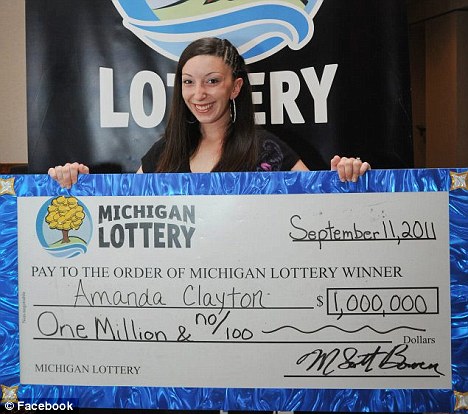
Amanda Fick, er, Clayton

Following in the despicable footsteps of Leroy Fick, the  Michigan millionaire lottery winner who collects food stamps because of a loop-hole in the law (and whose name, “fick,” has made the Ethics Alarms glossary as the word for someone who is willfully, openly and shameless unethical), here comes a Ms. Fick, a.k.a Amanda Clayton. She says that she is entitled to food stamps despite having two homes and a million dollar lottery prize that will leave her with $500,000 in the bank. No need for me to be creative here; what went for the Original Fick goes for her as well:

“What ethical principle doesn’t his conduct violate? He’s not responsible; he’s not accountable; he’s not fair. He doesn’t respect his fellow citizens or their opinions. He’s not loyal to his state or his community. He’s not compassionate, and I wouldn’t trust him to walk my dog: he’d probably sell him.  Is he honest? Applying for food stamps is an act that declares that you need them to eat, because that’s the only reason they exist: Leroy Fick isn’t honest.”

Ditto the honorary Ms. Fick, 2012, Amanda Clayton. And if there are any eugenics practitioners out there, please try to keep these ficks from ever getting together. That’s all Michigan needs…a litter of little Ficks.

Thanks to tgt for the tip.

Newt Gingrich’s Desperate, Dishonest, Irresponsible Pitch

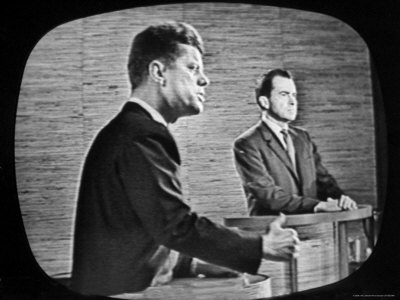
In 1960 the better hair beat the better debater. Maybe Newt's basing his strategy on his hair.

I heard it again on a radio ad for Newt yesterday, and decided that it was unfair to slam him for it, because the sponsor was his Super Pac, and we all know that (cough!) Super Pacs have no contact with the candidates they support. Then, last night, Gingrich made the argument himself, and not for the first time. The reason Newt Gingrich should be the Republican nominee for President is that he is the one best equipped to trounce Barack Obama in the debates.

“Wouldn’t it be great if we had our smartest guy going head to head against their smartest guy in the debates?” the perky actress playing a Newt supporter ( a dumb Newt supporter) said in the ad. “ “Newt would win for sure!”

The ad, please note, said absolutely nothing about whether Gingrich had any skills actually relevant to being President of the United States, and never said what his policies would be or how he would govern. Newt himself has talked about these things, but in the end he too boils his pitch down to one asset: He’s a better debater than Barack Obama. And the proper responses to that are, in order,

On Apologies: the Sincere, the Forced, the Cynical and the Harmful

"Apologize! SINCERELY!"

On February 17th, Washington Post political commentator Dana Milbank wrote a column disparaging what he called “forced apologies.” Although the context of his column and the apology he was refusing to make was too silly to bother with* (yes, there really are things too silly for Ethics Alarms to bother with) something told me I should keep his column handy, and indeed, the perfect time to consider Milbank’s argument has arrived. Forced apologies are flying all over the place.He wrote:

“…one of the most annoying components of our decaying political culture [is] false umbrage. Liberals created this form of identity politics, in which an underrepresented group claims persecution, but conservatives have embraced it. One of its most common expressions is the demand for an apology. It’s phony by definition — an apology can’t be sincere if it’s answering a demand — and the reflexive demand (like a demand for a resignation) serves only as an excuse to keep a news story alive. Sorry, but it’s time to put this tired gimmick to rest.”

Milbank’s essay included an impressive catalogue of recent demands for apologies, and since it was published there have been many more, the most recent example, of course, being Rush Limbaugh’s mea culpa for his outburst against Sandra Fluke. His central thesis, however, is wrong.

Here is the hierarchy of apologies, their function and their motivation, 1-10, from most admirable to despicable: Continue reading