Liar, Liar, Volt on Fire

Not a hotcake. Definitely selling like a hotcake.

There are times when I miss the David Manning Liar of the Month, a regular feature on my old Ethics Scoreboard reserved for flagging a breed of lie that I find the most annoying of all. These are the lies that even the liars know are unbelievable from the moment the dishonest statements leave their mouths. Then, when they are inevitably caught, the liars argue that the lie wasn’t really a lie because nobody believed it in the first place. Such lies tell us that the liar doesn’t think lying is anything to be ashamed of. Beware such people, especially when they dwell in high places. The lie may be trivial, but the attitude toward lying is not.

Spared the indignity of being a David Manning Liar by the Scoreboard’s dormant state is Rep. John Dingell, a Michigan Democrat, who took umbrage at Mitt Romney’s statement that the Chevy Volt was “and idea whose time has not come.” Dingell protested, isssuing a press release that said, Continue reading


A Frightening Figure, Setting Off Ethics Alarms

We don't even know how to play Russian Roulette responsibly.

On Friday, the day before Christmas Eve when much of America was thinking about sugar plums,  lay-away plans, and protesting Christmas pageants, the Federal Accounting Office released its analysis of  the net present value of the nation’s Social Security and Medicare obligations, “net present value” being  the total funds that would have to be set aside today to pay the costs of these programs in the future. Seldom do figures so clearly indict the unethical practices and statements of so many.

In fiscal 2011, the cost of the catching up on the required funding of Medicare and Social Security rose from $30.9 trillion to $33.8 trillion. That $2.9 trillion increase should be regarded as adding to the $1.3 trillion cash deficit for fiscal 2011, making a $4.2 trillion deficit—and this coming in a year in which the rising national debt was supposedly recognized, at last, as a threat to America’s stability, prosperity, and welfare. The costs of Social Security and Medicare are rising at a frightening rate, nearly doubling in the last decade, with little or nothing being done to address the problem. And there is good reason to believe that the Medicare estimates are based on unrealistic assumptions. The GAO report also includes an alternate, less rosy scenario (or perhaps “more putrid” is a better phrase) in which the projected Social Security-Medicare debt is more than $46 trillion. How serious is that? Well, the combined value of the equity in U.S. homes and the value of all publicly-traded companies is less than 20 trillion dollars.

What do these figures tell us about the ethics of the various players on the national scene? Continue reading

Comment of the Day: “Ethics Quiz: The Case of the Fake But Accurate Social Security Card”

My ethics conundrum regarding the fake but accurate Social Security card solution—the Dan Rather approach, if you will— continued to garner a wide range of responses. Rick, as usual, has delivered one of the most thoughtful and provocative, and it is a worthy Comment of the Day.

Here is his comment on “Ethics Quiz: The Case of the Fake But Accurate Social Security Card”:

It strikes me that sometimes—not always, but sometimes—ethics is on a continuum. There’s the truly ethical, the not unethical, and the unethical, with many finer distinctions to be made.

I don’t running screaming into the night at the idea of faking a card, under the circumstances. Still, the truly ethical thing to do in this situation is to tell the prospective employer the truth. And the availability of all those other possible means of identification is indeed relevant. Provide one of the non-Social Security card alternatives and whatever other documentation is available. Importantly, if the employer, for whatever reason, is unwilling to accept this legally sufficient documentation, you don’t want to work for this person, no matter how much you need a job. Continue reading

Ethics Quiz: The Case of the Fake But Accurate Social Security Card

A conundrum I have been asked to solve:

A mother is working to get her foreign adopted child a new copy of his Social Security card, which was lost. The child is a citizen since infancy, and a SS number has been assigned to him, but the process for a naturalized alien to get another is long and fraught with red tape, delays and frustration. So far, replacing the card has taken ten months, though it was supposed to take three. Now the son is waiting for the card to be issued. Social Security says it is waiting for final approval from Immigration, and Immigration says that there is a bottle neck, but not to worry.

Meanwhile, the boy has a standing job offer for a job that he is excited about and that would help family finances considerably. He cannot be processed without a Social Security card, however. And the job will not be held open forever.

For $250, a friend of the mother’s can get a counterfeit Social Security card with the son’s real number on it. He can have it in a week,

Your Question, in the last Ethics Quiz of 2011:

Granted that getting such a fake card is illegal, is it unethical?

None of the agencies involved dispute his citizenship, that he is enrolled in Social Security or that his number is valid. He has a document from Social Security that lists his number. The fake card would not assert anything that wasn’t true, except that he actually had the official card. He would be offering fake proof, but fake proof of something that is undisputed and true.

Is this one of the rare cases when conduct would be both illegal and ethical?

I’ll take your responses and update this with commentary later.

Dear Ethics Alarms: We Are Stealing Your Content. Love and Happy Hollidays, The Making Relationships Site

I think this is strange.

Yes, it's true: Nelson may be running a relationship website.

Ethics Alarms got a trackback, which means that a website notified me that it had used a post here. I get these all the time, and sometimes it leads me to a new source of ideas, or new professional relationship. A site has quoted or re-posted some or all of an essay, and that is fine with me.

This trackback led me to a website called “The Making Relationships Site,” and there was my recent post about Zenas Zelotes, the Connecticut lawyer who argues that it’s good for a lawyer to have a romantic relationship with his client. What wasn’t there was a link to the blog, a reference to Ethics Alarms, or any credit to me as the author. My post was presented as the original content of  The Making Relationships Site. The re=post permitted no comments, so I couldn’t write a “What the hell are you doing?” comment, and the site includes no information about who operates it or how to contact webmaster.

But whoever it is was kind enough to let me know, via the trackback, that it had stolen my post. This is the fickish behavior of being candid about being unethical, which also carries an implication of shamelessness, and a dash of Nelson Muntz, the bully on The Simpsons whose reaction to everybody’s misfortune is to point and laugh.

I’m not especially worked up about the theft itself. I don’t like it, but I assume my work will be lifted without attribution from time to time; it goes with the job, though stealing articles about ethics has an especially oxymoronic tinge.

But for a site to make sure that I know about it is strange. Now I’m send it a trackback, so the operators know that  The Making Relationships Site is the first official online fick.

Love Your Lawyer? Bad Idea. Love Your Client? Even Worse.

This is all your fault, Arnie!

A Connecticut lawyer under fire for commencing a lawyer-client relationship with a woman with whom he was romantically involved made the novel argument that it is good to be in love with your client.  This indicates a profound misunderstanding of human nature and the nature of a lawyer’s duties.

Almost ten years ago, the American Bar Association recommended that state bars include a direct prohibition against lawyers having sexual relations with their clients, and the majority of the states did so. As I have mentioned before, it’s a dumb rule, too broad and too narrow simultaneously, a classic example of how some kinds of unethical conduct do not lend themselves to precise rule-making.  The main problem with the no-sex rules is that they are unnecessary. The legal ethics rules are replete with exhortations to maintain objectivity, independent judgment and to avoid conflicts of interest. Common sense suggests that it is irresponsible to confuse one relationship by adding another; professional standards dictate that combining a professional relationship of independence and with romantic relationships is wrong.  As the D.C. Bar’s Rules of Professional Conduct point out in its comments to Rule 1.7, Conflicts of Interest: Continue reading

Alek and the Amazing Controllable Christmas Lights

I haven’t plugged my friend Alek O. Komarnitsky in quite a while, and since I’m having a hard time keeping up with all the abuse ( and repetitious rationalizations) from the NORML  crowd over on the “Distracted Driving…” thread, this is a good time to re-introduce him.

Back in 2004, Alek received national attention for his whimsical holiday website that allowed people all over the world to turn his elaborate Christmas lights on from their home computers. Everyone had fun, which was clearly Alek’s design. Still, when it became known that his site was a hoax and that the lights going on and off were only an illusion, I weighed in (on The Ethics Scoreboard) with the opinion that perpetrating such a large-scale deception was wrong, no matter how well-intentioned. Alek objected to my criticism, and we had a spirited e-mail debate.

Then, at a significant cost in time and money, Alek devised a way to really let people all over the world turn on his lights. He has done this ever since, and uses the site to raise money to cure Celiac disease. This year, he writes: Continue reading

More Unethical Fun With Twins: It’s Not Nice To Fool The Judge

You'll doubtless recall that the same tactic was used in the infamous "Parent Trap" murder trial....

Way back in May of 2010, I wrote about a lawyer who suspected that his criminal defendant had pulled a switcheroo, substituting his identical twin brother for himself in his trial. (He had, too.) That was bad enough, but when a lawyer pulls the same stunt, she has crossed some significant ethical lines that will land her in serious trouble with the judge and probably the bar. Thus when Dorothy Savory, a Kansas City defense attorney, placed her client’s identical twin at the counsel’s table just in time for him to be identified by a witness as the man who had snatched her purse, the judge was furious.

This sleazy tactic is older than Abe Lincoln, and has the theoretical purpose of establishing inherent reasonable doubt by showing that an eye witness has identified the wrong person. It has been long established, however, that doing this is a fraud on the court–deceiving not merely the witness, but the jury and, most important of all, the judge, unless a defense attorney alerts the judge to her intention and gets advance permission to try to fool the witness by seating a fake defendant where the real defendant would normally sit.  There were three things that made what Savory did unethical: Continue reading

Gallup’s Trust Survey: Congress in Freefall

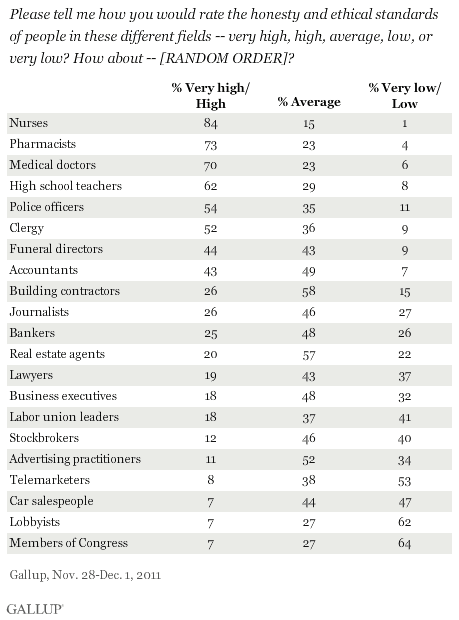
Gallup’s just released annual survey of public attitudes toward various professions held few surprises this year. As has been the case for over a decade,nurses and pharmacists topped the list as the  professions regarded as the most honest and ethical. I find the presence of high school teachers fourth (ahead of police officers)  a triumph of public relations, nostalgia and wishful thinking, but the other top rated professions were predictable. In general, the professions we are forced to depend upon the most are the ones we trust the most—because we have little choice. The ones we trust the least tend to be those with whom we can be in conflict with or see as having differing interests from our own. Doctors are always going to rank higher than lawyers, for example, because there are no doctors trying to make us sick.

Of the 21 professions in the survey, only seven—including funeral directors!—had positive numbers, meaning that more people regarded them as ethical than unethical. The seriously distrusted professions, with a percentage of very low ratings significantly higher than the proportion of very high ratings, begins with lawyers, business executives, union leaders, stock brokers, and advertising execs in order of trustworthiness; bankers, interestingly, avoided this group and had about as many supporters as detractors. But the bottom four is where the really dishonest professionals dwell, according to the poll. With single digit positive ratings compared to negative ratings of  more than 50% are telemarketers, car salesmen, lobbyists, and at the very bottom, Congress, with 64% of the public regarding the institution as dishonest and unethical. That, Gallup says, is not only the lowest rating for Congress since the survey has been taken; it is the worst rating for any profession.

That Congress has sunk so far is not a surprise. It is just depressing.

Here are the results:

Occupy Manny

Sing it, Manny! "You load 16 tons, and what do you get? Another day older and a pro-rated 20 million dollars a year.."

I admit it: Manny Ramirez’s existence is a constant irritant to me. I regard him as epitomizing the worst tendencies of professional sports stars, and the attitudes of the most conscience-free who walk among us who make/ society and the culture a little bit worse every day. I was thrilled when his baseball career came to an appropriately sordid end, with his being caught using performance enhancing drugs and retiring o avoid having to serve his suspension, and nauseated when he announced the end of his retirement a few weeks ago, hoping to lure some addled team owner into paying him a million dollars or so to hit home runs and loaf.

Now, thanks to the research skills of baseball blogger Craig Calcaterra, my morning began by learning that Manny is also akin to the recording stars, Hollywood actors, rich politicians and toadying business executives who have tried to pass themselves off as Occupy Wall Street’s virtuous and harshly exploited 99% despite all reason and evidence to the contrary. In an interview in Spanish, Manny was explaining that he might have to travel to Japan to play ball again, and said,“Somos un obrero y donde quiera que haya trabajo hay que ir a trabajar;” in English: “We are the working class and must go where there is work.”

“Working class!” Continue reading