The Ethics of Interviewing Kids on Camera


Art Linkletter was right: "Kids say the darndest things!"

When I initially learned about  Chicago TV station WBBM editing  an interview with a 4-year-old boy last month to make him sound like an aspiring gang-member when he actually said that he wanted to be a policeman, I decided to pass. I try to avoid making obvious observations, and nobody could defend the conduct of the station’s editors, who intentionally truncated the child’s remarks to the interviewer to make them sound chilling. The larger question of whether the child should have been interviewed at all, however, is more challenging. We see kids being interviewed on TV all the time, and it is far from certain that reporters are doing so ethically.

In the wake of  the WBBM incident, journalistic ethics expert Al Thompkins reprinted his guidelines for interviewing juveniles on the Poynter site. I’m an admirer of Thompkins, but I found his guidelines almost as chilling as the distorted interview itself. Here is his guidance on the issue of interviewing kids, with my reactions: Continue reading

Ethics Quiz: Is It Ethical to Confess to a Murder You Were Acquitted of Committing, or Merely Annoying?


Come on, O.J! If he can do it, so can you!

Isaac Turnbaugh of Randolph, Vermont recently confessed to the 2002 shooting murder of a co-worker, using a rifle to kill the victim as he was at work in the American Flatbread Co, stirring a pot of  sauce.  A jury acquitted Turnbaugh of the charges in 2004. In July, Turnbaugh contacted police and said, jury verdict notwithstanding, he indeed shot Declan Lyons in the head with the rifle and wished to surrender to authorities. Too bad, they told him. In the eyes of the law, you are “not guilty,” and have to stay that way. Double jeopardy and all that.

Your ethics quiz for today:

If you have been acquitted of a murder and have a guilty conscience about it, what is your most ethical course of action? Continue reading

Comment of the Day: “Scent Branding, Mind-Control, and Ethics”

Elizabeth was the first one to dive into this murky, interesting, science fiction/ “Brave New World” issue that I examined in  “Scent Branding, Mind-Control, and Ethics,” on a topic that confused me more the longer I considered it. What resulted was unusually long, perhaps accounting for the lack of comments, and Elizabeth’s reaction is long as well, but worth reading. There is something potentially sinister here, or perhaps around the corner—or just in our imagination and fears. Scent manipulation, and all it implies, is in the wilderness of ethics, where human nature, science and commerce meet.

Here is the “Comment of the Day”:

“I agree this is a complicated issue.  As you said, restaurant smells (natural, I assume) tend to make people hungry (or more hungry than they really are), as do waiters with large platters of beautiful food which often encourage patrons order more, different, and perhaps more expensive food than what they may have had in mind.  The goal of the restaurant is to sell food:  if memory serves, it’s only been in the last 20 years or so that restaurants had at least parts of their kitchens open to the dining area so “good smells” could waft out from them.  My memory from childhood of elegant restaurants were the multiple green baize doors that completely closed the kitchen off from the dining room.  So was this change intentional or simply simpler and cheaper as restaurant designs?  I don’t know, but it’s different. Continue reading

Scent Branding, Mind-Control, and Ethics

Agreed: this is scary. We're not there yet. We don't even know if "there" exists.

A recent article on the web that purported to explore the ethics of “scent branding” was fascinating for two reasons.

First, “scent branding” is a term I had never encountered before, for a practice that I had not focused on. About five seconds of thought, however, made me realize that indeed I was aware of the phenomenon, and had been for quite a while. “Scent branding”—using fragrances in a commercial environment to create a desired atmosphere and to prompt positive feelings, recollections and emotions from patrons—has been around a long, long time, though not under that label. When funeral parlors made sure that their premises smelled of flowers rather than formaldehyde, that was a form of scent branding. Progress in the science of scent allowed other businesses to get into the act: I was first conscious of the intentional use of smell when I spent a vacation at the Walt Disney World Polynesian Villages Resort. The lobby and the rooms had a powerful “tropical paradise” scent, a mixture of beach smells, torches and exotic fauna. It was obviously fake, like much in Disney World; also like much in Disney World, I found it effective, pleasant, and fun. I certainly didn’t think of it as unethical. I was normal in those days, however.

Well, more normal.

The second aspect of the article, entitled “Is it Ethical to Scent Brand Public Places?”, that caught my attention was that it had an obvious agenda. The piece was opposed to scent branding, and set out to find the practice unethical in order to justify condemning it. Continue reading

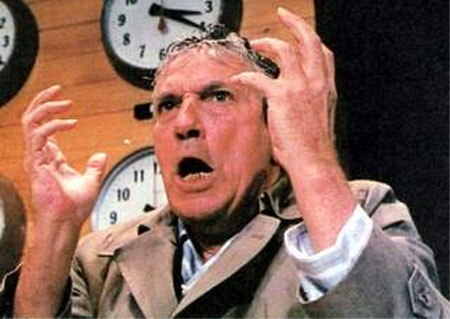
MSNBC Hires Al Sharpton, As “Network” Becomes Reality

Satire no more.

Noting that MSNBC has given Rev. Al Sharpton his own show, I am compelled to ask: What is broadcast journalism’s accepted criteria now that justifies an individual’s enshrinement as a cable news commentator?

Is it name recognition? The “right” political orientation, in this case, knee-jerk liberal? A ready-made fan base?  Theatrical presence? If these are the criteria, by all means, hire Al Sharpton. Hire Alec Baldwin, Donald Trump, Rod Blagojevich and Jane Fonda, too. Gary Busey. Manny Ramirez. Hulk Hogan. Bozo the Clown.

Or is the proper and responsible criteria credibility, integrity, honesty, fairness, and journalistic credentials? If those archaic standards are still in place, or if MSNBC wants to pretend that they are, then the hiring of Sharpton marks a new low in broadcast news coverage cynicism and recklessness. Continue reading

Comment of the Day: “Dear God: Stop Calling”

The post about political candidates announcing that they have been “called’ by the Lord to run for high office continues to generate provocative, passionate and  perceptive responses, the latest from Glenn Logan,a blogger who covers the University of Kentucky Wildcats for their most discerning fans. Glenn’s comments here—sadly less frequent than they once were—are always thoughtful. Here is his comment on “Dear God: Stop Calling!”, putting to good use his expertise regarding competition of all sorts. I think you’ll agree that it is a most deserving “Comment of the Day”:

“Just because God calls us to do something does not mean that our effort will be successful, even if we do it the best we can. I would hope that most people understand this. Very often, it seems to be the case that the value, or the lesson, is in the journey rather than the outcome. This is pure assumption on my part — God has not seen fit to reveal his works to me, a fact for which I am eternally grateful.

“It is also possible that these worthies mistook their own desires as a call from God. Sometimes, it’s hard to tell the difference, for whatever reason. If we forget, for a moment, that we are talking about politicians and just assume they believe what they say, this could be little more than a misunderstanding on their part.” Continue reading

Fact Checker Ethics, Part II: Validating Deceit, and Practicing It Too

Et tu, Fact Checker?

In its review of Washington Post “Fact Checker” Glenn Kessler’s shameful refusal to call the Democratic dissembling on Social Security, Ethics Alarms saved the best—which is to say, worst—for last.

Beginning with a statement typical of Obama Administration and Democratic leadership positioning on the subject, Rep. Xavier Becerra’s (D-Calif.) “Social Security has never contributed a dime to the nation’s $14.3 trillion debt…not one penny to our federal budget deficit this year or any year in our nation’s history,” Kessler gives a brief history of Social Security, why it has no more money, and concludes with this nonsense:

“Becerra is sincere in his convictions and his statement is true, so far as it goes. Yes, Social Security in the past has not contributed to the nation’s debt. But it’s basically a meaningless fact and actually distracts from the long-term fiscal problem posed by the retirement of the baby boom generation and the shrinking of the nation’s labor pool.” Continue reading

Fact Checker Ethics: Alibis For Obama, Part I

The Washington Post “Fact Checker,” Glenn Kessler, is among the most biased of the breed. On the issue of the Obama Administration’s outright dishonesty on Social Security, however, he is embarrassing his paper and the entire Fact-Check community.

Lately, his strategy has been to bury obvious dishonesty by the Obama Administration and Democrats regarding Social Security in technical details, excusing straightforward misrepresentation (how’s that for an oxymoron?) and encouraging readers to shrug, give up, and move on

How nice for the President to have political allies posing as objective truth-tellers. Continue reading

Ethics Dunce: CBS

"That's Entertainment!"

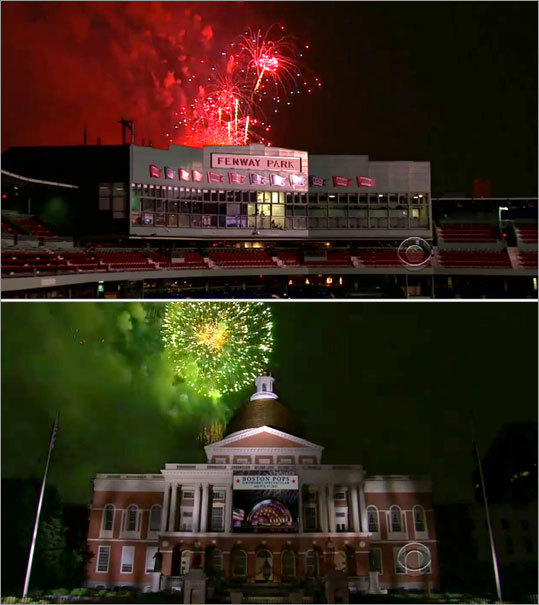
It took a few days, but Boston viewers finally figured out that CBS’s broadcast of the city’s famous Fourth of July fireworks display was digitally altered to present a spectacular view of the display that is geographically impossible. Yes, CBS, network of Murrow and Cronkite, presented a phony, enhanced version of the fireworks without bothering to disclose to viewers what they were really seeing.

Yesterday Boston bloggers and observers began pointing out that it was  impossible to see the fireworks above and behind such famous locales as the State House, Quincy Market, and home plate at Fenway Park, because the display, as always,  was launched from a barge in the Charles River, located where it could not be seen from those places.

“According to CBS, you can see the fireworks from the right side of Quincy Market, even though Beacon Hill is in the way,’’ wrote Karl Clodfelter, a research scientist and a commenter on the Boston blog UniversalHub.com. “Also, they come up behind the State House when you’re standing across the road . . . which means the barge must have been parked on the Zakim* this year.’’ Continue reading

Ethics, Porn, and the Creepy Professor

The Ronald Ayers saga raises the intriguing, Weiner-esque ethical issue of whether a college professor being creepy is sufficient reason to fire him.

The former economics professor was fired by the University of Texas for viewing pornography on an office computer, which the University’s policies forbade. The chain of facts has the ring of Kafka: 1) a student claims he hears “sexual noises” emanating from Ayers’ office, which 2) is considered sufficient provocation (the professor denied the accusation that he was not “master of his domain” at work) for the school to search his computer, which 3) uncovers evidence that he looked at some pornographic sites, and 4) also that he searched for the term “teen,” which 5) the university deems sufficient to indicate that he was searching for child pornography, so 6) they fired him, after three decades and tenure on the faculty.

University records say Ayers at first denied the allegations that he viewed pornography, but when confronted with a printout of his computer records, admitted that it may have happened “at the end of a long work day.” Ayers later told administrators seeing the porn was for “academic research.”

Uh-huh… Continue reading