The Audacious And Everlasting Hypocrisy Of Al Gore

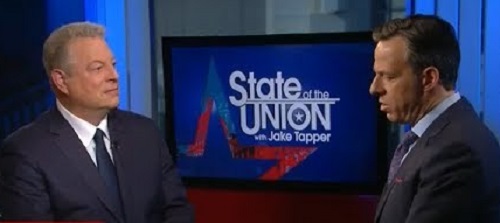
In June, CNN’s Jake Tapper asked Al Gore about his apparent energy-use hypocrisy:

TAPPER: This is a criticism we hear from conservatives all the time when talking about people like you or Elon Musk or Leonardo DiCaprio, that you, yourself, have a large carbon footprint.

GORE: Yes. Well, I don’t have a private jet. And what carbon emissions come from my trips on Southwest Airlines are offset. I live a carbon-free lifestyle, to the maximum extent possible.

As Ann Althouse noted at the time, for  a carbon-based organism like Gore to claim to be living carbon-free is a demonstration of shocking ignorance by someone who has been making his millions as an earth-science huckster. To me, the amazing thing was that after repeatedly showing that he couldn’t pass a middle-school science test (as when he declared on national TV that the core of the Earth was “several million degrees”)

After he found himself the official guru of global warming hype, Gore should have had the sense and discipline to educate himself and really learn about the topics he was purporting to be an expert on. He obviously didn’t bother; like the similarly lazy Sarah Palin, he figured that the people who agreed with him weren’t going to be that discerning, so mastery of facts wasn’t worth the trouble.

The other infuriating aspect of Gore’s answer to Tapper  was his “offset” excuse. That just  meant “I’m rich, so I pay to for all my carbon pollution.” Gore really believes that leaving a carbon footprint the size of Godzilla is responsible conduct for a climate change shill telling the peasants that they must change their life-style, because he can “offset” it. He really believes that’s fair and honest.

In the wake of Gore’s sequel to his error and hype-filled climate change alarmist documentary “An Inconvenient Truth,” the National Center For Public Policy Research, which had embarrassed Gore with its 2007 revelations after his first documentary, checked to see if Al, as he promised at the time, had addressed his own polluting ways. It checked Gore’s electricity usage information through public records requests and conversations with the Nashville Electric Service (NES), and found.. Continue reading
Ethics Hero: The Chicago Cubs Organization

This was a wonderful gesture of kindness and reconciliation. It won’t mean much to those who don’t follow baseball, and that is Reason #478,653,222 why it’s a mistake not to follow baseball.

I’ve written about the Steve Bartman fiasco several times.  I am not in the “Steve Bartman was an innocent victim of circumstance” camp, though he was a victim of moral luck. He was an  incompetent baseball fan, not paying sufficient attention to the game and interfering with it as a direct result. On the other hand, for members of the 2003 Cubs to use him as a scapegoat for their blowing a lead,  the game, and the play-offs, and for Chicago fans to hound him out of town and into hiding, was far worse than his negligence, the most disproportionate and vindictive treatment of a fan in sports history.

Here was my summary of the saga to date before the Cubs finally won the World Series after more than a century of failure:

Bartman, for those of you who have lived in a bank vault since 2003, was the hapless young Chicago Cubs fan who unintentionally interfered with a foul ball that might have been catchable by Cubs outfielder Moises Alou in the decisive game of 2003 National League Championship Series. In a perfect display of the dangers of moral luck, Bartman’s mistake—it didn’t help that he was wearing earphones and watching the ball rather than the action on the field—began a chain of random events  that constituted a complete collapse by Chicago in that very same half-inning, sending the Miami Marlins and not the Cubs, who had seemed comfortably ahead, to the Series. Bartman, who issued a sincere and pitiful apology, was widely vilified and literally run out of town. He then became part of Cubs and baseball lore, one more chapter in the sad saga has been called “the Billy Goat Curse,” the uncanny inability of this team to win it all.

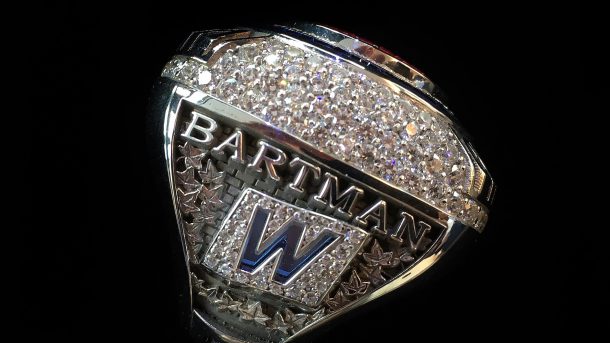
Yesterday the Cubs announced that the team had privately awarded Bartman  an official Chicago Cubs 2016 World Series Championship ring as a special gift from the the Cubs organization. These things contain 214 diamonds at 5.5 karats, three karats of genuine red rubies and 2.5 karats of genuine sapphires, and are worth about $70,000. Even so,  the symbolism is worth far more.

Tom Ricketts, the Cubs owner, issued a statement: Continue reading

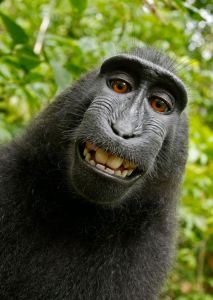
From The “Law vs Ethics” Files: PETA Chooses To Harm An Artist On Behalf Of A Monkey Who Couldn’t Care Less, And Judges Think It’s An Amusing Legal Condundrum

“I’m baaaaack!”

When we last heard from  photographer David Slater, the U.S. Copyright Office had rejected his claim that he owned the  copyright for the famous series of selfies presumably taken unintentionally by a Celebes crested macaque.  In 2011,  Slater spent several days following and photographing a troop of macaques in Sulawesi, Indonesia, and the selfies were a lucky bi-product that quickly became a web sensation. Slater had asserted ownership over the photos, and had demanded that various on-line users, such as Wikipedia, either take them down or pay him as the copyright holder. The ruling of the Copyright Office was based on the theory that Slater had not taken the photo, so he was not the creator, and animals couldn’t own copyrights, so the photos were in the public domain.

Pop Ethics Quiz: Would it have been unethical had Slater simply released the photos without revealing that the selfies had been the lucky result of an  accident, snapped by the monkey while it was messing around with his equipment?

About the Copyright Office’s ruling: I’m dubious. Slater owned the equipment, and had the sense to preserve the photos. A decision that if a photo is taken accidentally by a non-human or an act of God, the photographer who owns the equipment gets the copyright would have been fair.  Zapruder owned the film that inadvertently caught President Kennedy having his forehead shot off, and it made him rich. Slater’s claim just goes a step further: Zapruder left the street  to buy a hotdog, put his camera on on a trash can and asked a friend to “watch it,” and a dog turned the camera on, catching the grisly scene. So Zapruder doesn’t own the film anymore? Does that make sense to you?

Well, that was the ruling anyway. Then things got really ridiculous. Slater included the monkey selfies in a book, and People for the Ethical Treatment of Animals (PETA)  brought a law suit against Slater on behalf of the monkey,which PETA claims is named Naruto, and asked that PETA be appointed to administer proceeds from the photos for the benefit of Naruto and other crested macaques in the reserve on Sulawesi. So PETA would suddenly be the de facto copyright holder. Continue reading

This Is Why It’s Time For Political Cartoons To Go


Here (and above) is a sample of the bumper crop of political cartoons inspired by the Donald Trump, Jr. aborted meeting to acquire damaging information on Hillary that never materialized.

They are all, to various degrees, unfair, misleading, or simply untrue. Why is this acceptable? If presenting a false representation of the truth is required to make a joke, and the intended audience accepts what is false as fact, how is that justifiable?

The cartoon above, one of the most unethical, is typical of the work of Tom Toles, the Washington Post’s relentlessly biased cartoonist.

The others are presented below, in approximate order of unfairness and dishonesty.

They collectively state that there has been treason, a crime, corruption, collusion and conspiracy, and that there is actual, as opposed to speculated, “news” that the Trump campaign worked with Russia to interfere with the election. This is old fashioned yellow journalism-style political cartooning, throwing red meat to members of the public who want to believe that the President of the United States is a traitor so they can undo the election. That isn’t funny. That’s disgusting.

As I wrote in 2012, focusing on another dishonest and partisan Toles cartoon:

” Political cartooning peaked as a form of commentary about half a century ago, and has been declining ever since. Now it is dominated by hateful, unfunny and witless culture warriors who have as much in common with Jules Feiffer and Bill Mauldin as Mario Mendoza had in common with Hank Aaron. Are there exceptions? There are always exceptions. Pat Oliphant, Exhibit A, is brilliant, nuanced and clever; he’s also 77 years old, the last of the greats. If there are Oliphants out there, legitimate commentators who can make fair and honest observations with humor and a pen, great: what a wonderful alternative to the typical pundit rants. Put them on the editorial pages. The standard, however, should be content, not form. Political cartoons were once an efficient means of aiming a thousand words at non-readers and members of the public without the skills or education to grasp complex issues. They have become a vehicle for the unqualified and trivial-minded to acquire a platform they don’t deserve, to the detriment of the public and journalism.”

Now the evidence: Continue reading

Comment Of The Day: Why That “We’re Glad You’re Our Neighbor” Sign Is Unethical (As Well As Obnoxious)

Mrs. Q, who is keeping Ethics Alarms current on the oppressive politically correct environment slowly poisoning Portland, Oragon, was moved to issue another report in reponse to the Ethics Alarms post about a virtue-signalling sign popping up live wild-flowers on yards across America here is her Comment of the Day on the post, “Why That “We’re Glad You’re Our Neighbor” Sign Is Unethical (As Well As Obnoxious)”…(I’ll be back at the end.)

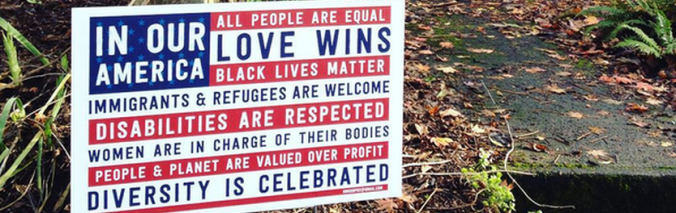
This yard sign is just about everywhere in the city including businesses, churches, schools, and city offices.


This one is also popular. I love how the “Science is real” part is in green.

Black Lives Matters signs often accompany the 2 above. Also on businesses, schools, etc.

This one is mostly on businesses/community centers but some residents have this sign taped to their living room windows.

What’s most interesting is that all the problems this town suddenly has with “hate” came after the anti-Trumpers started putting these signs up. I told a (former) friend that I thought these signs were virtue signaling and devisive and smug I didn’t appreciate that every day everywhere an average citizen can’t take a walk or go to the gym without knowing the political opinions of the home/business/agency owners.

She promptly quoted Eleanor Roosevelt’s “No one can make you feel inferior” mantra. Funny enough she’s white, I’m not, and instead of actually listening to me, you know as a special downtrodden minority, she dismissed my concerns altogether about how such signs may negatively affect a community (and then she cut me out of her life. Yep, so tolerant). Continue reading

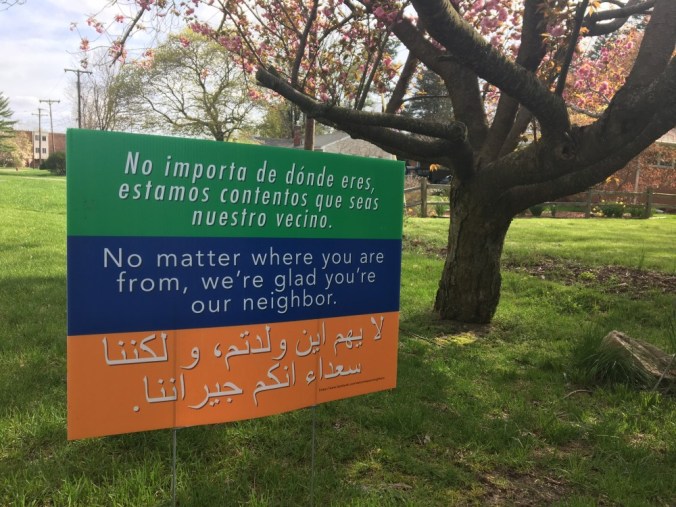
Why That “We’re Glad You’re Our Neighbor” Sign Is Unethical (As Well As Obnoxious)

NPR claims that people get teary-eyed viewing this supposedly viral sign in front of houses across the country. I’ve only seen two in my neighborhood, thank goodness, and they irritate me no end. Why? The sign is dishonest, unfair and divisive. It is also political, while pretending not to be.

First, the sign is not what it represents itself as being. It is not written for an actual neighbor. If it were, the sign would be remote and rude. I welcome new neighbors personally, not by putting garish signs on my lawn.  The sign is blatant virtue-signalling, telling the neighborhood that this household is in favor of diversity, love, and immigration…as if lots of other people are not. If it is not a public sign designed to rebuke those people, whoever they are, then why the sign? If everyone in the neighborhood welcomes Americans of all colors and origins—and I know of no Klan chapter in Northern Virginia—then the sign is a straw man. I’m sure, however, that Hispanic-Americans or Muslim-Americans who see these signs on lawns might be moved to think: Wait, does this mean that many people in this community DON’T welcome us as neighbors? How are we to recognize them?

That’s not a healthy or welcoming message, but hey, if it makes the homeowner seem enlightened and virtuous, it’s a net win. Continue reading

Comment Of The Day: “Facebook User Ethics : Don’t Spread Panic, And Don’t Make Your Friends As Ignorant As You Are”

The post on Facebook hysteria over the U.S.’s decision to withdraw from the largely symbolic Paris climate change accords has drawn perplexing commentary. The post did not assert a position on climate change, nor did it defend the reasons given for the withdrawal.  The post simply stated that it was irresponsible and dishonest to claim dire consequences of the decision when the accord itself is almost entirely symbolic, requires nothing, in the sense that there are no enforcement mechanisms, and can’t possibly carry the existential weight that social media, politicians, pundits and activists are claiming. It is all appeal to emotion and ignorance.

And it is. Especially since most of the social media hysterics haven’t read the accord and are illiterate regarding climate science.

And they are.

I guess I knew that both climate change flacks and those suspicious of them would shift gears into the messy issue itself and its controversial research and models. The dreaded (and misleading) “97% of all scientists” stat even made its appearance, although, again, it was irrelevant to the post.

Finally, Zoltar Speaks!, Popeye-like, declared that “I ain’t gonna take it, ’cause I can’t take no more!” after a side debate over whether the infamous hacked e-mails among climate-change researchers “proved” that there was a conspiracy to distort the science on climate change (no,  they prove that the scholarly research community members are not as objective and independent as they are professionally obligated to be, and that this makes their conclusions inherently untrustworthy). He produced an epic essay in response, so long and detailed that he posted it on a satellite blog. With his permission, I am posting it in it’s entirety here.

Here is the Zoltar Speaks! Comment of the Day on the post, “Facebook User Ethics : Don’t Spread Panic, And Don’t Make Your Friends As Ignorant As You Are” … Continue reading

Unethical Quote Of The Week: New York Times Publisher Arthur Sulzberger Jr. [UPDATED and CORRECTED]

“Our followers on social media and our readers across the internet have come together to collectively serve as a modern watchdog, more vigilant and forceful than one person could ever be. Our responsibility is to empower all of those watchdogs, and to listen to them, rather than to channel their voice through a single office.”

—-New York Times publisher Arthur Sulzberger Jr, announcing that the Times was eliminating its “public editor” and its public editor position.

The decision was bad enough, the disingenuous excuse was almost worse. Yes, by all means, the Times doesn’t need an independent, internal expert on journalism ethics to blow the whistle when the Times ignores its duties of competence, independence and objectivity and breaches its own ethics code: the overwhelmingly left-wing readers the Times panders too daily will keep it on the straight and narrow! Besides. why does the Times need an ethics cop now? After all, the public’s trust in the news media, of which the Times is supposed to be the role model, has never been higher!

Well, no, actually, the public’s trust in journalism has never been lower, and the New York Time’s blatant bias during the 2016 campaign and in the wake of Donald Trump’s election is one of the main reasons. Tell me: if an organization finds its public trust diminishing drastically, which act shows a sincere interest in addressing that distrust and reversing it…

A. Hiring an independent journalism ombudsperson who investigates instances of dubious journalism ethics and reports to the public in the paper, no matter what the results, entering criticism and recommending changes as needed, or

B. Eliminating the above position entirely?

The New York Times chose B. What this indicates is that the Times doesn’t care about the public trust, just its readers’ trust. It knows most of its current readership wants an aggressive progressive advocacy rag, not bold, objective and independent journalism. When a new less-progressive-than-usual op ed writer dared to suggest that critics of climate change orthodoxy be listened to respectfully, Times readers tried to get him fired. Continue reading

The Legal Profession Appears To Have A Serious Character Standards Problem…

I refer you, for context, to the recent post about Shon Hopwood, Georgetown Law Center’s former bank-robber, former federal prisoner professor, who was welcomed into membership in the D.C. bar…like me.

Now comes word that Tarra Simmons, a third-year law student, convicted felon and former drug addict, who in December won a Skadden Fellowship to help people recently released from prison, was told by the Washington State Bar Association that she did not possess the character to make her a trustworthy lawyer.

Tarra was a magna cum laude law school graduate, and co-chairs Washington’s Statewide Re-Entry Council.  She recently received a gubernatorial appointment to the state’s Public Defense Advisory Committee, and was selected by the dean of Seattle University School of Law to receive the school’s dean’s medal this year.

Nevertheless, the character and fitness board’s vote against Simmons was not even close, at 6-3.

A registered nurse for 11 years, Simmons became addicted to prescription drugs and methamphetamine after her father died, as she self-medicated for depression. In 2011, she was charged with felony theft, drug possession and gun possession, pleaded guilty, served 20 months in state prison. She says she  wants to assist former justice-involved individuals, as  a lawyer who has lived their experience, so they “can overcome barriers and rejoin society.”

But Tarra cannot cannot take the Washington Bar examination without getting a positive  character and fitness recommendation, and that looks unlikely. She’s appealing to the Washington Supreme Court, but traditionally that forum is tougher in assessing the  character and fitness of  potential admittees.

I think her course now is obvious: move to the District of Columbia. The bar there will surely see no reason to doubt her character.

After all, it’s not like she robbed a bank.

__________________________

Pointer: ABA Journal

Ethics Quiz: The Bank Robber Professor

A few weeks ago the Washington Post published the unusual story of  Shon Hopwood, a member of the D.C. Bar and  a tenure-track faculty member at the Georgetown University Law Center. He spent 11 years in federal prison for robbing banks n Nebraska—that’s banks, plural—became a jailhouse “lawyer,” got  a scholarship to law school, was somehow approved as meeting the character provisions required for bar membership, and now amuses his Georgetown law students with tales about how when he played basketball in federal prison, he had to carry a shank in case his team started to lose.

You should read his story, which I’m sure will enrich Hopwood in  a movie deal, if it hasn’t already, but you shouldn’t have to read it before you answer today’s Ethics Alarms Ethics Quiz:

Should a convicted bank robber be teaching law students?

Continue reading