Unethical Quote of the Month: Howard Kurtz

“Brinkley’s book will undoubtedly tarnish the Cronkite legacy. But my admiration for the man is only partly diminished. Perhaps it is too easy to judge him by today’s standards, any more than we should condemn Thomas Jefferson for owning slaves. Perhaps he simply reflected his times, when some journalists and politicians quietly collaborated, when conflicts of interest were routinely tolerated, when a powerful media establishment could sweep its embarrassments under the rug. Cronkite thrived as television came of age, always protecting what we would now call his brand. That’s just the way it was.”

—-CNN good journalism watchdog Howard Kurtz, closing his review of the new Douglas Brinkley biography of Walter Cronkite, which shows that the legendary paragon of broadcast journalism was biased, often dishonest, and frequently conflicted.

No, no, no, no.
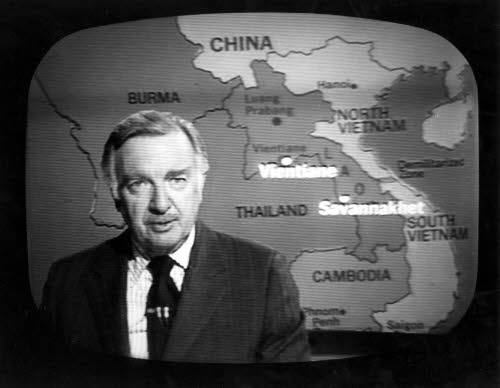
And that’s the way it wasn’t…

The “things were different then” excuse won’t fly as a defense of Cronkite, and shame on Howard Kurtz, who is supposed to stand for ethical journalism, for trying to rationalize the obvious conclusion demanded by Brinkley’s biography. That conclusion is that there was no Golden Age of TV journalism, and that rampant liberal bias infected the nightly broadcasts then as now, but we were too trusting and unsophisticated to realize it. Kurtz spends an entire book review extracting information Brinkley uncovered that proves Walter Cronkite’s image as an objective, incorruptible truth-teller was a lie, and then attempts to make the case that we shouldn’t judge him harshly.

Why? Because he was one of Kurtz’s heroes? Perry Mason made me want to be a lawyer, and it wasn’t until I became one that I realized that the fictional defense attorney was the sleaziest criminal lawyer this side “The Practice.” Tarnished heroes are part of growing up, Howard. Don’t pretend that journalistic ethics were different then…journalism schools were teaching objectivity, transparency, fairness, honesty and avoidance of conflicts of interest when Walter was saying “And that’s the way it is!” in a high soprano. Yet Brinkley shows that he… Continue reading
Post-South Carolina Confession

Sunday morning, I am duty bound to play roulette with the talking head shows on the networks, watch “Reliable Sources,” Howard Kurtz’s weekly journalism ethics critique on CNN, and scour the Washington Post, all in search of contentious or interesting ethics topics.

But rather than listen to endless rehashes of the South Carolina Republican primary, endure Newt Gingrich’s gloating, and again hear so-called experts repetitively apply their imaginary expertise to musings about what will happen in the next primary, Florida—-last week’s consensus: Romney had South Carolina wrapped up– I am watching “MVP: Most Valuable Primate” on Encore Family. It’s about a hockey-playing chimp (named Jack, appropriately enough).

It’s not bad.

Screw it. A man can only take so much.

Cheater’s Remorse: ABC News Gets Ethical Without Knowing What “Ethical” Means

"Right now, cheating doesn't pay, so we're committed to ethics."

If you think ABC News is going to get any credit here for officially (sort of) banning the practice of paying so-called “licensing fees” to get exclusive interviews, I’m going to disappoint you. For there is nothing admirable about….

1….. engaging in the discredited practice of paying big money to central figures in news stories in order to gain access to them, and

2….disguising the practice by technically paying them inflated fees for the rights to photographs, even though the real reason for the pay-off is #1 above, then…

3….rejecting the practice when it leads to questions about how the network got an interview when it didn’t pay “licensing fees,” but…

4…noting that it might still go back to the unethical practice “perhaps once every couple of years,” since…

5….the other networks do it.

Yuck, pooie, ichhhh, petah!  ABC’s decision, outlined in a report by media watchdog Howard Kurtz, tells you everything you need to know about the state of ethics in broadcast journalism in general and ABC in particular, and I have seen prettier sights floating in an unflushed toilet bowl. Continue reading

What Today’s Broadcast News Regards As “Credentials”

"Yes, yes...journalism degree, experience at a local affiliate, blah, blah...but no rapes? Arrests? Scandals? Sexual abuse? Miss, you have NO credentials that make you valuable as a network reporter! Wait--what's your bra size?"

Good for media ethics pundit Howard Kurtz for blowing the whistle, however gently, on ABC News’s hiring of Elizabeth Smart as a contributing on-air expert on missing children cases. “Does that strike anyone as odd?” he writes.

Well, it depends what you mean by “odd,” Howard.

If you mean, does it surprise me that a broadcast media outlet, one of the journalistic mutations that hired Eliot Spitzer, fresh off his prostitution disgrace, to headline a current events show on CNN, that puts a giggly fold-out-come-to-life  like Robin Meade in charge of Headline News’ morning, and that, like Fox News, chooses its female newsreaders and guest pundits according to their degree of resemblance to Mamie Van Doren or Raquel Welch, would hire a young, attractive blond woman with no credentials other than her role as the victim of kidnapping, sexual abuse and rape, as a correspondent, why no, I don’t find it odd at all.

If you mean, do I find it odd that a supposedly professional news network would so blatantly abandon professional standards  just to cash in on the Casey Anthony uproar, however, then…wait, no, I don’t find that odd either. Revolting, but not odd. Continue reading

Partisan Opportunism: The Media and the Arizona Massacre:

The shooting of Rep. Gabrielle Giffords, a Federal judge, and 18 others yesterday has exposed media bias and unfairness at its despicable worst. That so many reporters, commentators and bloggers learned of  Arizona parking lot carnage and immediately thought, “Wow, what a chance this is to pin everything on Sarah Palin and the Tea Party!” speaks volumes about the ethics and integrity of America’s journalists. The Daily Beast, for example, began a column this way:

“No motives have emerged from today’s senseless shooting in Tucson, but Democratic Rep. Gabrielle Giffords has a long history of being targeted by the Tea Party—sometimes in violent terms.”

Is there a shred, an inkling, a hint or a clue anywhere that the man who did the shooting had anything whatsoever to do with the Tea Party? No. Is there anything at all linking Tea Party rhetoric to his motives for the shooting? No. So how can this paragraph be explained? Easy. The Daily Beast doesn’t like the Tea Party movement, and saw this horrific shooting as an opportunity to discredit it. Continue reading

Flunking the Keith Olbermann Test

Every so often there is a news story that exposes the serious deficiencies in the ethics comprehension in the public and the media. The Clinton-Lewinsky scandal was one such story; Major League Baseball’s steroid controversy was another. I confess: I didn’t see the Keith Olbermann suspension for making political donations as having the potential to be another test of ethical competence, but it is. And almost everyone is flunking it.

The facts of the Olbermann incident are deceptively simple. The rant-prone, self-annointed champion of the Angry Left violated an NBC ethics policy that forbade its reporters and commentators from making political contributions, on the theory, absurd when applied to Olbermann,  that it compromises their reputation for objectivity. Olbermann has no objectivity, or reputation for it either. Nonetheless, he intentionally and flagrantly violated his employer’s policy. That alone justifies his suspension, whether or not the policy is idiotic. And it is.

But Olbermann’s fans and critics alike are all over the internet attaching rationalizations and flawed ethical reasoning to the episode. Such as: Continue reading

Sunday Morning Revelations: Kurtz, Feldstein, Anderson, and Why We Can’t Trust the News Media

Media critic Howard Kurtz interviewed reporter/author Mark Feldstein this morning on CNN’s “Reliable Sources, who is promoting his book, Poisoning the Press, an insider’s account of how famed Washington, D.C. muckraker Jack Anderson bent, broke, or entirely ignored basic principles of ethics and decency in his quest to fill his column with damaging information about President Richard Nixon and his allies.

There were two moments in the interview that stand as persuasive evidence against anyone who maintains, against mountains of evidence to the contrary, that American journalism is fair, responsible, unbiased and ethical.

One was at the start of the interview, when Kurtz characterized Feldstein’s book as showing that Anderson was as willing to cut ethical corners as Nixon was. “Well, Nixon’s were felonies, and Anderson’s were misdemeanors,” Feldstein corrected him. “Nixon’s felonies killed thousands of people.”

What? Exactly what “felonies” was Feldstein referring to? Continue reading

Sunday Ethics Round-Up: Cynical Fines, Drunk Norwegians, Lazy Newsmen and Pitiful Ballplayers

Here are some ethics issues to ponder from the recent news and around the Web:

  • Who says it pays to be ethical? The astounding insistence, under oath, by Goldman Sachs executives that they had done nothing wrong in selling admittedly “crummy” investment products to clients while using the company’s own money to bet that the same products would fail will not be sufficiently punished or contradicted by the S.E.C.’s cynical cash settlement of its suit against the firm. For a $500 million penalty, Goldman Sachs is off the hook for the equivalent of four days’ income, as the Obama Administration claims to the unsophisticated public (“Isn’t $500 million a lot of money?”) that it is “getting tough” with Wall Street. The fact is that Goldman Sachs’ unethical maneuvers paid off handsomely, and nothing has happened that will discourage it from finding loopholes in another set of regulations and making another killing while deceiving investors legally and, by the Bizarro World ethics of the investment world, “ethically.” You can read a perceptive analysis here. Continue reading