Ten Observations On The Trump Assassination Attempt

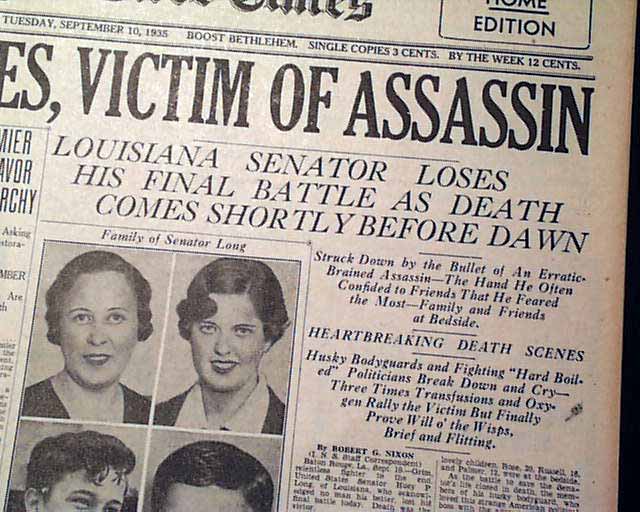
Huey Long assassination

Perhaps you missed it? Someone tried to shoot Donald Trump. From the Associated Press:

“A British man arrested at a weekend Donald Trump rally in Las Vegas tried to grab a police officer’s gun so he could kill the presidential candidate after planning an assassination for about a year, according to authorities. U.S. Secret Service agents said Michael Steven Sandford approached a Las Vegas police officer at the campaign stop to say he wanted Trump’s autograph, but that he then tried to take the weapon.”

Observations:

1. Wow. Talk about being incompetent at your chosen avocation! This guy has been “planning an assassination for about a year” and the big plan was “try to get a police officer’s gun”?

Assassins, like everything else, just aren’t what they used to be.

2. Remember, however, that the only difference between a failed assassination attempt and a successful one is moral luck.

3. The Washington Post asks why the incident didn’t provoke more news coverage. Isn’t that a strange question to come from one of the news organizations responsible for the lack of coverage? Why doesn’t Callum Borchers just ask his own editors at the Post?

The answer seems clear to me: the news media doesn’t want any public sympathy going Trump’s way, or to give him what would amount to positive publicity. This is the double standard we are being told that we need to get used to. Does anyone want to make the case that an assassination attempt on Hillary’s life would be a multi-day story, with a repeat of the U.S. Representative Rep. Gabrielle Giffords shooting mass accusation, now holding  that Republican “hate speech” and anti-Hillary rhetoric nearly resulted in a tragedy?  Rush Limbaugh and Sarah Palin were being fingered as the reason why a deranged man went on a killing spree in Tucson. Why not blame a Trump assassination attempt on Paul Krugman or Elizabeth Warren? Or me? Continue reading

Joe Scarborough, Sarah Palin, and “No Labels”

Joe Scarborough, the former Florida congressman and as host of “Morning Joe” on MSNBC, the token conservative on MSNBC, is a participant in the launching of “No Labels” on December 13 at Columbia University in New York. He will be joined by such political glitterati as New York Mayor Michael Bloomberg, Sen. Evan Bayh (D-Ind.), Sen. Joe Lieberman, (I-Conn.), former Rep. Tom Davis (R-Va.), Rep. Chris Shays (R-Conn), Los Angeles’s Democratic Mayor Antonio Villaraigosa, Sen. Deb Stabenow (D-Mich.) and others.
“No Labels” is a primarily centrist-Democrat call for civility in politics, that according to its “Declaration,” written by Mark McKinnon (a former media advisor to George W. Bush in 2000 and Sen. John McCain in 2008, who appears to be a paid consultant rather than a participant), is dedicated to countering partisan deadlock with reason and cooperation.

“We are not labels, we are people,” the screed says.”We believe hyper-partisanship is destroying our politics and paralyzing our ability to govern… We may disagree on issues, but we do so with civility and mutual respect….We have a crisis of governance – a crisis that compels us to work together to move America forward… We must put our labels aside, and put the issues and what’s best for the nation first.”

In preparation for the “No Labels” debut, Scarborough wrote a column for Politico, in which he warned Republicans to stop Sarah Palin before it was too late. In it, he variously described Palin as “anti-intellectual,” “maniacal,” “a reality star,” and “ignorant.” Would it be fair to label  “Morning Joe” as “a hypocrite”?

Continue reading

Oprah and the Icons: the Ethics of Lying to Make a Difference

Kitty Kelley’s unauthorized, rip-the-mask-off-the-icon bio is out, and now Oprah Winfrey must weather the inevitable de-construction of some of her meticulously self-created image. Oprah is pretty much untouchable now; I was a guest at her “O” Magazine Expo last Fall in Kansas City, and it was clear that her status with he legion of followers is somewhere between a guru and a goddess. There aren’t many revelations, short of proving that she is secretly Dick Cheney in an elaborate disguise, that could do much to reduce her cultural influence or undo her popularity.

Still, it used to be that heroes, celebrities and cultural icons could count on the whole truth about their personal and career embellishments to surface only late in life, or more often, long after death. Thus it has been a standard tool of rising figures in America to carefully craft an inspiring story and an appealing persona that excite and engage the public, and the truth has had little to do with it. It’s worked, too. Continue reading