Missouri’s Unethical Food Stamps Bill

Sometimes you just need a good lobster. I'm from Boston. Trust me on this.

Sometimes you just need a good lobster. I’m from Boston. Trust me on this.

Years ago, my wise and wonderful first year Contracts professor at Georgetown Law Center, the late Richard Alan Gordon, made a permanent impact on my conscience with a spontaneous rant. He was discussing a case involving a welfare recipient who had been sued by a Washington department store for failing to keep up with installment payments on a Hi-Fi system. The court voided the contract, saying that it was unconscionable for the store to intentionally create incentives for poor people to spend public assistance money on “non-essentials” like music systems. (I wish I remembered the name of the case, but then I only got a C+ in the course.)

As the students nodded their heads in agreement with the opinion, Professor Gordon cut them short and thundered (I am copying from faded old notes: Dick’s rants were always eloquent and memorable, and I began reconstructing them after class for posterity):

“Outrageous! Who are you, or a court, or a government, or any authority to tell another human being that feeding his body is more important than feeding his soul? Music is “non-essential”? I suppose that means that literature, culture, inspiration, wisdom, knowledge…or a moment of joy, the thrill of discovery, experiencing a concert, admiring a great work of art, or sharing an intimate and timeless moment with the love of your life is “non-essential” too! Neither the law nor any court nor a government authority has a right to dictate what is essential to any human being, whether he is receiving public assistance or not. Being poor imposes its own cruel restrictions on liberty and autonomy. Imposing more still is both an abuse of power and a violation of basic human rights. This is an assault on human dignity.”

Continue reading

“Grow Your Own Marrow Donor” Ethics and Consequentialism: The Ayala Family Saga

Anissa Ayala and her custom-made bone marrow donor

Once again, the fans of that ethically corrosive twin of  “the ends justifies the means,” consequentialism, were holding court in the mass media, as the “Today Show” revisited a two-decade old ethical outrage to declare that it was all perfectly fine after all…because it worked.

Thus does television, itself dominated by ethically-dim writers, producers and stars, corrupt the public. So here we go again:

Does the fact (if it indeed is a fact) that Osama bin Laden capture and execution was facilitated by torture make torture less ethically wrong?

No.

Do the fortuitous results of any action that was unethical from its inception change the nature of that conduct from unethical to ethical.

Again, no.

Is conceiving a child solely to provide donor bone marrow to her cancer-stricken older sister ethically acceptable as long as the sister’s cancer is cured?

Absolutely not!  But to listen to the “Today Show,” and revoltingly, the “Today Show’s” resident medical correspondent Dr. Nancy Snyderman, it is not only ethically acceptable but laudable. Because it worked.

Twenty years ago, Abe and Mary Ayala were desperate because Anissa, their 16-year-old daughter, had been diagnosed with leukemia. Chemotheraphy proved ineffective, and neither the Ayalas nor their son was a compatible bone marrow donor. The Ayalas had long before decided that two children were enough; Abe had a vasectomy. But then Mary came up with the idea of having another child in the hopes that it would be a bone marrow donor who could save Anissa’s life. Continue reading

No, It Still Doesn’t Justify Torture

No.

The news of how Osama bin Laden was finally tracked down and killed has caused a predictable outbreak of consequentialism. It appears that Khalid Sheikh Mohammed provided some of the key intelligence that led to the successful operation in Pakistan while he was undergoing “enhanced interrogation” in CIA prisons in Rumania and Poland. “See?” Dick Cheney’s fans are saying today. “Rendition and torture work. We wouldn’t have killed Bin Laden without them. So what do you think of those tactics now?” The opponents of torture who foolishly argued against it based on pragmatic considerations—“Torture doesn’t work!”—rather than ethical ones–-“It is absolutely wrong!“—set themselves up for this.  Now what should they say? Continue reading

Consenting To Be Beaten

Bought and paid for.

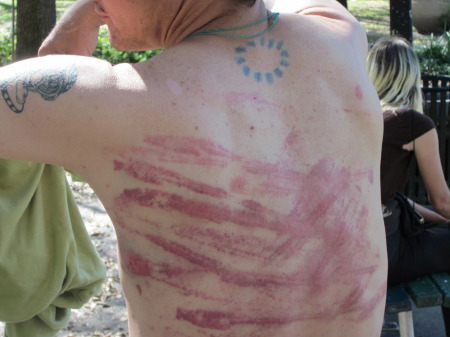
Ethics Alarms has frequently used the analogy of a drunk paid by cruel bar patrons to dance for their entertainment as an example of how using money to persuade a desperate, impaired or foolish individual to allow himself to endure humiliation or harm is still unethical and cruel, despite the supposed “consent” of the victim. PETA’s attempt to pay Nadya Suleman, a.k.a. “Octomom” was recently cited in this context in the post about painting homes as billboards. Now, from St. Petersburg, Florida comes an even more horrible example. Shefights.net, a locally operated website that sells videos (for up to $900) of scantily clad or semi-nude women beating up men, has been paying homeless men, drug addicts and street alcoholics $50 for submitting to  12-minute videotaped beatings by attractive females. Continue reading

Bush’s Torture Admission, Absolutism, and America’s Survival

George W. Bush, currently hawking his memoirs, has admitted in the new book and in interviews about it that yes indeed, he approved waterboarding of terrorist suspects, believed it was legal, and moreover offers evidence that the information thus acquired saved American lives. W’s opinion on these matter are hardly a surprise, but they have re-energized the defenders of the Administration’s policies of “enhanced interrogation” and rendition of apprehended terror suspects to foreign locales where the interrogation techniques were “enhanced” even more.

“NOW do you agree with the policy?” they ask, as if the answer was obvious. “The information prevented a horrific terrorist attack on Heathrow Airport (in England). See? See?

Let us assume, just to simplify things, that everything is as President Bush represents. Waterboarding was, by some legitimate analysis, legal. The information saved American lives and prevented terrorist attacks. Do these facts mean that the use of torture—and waterboarding is torture, whether one defines it as such or not—by the United States of America was justified, defensible, and ethical?

No. I don’t think so. I believe that for the United States of America to approve and engage in the use of torture is by definition betrayal of the nation’s core values, and thus threatens its existence as the nation our Founders envisioned as completely as a foreign occupation.  I wrote on this topic in 2009… Continue reading