
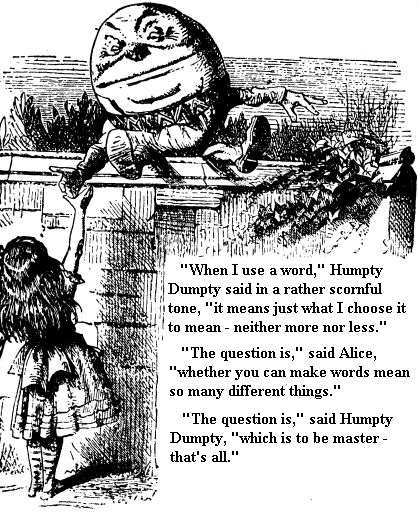
Rich (in CT) adds a superb and learned enhancement to the day’s post about President Obama’s dubious rape claims during the Grammy Awards. It raises a question I hadn’t considered before: is part of the problem that researchers are as clumsy in their understanding of language as liberal arts types are in their use of statistics and numbers? The word “rape” has meaning; this is no place for Humpty Dumpty’s habit of using words to mean whatever one pleases. [“When I use a word,’ Humpty Dumpty said in rather a scornful tone, ‘it means just what I choose it to mean — neither more nor less.’ ’The question is,’ said Alice, ‘whether you can make words mean so many different things.’’The question is,’ said Humpty Dumpty, ‘which is to be master — that’s all.”—― Lewis Carroll, “Through the Looking Glass” ] Rich writes, “This data is important, as mental health and sexual disease propagation is affected by such contact, even if the traditional criteria imaged for “rape” is not met. ” I’ll concede that the data is important, but shouldn’t important data be clearly and accurately described? The data isn’t about rape! It’s about a variety of conduct linked by the researchers that they chose to call “rape,” knowing, presumably, that people who never read the data will take the misleading “rape” description and use it to confuse, persuade, deceive, and engage in scaremongering for political gain.
Rich writes that “not enough evidence is given to suggest that either study is unethical in and of itself.” Isn’t using vague, overly broad and misleading terminology for a study that is going to be made public intrinsically unethical—irresponsible, incompetent, untrustworthy?
Here is Rich (in CT)’s enlightening Comment of the Day on the post “The President’s Irresponsible And Untrue ‘One in Five Women Are Raped’ Claim”: Continue reading
 Ethics Alarms