Suggested Course For Princeton: “Campus Protesting For Weenies”

I waited a few days before writing about this because I had to stop giggling to type.

I you watch Aaron Sorkin’s excellent if a bit too fawning movie, “The Trial of the Chicago Seven,” you will see that the anti-war campus protesters of the Sixties had, if nothing else, integrity and guts. Maybe they had inherited some from their parents, of “The Greatest Generation.” Today’s student protests in favor of Hamas, terrorism and Jew-killing (I know, I know: “Think of the children!”), in contrast, are marked by hypocrisy, ignorance and weenie-ism.

Princeton has certainly moved to the front of the line in the latter. After the protesting students announced a hunger strike in support of allegedly starving Gazans (Pro tip: if you don’t want to suffer from the predictable consequences of war, don’t elect terrorists as your government). Then they complained that they—the students, now, not the Gazans—were hungry. One female protester shouted into a megaphone, “This is absolutely unfair. My peers and I, we are starving. We are physically exhausted. I am quite literally shaking right now as you can see.” What, is the nearby McDonald’s closed?

Then the protesters persuaded some of the professors whose indoctrination made them the misguided weenies they are to make themselves look foolish by signing a letter of protest in the students’ support. It’s long and infuriating, but here are the best parts…
Continue reading

Sorry, Gandhi: Hunger Strikes Are Unethical, And Organizations Should Not Respond To Them

Maha Alshawi, a Dartmouth graduate student in the computer science department, accused computer science professor Alberto Quattrini Li of multiple incidents of sexual misconduct. She also accused science department chair Prasad Jayanti  of unfairly failing her on an exam and giving her a “low pass” as a teaching assistant as retaliation  after she raised concerns about Li. The student has called on Dartmouth to conduct a “clear and fair investigation” of the alleged harassment. The College, however, has stated that it has concluded evaluating the allegations through all applicable procedures.

On July 14, the first-year Ph.D. student began a  hunger strike , publicly posting on Facebook that she would not eat  “because the Title IX office conducted [an] unfair assessment” of her case. Seven days later,  Dartmouth announced that it would conduct another review of Alshawi’s claims if she agreed to end her protest and seek medical attention. She would not agree.

This week, on the 22nd day of Alshawi’s hunger strike, Dartmouth announced that it will launch an external investigation into her harassment allegations.  Alshawi says  she will not stop her hunger strike and will  begin a “thirst strike,” refusing to eat or drink until the external investigation has officially begun.

The College wrote in its statement that “in the interest of [Alshawi’s] safety and in keeping our commitment to Ms. Alshawi,” an external investigation would be opened “in addition to the extensive assessment and multiple reviews Dartmouth has previously undertaken.”

Dartmouth’s capitulation is irresponsible and incompetent.  The school has done nothing to jeopardize Alshawi’s safety. She is threatening herself. In fact, this “Blazing Saddles” scene comes to mind: Continue reading

Ethics Dunce: Marwan Barghouti, The Snacking Hunger Striker

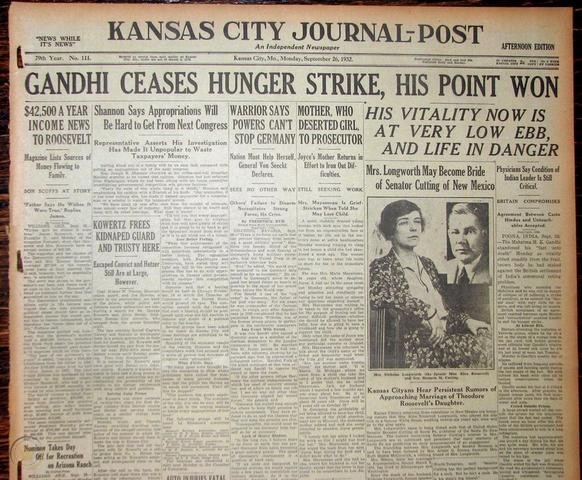
See, this is the thing: if you are secretly snacking while leading a hunger strike, you’re doing it all wrong. Gandhi didn’t do this. At least we don’t think he did.

 Over a thousand Palestinian prisoners in Israeli jails are in the third week of a mass hunger strike, demanding better conditions. Now the leader of the strike, terrorist Marwan Barghouti who i being  held in solitary confinement at the Kishon prison, has been caught on camera eating cookies and a candy bar.  Israel released videos of the would-be martyr sneaking snacks in his cell, and naturally  Palestinian leaders called foul, dismissing the videos as fakes aimed at demoralizing his hungry followers. The problem is that Barghouti has cheated before.

In 2004, leading another hunger strike, he was caught on camera eating while his fellow prisoners were refraining from food like good hunger strikers. Not knowing he was being surveilled,  the Palestinian leader covered the door and window of his cell,  washed his hands and chowed down after asking wardens for food.  The Israeali Prison Services spokesman said that cameras were set up to show the fasting prisoners how their leader was behaving. “Barghouti is sitting on a pot of meat and he sends his friends to die,” the spokesman said at the time. Continue reading

Ethics Dunce: ESPN

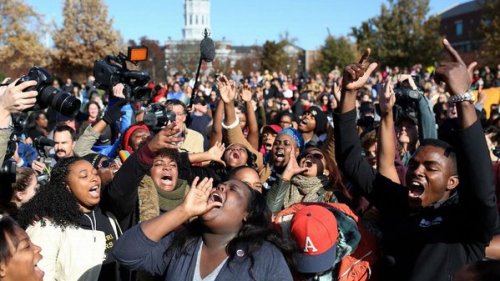
protest-mizzou

ESPN has announced it will give the University of Missouri (MU), a.k.a Mizzou, football team a special humanitarian award in July to honor the team for its strike  in 2015. You know the one, right?  If you did, then you are probably retching.

This was the Black Lives Matter-esque fuse that caused over a hundred universities to explode in racial unrest and cave in to pressure from black student groups to yield to demands supposedly addressing various imagined, concocted or politically exploited race-related problems on campuses, ranging from microagressions, to inadequate race-consciousness, to unidentified people saying mean things.

That last, in fact, was what caused the Mizzou foolishness. There, three unrelated episodes caused the “crisis”:

  • Payton Head, MU senior and president of MSA,  published a Facebook saying that he was walking around campus when the passenger of a pickup repeatedly shouted the “nigger at him.

No one confirmed his claim.

  • The Legion of Black Collegians posted on social media that the group was rehearsing for a performance at the University’s Traditions Plaza when a “young man” talking on his cellphone walked up to the group, was politely asked to leave, and hurled “racial slurs” at LBC members.

Was he a student? Nobody knows.

  • Someone draw a swastika using human feces inside Mizzou’s Gateway Hall.

Funny, I think of the swastika as an anti-Semitic symbol, not anti-black one, but hey, whatever it takes, right?

None of these involved perpetrators who were identified, or who were shown to be students. None of them  were remotely within the control of the University; nor were they coordinated in any way.  Black groups on campus, however, harassed the school’s president, Tim Wolfe,  and demanded that he resign. A black graduate student began a hunger strike, promising to forgo all food and nutrition until Wolfe was ousted. Finally, black University of Missouri football players announced that they would not participate in team activities or games until the university yielded to various demands, including Wolfe’s dismissal. The coach and the rest of the team backed the black players, and the university caved.

In addition to sparking many other conflicts on other campuses, disrupting students’ education, making U.S. ccolleges look like the inmates were running the asylums (because they were) and increasing racial tensions, the episode had the effect of  causing a huge drop in enrollment that has cost Mizzou about $32 million.

Isn’t that great?

Good job, everybody!

Apparently ESPN think so, anyway. Continue reading

Ten Ethics Observations On The Resignation Of University of Missouri President Tim Wolfe

dominoes2

…for nothing, as far as I can see, except being in the wrong job when an “I’m mad at the world and somebody has to pay for it” tantrum by some of the black students got out of control.

Observations:

1. I have searched and searched for a substantive reason for the upheaval. There is apparently nothing there. The university, the education of students and two men’s career’s (the University’s Chancellor has also been forced to resign) have all been disrupted, and for no good reason, except that some students decided it was a good time to grandstand. This makes the entire episode unjust by definition.

How ironic it is supposed to be about “justice.”

2. The main driver of events was graduate student Jonathan Butler, who started a hunger strike to force Wolfe to resign”for justice.” Given a chance to explain his position by the Washington Post, he had nothing definitive or constructive to offer, just vague dissatisfaction:

“I’m saying, even if you can’t really understand systemic oppression and systemic racism, is the fact we can’t be at a university where we have values like “Respect, Responsibility, Discovery and Excellence” and we don’t have any of those things being enacted on campus, especially in terms of respect. I’m on a campus where people feel free to call people the n-word, where people feel free as recently as last week, to used [their] own feces to smear a swastika in a residential hall. Everything that glitters is not gold. We really need to dig deep and be real with ourselves about the world we live in and understand that we’re not perfect but understand that just because we’re not perfect doesn’t mean we don’t start to understand and address the issues around us.”

Right. Some kids in a car that may not have been students and another individual on campus who has not been identified used  racial epithets. Some mentally deficient person, also unidentified, drew a swastika on campus using human excrement. (This type of incident tends to be a hoax  as often as not.) What exactly is the president of a university supposed to do about such things ? Wolfe mandated “sensitivity courses” for everyone on campus, which is already too much. I would refuse to attend. I would not respect anyone who did attend.

Heck, I might start a hunger strike.

It works. Continue reading

The University Of Missouri Football Players Boycott And The Campus Race Conflicts To Come

In 1967, it was called "Columbia"...

In 1967, it was called “Columbia”…

I have searched far and wide, and this appears to be the full extent of the alleged provocation for the revolt of black students against the president of the University of Missouri, Tim Wolfe:

Sept. 12: Missouri Students Association president Payton Head posts about a racial slur directed at him.

Payton Head, MU senior and president of MSA, renewed the dialogue about racism and the racial climate on the University’s Columbia campus after publishing a Facebook post about his first-hand experience with racism. The night before, Head said he was walking around campus when the passenger of a pickup repeatedly shouted the “N-word” at him.

Head’s statement went viral on social media, and many people shared their support of Head and frustration with MU’s response, or lack thereof, to his post. “I’d had experience with racism before, like microaggressions, but that was the first time I’d experienced in-your-face racism,” Head told a Missourian reporter.

Oct. 5: Legion of Black Collegians members are the targets of racial slurs by a man on campus.

Another instance of racism brought the racial climate on campus again to the attention of students and administrators.

The Legion of Black Collegians shared a letter on social media describing the group’s encounter with overt racism the night before. The group was rehearsing for a performance at Traditions Plaza when a “young man” talking on his cellphone walked up to the group. After being politely and repeatedly asked to leave, the man walked away but referenced LBC members using racial slurs.

That same day, MU Chancellor R. Bowen Loftin responded with a post of his own, acknowledging and condemning racism at MU.

“There was a silence that fell over us all, almost in disbelief that this racial slur in particular was used in our vicinity,” Naomi Collier, president of MU’s NAACP chapter and member of the LBC’s activities committee, wrote in the letter.

Oct. 8: Loftin announces mandatory online diversity training for faculty, staff and students, which is met with widespread skepticism.

The training came after a number of accounts of overt racism experience by students on campus, but was met with skepticism and suspicion.Jonathan Butler, MU graduate student and campus activist, wrote a letter to Loftin saying the training was “a step in the right direction, but it is not enough.”

More recently,  someone used human feces to draw a swastika inside Mizzou’s Gateway Hall. Continue reading

Web Hoaxes: Would You Trust This Lawyer?

In an earlier post this month, I related the story of Ethan Haines, an unemployed, newly-graduated lawyer who was staging a hunger strike, he said, to protest the fact that law schools misled their recruits about the employment prospects of their graduates. I was not sympathetic, and concluded:

“Law degrees still are valuable credentials, as is a good legal education, and if Haines got a good legal education, he received everything a law school is obligated to provide. Turning the degree into a career is his responsibility, and it is wrong for him to claim that anyone but himself is accountable for his present unemployed state.”

His stunt was more than an avoidance of responsibility and accountability, however it was a lie. Continue reading

The Strange Case of the Starving Lawyer

Newly minted and unemployed lawyer Ethan Haines has gone on a hunger strike in the name of all unemployed former law students, to protest misleading law school employment statistics, commercial school rankings, and antiquated career counseling programs. “I designated myself class representative since these students are not able to come forward themselves, for fear that vocalizing their concerns will negatively affect their careers,” he writes on his website. He is alerting various law schools about his Dick Gregory-style protest, intending “to bring awareness to the concerns of law students and recent law graduates by having them addressed by law school administrators. Their primary concerns are inaccurate employment statistics, ineffective career counseling, and rising tuition costs.” The strike, he says, “was motivated by a recent American Bar Association (ABA) investigate Report, which concluded that educational leaders are unable to timely combat the adverse affects of U.S. News’ rankings on legal education.” Continue reading