Ethics Quiz: Harvard’s Human Skin-Bound Book

As if it doesn’t have enough to worry about, Harvard University announced yesterday that its copy of Arsène Houssaye’s “Des Destinées de L’Ame,” or “The Destiny of Souls” had been stripped of the very feature that made it unusual enough to be worth collecting. The book (above) had been bound in human skin, just like the book in “The Evil Dead” movies. Its first owner, Dr. Ludovic Bouland, a French doctor, had inserted in the volume a handwritten note saying that “a book about the human soul deserved to have a human covering.” The alumnus who gave the book to Harvard in 1934, the American diplomat (and the famous hat family heir) John B. Stetson, had informed the Houghton Library (Harvard’s rare book collection), that Bouland had taken the skin from an unknown woman who died in a French psychiatric hospital.

Harvard removed the binding and said it would be exploring options for “a final respectful disposition of these human remains.” “After careful study, stakeholder engagement, and consideration, Harvard Library and the Harvard Museum Collections Returns Committee concluded that the human remains used in the book’s binding no longer belong in the Harvard Library collections, due to the ethically fraught nature of the book’s origins and subsequent history,” the university’s statement read.

Incidentally, the word for binding books in human skin is anthropodermic bibliopegy.

Your Ethics Alarms Ethics Quiz of the Day is…
Was this really ethically necessary?

Continue reading

“Ick” vs. Ethics: The Nazi Gems Collection

Once again, we encounter the conundrum of so-called “dirty money.”

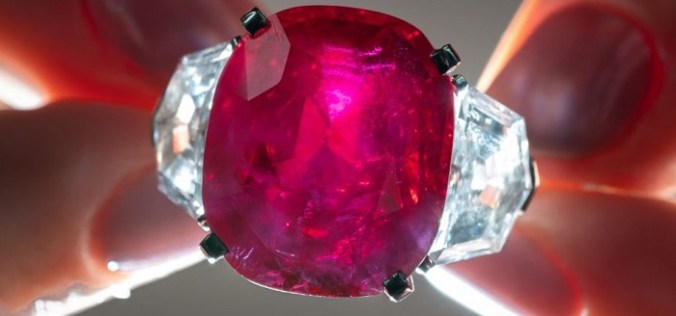
In May, the auction house Christie’s sold a collection of jewels and jewelry from the estate of Heidi Horten, an Austrian philanthropist. The auction earned $202 million, establishing the Horten sale as the biggest precious gem sale ever. There was, however, an ethics controversy: all that jewelry had been bought with a fortune amassed by Horten’s husband Helmut, a Nazi who bought up Jewish businesses in forced sales during the Holocaust.

The Holocaust Educational Trust called the May auction a “true insult to victims of the Holocaust.” Yoram Dvash, president of the World Federation of Diamond Bourses, wrote, “In a time of Holocaust denial and the resurgence of antisemitism around the world, we find it especially appalling that a world-renowned auction house would engage in such a sale.” David Schaecter, president of Holocaust Survivors’ Foundation USA, which represents support groups for victims’ families in the U.S., called the sale “appalling” and said it had perpetuated “a disgraceful pattern of whitewashing Holocaust profiteers.” But Christie’s officials argued that the proceeds of the sale would go to the Heidi Horten Foundation, which supports medical research and a museum containing her art collection. The auction house also pledged to donate some of its own profits arising from the sale to Holocaust research and education.

Since May, however, attacks on the collection, Chistie’s, and the money paid for the jewels at auction have escalated. Christie’s announced this week that a scheduled November sale of more lots of jewelry from the Heidi Horten collection would be canceled, citing the “intense scrutiny” from Jewish organizations and some critics. The Jerusalem Post reported that other Jewish groups had rejected Christie’s donations from the May auction.

Continue reading

Not Unethical, Just Narcissistic And Stupid, But Criticism Goes With The Territory

31-year-old Theresia Fischer, who starred on Germany’s “Celebrity Big Brother,” has paid $160,000 for two painful surgeries that added five and a half inches to each leg. Now she is six feet tall in her stocking feet, six-four in those platforms.

The doctors inserted adjustable telescopic rods into her tibiae. I believe that this is a violation of medical ethics, as she had no actual malady that required medical intervention, and the procedure involved risk, as all medical procedures do. However, cosmetic surgeons tend to be live on the bottom of the ethics barrel.

In her publicity campaign celebrating being turned into a freak, she extols what the operation has done for her sex life, but also complains that she has been the target of “hate” on the web, where she is well-followed on TikTok and Instagram. “Why am I subject to so much hate?” she lamented to the New York Post.

Continue reading

‘Ick Or Ethics’ Ethics Quiz: The Self-Repossessing Car

This one has my ethics alarms ringing, but I can’t seem to find anything unethical about it.

A recently published patent application from Ford describes a system that would lock drivers out of their vehicles for nonpayment and allow the vehicle to repossess itself.

The patent document was formally published on February 23. Titled “Systems and Methods to Repossess a Vehicle,” it outlines different methods that could be taken if the vehicle’s owner misses payments. This would trigger a”repossession system computer,” which would be capable of disabling “a functionality of one or more components of the vehicle,” including the air conditioning, and radio.” “Incessant and unpleasant sound” could be turned on “every time the owner is present in the vehicle.” Finally, the car could be placed in a “lockout condition,” unable to be driven except in the case of an emergency.

Continue reading

I Don’t Know Exactly What This Story Signifies, But I’m Going To Write About It Anyway…

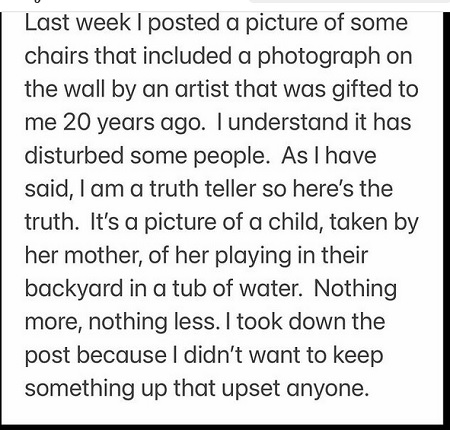
Actress Jamie Lee Curtis posted about her chairs on Instagram for some strange reason, and in so doing, revealed the creepy photograph she has hanging in her home. Conservatives, who have been in an art critic mood thanks to “The Embrace” were triggered. “Why does Jamie Lee Curtis have a picture of a naked child stuffed inside a suitcase on her wall,” said rightish broadcaster Stew Peters. “Strong Epstein vibes.” Right-wing activist Rogan O’Handley tweeted in part, “Hollywood has-been Jamie Lee Curtis posted …an extremely disturbing picture she has in her home of a child stuffed in a suitcase. We have serious questions.”

Curtis then took down the post and photo, explaining,

What’s going on here?

Continue reading

Dead Body Ethics: Why Is “Mind Your Own Damn Business!” Such A Difficult Principle To Grasp?

This post was almost titled “Stop Making Me Defend Governor Hochul!” Conservative pundits, bloggers and busybodies are freaking out over Governor Kathy Hochul (D-NY) signing into law legislation that makes New York the sixth state to legalize the composting human remains. The law adds “natural organic reduction” to cremation and entombment as legal ways to dispose of bodies. The new law defines the practice as the “contained, accelerated conversion of human remains to soil” in a “structure, room, or other space” in which decomposition can occur.

To all of which I say, “Fine.” Any time government increases individual autonomy and the liberty to do as citizens please as long as it doesn’t harm society or other individuals, or infringe on their rights, that’s an ethics win. It is especially encouraging to see a Democratic governor move in this direction, since her party has lately embraced a philosophy of seeking more restrictions on core American rights—like, say, freedom of speech— rather than fewer.

Never mind, though: some on the right are eager to bash Hochul anyway.

Here’s “Not the Bee”s” John Knox:

Continue reading

Morning Ethics Warm-Up, 9/7/2022: Neil, Sam, Kwame, Mehmet And More

I took a wild guess that Neil had to have done this parody of his biggest hit because it was so obvious, and sure enough, I was right!

It’s not exactly an ethics story, but it does involve my home town of Arlington, Massachusetts: on September 7, 1813, a local newspaper in Troy, New York wrote about how Troy’s Samuel Wilson, a meat packer who supplied barrels of beef to the United States Army during the War of 1812, was being facetiously called “Uncle Sam” by soldiers because he stamped the barrels of meat “U.S.” The trivial story caught on and the nickname persisted. Decades later, brilliant 19th Century political cartoonist Thomas Nast (1840-1902) began using a character called Uncle Sam as the personification of the nation, giving Sam the white beard and stars-and-stripes suit that he still wears today. Troy, quite reasonably, later dubbed itself “The Home of Uncle Sam.” But Wilson was born in Arlington, Mass., and the town management, frustrated with its relative obscurity despite being in the midst of other Greater Boston tourist destinations like Concord, Lexington and Cambridge, decided a few decades ago to promote Arlington as “The Birthplace of Uncle Sam,” essentially horning in on Troy’s historical territory (Troy was not pleased). Arlington even paid to have a statue of Nast’s Sam designed, cast and erected.

Nobody cared.

1. More on “quiet quitting”:  Gallup estimates that at least half the workforce is “quiet quitting,” meaning that it does the bare minimum required to keep jobs rather than working to do their best. Gallup’s analysis blames management, which is certainly part of the problem. It does not address the serious cultural ethics issue of workers seeking to be excellent because it is beneficial for society as a whole and an embodiment of the Golden Rule, as well as a life habit that develops good character and justifies trust. Quiet quitters are just a few degrees better than freeloaders, an anchor on the nation, the economy and the quality of life. Continue reading

Icky Or Unethical? Alexa Is Learning A New Trick

From Ars Technica:

Amazon is figuring out how to make its Alexa voice assistant deepfake the voice of anyone, dead or alive, with just a short recording. The company demoed the feature at its re:Mars conference in Las Vegas on Wednesday, using the emotional trauma of the ongoing pandemic and grief to sell interest.

Amazon’s re:Mars focuses on artificial intelligence, machine learning, robotics, and other emerging technologies, with technical experts and industry leaders taking the stage. During the second-day keynote, Rohit Prasad, senior vice president and head scientist of Alexa AI at Amazon, showed off a feature being developed for Alexa.

After noting the large amount of lives lost during the pandemic, Prasad played a video demo, where a child asks Alexa, “Can grandma finish reading me Wizard of Oz?” Alexa responds, “Okay,” in her typical effeminate, robotic voice. But next, the voice of the child’s grandma comes out of the speaker to read L. Frank Baum’s tale.

Continue reading

A “I Must Be Missing Something” Ethics Quiz: Arizona’s Execution Option [Corrected]

gas chamber

Usually ethics quizzes on Ethics Alarms involve borderline ethics conflicts or dilemmas that I can’t make up my own mind about. Not this one: on this one: my mind is virtually made up. The arguments that the Arizona plan to use cyanide gas in future executions is an ethics outrage because of previous uses of cyanide gas seem contrived, emotional, and, frankly, weird, with no ethical validity whatsoever. But the intensity of these arguments make me wonder if I’m missing something, and Voilà! An Ethics Quiz!

The state of Arizona allows condemned inmates to choose the gas chamber, rather than lethal injection, if they committed a capital offense before November 23, 1992. Arizona’s attorney general, Mark Brnovich, is seeking to complete the execution of two men who committed murders before that date, and Arizona officials are reconditioning the state’s mothballed gas chamber in case they pick gas over a shot. Arizona authorities plan to use, if it comes to that, hydrogen cyanide to concoct the fatal agent of death. Cyanide gas is a particular gruesome way to die. It takes almost 20 minutes, in some cases, and this is a problem for some people.

Not for me: I find the obsession with making sure executions of the upper tier monsters who earn capitol punishment as pleasant as a spring day to be incomprehensible, and always have. We’re killing someone. It might hurt a little, and it won’t be pretty. An 18 minute judicially sanctioned death isn’t “cruel and unusual,” especially if the subject chose it. What I find cruel and unusual is the way our endless system of appeals dangles executions over the heads of Death Row inmates like a Sword of Damocles from Hell.

Continue reading

PM Ethics Medley, 5/26/2021: It’s A Strange, Strange World

Pastiche

1. Priorities! Major League Baseball has placed Angels pitching coach Mickey Callaway on its ineligible list through at least the 2022 season, MLB commissioner Rob Manfred announced. The league made the decision after investigating Callaway for sexual sexual harassment allegations reaching back several years, with several female sporstwriters among the alelged victims. The Angels fired Callaway this afternoon. Opines a major baseball news site: “Callaway is facing a year-plus ban, and it seems hard to believe any MLB team will hire him when he’s eligible to return.”

Hmmmm…

Alex Cora was suspended and fired as manager by the Boston Red Sox after a one-year suspension, then immediately hired back by the team. All he did was play a major role in devising a cheating scheme for one team, the Houston Astros, that extended through the play-offs and World Series, then oversaw a second team, Boston, that was found to have engaged in cheating, though less extensively, the next season. Cora’s cheating scheme with Astros was unprecedented, and cost two other professionals their jobs and the Astros millions in fines,while seriously scarring the integrity of the game. The conduct Callaway engaged in has been routine among professional athletes for decades, though in his case it was apparently 1) a bit more extreme than the norm and 2) “unwelcome.” After all, he was just a coach. So far, nobody has accused a player making more than $10 million a year of making sexual advances that were “unwelcome.’

Continue reading