What Is The Ethical Response To The Racially Unbalanced Admissions To New York City’s Elite High Schools?

The question has been giving me a headache since I first read about the stunning results of the process that gives New York City students access to its elite public schools.  Of the nearly 4,800 students admitted into the specialized schools for 2019, 190 are black, down from  207 black students admitted last year out of just over 5,000 offers. Stuyvesant high school, which is representative, gave 7 offers to black students (out of 895 slots),   33 offers to Hispanic students, 194 offers to white students, and Asian-American students received a whopping  587 offers. Overall, Asian-American students constitute 60% of the student bodies of the eight elite schools.

Students take  a single exam that tests their mastery of math and English in order to gains entrance to the academically challenging school. Stuyvesant, which has the highest cutoff score for admission and is thus the most selective of the schools, now has the lowest percentage of black and Hispanic students of any of New York City’s roughly 600 public high schools.

What should the city do about this? Should it do anything?  Continue reading

Comment of the Day and Ferguson Thread Highlight: Chris Marschner On The Elusive Equal Treatment Problem

Doesn't seem right, somehow...

Doesn’t seem right, somehow…

At least one good thing has out of the Ferguson Ethics Train Wreck, anyway: several unusually intense, frank and thought-provoking threads about race, “privilege” and poverty led by Ethics Alarms All-Stars Chris Marschner, deery, and urbanregor, with trenchant contributions by others as well. The most vigorous thread emerged here, in response to Marschner’s Comment of the Day on this post, on the unfolding Ferguson situation.

I could have chosen any number of comments to highlight by a separate post, but decided on this one, by Chris. First of all, it is remarkably thoughtful. Second, it transcends Ferguson and addresses the larger, related issues of poverty and perceived inequality of opportunity in the U.S. Third, it constitutes a first: a Comment of the Day, by the author of a Comment of the Day, commenting on his own piece. Guinness has been notified.

Here is Chris Marschner’s Comment of the Day on his previous post, Comment of the Day: “Ethics Train Wrecks Collide, As The Redskins And Trayvon Martin’s Mother Board The Ferguson Express”: Continue reading

Ethics Quote Of The Week:

“Voters are significantly more conservative than nonvoters on redistributive issues and have been in every election since 1972. Voters may be more liberal than nonvoters on social issues, but on redistributive issues, they are not. These redistributive issues define a fundamental relationship between citizens and the state . . . and are central to ongoing conflicts about the scope of government. It is on these issues that voters offer a biased voice of the preferences of the electorate.”

—– Political scientists, Jan E. Leighley of American University and Jonathan Nagler of New York University in their new book, “Who Votes Now? Demographics, Issues, Inequality, and Turnout in the United States.”(Quoted by Dan Balz in the Washington Post)

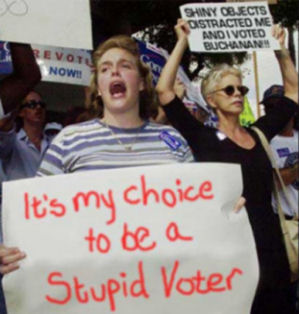
idiot-votersA better example of the warped and unethical thought habits of the Left it would be hard to find.

So the results of an election based on who actually has the initiative, knowledge, civic responsibility and sense to vote are now called “bias,” are they? Talk about academics wearing their own biases tattooed on their foreheads: naturally any conservative consensus is illegitimate, right boys? Continue reading