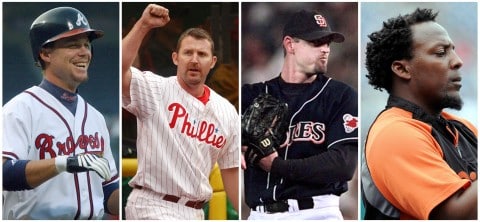
The results of the voting for the Major league Baseball Hall Of Fame in Cooperstown are in. The Baseball Writers Association of America elected Braves third-base great Chipper Jones, slugger Jim Thome, relief pitcherTrevor Hoffman and Montreal Expo legend Vladimir Guerrero, excellent ad deserving choices all.
1 Derangement test! As I write this, Washington, D.C. is on high anxiety alert over whether there will be a government shutdown due to Senate Democrats staging a tantrum over DACA. Previous shutdowns, stupid all, and all ultimately a disaster for the party that triggered them, the Republicans, at least involved a dispute over the budget, which we call a “nexus.” In this one, however, the triggering party is the Democrats, who are grandstanding to their increasingly radical base, declaring the interests of about 800,000 illegal immigrants as a higher priority than the interests of the law-abiding citizens of this country who are not obsessed with “Think of the children!” and the imaginary right of foreigners to cross into the country illegally and stay here as long as they don’t rape someone and blow their “good illegal immigrant” status.
Essentially the Democratic leadership has decided to test the question of how many Americans have had their brains and values scrambled by the emotion-based pro-illegal immigration argument battered into their heads by the progressive/maintsteam news media coalition. Oh…there’s also their collateral justification of “We can’t make a deal with the President because he used a bad word in a private meeting, or so some say.”
Since both Nancy Pelosi and Senate Minority Leader Chuck Schumer have their unequivocal condemnation of the very same tactic they are now engaging in on videotape, they must really be convinced that social justice warrior cant now infests the population. Well, maybe they are right. Maybe they aren’t as incompetent as I think they are, and their flip-flop won’t strike anyone else as cynical and proof of an integrity deficit.
If a party is successful, even once, using this extortion tactic to pass legislation, then the legislative process will have officially collapsed. Democrats—this shut-down is a unilateral offense, not another “everyone is to blame” fiasco—signaled their emergence as a protest organization rather than a responsible party in 2016 when they held a sit-down strike in the House to try to force the unconstitutional measure of banning gun ownership for citizens placed without due process on FBI no-fly lists. If Republicans allow such a tactic to succeed now, however, they will share the Ethics Dunce honors.
And, of course, will use the tactic themselves when the time is ripe.
Let’s see if sufficient numbers of Democrats have their brain cells and values in sufficient good health to tell their representative that those DACA kids have their sentimental support, but not THAT much support, you idiots, don’t be ridiculous!
Here is Houdini showing the Scientific American panel how spiritualists and mediums made bells ring. See his foot?
I once subscribed to Scientific American. We had to read it in high school, and I often used articles from the magazine in research projects. I also was a fan of its history, which intersected with my long-time love of magic and magic history. It was Scientific American, back in the 1920s, that created the special cash prize for anyone who could prove they had supernatural powers, or that paranormal phenomena was real. After a while psychics and other miracle workers stopped applying for the prize, because SA’s panel of experts always exposed them as frauds. The star member of that panel was Harry Houdini, in his post-performing second career as the enemy of charlatans and frauds
Thus it pains me to see the once great, dumbed-down vestige of Scientific American publish an article with this unforgivable headline, in front of content that is little better:
Climate Change May Have Helped Spark Iran’s Protests
And space aliens may have built the pyramids.
Actually, the article still has educational value, though no teacher is likely to use it properly. It is a wonderful example of poor critical thinking, bad science, the result of mixing science with politics, and how bias makes you stupid. The author, Scott Waldman, doesn’t even try to hide the article’s weak logic and lame premise, beginning it with this:
The impacts of climate change are among the environmental challenges facing Iran that helped spark protests in dozens of cities across the Islamic republic.At least 20 people have died in the uprising, driven by the sudden collapse of financial institutions, low wages and mistrust of national leaders. Rising temperatures are seen by some experts as an underlying condition for the economic hardships that led to the unrest. A severe drought, mismanaged water resources and dust storms diminished Iran’s economy in recent years, according to experts who study the region. While the protests are largely driven by resistance to the country’s hardline conservative government, such environmental factors might have contributed to the largest protests inside Iran in years.
That tells any objective reader all he needs to know: junk ahead. The old “some experts” ploy, eh? You can find “some experts” who will say anything, especially on TV. We just went through weeks of unethical speculation on whether the President was suffering from dementia based on “some expert,” a Yale professor of psychiatry who breached the American Psychiatric Association (APA) ethics protocols and was revealed as not to be licensed to practice anymore.You know. An expert.
Waldman himself isn’t an expert on climatology or even science: he’s a reporter, and his degree was in journalism. Funny, I’m so old, I remember when the articles in Scientific American were written by scientists. How quaint. Continue reading →
1 On the other hand, “Bite me!” I find myself feeling bad about a Facebook retort yesterday laying out an old friend, also a former Democratic official’s staff member, for taking a snide shot at my “bias” after my answer to a query about anti-Trump legal ethicist Richard Painter. Painter has been on the “remove Trump by any means possible” bandwagon since the 2016 election, and because he was an ethics advisor to the Bush White House, he has been a favorite go-to source for CNN and MSNBC while authoring bizarre op-eds that distort the Constitution. My response about Painter was that he has apparently been driven mad by the whole Trump experience, and is now in the process of wrecking a very fine reputation as his colleagues in the field, like me, roll their eyes and weep. (Painter is a Bush family loyalist, and the guessing is that he is following the lead of the two Georges, who hate Trump to pieces.) Yes, Richard was among the first to advocate Plan E, removing Trump because he is “unable” to do the job, so he’s especially hot right now.
I feel bad because I’m a nice guy, but I’ll be damned if I will put up with being called “biased” for correctly pointing out what is dishonest and wrong about the various plots to circumvent the election. It’s not a “bias” to believe that an entire party attempting to undermine an elected President is wrong, and that lawyers and ethicists who pander to that mob have slipped a professional cog. I sent my friend to this website to find any evidence that I am a Trump fan, other than being the apparently rare critic who will give the President credit when he deserves it, and who will defend him against fake news and dishonest accusations. I’m a passionate supporter of U.S. values, the system, our institutions, the Presidency itself and elections. That’s not bias. That’s called being an ethical citizen.
2. Signature significance for a weasel. Five days after his reported quotes in “Fire and Fury” including one accusing Don Jr. of “treason” caused President Trump to slam him on Twitter, former White House aide and Breitbart power Steve Bannon sent an “apology” to Axios, of all places. This is known as ” crawling back.” Bannon, while at the White House, leaked to reporters and played both ends against the middle to further his own agenda, and betrayed the President’s trust and confidence by aiding and abetting sleazy political gossip-monger Michael Wolff. Now, after Bannon’s split with Trump has obviously cost him support, influence and credibility, the man who chomped on the hand that fed him wants a do-over. Only the worst species of unethical and unprincipled weasel would try something like this. If he genuinely regretted the quotes, he would have immediately said that they misrepresent him, and repudiated them. Waiting five days makes it clear that Bannon was waiting to see how the episode was playing in the media and public to decide whether to stand by his own words or not. The short version of this is: “Integrity? What’s that?”
Moreover, the text of the “apology” shows that Bannon isn’t very bright. Why bother looking pathetic and weak if you aren’t even going to do it effectively? He doesn’t even apologize: he says that he regrets his “delay in responding to the inaccurate reporting regarding Don Jr has diverted attention from the president’s historical accomplishments in the first year of his presidency.”
An insincere and dishonest apology designed to allow the wrongdoer to escape accountability cheaply, and to deceive his or her victims into forgiveness and trust, so they are vulnerable to future wrongdoing.
3. Is expressing “regret” the same as an apology? Let’s look closely at which mainstream media outlets call Bannon’s statement an “apology.” Axios does. When President Obama was making his so-called “apology tour,” as it was dubbed by the Right, journalists rushed to his defense, arguing that saying in multiple nations that he “regretted” the policies of his predecessors and the past actions of the United States was not the same as apologizing for them.
4. Somewhere, Dan Rather is smiling...I’m putting this in the Warm-Up because, as you may have noticed, yesterday’s posts were dominated by “the resistance’s” Plan E and the news media’s dutiful assist by hyping “Fire and Fury.” Incredibly—yes, I’m an idiot: the degree to which the news media will abandon core journalism ethics if it means bringing Trump down still surprises me–there was little effort on the news shows yesterday to hide the fact that much of Wolff’s book is unreliable, and that the author admits it. Nonetheless, they reported on the salacious quotes and accounts, debated in panels whether it “proved” the President is disabled, and generally presented the book to the public as fact, not fiction.
How can journalists possibly justify this? It can’t be justified, but the news media’s anti-Trump bias has made them stupid and incompetent.
For example, CNN MEDIA ETHICIST—I have to place both hands over my head to prevent an explosion when I type that, which means I have to type with my nose—Brian Stelter tweeted,
Big picture point: Wolff’s errors are sloppy, but many Trump experts say the book “rings true” overall.
1 On feminist integrity. The reader poll on the post about the interesting silence of US women’s rights organizations and their component feminists as their Iranian sisters protest oppression in Iran has already had more participation that the last four Ethics Alarms polls combined. Why is that? In more news related to that post, some determined spinners here claimed that the feminists have been burning up the blogs and websites with supportive essays and blog posts, so the radio silence is a myth. No, THAT was a myth: there is nothing on those sites, or if there is, it didn’t surface when I checked Ms., Jezebel, NOW and four prominent blogs. (Update:Reader Humble Talent has checked two more. Also nothing.)
Please don’t make up stuff or assume facts you haven’t checked when you don’t want to accept reality, friends. It’s not fair, and it’s not ethical debating practice. Because I trust and respect the commenter in question, I just assumed she was right, because I assumed she had checked. No, it appears she had assumed, and was not right. And you know what Felix Unger proved happens when you assume..
2. This is why they give actors scripts. I enjoy actress Meryl Streep as an artist, but for me she is fast entering Alec Baldwin territory, a performer whose personal character deficits are becoming so overpowering that even her undeniable talent can’t make watching the performer on screen endurable. Streep is in a deep hole she keeps digging. Being a Harvey Weinstein acolyte and beneficiary for years (and a Roman Polanski apologist), she is denying culpability as an enabler of his serial sexual predation because, she says, she didn’t know. Almost nobody finds her denial credible. Yesterday the Times published a joint interview with Streep and her “The Post” co-star, Tom Hanks. Told by the interviewer that in light of the doubts about what she knew, the public wants to hear more from her, she responded,
“I don’t want to hear about the silence of me. I want to hear about the silence of Melania Trump. I want to hear from her. She has so much that’s valuable to say. And so does Ivanka. I want her to speak now.”
Streep locks up the 2018 Whataboutism of the Year title with that one, along with adding a ridiculous sentence into my personal collection of statements that deserve note because they had never been said before in the history of the English language. I started my collection decades ago at a family Thanksgiving dinner, when my sister said, “You know, the fish looks so good, I think I’ll wear my bra on my head.” And a collection was born.
“I don’t want to hear about the silence of me” has an elegant simplicity about it. In addition to being a strange sentiment, Streep also misses the whole concept of an interview—surprising, since she has done so many of them. See, Meryl, these questions are about what the public wants to hear about, not what you want to hear about. Was that really unclear to you until now? This was not an open invitation to announce all the things you’d like to hear about that have absolutely nothing to do with Harvey Weinstein. This is “Look! Squirrel!” carried to a demented extreme. Streep revealed herself as seriously Trump Deranged, as she thinks that the way out of every personal crisis is to declare, “But what about TRUMP????”
Looks like I won’t be watching “The River Wild” again. Pity. (I won’t watch “The Dear Hunter” again either, but then you never could have made me watch that thing a second time, not under torture or extortion.)
“Liberal feminist groups in America have been busy this year, knitting pink hats with cat ears, organizing marches, dressing up like characters from The Handmaid’s Tale, and tweeting their #Resistance panic that the Trump administration will soon chain all of us ladies in the kitchen, barefoot and pregnant, where we’ll be forced to make sandwiches and watch Archie Bunker…you’d think that a story about women who are actually facing systemic gender-based oppression would be an obvious rallying cry.
Nah.
Conservative author Christina Sommers tweeted,
“Women in Iran are valiantly protesting genuine oppression. So far the silence of major feminist groups in USA is deafening. Where are you @NationalNOW, @AAUW @nwlc @MomsRising?
Where indeed. Nor have Hollywood celebrity feminists like Madonna, Meryl Streep, Ashley Judd, Lena Dunham, Alyssa Milano, et al. mentioned the Iranian protests. The Democratic party feminists among their elected officials have similarly been silent. Why? From an ethics perspective, it seems like a serious breach of integrity.
I see the following possible explanations:
Cognitive dissonance. The feminists are more dedicated to opposing President Trump than they are supporting women’s rights abroad. Trump has been vocal in support of the Iranian protests.
That means the protests are bad.
Pro Obama denial. President Obama let the 2009 protest, and by extension any chance of liberty for Iranian women, come and go without his support or endorsement in a cold display of real politick at its worst.
Obama’s ex-staff and supporters are twisting themselves into pretzels to insist that this wasn’t the mistake—and betrayal of principle–that it was.
Apathy. They don’t care about Iranian women.
They care about abortion.
Selective multiculturalism: Muslims can do no wrong is the progressive party line, and U.S. feminists don’t have the courage of integrity to break from it.
(i lived in e e cummings’ old dorm room as a college freshman. never got him at all, but it would be great not to have to worry about the shift key)
1 Three wrongs don’t make a right. They track baseball’s Hall of Fame votes as they come in now, using those ballots that the baseball writers make public (not all of them do). It looks like neither Barry Bonds, nor Roger Clemens, the all-time “greats”—cheaters cannot be fairly considered great—who sullied the game and its records by using performance enhancing drugs, are not gaining support to the extent than many predicted, and will fall short again.
Good. That makes six years down and only four more to go before the two are no longer eligible for this method of entering Cooperstown. Not so good is the development that the newer and younger voters tend to support Barry and the Rocket while the older sportswriters they replace as voters did not. Why is this? Well, the young Turks don’t see anything wrong with illegal drugs, for one thing: they probably used–use?— them themselves. Next, they have been hearing the routine rationalizations and flawed arguments defending Bonds for 20 years, which can rot one’s brain—I know they have nearly rotted mine, and I know they are worthless. Mostly, I think, each succeeding American generation has less ethical literacy and competence than the one before. The field isn’t taught in grade school, is barely mentioned in the media, and unlike the good ol’ days of “The Lone Ranger,” “Father Knows Best” and “The Defenders,” popular culture undermines an ethical culture more than it nurtures one.
There is also a new bad argument for letting in Bonds and Clemens, which would then open the floodgates for arguably worse baseball deplorables like Alex Rodriguez and Manny Ramirez—who knows? Maybe even Pete Rose. That line of reasoning is that since the Baseball Commissioner, Bud Selig, who averted his gaze while the steroid epidemic was infecting every team and the evidence was undeniable, was admitted to the Hall last year by his complicit cronies, the cheating players he enabled should be forgiven too.
That this is increasingly being cited a justification by the younger writers tells us that mothers aren’t teaching their kids that two wrongs don’t make a right any more.
2.Three wrongs don’t make a right, Part II. In related news, California went all-pot-head at midnight New Years Eve. My conviction that legalizing marijuana is an abdication of government’s responsibility to protect society, a leap down a deadly slippery slope, and the product of greed and cowardice hasn’t abated one iota, but I’m happy to have a large-scale experiment to prove me wrong—or right. Now we can expect a wave of stoners as well as illegal immigrants into the Golden State—ah, what a paradise it will be! This creeping crud in U.S. culture is also in part the result of a terrible example of “two wrongs make a right” fallacy—I’m sure you have either heard it or—yecchh—used it yourself. “Alcohol and tobacco are worse than marijuana, and they are legal!”
[A]lcohol overuse remains a persistent public health problem and is responsible for more deaths, as many as 88,000 per year. … [T]here has been about a 50 percent uptick in emergency room visits related to heavy drinking. After declining for three decades, deaths from cirrhosis, often linked to alcohol consumption, have been on the rise since 2006….[B]inge drinking — often defined as five per day for men and four per day for women — is on the rise among women, older Americans and minorities. Behind those figures there’s the personal toll — measured in relationships strained or broken, career goals not met and the many nights that college students can’t remember.
3. Gee, thanks, David, I love starting a new year with my brains on the ceiling...David Leonhardt, one of the many Democratic operatives with press credentials (Instapundit calls them) writing for New York Times, exploded my head with his New Years column, “7 Wishes for 2018.” His wishes 1, 2, 6 and 7 each would have done the trick by themselves, but collectively it was Krakatoa all over again.
I really wanted to go to Oberlin. Loved the campus, loved the atmosphere and the curriculum. It turned me down flat—the interviewer was actually hostile— so I ended up having to settle for my second choice.
Boy, am I glad I don’t have to try to defend Oberlin today.
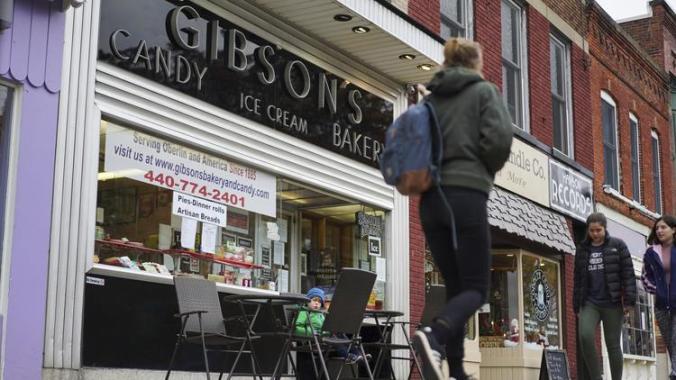
Gibson’s Bakery, a small family-owned bakery with a contract with Oberlin, is suing the Ohio college, alleging that school officials facilitated a boycott after three black Oberlin students were arrested at the bakery for shop-lifting some wine. The complaint is here.
On November 9, 2016—probably not coincidentally the day after Donald Trump was elected, throwing ultra-liberal schools like Oberlin into a ludicrously extended period of irrational fear and loathing—Jonathan Aladin, Endia Lawrence and Cecelia Whettstone were caught stealing bottles of wine. As they have been duly trained by our culture, the students played the race card, initially claiming the shop had racially profiled them, and that their only misdeed was presenting fake IDs. When that wasn’t working, the three admitted their guilt and also signed statements that the store was innocent of any race-related bias. It also appears that the students punched and kicked the shopkeeper. What a fine job our institutions of higher learning are doing civilizing the rising generation! (Here is the police incident report.)
The day after the arrests, hundreds of students protested outside the bakery, and Oberlin’s student senate published a resolution saying Gibson’s had “a history of racial profiling and discriminatory treatment.” The Oberlin police conducted an investigation into the arrests and found “a complete lack of evidence of racism.” Over a five-year period, the bakery had pursued charges against 40 shoplifters, and only six were African-American.
Never mind. The owner met with then-Oberlin President Marvin Krislov and Tita Reed, assistant to the president, and they pressured him to drop criminal charges against the three students and any future student-thieves who were first time offenders. When he did not agree, the complaint alleges, the school made good on its threat and dropped its decade’s long contract with the bakery. Then, the complaints says, Meredith Raimondo, vice president and dean of students, joined students and members of the school faculty in campus demonstrations against the bakery, distributing a flyer that accused Gibson’s Bakery of being a “RACIST establishment with a LONG ACCOUNT of RACIAL PROFILING and DISCRIMINATION.” A boycott of the business was organized, and according to the complaint, facilitated by the school. College tour guides reportedly inform prospective students that Gibson’s is racist. How is it racist? Well, it doesn’t let black students shoplift, and black students told reporters that when they enter the store, they feel as though they’re being watched. Continue reading →
Arthur in Maine, who has kindly featured me on his radio show and actually given me sufficient time to explain things without being cut off, submitted the following discourse focusing on my embarrassingly slow-to-form realization that all investigative reporting into political matters had to be considered as manipulated to serve some political agenda by the news organization.
…Why are any of you – including Jack – surprised? Media is, first and foremost, a BUSINESS. It doesn’t sell news – it provides news as a mechanism for generating advertising (in the case of NPR, underwriting and/or listener) support.
The United States is one of the only so-called free nations that embraces the concept of objective media. In fact, the whole concept started in this nation – with Joseph Pulitzer (recognize the name?). In other words, the concept of objective media is an American conceit.
Pulitzer’s drive towards so-called “objective” media certainly raised standards, but it wasn’t due to the noble idea that newspapers – pretty much the only game in town at his time – should be objective. Pulitzer was the visionary who recognized that the way news was being reported was scaring off the advertisers, and the advertisers were way more important than the folks who plunked down a penny or two to buy a copy at the news stand.
American media at the dawn of the 20th century wasn’t dissimilar to the way it is today – and much like it has ALWAYS been in nations in which the media isn’t state-controlled. It’s rambunctious. It’s partisan. It wears its beliefs on its sleeve – both with regard to what it covers and the way it covers it. Continue reading →
This comment by Humble Talent, one of several COTD entries he has made lately, has to get up today before the ick that was the Alabama Senate Race subsides, and the comment feels moot—though it would not be.
But first, my epiphany about investigative reporting…
Humble’s comment made me realize something that was right in front of my eyes, and has been for a long time, and yet I never before connected the dots. This is especially galling because it involves distrust of the news media, and as you know, I think about this a lot.
What I only now realize, thanks to Humble Talent, is that investigative reporting is virtually always partisan or agenda-driven one way or the other. It isn’t the highest form of journalism, as we of the post-Watergate era have been taught to believe. It may be the most sinister.
Journalists can’t investigate everything. They have to choose what to investigate, and when, and those choices are inevitably determined by biases and political agendas. If choices are made, and they have to be—what do we investigate, about who? When do we know we have something worth printing? When do we run it? What will happen if we do?—the choices will reflect biases, unless coins are flipped and lots are drawn.
I never thought about whether the timing of the Roy Moore teen dates stories the Post ran were timed to come out when they did. But Humble makes me think: did the Post bother to look for dirt on Jones? I doubt it. I think an editor said, “This guy Moore is horrible. I bet there’s some scandal out there that can take him down, maybe a sex scandal. Let’s dig.” The Post sees that as a public service—Moore is objectively horrible—but the “investigative reporting” is essentially opposition research to benefit the Democratic candidate. Then the damning results of the investigation were published when they were deemed to be able to cause the most chaos in the campaign.
Why didn’t this occur to me when I was watching “Spotlight”? We see, in that film about the Boston Globe’s investigation into child abuse in the Boston Catholic Diocese, how the story was held up for months as a mater of tactics and politics. The story almost wasn’t run at all. Now, why did I just assume that it was random chance that…
The Harvey Weinstein esposé wasn’t released before the 2016 election?
Provocative passages in Barack Obama’s books about “considering” homosexuality and eating dog never were investigated or explored by the mainstream news media during the 2008 campaign?
The revelations about Hillary Clinton’s illicit private server were published by the Times 18 months before the election, giving her plenty of time to make them harmless?
No major news organization sought to do a Watergate-style investigation of the IRS sabotage of conservative group participation in the 2012 Presidential campaign, although the Obama Justice Department investigation was obviously a sham?
I’m an idiot. Was I the only one this gullible? I knew that the press could have ended JFK’s Presidency almost at will, but was intimidated out of doing so and wasn’t that unhappy about it. I knew the press intentionally kept the Clinton rape allegation from the public, for fear it would affect the impeachment outcome. I knew that CBS and Dan Rather’s investigative reporting about President Bush’s National Guard conduct was devised and timed (and falsified) to give Kerry the election.
Investigative reporting regarding politics is always politically driven. It has to be.
Duh.
I am completely dedicated to the Bill of Rights’ guarantee of a free and unencumbered press. A democracy without a free press is doomed. I am also convinced that a free press that abuses its power and influence is as great a threat to democracy as no free press at all.



This comment by Humble Talent, one of several COTD entries he has made lately, has to get up today before the ick that was the Alabama Senate Race subsides, and the comment feels moot—though it would not be.
But first, my epiphany about investigative reporting…
Humble’s comment made me realize something that was right in front of my eyes, and has been for a long time, and yet I never before connected the dots. This is especially galling because it involves distrust of the news media, and as you know, I think about this a lot.
What I only now realize, thanks to Humble Talent, is that investigative reporting is virtually always partisan or agenda-driven one way or the other. It isn’t the highest form of journalism, as we of the post-Watergate era have been taught to believe. It may be the most sinister.
Journalists can’t investigate everything. They have to choose what to investigate, and when, and those choices are inevitably determined by biases and political agendas. If choices are made, and they have to be—what do we investigate, about who? When do we know we have something worth printing? When do we run it? What will happen if we do?—the choices will reflect biases, unless coins are flipped and lots are drawn.
I never thought about whether the timing of the Roy Moore teen dates stories the Post ran were timed to come out when they did. But Humble makes me think: did the Post bother to look for dirt on Jones? I doubt it. I think an editor said, “This guy Moore is horrible. I bet there’s some scandal out there that can take him down, maybe a sex scandal. Let’s dig.” The Post sees that as a public service—Moore is objectively horrible—but the “investigative reporting” is essentially opposition research to benefit the Democratic candidate. Then the damning results of the investigation were published when they were deemed to be able to cause the most chaos in the campaign.
Why didn’t this occur to me when I was watching “Spotlight”? We see, in that film about the Boston Globe’s investigation into child abuse in the Boston Catholic Diocese, how the story was held up for months as a mater of tactics and politics. The story almost wasn’t run at all. Now, why did I just assume that it was random chance that…
I’m an idiot. Was I the only one this gullible? I knew that the press could have ended JFK’s Presidency almost at will, but was intimidated out of doing so and wasn’t that unhappy about it. I knew the press intentionally kept the Clinton rape allegation from the public, for fear it would affect the impeachment outcome. I knew that CBS and Dan Rather’s investigative reporting about President Bush’s National Guard conduct was devised and timed (and falsified) to give Kerry the election.
Investigative reporting regarding politics is always politically driven. It has to be.
Duh.
I am completely dedicated to the Bill of Rights’ guarantee of a free and unencumbered press. A democracy without a free press is doomed. I am also convinced that a free press that abuses its power and influence is as great a threat to democracy as no free press at all.
Here is Humble Talent’s Comment of the Day on the post, “The Popeye,” From The Ethics Alarms Ethics Estoppel Files: I Can Say The Republican Party Is Rotting, Democrats, But You Can’t: Continue reading →