Next Up At Bat On “Controversial Tweet Friday,” The Reserve Catcher’s Tweets!

cropped_clevenger

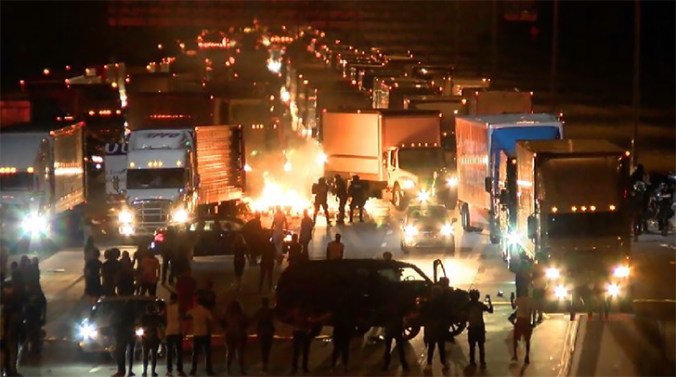
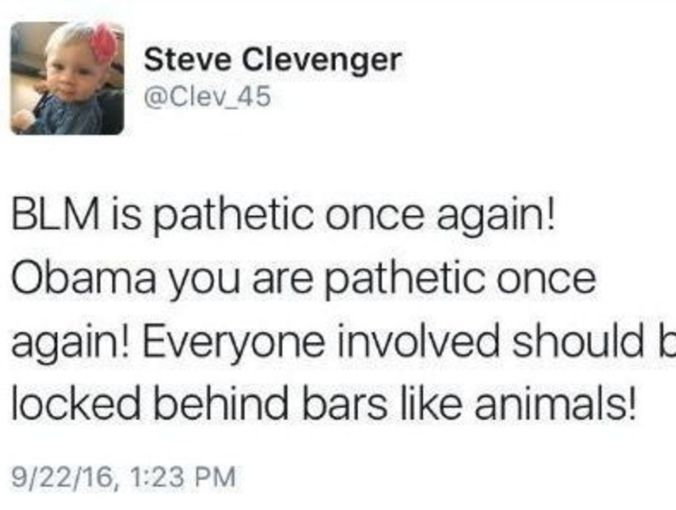
Like Prof. Reynolds, Seattle Mariners second-string catcher  Steve Clevenger decided to express his unhappiness with the riots in Charlotte using his Twitter account, and also like the “Instapundit,” found himself in trouble as a result. Before posting the above tweet, Clevenger wrote this as his introduction:

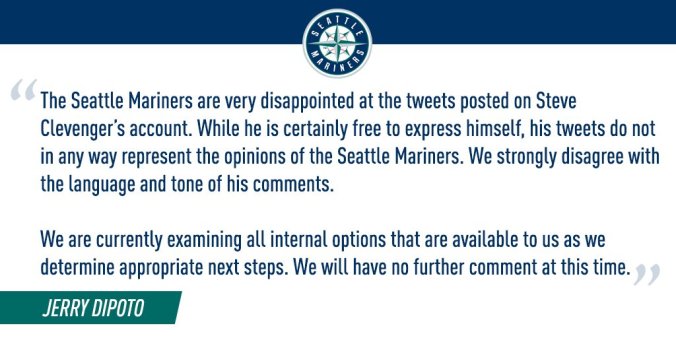
cropped_steve_clevenger1Twitter didn’t suspend Clevenger’s account, but his employer, a baseball team located in a very liberal city and also a team that is embroiled in a desperate fight to make the play-offs, reacted initially with this, also on Twitter…

mariners-tweet

Clevenger apparently didn’t expect that his tweets would suddenly result in his being labelled as a racist blight on humanity  by the many, many, people on social media who live for such incidents, and he quickly released a long and emotional apology:

First and foremost I would like to apologize to the Seattle Mariners, my teammates, my family and the fans of our great game for the distraction my tweets on my personal twitter page caused when they went public earlier today. I am sickened by the idea that anyone would think of me in racist terms. My tweets were reactionary to the events I saw on the news and were worded beyond poorly at best and I can see how and why someone could read into my tweets far more deeply than how I actually feel.

“I grew up on the streets of Baltimore, a city I love to this very day. I grew up in a very culturally diverse area of America and I am very proud to come from there. I am also proud that my inner circle of friends has never been defined by race but by the content of their character. Any former teammate or anyone who has met me can attest to this and I pride myself on not being a judgemental person. I just ask that the public not judge me because of an ill worded tweet.

“I do believe that supporting our First Amendment rights and supporting local law enforcement are not mutually exclusive. With everything going on in the world I really just want what is best for everyone regardless of who they are. I like many Americans are frustrated by a lot of things in the world and I would like to be a part of the dialogue moving forward to make this a better world for everyone.

” I once again apologize to anyone who was offended today and I just ask you not judge me off of a social media posting. Thank you and God bless everyone.”

Steve Clevenger

Continue reading

Observations On The Instapundit’s Tweet

reynolds-tweet

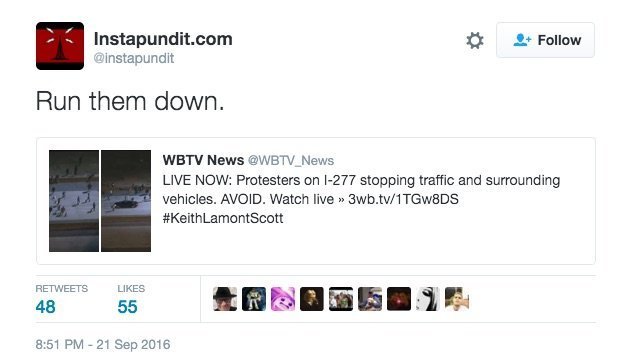
Yesterday, conservative law professor, author and blogger Glenn Reynolds learned that Twitter had suspended his account, and he wrote on his iconic website Instapundit...

Can’t imagine why they’d do that, except that it seems to be happening to a lot of people for no obvious reason. It’s as if, despite assurances to the contrary, Twitter is out to silence voices it disagrees with or something.

Then he learned that his offense was the above tweet. Reynolds wrote…

Sorry, blocking the interstate is dangerous, and trapping people in their cars is a threat. Driving on is self-preservation, especially when we’ve had mobs destroying property and injuring and killing people. But if Twitter doesn’t like me, I’m happy to stop providing them with free content.

and..

“Run them down” perhaps didn’t capture this fully, but it’s Twitter, where character limits stand in the way of nuance”

But one of Reynolds’ extra-curricular gigs (he is a University of Tennessee law professor) is monthly columnist for USA Today. After the progressive Furies took to social media and demanded that he be fired from the law school, dropped by the newspaper and forced to wander in the wilderness in sackcloth, Gannett’s paper suspended him for a month.

Reynolds was reinstated by Twitter after purging the offending tweet, and he issued this mea culpa to USA Today:

Wednesday night one of my 580,000 tweets blew up. I didn’t live up to my own standards, and I didn’t meet USA TODAY’s standards. For that I apologize, to USA TODAY readers and to my followers on social media.

I was following the riots in Charlotte, against a background of reports of violence. Joe Bruno of WSOC9 interviewed a driver whose truck had been stopped by a mob. Trapped in her cab, she “feared for her life” as her cargo was looted. Then I retweeted a report of mobs “stopping traffic and surrounding vehicles” with the comment, “Run them down.”

Those words can easily be taken to advocate drivers going out of their way to run down protesters. I meant no such thing, and I’m sorry it seemed I did. What I meant is that drivers who feel their lives are in danger from a violent mob should not stop their vehicles. I remember Reginald Denny, a truck driver who was beaten nearly to death by a mob during the 1992 Los Angeles riots. My tweet should have said, “Keep driving,” or “Don’t stop.”

I have always supported peaceful protests, speaking out against police militarization and excessive police violence in my USA TODAY columns, on my website and on Twitter itself. I understand why people misunderstood my tweet and regret that I was not clearer.

Today, Reynolds wrote on Instapundit:

TWITTER HAS UNBLOCKED MY ACCOUNT ON CONDITION OF DELETING THE OFFENDING TWEET. But lest I be accused of airbrushing, it’s preserved here. Still planning on quitting Twitter, though, after making a few points. Earlier post is here. UPDATE: From Nick Gillespie at Reason: In Defense Of InstaPundit’s Glenn Reynolds. “Whatever you think of the tastefulness of his suggestion regarding the protesters in Charlotte, the idea that he is seriously inciting any sort of actual or real threat is risible.”

Related: “Glenn Reynolds is old enough to remember Reginald Denny. (Look it up, kids.)”

and

SO MY USA TODAY COLUMN is suspended for a month. My statement is here. I don’t apologize for saying that you shouldn’t stop for angry mobs, even if they’re blocking your way. But I could have said it better

Observations:

Continue reading

Voter IDs And The “Don’t Lock The Barn Door Because The Horse Hasn’t Escaped Yet” Argument

horse-in-barn-door

There are some political and partisan controversies in which I just cannot comprehend, from an ethical perspective, why there is any serious disagreement. Illegal immigration is one of them. Of course we need to control immigration; of course it is madness to encourage illegal immigrants to enter the country; and of course we have to enforce our laws. The arguments against these obvious and undeniable facts are entirely based on rationalizations, emotion, cynical political strategies and group loyalties. The advocates for illegal immigrants have  one valid argument that only applies to those who currently live here: it’s too late and too difficult to get rid of them now. I agree, but that doesn’t mean it is responsible to keep adding to the problem.

Voter identification requirements is another one of those debates. Of course it makes sense to protect the integrity of elections by requiring valid IDs. The last time the Supreme Court visited the issue, an ideologically-mixed court found a voter ID requirement reasonable, necessary and constitutional. Writing for the 6-3 majority in 2008, Justice Stevens (who in retirement has become something of a progressive icon), wrote,

“The relevant burdens here are those imposed on eligible voters who lack photo identification cards that comply with [the Indiana law.] Because Indiana’s cards are free, the inconvenience of going to the Bureau of Motor Vehicles, gathering required documents, and posing for a photograph does not qualify as a substantial burden on most voters’ right to vote, or represent a significant increase over the usual burdens of voting. The severity of the somewhat heavier burden that may be placed on a limited number of persons—e.g., elderly persons born out-of-state, who may have difficulty obtaining a birth certificate—is mitigated by the fact that eligible voters without photo identification may cast provisional ballots that will be counted if they execute the required affidavit at the circuit court clerk’s office. Even assuming that the burden may not be justified as to a few voters, that conclusion is by no means sufficient to establish petitioners’ right to the relief they seek.”

Of course.  Our government is entirely dependent on elections. Nobody questions the reasonableness of requiring IDs to buy liquor, open a bank account, rent a car or check into a hotel, yet we’re going to rely on the honor system for our elections? The idea is madness, though, to be fair, two current members of the Court, Justice Ginsberg and Breyer,  argued that avoiding “disparate impact” justified allowing a gaping vulnerability in the integrity of elections to go unaddressed. Breyer wrote:

“Indiana’s statute requires registered voters to present photo identification at the polls. It imposes a burden upon some voters, but it does so in order to prevent fraud, to build confidence in the voting system, and thereby to maintain the integrity of the voting process. In determining whether this statute violates the Federal Constitution, I would balance the voting-related interests that the statute affects, asking “whether the statute burdens any one such interest in a manner out of proportion to the statute’s salutary effects upon the others (perhaps, but not necessarily, because of the existence of a clearly superior, less restrictive alternative)…”

Justice Breyer concluded that the alleged “burden” to some groups outweighed the integrity of the democratic system, thus embodying the current delusion of modern liberalism: race is more important that anything else, especially when that race is a reliable and uncritical source of power for Democrats.

It wasn’t until several political and judicial factors changed that the Ginsberg-Breyer rationale became politically weaponized, among them the increasing employment of the dubious “disparate impact” doctrine, the Democratic party strategists’ realization that painting Republicans as racists was an excellent way to get minorities to the polls; the growing tendency of African Americans to automatically vote a straight Democratic ticket regardless of who the candidates were and what they had accomplished; an aggressively political and partisan Justice Department and, yes, the realization that all those illegal immigrants here who are counting on keeping the borders as porous as possible might somehow find ways to vote, that requiring IDs became controversial.

Do some, even many, Republican legislators and conservative pundits promote state voter ID laws because they believe there would be a disparate impact on Democratic voting blocs? Absolutely; I have no doubts whatsoever. Does responsible and necessary legislation become magically irresponsible and unconstitutional because unethical motives merge with the ethical ones in passing it? Again, of course not. It is a principle of ethical analysis discussed here many times: many actions have both ethical and unethical motives, but the ethical nature of the conduct must be judged on its intended purpose, reasonably anticipated results, and effect on society as a whole. In the case of voter identification, the obvious and reasonable approach is to pass legislation to protect the integrity of the system and then seek to mitigate any inequities by separate means. In an ethical, reasonable system where one party didn’t see itself gaining power by allowing loose enforcement of voting requirements and the other party didn’t similarly see happy side-effect of enforcing them vigorously, this wouldn’t be a partisan issue at all. Of course we should have laws making sure that voters are who they say they are. Of course we should make sure that every citizen has access to such identification.

The current ascendant argument against voter ID laws is articulated by the New York Times in an editorial today titled, The Success of the Voter Fraud Myth.  Continue reading

Why It’s Unethical For Journalists To “Fact Check” Donald Trump—Especially CNN Journalists

Donald Trump

In Donald Trump’s meaningless statement yesterday, which was covered by the news media as if it was the revelation of the millennium, he  officially conceded that Barack Obama is a natural born U.S. citizen. He also used the silly media attention to drag out his announcement into a long campaign infomercial for which he didn’t have to pay a cent. Nice, and it serves the broadcast media right for giving any significance to a five-year-long trolling exercise.

Trump used the phony controversy over President Obama’s birth certificate to get publicity five years ago, because he is shameless. That’s all. Did he really think Obama was born in Kenya? Oh, who knows? He is an idiot, after all. Then again, he is a skilled professional troll. Whether he believed it or not, Trump used the issue to get attention then, and now has used his 180 degree reversal to get attention now. Obviously nothing has changed that would justify this flip-flop if he believed what he insisted was true for five years. A more transparently cynical and insincere retraction I cannot conceive. Who cares what Trump says he believes at any point, about anything?

But I digress. What really seemed to enrage the journalists who have embraced Rationalizations #28. The Revolutionary’s Excuse: “These are not ordinary times,” and #31. The Troublesome Luxury: “Ethics is a luxury we can’t afford right now” to anoint themselves as full-time volunteer members of the Hillary for President campaign, was that Trump said this:

“Hillary Clinton and her campaign of 2008 started the birther controversy. I finished it.”

Quoth the thoroughly partisan news media,

“ARRGH!!!!:

Continue reading

Ethics Hypothetical: Rules, Compassion, Integrity, Fairness, And A Looming Race Card

clock2

[The hypothetical is inspired by two recent events I witnessed in the past week.]

Preface: The state requires new bar admittees to take a one-day course covering the basics of practicing law in the jurisdiction—how the courts work, special procedural rules, unique aspects of local practice, horror stories, the works. They must complete the course or they can’t be certified, and the court-ordered series of lectures and presentations is held only once a month.

A company runs the mandatory curriculum under contract to the state, and is required to confirm in writing to the courts that its requirement have been fulfilled. One key requirement is that every attendee must be present for every minute of the presentations, except for brief emergencies, like using the rest rooms. The course administrators carefully monitor attendance. The published description of the course directs that once the course begins, theoretically at 9 am sharp, no late-comers will be admitted.

As you might imagine, missing the session can be quite a hardship, as participants often live and work in other jurisdictions.

The Event: It is 9:08 am on the day of the program, and the introductory video that begins the orientation is almost finished. It consists of interviews with members of the bar about the benefits of practicing in the state, the importance of ethical practice, etc: to say it is not substantive is an understatement. Literally nothing that is said and shown in the video is anything but boilerplate.

A young man, sweating profusely, bursts in the door, looking unhappy and desperate. “I’m sorry I’m sorry!” he babbles. He says that he had to drive up from a neighboring state and had an accident. “Can I still get in?” he pleads.

The male staffer responsible for the session chats briefly with an associate. The program was late starting, and this late arrival will miss nothing if he goes in now. “All right,” the honcho says as the young man heaves a sigh of relief. “I shouldn’t do this, but you haven’t missed anything.” As he goes into the auditorium, one can here the opening remarks of the first speaker, a judge. It is now 9:12 am, and another young man bursts through the door on a dead run. “My crazy cabbie’s been driving me all over the city for an hour!” he shouts. “I flew in last night from Arizona! Please, please, don’t make me do this again…I barely was able to afford this trip.” The administrator is wondering if he had seen the previous guy go into the auditorium. He’s heard this judge’s spiel many times: all that has been missed, to be honest, are a few (lame) jokes. “All right, all right, get in there quick!” he tells the new supplicant. “I’ll finish your paperwork during the break!” The kid looks like he’s going to cry, he’s so relieved.

I’m there, watching this (I’m on the program) and say to the administrator, “I bet this happens every time.” He says, “It does. I know that nobody misses anything that isn’t in the printed materials until 9:15, so it’s a hard stop after that.”

And another late arrival bursts through the door. It’s a bit after 9:14. The staffer has just told me that the final final deadline is 9:15, and it’s not that yet. This poor guy is bleeding through his pants,  has a big bruise on his face, and is saying something about a bicycle accident. By the time he gets himself settled—he is told that there is no time to clean up—it’s past 9:16. He starts toward the auditorium door as the other staffer says, “OK, that’s IT,” and starts to take the registration materials and lists away….just a very stressed young African-American woman enters, in plenty of time to see the bicycle rider, who is white, enter the auditorium. I can hear the judge through the open door. He’s still telling jokes, longer this time than usual.

Issues and Observations

1. The young woman was not admitted, and told that she had to come back another month. She too was from out of state. She also had a legitimate-sounding excuse.

  • Was that fair to her?
  • Should it have mattered that the program had not yet reached a serious stage?
  • She was told that 15 minutes was the absolute, unwaivable deadline. That was true, but it was not the deadline the company was contracted and pledged to enforce. That deadline was 9:00 am.

2. Should the explanations used by the latecomers play any part in the decision to allow them in? Why? Continue reading

Ann Coulter’s “In Trump We Trust: E Pluribus Awesome!” : Unethical Book Title Of The Millennium?

Ann Coulter: Take seriously at your own risk. Just like Donald Trump...

Ann Coulter: Take seriously at your own risk. Just like Donald Trump…

I have long been waffling over whether to bother mentioning Ann Coulter’s cheerleading for Donald Trump, which began almost a year ago. Coulter is freakishly unethical and proud of it, a rare professional fick, whose shtick (I guess one shouldn’t use fick and shtick in the same sentence: sorry) is to pander to The Angry Right in such obnoxious and inflammatory terms that the Angry Left goes bananas with hate, thus selling books and providing her with media appearances to promote them. I have  assigned her to the dark corner reserved for performance artists who posture and lie for a living, for that’s Ann. I have no idea what she really believes, just as I have no idea what James Carville, Milo Yiannopoulos or Rush Limbaugh really believe—and anyone who really thinks that they know what Donald Trump really believes is beyond redemption, since it is quite evident that he doesn’t know himself.

Thus when I heard that Ann’s latest book, doubtlessly written in about five hours of dictation and containing some measure of her trademark snark, which she is very skilled at, was called “In Trump We Trust: E Pluribus Awesome!,” I was sorely tempted to express my disgust, especially since Coulter, an educated woman and a lawyer, actually stooped to using that mark of an illiterate, “awesome,’ like the book was authored by a modern day Gidget. But why play into Ann’s hands? This is why she writes this crap: to cause buzz on the net and cable so she can sell the books to right wing idiots who will be soothed by her calculated pose.

The title is an absurd, almost Orwellian (“War is Peace”) lie. Trump, as much as anyone alive,  cannot be trusted regarding anything, especially to hold great power. The reasons for this are evident and undeniable, and have been so long before running for President, wrecking the Republican Party, threatening the United States’ public’s faith in democracy and handing the White House to the most corrupt candidate a Presidential race has ever featured was a twinkle in the Donald’s eye.

However, listening to Trump blather about immigration last week, and seeming to renege on his signature promise to depart each and every illegal immigrant, almost compelled one to direct massive schadenfreude Ann Coulter’s way. Continue reading

Good: Hope Solo Finally Loses The Protection Of The Star Syndrome; Bad: U.S. Soccer Still Doesn’t Get It; Good: Hope Provides Rationalization #59

Solo loses

The Star Syndrome, a.k.a “The King’s Pass,” #11 on the Ethics Alarms Rationalization List, is the ethics bane of organizations generally and sports especially. It is one of the major catalysts of cultural corruption, whether the “star” is Bill Clinton, Lance Armstrong, Manny Ramirez, O.J. Simpson, Roget Ailes,  Brian Williams, George S. Patton, or Werner Von Braun. To refresh your memory…

11. The King’s Pass, The Star Syndrome, or “What Will We Do Without Him?”

One will often hear unethical behavior excused because the person involved is so important, so accomplished, and has done such great things for so many people that we should look the other way, just this once. This is a terribly dangerous mindset, because celebrities and powerful public figures come to depend on it. Their achievements, in their own minds and those of their supporters and fans, have earned them a more lenient ethical standard. This pass for bad behavior is as insidious as it is pervasive, and should be recognized and rejected whenever it raises its slimy head.  In fact, the more respectable and accomplished an individual is, the more damage he or she can do through unethical conduct, because such individuals engender great trust.

Thus the corrupting influence on the individual of The King’s Pass leads to the corruption of others, through…

11. (a) “I deserve this!” or “Just this once!”

Especially common to the hero, the leader, the founder, the admired and the justly acclaimed is the variation on the Kings Pass that causes individuals who know better to convince themselves that their years of public service, virtue and sacrifice for the good of others entitle them to just a little unethical indulgence that would be impermissible if engaged in by a lesser accomplished individual. When caught and threatened with consequences, the practitioner of this rationalization will be indignant and wounded, saying, “With everything I’ve done, and all the good I’ve accomplished for others, you would hold this against me?” The correct answer to this is “We are very grateful for your past service, but yes.

There are few more striking examples of this phenomenon than women’s soccer star Hope Solo. The New York Times neatly summarizes her last decade of dubious conduct (I’m being diplomatic): Continue reading

Major League Baseball Cares About Integrity And I Wish This Proved It…But It Doesn’t

I know this will be a shock, Henry, but there's forest here, not just trees...

I know this will be a shock, Henry, but there’s forest here, not just trees…

On Baseball Prospectus, one of the scholarly baseball sites, Henry Druschel has a provocative, inspiring and ultimately silly post pointing out that if baseball teams were only concerned with winning, they would forfeit games for strategic purposes, yet they literally never do. He writes…

“Teams are almost certainly harming their long-term win rates in a meaningful way by playing until every out of every game has been recorded. For example, the Red Sox encountered a grueling quirk of the schedule on Wednesday night, when they were scheduled to play the Orioles at 7:05 p.m. before traveling to Detroit and playing the Tigers at 1:10 p.m. the next day. When it began to pour in Baltimore at roughly 9:00 p.m., the Red Sox were leading 8-1 after six innings, but imagine if the situation was reversed, and Boston was instead trailing 8-1 with three innings to go. Their odds of coming back to win such a game would be something like 0.5 percent. In such a scenario, they could either wait in the clubhouse until the game was either resumed or officially cancelled, or they could forfeit as soon as the rain began, and head for the airport and Detroit right away. In the non-hypothetical game, the rain delay lasted about 80 minutes before the game was officially called; it seems obvious that an extra hour and a half of rest before the next game would add more to a trailing Boston’s total expected wins than remaining in Baltimore and hoping for a miracle would. That might seem like a corner case, and truthfully, it is; I bring it up to note that no one would even consider a forfeit in such a scenario, despite the strategic logic of the move. This isn’t limited to corner cases, however; every time a position player enters a baseball game as a pitcher in a blowout, teams are harming their long-term expected win totals by not forfeiting instead….”

The writer concludes:

Given that forfeitures would be win-maximizing in certain cases, and given that teams choose never to strategically forfeit regardless, there are two possible conclusions. One: Teams are behaving irrationally. Given the immense value even a single win can have to a franchise, I feel confident stating that this is not the case. That leaves the second conclusion: There is something the team values more than winning as much as possible. There is a societal norm that places something—a competitive ideal, maybe, or just completion—over winning, a norm that would be violated by a strategic forfeit, and a norm that teams invariably follow.

As someone who values other things over winning, this excites me…

Don’t get too excited, Henry.

Yes, I believe that baseball teams take considered actions sometimes that do not maximize their chances of winning. I was roundly pilloried in baseball circles for an article I wrote in 2008 (for another scholarly baseball site)  which argued that Barry Bonds, the shameless steroid cheat and home run champion who was suddenly a free agent and who could, based on his recent exploits, still hit though well past 40, would not be signed by any team—not even the Yankees!—because doing so would signal to that team’s fans, city, players and organization that the team endorsed flagrant dishonesty as well as a willingness to disregard fairness, integrity and sportsmanship for a few extra wins. I was on a MLB radio show where the host laughed at me. “Of course he’ll be signed! You’re crazy!” were his words. “Just wait,” I said. “If he isn’t signed, it will mean that baseball colluded against him!” he said. “Just wait,” I said.

Bonds, who said he was dying to play, that he was healthy, that he’d play for the Major League minimum, that he’d sue MLB if someone didn’t sign him, never swung a bat in anger again. There was no collusion, either. It was pure cognitive dissonance, you see. Remember the scale? Continue reading

Unethical Quote Of The Month: Wonkette Writer Rebecca Schoenkopf

juanita

I can absolutely see Bill Clinton doing this (then, not now) and not even thinking of it as rape, but thinking of it as dominant, alpha sex. I can see a LOT of men doing that during that time period, before we started telling them in the ’80s, “hey, that is rape, do not do that.” I can see YOUR NICE GRANDPA doing that, back then…I think good men can rape, and be sorry, and not do it again. This is very bad feminism…To sum up, I think Bill Clinton could very well have raped Juanita Broaddrick; that it doesn’t make him an evil man, or irredeemable (I’m Catholic; we’re all forgiven, if we’re sorry, and Broaddrick says Bill Clinton personally called her up to apologize). It doesn’t even necessarily make him a bad feminist — you know, later, once he stops doing that.

  Rebecca Schoenkopf, writing in the progressive blog Wonkette, talking about Juanita Brodderick’s rape accusation against Bill Clinton

Broaddrick’s claims are back in the news, now that it was noticed that the Hillary Clinton website quietly pulled its statement about the victims of sexual assault having “the right to be believed,” Clinton’s jaw-dropping assertion—given her despicable role in silencing and discrediting Bill’s various victims—that Ethics Alarms discussed when it was first made.

I awoke to multiple rightish blogs, and Ann Althouse, who is dead center, going bonkers over this piece, and rightly so. My initial query is, why only right wing and moderate blogs? Is the left this corrupted by Bill and Hillary? (Okay, that’s rhetorical: the answer is “Damn right they are.”) When did it become progressive to argue that “good men can rape”?

I thought that was a misogynist pig position scrawled on the walls of a troglodyte’s cave.

Good men do NOT rape. Ever. Rape—do I really need to say this?—is signature significance. It was in the 80s, it was in the 60s, it has always been. If you rape (and if you defend rape), you’re not good, you’re not ethical, and you’re not trustworthy. And–do I really have to say THIS?–you’re not just a bad feminist, you’re a phony feminist. (By the by way, you gotcha-masters out there: I am not saying that there is anything wrong with a lawyer defending an accused rapist, like Hillary Clinton did. That is not defending rape itself.)

So why aren’t the indignant, politically correct, feminist, war-on-women-deriding left-leaning web sites, commentators and bloggers collectively retching at the Wonkette post? Explain that to me, someone. Explain why it isn’t evidence that integrity hasn’t died in their skulls, and is stinking up their ethics like a dead rat under the floor-boards. Continue reading