Almost any rule, low or ethical principle can be deconstructed using what I call border anomalies. The first time I was aware of it was as a Harvard freshman in the late Sixties, when all assumptions, good and bad, useful and not, were considered inherently suspect. The college required all students to wear jackets and ties to meals at the student union, and up until my first year, nobody objected. But that fall, my classmates set out to crack the dress code, so they showed up for meals with ties, jackets, and no pants, or wearing belts as ties, or barefoot. (Yes, there were a lot of future lawyers in that class.) Pretty soon Harvard gave up, because litigating what constitutes ties, jackets and “proper dress” became ridiculously time-consuming and made the administration look petty and stupid. Of course, there are good reasons for dress codes—they are called respect, dignity, community and civility—-but never mind: the dress code couldn’t stand against those determined to destroy them by sending them down the slippery slope.
If any rules are to survive to assist society in maintaining important behavioral standards, we have to determine how we want to handle the effects described by the Ethics Incompleteness Theory, which holds that even the best rules and laws will be inevitably subjected to anomalous situations on their borders, regarding which strict enforcement will result in absurd or unjust results. The conservative approach to this dilemma is to strictly apply the law, rule or principle anyway, and accept the resulting bad result as a price for having consistent standards. The liberal approach is no better: it demands amending rules to deal with the anomalies, leading to vague rules with no integrity—and even more anomalies. The best solution, in my view, is to regard the anomalies as exceptions, and to handle them fairly, reasonably and justly using basic principles of ethics, not strictly applying the rule or law alone while leaving it intact. Continue reading →
Oh, rats. There goes my head again…where’s the duct tape?
The reductio ad absurdum of the debate over illegal immigration has reached its apotheosis in California, where Governor Brown actually signed into law a provision allowing illegal immigrants to be awarded licenses to practice law in the state. The law was designed to render moot the case of illegal immigrant Sergio Gomez, who was brought into the country as a child, managed to evade detection and enforcement through law school and the bar exam, and is now fighting to be admitted to the California Bar.
Garcia has said that being able to obtain a law license “is my life’s dream come true. One of two. I’m going for the U.S. citizenship next. I want to be a full part of this country.” Well, why stop at that bizarre sequence? Why not let Mexican citizens first become U.S. lawyers, and then aspire to sneak over the border some day and become U.S. citizens? Continue reading →
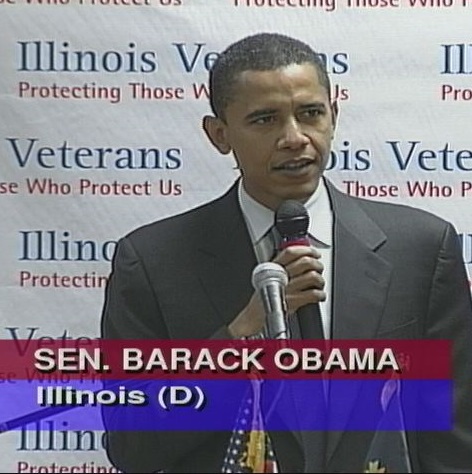
Whay ever happened to this guy? Boy, we sure could use someone like him about now…
As we all know by now, President Obama is refusing the negotiate over raising the debt limit, which, since the House of Representatives refuses to agree to raise the limit without some kind of concessions in spending by Democrats, is raising the specter of a catastrophic default.
Conservatives have been citing as an example of the President’s hypocrisy the fact that he voted against raising the debt limit in 2006, when Bush was President and the debt owed was just about half what it is today, posing far less of a threat to the nation’s fiscal future. At that time, Senator Obama said this:
“The fact that we are here today to debate raising America’s debt limit is a sign of leadership failure. It is a sign that the U.S. government can’t pay its own bills. It is a sign that we now depend on ongoing financial assistance from foreign countries to finance our Government’s reckless fiscal policies. . . . Continue reading →
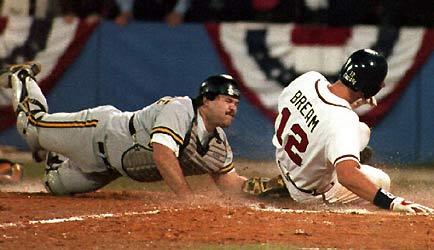
You all remember Sid Bream, don’t you? Well, probably not: he was a mediocre first baseman about 20 years ago who played for the Pittsburgh Pirates and the Atlanta Braves. He hasn’t been heard from in a long time, being quietly retired, but the Braves may be hosting the Pirates in an upcoming National League Division Playoff Series as the baseball post season gets underway, and they invited Bream to throw out the first pitch in Game #1 if that is the case—-Pittsburgh has to win a wildcard play-off game with Cincinnati first. You see, the one thing in his career that Bream is remembered for, at least in Atlanta, is scoring the run that won the National League Championship Series over the Pirates in 1992, in a close play that also lives in Pirates’ fans nightmares.
Throwing out the first pitch is fun: the team flies you in and pays for your hotel, gives you a prime ticket, and then announces your name as you trot on the field to cheers. If you have kept your arm in shape, you might even get off a throw to the catcher from the pitcher’s mound that doesn’t embarrass you, and that will acquire more cheers. from the packed stadium. Wait…this is Atlanta, not Boston. OK, from the two-thirds filled stadium. Even then, what’s not to like?
But Sid Bream turned the Braves down. Remember that I began by saying that he played for both the Braves and the Pirates. He said,
“Whatever their motive (for the invite) was, I don’t want to be involved. I wasn’t surprised (by the offer). Whether their motive was to rub it in the Pirates’ faces, I don’t know. I think it was just more of a gesture to commemorate those two teams getting back together in the postseason. But I’ll stay neutral. I’m not going to do anything to tell the fans in Atlanta or Pittsburgh that I’m (rooting) one way or the other.”
Oh, I think it’s fair to say that rubbing the Pirates’ faces in their last loss to the Braves in a postseason game was exactly what the Braves had in mind. This kind of voodoo has been a standard part of baseball gamesmanship for a long time: nobody believes that the Yankees had Bucky Dent throw out the first pitch when the Yankees had a crucial playoff game against Boston (which they lost) in 2004 “to commemorate those two teams getting back together in the postseason.” It’s psychological warfare, and more or less good-natured; there’s nothing wrong with it, and there would have been nothing wrong with Bream agreeing to play along.
But Sid Bream is, it seems, loyal. He was a Pittsburgh Pirate for a long time, a Brave only for a couple of years, and he doesn’t feel like being part of one of his former teams’ effort to unsettle the other one, even though its’ no big deal, and even though his old team won’t hold it against him. It just would feel right to him.
Little is more damaging to the public’s trust and faith in government than when elected officials engage in gratuitous lies—statements that can only convince those who don’t bother to check the facts underlying them, made for their momentary impact on the theory that the effect is worth the eventual exposure of the lie for what it is. Such lies are detestable, because they not only reinforce the impression that politicians lie when their lips are moving, they also convey the message that lies are merely tools of the politicians trade, and not even particularly shameful or worthy of criticism. When a politician engages in such transparent dishonesty, he or she is saying, quite literally, that lying is no big deal.
It is a big deal. It is especially a big deal when the point of the lie is to fool the public into believing something the politician is doing is a big deal itself, when it is really a sham.
Welcome to Sen. Ted Cruz and his fake filibuster, also known as Ted Cruz’s Bad Jimmy Stewart Impression.
“Ted, I knew Mr. Smith, and you’re no Mr. Smith. You’re not even Rand Paul…”
Evoking memories of the Frank Capra classic, “Mr. Smith Goes To Washington,” Sen. Cruz told the world that he was going to talk on the floor of the Senate against Obamacare until he couldn’t stand any more…you know, just like the Jimmy’s idealistic junior Senator in the film, who finally collapses of exhaustion to end his filibuster but whose courage makes the corrupt, manipulating senior Senator from his state confess that he was trying to fund a lousy health care b…no, wait, it had something to do with a kids camp and influence peddling. I haven’t seen the film in a while.
Quick, now…and no cheating: Who is this recently deceased TV legend?
Three separate organizations present the Emmy Awards: the Academy of Television Arts & Sciences (ATAS), the National Academy of Television Arts & Sciences (NATAS), and the International Academy of Television Arts & Sciences. Each is dedicated to the television industry, and the award the organizations collaborate to hand out for excellence are intended to serve multiple objectives. Prime among them is to honor and promote the professionals who bring—in theory, at least, quality entertainment into the homes of Americans. The show itself that broadcasts the awards only exists because of their larger mission, which is to say that the Emmy show exists to support the Emmys, not the other way around. The program’s producers, not for the first time, managed to forget their priorities this year, and are getting well-deserved scorn for it both in and outside the entertainment community.
The offense occurred during Sunday’s live telecast, when the show reached its annual “In Memoriam” segment. The Oscars have botched this crucial part of its own show in recent years by failing to recognize the deaths of important Hollywood figures who deserved their final bow and a last ovation. Emmy found a new and different way to insult its own. The Oscars’ omissions were negligent; the Emmys insult was, incredibly, intentional. It’s just that either nobody realized it was insulting, or, more likely, they knew but had other objectives. Continue reading →
Senators should not intentionally set out to make the American public stupid, or to validate invalid ethical constructs. Thus this explanation of his current proposal from Sen. Rand Paul needs to be derided, and should also cause concern for anyone who thinks it’s important for the Republican party to find some leaders who are trustworthy. Paul, in the course of pushing his stillborn, grandstanding plan to use a constitutional amendment to require government bigwigs to live with the same health care laws they impose on the rest of us, said this to The Daily Caller:
“My amendment says basically that everybody including Justice Roberts — who seems to be such a fan of Obamacare — gets it too. See, right now, Justice Roberts is still continuing to have federal employee health insurance subsidized by the taxpayer. And if he likes Obamacare so much, I’m going to give him an amendment that gives Obamacare to Justice Roberts.”
See, the fact that U.S. Supreme Court Chief Justice John Roberts refused to declare the Affordable Care Act unconstitutional using a highly-controversial legal distinction in no way suggests that he personally “likes” it, and anyone who thinks that is what judicial opinions, especially Supreme Court Opinions, mean is shockingly ignorant of the judicial system, the legal system, the law, the role of judges in society, the Constitution, and by extension, pretty much most of the principles that give government, management and leadership any integrity or competence. The fact that such an anyone has risen to the level of U.S. Senator goes beyond shocking to terrifying. Continue reading →
“”I’m not old fashioned. She could have come out naked, and if she’d just rocked the house, I would have said, ‘You go, girl.’ She could have come out naked, and if she’d just rocked the house, I would have said, ‘You go, girl.’ It just wasn’t done well. She can’t dance, her body looked like hell, the song wasn’t great, one cheek was hanging out. And, chick, don’t stick out your tongue if it’s coated. If you’re going to go that far, then think about it before you do it.“
These are wise words from a veteran and proven performing star to a young one on the way up, or heading for a crash. Essentially, Cher is stating the principles of professionalism: whatever you do, do it right, do it well, and respect your constituency. Cher has the bona fides to offer such an opinion since she has stretched the lines of sexual propriety on stage more than once, but it was always used as an additional enhancement on the way to her “rocking the house.”
The legendary pop diva was apparently surprised that her comments became a one-day sensation on the gossip websites and cable entertainment shows, and had second thoughts about them, which she communicated in a couple of tweets to the Twitterverse. In Cher-ese, they are all about ethics:
Miss Kansas, also known as Theresa Vail, would be a standout in current 2014 Miss America pageant just based on her unusual set of experiences and talents: the 22-year-old student at Kansas State is a member of the Kansas Army National Guard’s Medical Detachment, a serious bowhunter, a former motorcycle racer, an M16 marksman, a boxer, an auto mechanic, and an opera singer.* What is ethically of interest, however, is that she wore a bathing suit that revealed her two tattoos.
This just isn’t done in beauty pageants, not that many contestants are the tatooing sort. Tatoos have traditionally been regarded as ruining a contestant’s “perfection,” and aesthetically, I have to agree: a beautiful woman is still beautiful with something scribbled on her side, but it is hardy an enhancement. But Vial, in announcing her decision on her blog, made a compelling ethical argument for letting her tats show:
“What a hypocrite I would be if I covered the ink. With my platform, how could I tell other women to be fearless and be true to themselves if I can’t do the same?…But I am who I am, tattoos and all.”
That is as good a definition of integrity as you will find. Brava. Where integrity lies, you can usually find honesty, trustworthiness and courage as well. Continue reading →
I live in the Washington, D.C. area, and at this moment even the beginning of the NFL season, usually the one thing everyone here (except me) usually cares about, is being over-shadowed by the drama of the looming Congressional vote on Syria. What was assumed—why, I cannot imagine–to be a likely rubber stamp with only an insufficient number of Republicans providing opposition because, as we all have been told repeatedly, they will oppose the President on anything, has materialized as strong bi-partisan opposition. The Washington Post estimated last night that the votes in the House are currently running 3-1 against the symbolic-and-deadly-but-promised-to-be-non-committal missile strikes on pre-announced targets. This is the most encouraging development in the government since President Obama was elected, I am tempted to say. It shows that this is not a nation of lemmings, and that the separation of powers has its virtues after all. Nonetheless, interesting ethical arguments are arising in favor of votes both no and yes.
The no arguments are varied, and reach the same conclusion from different positions, some more ethical than others. The pacifist Left and the isolationist Right, both irresponsible and dedicated to ideology over reality, are on the same path here, and would be on that same path even if the President’s argument for missile strikes was strong. Others, including me, but also those who supported more extensive military action in the Bush administration, fault the plan because of its dubious results, its contradictory logic, and the feckless and troubling way the President brought us to where we are.
I just heard an interview with a Republican House member who announced that he reversed his initial support for the missile strike after hearing Obama’s remarks in Sweden. After hearing Obama appear to deny that he drew the red line—a rhetorical point that was too cute by half and clumsily stated—this Congressman decided that he couldn’t believe anything Obama said or promised regarding Syria, including his assurances that nothing would lead to “boots on the ground.” (I would argue that his assurances that nothing would lead to boots on the ground is, if not dishonest, frighteningly irresponsible.)
The yes arguments are more perplexing. Naturally, there are those who, against all logic, simply adopt the contradictory and militarily nonsensical arguments John Kerry was asked to present to the Senate (apparently because President Obama knows that he appointed an inarticulate—but loyal!!!—dim-bulb, Chuck Hagel, as Secretary of Defense—but that is another, though related, issue). Liberal columnist Eugene Robinson, who has won an Affirmative Action Pulitzer Prize and who has proven that he will cheer whatever his fellow-African American in the White House does, even if he makes a decree like the South American rebel-leader-turned-dictator in Woody Allen’s “Bananas”...
“From this day on, the official language of San Marcos will be Swedish…In addition to that, all citizens will be required to change their underwear every half-hour. Underwear will be worn on the outside so we can check. Furthermore, all children under 16 years old are now… 16 years old!”
made this “argument”…
“The issue can’t be who wins that country’s civil war. It has to be whether the regime of Bashar al-Assad should be punished for using chemical weapons — and, if the answer is yes, whether there is any effective means of punishment other than a U.S. military strike…Let me clarify: I believe that a U.S. strike of the kind being discussed, involving cruise missiles and perhaps other air-power assets, can make it more likely that Assad loses. But I also believe that — absent a major commitment of American forces, which is out of the question — we cannot determine who wins.”
Gee, thanks for clarifying, Eugene!
Other, more coherent voices argue for endorsing Obama’s plan do sent a few missiles—not any that might hit Assad or his weapons, mind you– because they argue, even if the plan is weak, misguided, dangerous or certifiably bats, the President and, by extension, the United States will be dangerously weakened if a call to arms is rejected. This is essentially the argument of rational conservative James Taranto. Here is former Bush speechwriter Michael Gerson, this morning:
“…During the Syrian crisis, the Obama administration has generally waged a war of words and then used those words casually and clumsily. President Obama declared that Assad “must go” when his departure seemed inevitable — without a strategy, or even the intention, to achieve this goal when it became difficult. He drew a chemical-weapons “red line” that became a well-trodden thoroughfare. The Obama administration revealed details of an imminent military operation, which was promptly repudiated by the parliament of our closest ally, then abruptly postponed. The administration seemed to indicate that United Nations support for a military strike was needed — before declaring it unnecessary. It seemed to indicate that a congressional endorsement was superfluous — just before staking everything on securing it. Obama is inviting members of Congress to share responsibility for a Syrian policy that has achieved little to justify their confidence. In fact, he has undermined political support for the legislative outcome he seeks. For more than five years, Obama has argued that America is overcommitted in the Middle East and should refocus on domestic priorities. Now he asks other politicians to incur risks by endorsing an approach he has clearly resisted at every stage…”
Wait…this is how Gerson argues that Congress should vote yes? Indeed it is…
“Legislators are not arguing between preferred policy options, as they would on issues such as health care or welfare. They are deciding if they will send the chief executive into the world with his hands tied behind his back. This would be more than the repudiation of the current president; it would be the dangerous weakening of the presidency….even if this military action were wrong or pointless, it would have to be sufficiently dangerous to justify the gelding of the executive branch on a global stage. A limited military strike may be symbolic. But for Congress to block that strike would be more than symbolic. It would undermine a tangible element of American influence: the perception that the commander in chief is fully in command.”
This is a good time to stop and offer today’s Ethics Alarms Ethics Quiz, based on the reasoning of Gerson and others:
Are members of Congress ethically obligated, by loyalty and responsibility for the image and credibility of the U.S. abroad and to avoid weakening the institution of the presidency, to support the missile strikes on Syria, even if they and their constituents believe that to do so is wrong and misguided?









 Ethics Alarms