Unethical Quote of the Week: Jerry Sandusky

“Joe preached toughness, hard word and clean competition. Most of all, he had the courage to practice what he preached. Nobody will be able to take away the memories we all shared of a great man…”
My advice, Jerry? Skip the funeral.

Former Penn State assistant football coach Jerry Sandusky on the passing of Joe Paterno, whose failure to take the necessary steps to prevent Sandusky from sexually molesting young boys (<cough!> allegedly) on and off the Penn State campus scarred the iconic coach’s legacy, not to mention setting up children for a (<cough!> allegedly!) sexual predator’s smorgasbord.

This might be the creepiest tribute in the history of mankind. Why did any reporter ask Sandusky for a statement in the wake of his former boss’s sad end? Who cares what Sandusky thinks about Paterno’s legacy, which Sandusky played a pivotal role in ruining? Continue reading

Saluting the GOP’s Most Ethical Candidate, Distrusted For Doing the Right Thing

We'll miss his daughters, too...

Jon Huntsman is gone, finally quitting the hunt for the Republican Presidential nomination long after the futility of his quest had been established. Huntsman was easily the ethics favorite in the competition, though Ron Paul’s candor and integrity also get high marks. He began his campaign with a call for civility, and seldom missed the high standard he set out for himself. Best of all, he correctly identified the ethics core of our nation’s various problems: the trust deficit. Huntsman began hitting this theme hard in Iowa, but perhaps not hard enough. The collapse of public trust in all our institutions is a very real threat to our democracy, for democracy, more than any government philosophy, requires trust to survive. Whatever it is that Republicans want right now, however, trust isn’t very high on the list, and neither is civility. Continue reading

Ethics Hero: Rep. Ron Paul

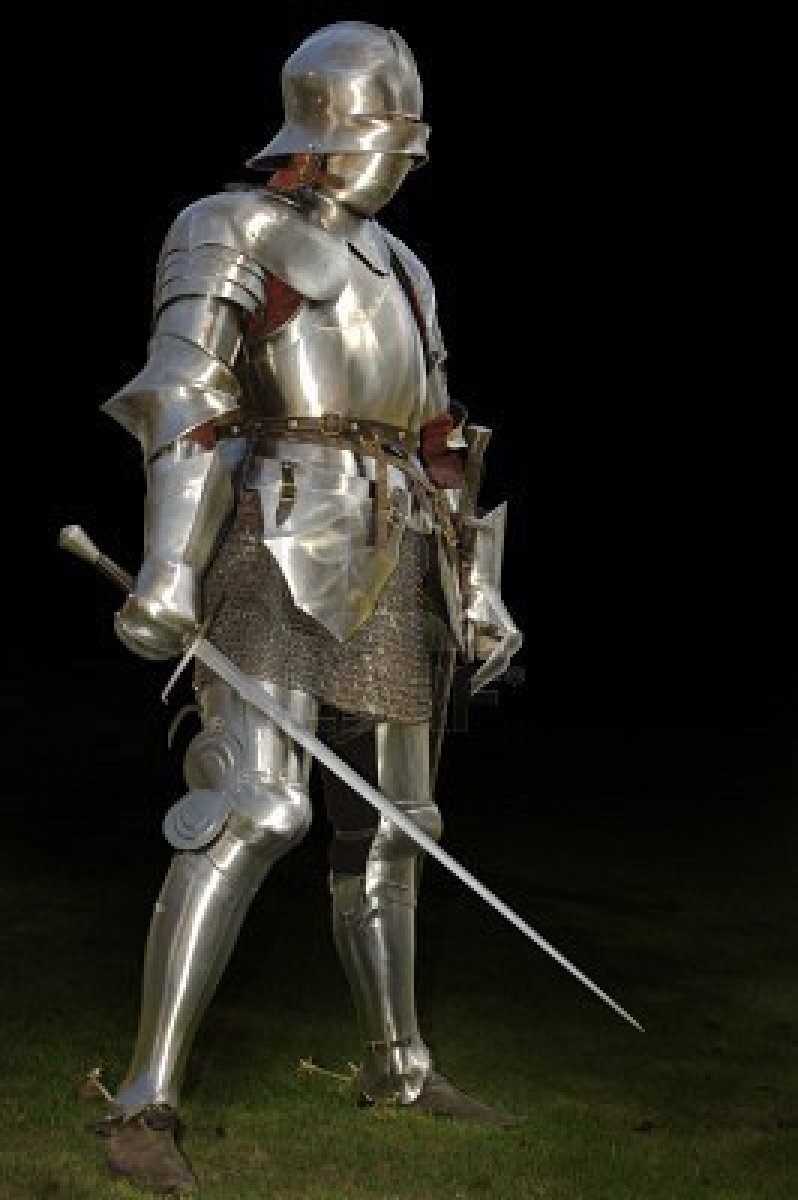
The identity of Mitt Romney's knight in shining armor was a surprise, but it shouldn't have been.

Ron Paul is, to engage in understatement, unusual, and often in a good way. How many politicians, for example, will actively defend their adversary in a campaign  right before a critical vote? Yet that’s what Ron Paul did, defending Mitt Romney, his main competition for the GOP presidential nomination, after Romney had blooped a line that will undoubtedly haunt him for a long time. “I like being able to fire people who provide services to me,” Romney had said. “You know, if someone doesn’t give me the good service I need, I want to say ‘You know, I’m going to go get someone else to provide that service to me.” It was predictable that the line would be truncated and taken out of context, and it was…by the press, by Jon Huntsman, by Rick Perry. It will surely be used against Romney by President Obama, who has adopted the position that people should be able to hold on to jobs whether they do them well or not— Eric Holder and Janet Napolitano, for example. But Paul would have none of it, saying,

“I think this is just typical politics and they’re unfairly attacking him on that issue,” Paul said outside a polling place at Webster School in Manchester. “He never literally said what they say he said. They’re taking him way out of context.”

Paul also defended Romney’s history as CEO at Bain Capital, the subject of a new attack video by Newt Gingrich, as an example of the free market working properly. “You save companies, you save jobs when you reorganize companies that are going to go bankrupt,” Paul said. “They [the critics] don’t understand.” Continue reading

Iowa Aftermath: Five Ethics Lessons

The Iowa Caucuses produced a bumper crop of ethics lessons.

Ah, it may look like corn, but but there are kernals of ethics knowledge in those Iowa fields!

1. People may do the right thing for the wrong reasons, but what counts is that they do the right thing. Jaw-dropping statements from some Evangelicals in Iowa that they just couldn’t see voting for a woman to be President had many pundits writing that Iowa was too backward to have such a prominent role in electoral politics. The result of this particular bias, however, was to knock Rep. Michele Bachmann out of the race, a result she had earned with her serial irresponsible statements and half-truths. And it was a bias that she courted, both by her repeated nod to subservience in her own marriage and her self-identification with the Evangelical bloc. The bigotry that helped end her candidacy was a bigotry that she  supported, and that equals rough justice, but justice nonetheless.

2. The news media’s lack of diligence and professionalism warps the process. Continue reading

Ethics Hero: Google

Yesterday, Google demoted its own Google Chrome homepage in pagerank for at least 60 days following the revelation that the browser’s online advertising campaign violated Google’s policy banning the use of paid links. Google had contracted with an outside firm to handle Chrome’s the campaign, and it mutated into a scheme where bloggers were paid to link to a video that extolled the virtues of Chrome to small businesses.

Thus Google was violating its own policies, the stated punishment for which is demotion in search results. Google says that it didn’t know that its sub-contractor was doing this, but nonetheless issued this statement:

We’ve investigated and are taking manual action to demote http://www.google.com/chrome and lower the site’s PageRank for a period of at least 60 days. We strive to enforce Google’s webmaster guidelines consistently in order to provide better search results for users. While Google did not authorize this campaign, and we can find no remaining violations of our webmaster guidelines, we believe Google should be held to a higher standard, so we have taken stricter action than we would against a typical site.”

Today, if you do a Google search for “browser,” Chrome doesn’t appear on the first page of results.

Living by your own rules is the mark of integrity. This time, Google delivered.

The Third Annual Ethics Alarms Awards: The BEST of Ethics 2011

Why is the The Best in Ethics 2011 only about 33% the size of the “Worst”?

This troubles me. My objective is not to be negative. The problem, I think, is that ethical conduct is still much more common than unethical conduct, and it is usually less controversial to identify: most of the time, good ethics is self-explanatory. All of us learn more from mistakes and misdeeds, our own and those of others, than we do from meeting societal standards. Most of what Ethics Alarms does is to try to identify unethical conduct, what was wrong with it, why it happened, and how we can discourage it.

Which is all well and good, but I still would like to make 2012’s Ethics Alarms  more positive year than this one, if possible. Help me, will you, find more topics involving good ethics, so next year’s Best list can hold its own with the Worst.

Here are the 2011 Ethics Alarms Awards for the Best in Ethics:

Most Important Ethical Act of the Year: Acquitting Casey Anthony. The Florida jury charged with deciding if Casey Anthony murdered her daughter faced the ire of a lynch mob-minded public that wanted the unsympathetic Anthony convicted, based on suspicious conduct and a dubious explanation,  but the evidence just wasn’t there. Thus the courageous twelve upheld the American values of fairness, objectivity, and justice under the law. It is interesting that the most ethical act of the year also sparked some of the most unethical arguments of the year, by too many citizens who benefit from our nation’s ideals without comprehending them. Continue reading

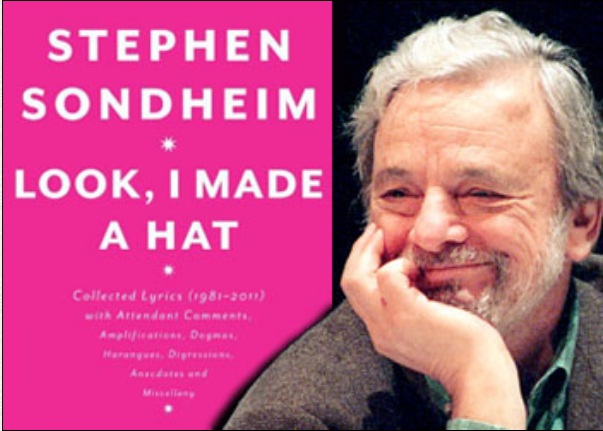
The Admirable Mr. Sondheim

And an ethical hat it is, too!

Readers who are not interested in the art of lyric writing and the mechanics of constructing a Broadway musical should probably avoid the second and final installment of Stephen Sondheim’s chronicle of his creative life, “Look, I Made a Hat.”  They will be missing something important nonetheless: a rare example of truly ethical memoirs.

As in his first volume, “Finishing the Hat,” America’s pre-eminent composer-lyricist for the stage reveals himself as a gentleman, an adult, and a thoroughly ethical human being, and does so not by proclaiming his virtues, but by demonstrating them in his writing. He is not uncritical, but always fair and kind. He accepts personal responsibility for projects that failed, and is generous with giving credit for projects that were successful. There is no false modesty in Sondheim about his own skills and achievements, but neither does he seem to overvalue them or seek his reader’s admiration by blowing his own horn.

The line Sondheim walks in both books is fine, and he walks it finely. For example, I initially thought his decision to only criticize the techniques of other lyricists who are dead was a cowardly one, but upon reading both books it is clear that the decision was motivated by kindness. Sondheim takes the craft of lyric-writing very seriously, and his integrity would not allow him to censor a critical observation regarding a colleague’s work when he believed the criticism was illuminating and had merit. Realizing how hurtful a critique from someone of his reputation and accomplishments could be, Sondheim restricted his frank and (mostly)  fair assessments to writers beyond wounding. If Jerry Herman isn’t grateful, he should be. Continue reading

Ethics Dunce: Libertarian Andrew Cohen

The ethical virtue at issue is integrity.

On the other hand, some times you just have to say, "oh, the hell with it" and stomp on the damn snake...

Those who oppose abortion as the taking of innocent human life may not, consistent with integrity (forget about logic) also say that abortion is a personal choice. Those who oppose capital punishment as a matter of principle (rather than as a problem of fair application) may not, consistent with integrity, announce that of course they would make exceptions in the cases of Hitler, Bin Laden, and Ted Bundy. A pacifist who won’t explain why the U.S. shouldn’t have fought World War II isn’t a pacifist at all, but a poseur.

Now Andrew Cohen, a self-declared libertarian blogger, has written a defense of the state determining whether or not potential parents may have children.  He writes: Continue reading

Fairness for Ron Paul

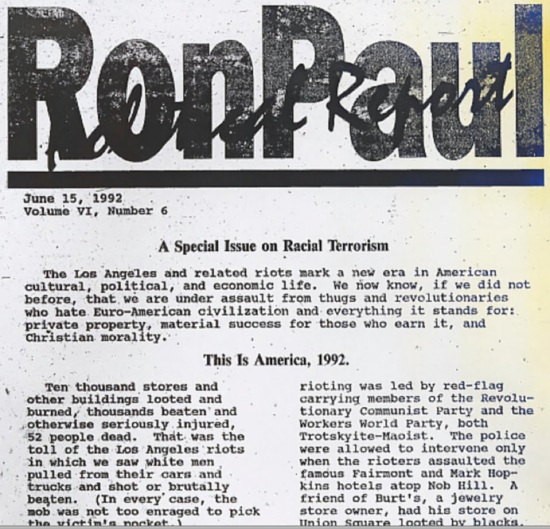
So as not to leave you in suspense longer than necessary, let me be direct: fairness to Ron Paul means firmly declaring him unqualified to run for President on the Republican ticket in 2012.

The reason is old, which means that we should have been having this discussion months ago, before Paul first set foot on a debate stage. In the late Eighties and Nineties, while Paul was out of Congress, he published a group of newsletters to true believers called “The Ron Paul Political Report,” “Ron Paul’s Freedom Report,” “The Ron Paul Survival Report,” “The Ron Paul Investment Letter,” and “The Ron Paul Greyhound Racing Tip-Sheet.”  Okay, okay, I’m sorry: that last one is made up—I couldn’t resist. But the others are real.

Also real were periodic statements in the newsletters that could charitably be called “racially-insensitive” or not-so-charitably be called “racist.” Paul has been questioned about these before, and in the run-up to the Iowa Caucuses where he is a genuine contender is being grilled on them again. Yesterday, he walked out of a CNN interview when Gloria Borger refused to let the subject go. Continue reading

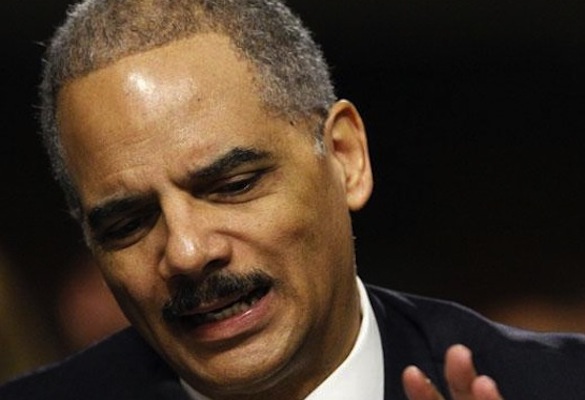
Unethical Quote of the Month: Attorney General Eric Holder

“This is a way to get at the president because of the way I can be identified with him, both due to the nature of our relationship and, you know, the fact that we’re both African-American.”

—-Attorney General Eric Holder, explaining what he believes to be the motives of “extreme factions” in their efforts to hold him accountable for the Justice Department’s “Fast and Furious” debacle in an interview with the New York Times.

That's right, Eric. It's not because you've been a pathetic Attorney General---heck, aren't they all?

Ah, the race card! What a versatile, powerful weapon in the arsenal of public figures under scrutiny, criticism and attack who happen to be African-American! How comforting it must be to know that when it gets really difficult, even impossible, to talk your way out of a mess of your own making, there us always this last ditch, accountability-ducking tactic that will cause reporters to recoil, accusers to quail, public sympathy to shift, and Al Sharpton and Tavis Smiley to leap to attention. Play the race card! Jesse and Al have made a career doing it. Clarence Thomas, Barry Bonds, Marion Barry, Armstrong Williams, Herman Cain, and so many others resorted to it. Sometimes it works, sometimes it doesn’t, but it’s always worth a try…unless, of course, you have sufficient dignity, honesty and integrity to resist the impulse. Say what you will about Charlie Rangel, and I’ve said plenty, but he never claimed that his ethics problems were due to his race. It’s strange to praise someone for not resorting to dishonest and unconscionable tactics, but so automatic is the race card ploy among prominent African Americans in peril that I think Rangel deserves more credit than I gave him. Continue reading