Yesterday I happened upon Lincoln Chafee on one of the Sunday shows, giving his elevator pitch for why he should be President. You may recall that Chafee, former Republican Senator and Governor of Rhode Island, turned independent after being defeated for re-election and now is following Bernie Sanders’ example, declaring himself a Democrat for the purpose of getting nominated. Chafee is another politician, like the Bush bothers and Hillary Clinton, who owes his initial political prominence to being related to a popular political figure rather than his own innate abilities. As he made obvious the more he spoke…
His two primary campaign positions were 1) “Wage peace”—whatever that means. This is right up there with John Lennon songs as serious policy discourse, though I’m sure ISIS is fascinated by the concept, and 2) Adopt the metric system. Chafee borrowed this from the idea machine known as the Andrew Johnson administration, as Andy was the first President to officially acknowledge the benefits of the U.S. adopting the less eccentric measurement system used by Europe. I’m sure we all can agree that this is one of the most pressing issues facing the country today.
However, Chafee really got my attention, and sparked this post, when he attempted to combine his two prime objectives, which is no mean trick. I tried to find a transcript, video or a news report to document this, but so far I have failed: maybe everyone is trying to be nice. I swear I am not making this up, though I wish I were.
Chafee argued that the United States should adopt the Metric system because it invaded Iraq and didn’t find the weapons of mass destruction.
If I accomplish nothing more through Ethics Alarms than to cure some intelligent readers of the seductive fallacy of consequentialism and the insideous influences of moral luck, then the long, aimless trail of squandered opportunities, under-achievement, diffuse focus, quixotic quests, Pyrrhic victories and lost causes I call my life will not have been entirely in vain.
Last week I was again in the throes of consequentialism hate. The Boston Red Sox, in the midst of a terrible start to their season, brought up minor league prospect Eduardo Rodriguez for a spot start. He was spectacular, allowing no runs and looking like the team ace Boston has been searching for all season. Immediately after the game, articles popped up in the baseball media excoriating the team for not bringing him up from the minor leagues long before. It was obvious back in Spring Training, said unnamed scouts, that he should be with the big club. It was negligence and stupidity, said other pundits, that it had taken this long to promote him. Strangely, there had been no published arguments to this effect before his impressive debut. And would any of these “I could have told you so” pieces have been written if Rodriguez had been bombed out of the game in the early innings, as literally any starting pitcher may be in a given game?
No. That’s the marvel of hindsight bias, the human tendency to presume that what could have been known should have been known after it is known. Consequentialism is its more destructive cousin. These same analysts will conclude that the decision to bring up the pitcher was a brilliant one, if tardy, because he performed well. If he had done badly, the decision would have been, in all likelihood, decreed ” a mistake.” This was the fallacy that Jeb Bush was recently pilloried for not embracing regarding his brother’s decision to invade Iraq.
And moral luck? That’s the phenomenon that makes hypocrites and fools of us all, pointing us to the suffocating arms of Dame Consequentialism. If two decision-makers take exactly the same course in exactly equivalent circumstances, the one who is the beneficiary of good fortune—moral luck—will be hailed as a genius. The unlucky soul whose identical plans are derailed by unpredictable misfortune will be handed the mantle of an incompetent failure.
Situations where reasonable decisions and actions are declared “mistakes,” or, as is more germane here, “unethical” according to how uncontrollable events and contingencies occur subsequent to the conduct itself are legion. I am always looking for the counter example, where wrongful conduct has a good result, and is there for forgiven, ignored, or even praised. Well, I found one, and it just happened to me.
I had an important though brief client meeting scheduled this morning, and I had managed to forget the exact time. It was either at 10:45 or 11:00, and I had to be on time, because he was on a tight schedule. My wife was annoyed at me for my scheduling, since she had to use the car to get to a long scheduled appointment of her own at noon and my meeting was 30 minutes away. To make things worse, I couldn’t reach my meeting partner to determine the right time ( a postponement was impossible). To complete the fiasco, I misplaced the car keys, delaying my departure until after 10:30. I was informed, as I left the house with my newly discovered keys (never mind where they were; it is too embarrassing), that if I didn’t have the car back by 11:45, I was dead.
Newspaper “fact-checking” is a mostly unethical and misleading exercise in which media partisans use the format to call positions they differ with ideologically and politically “lies.” PolitiFact is well established as the worst and most biased of these features; Annenberg’s Factcheck.org is easily the best (but still shows its leftward bias), and somewhere in between is Glenn Kessler, the Washington Post’s “Factchecker.” Today’s installment of his periodic column shows that after many years at his job, he still doesn’t know what a lie is. Amazing.
This is not, or should not be, necessarily for a factchecker, as long as he sticks to checking facts, and not characterizing why the facts don’t jibe with a particular public figure’s public statements. PolitiFact’s specialty is making questionable interpretations of statistics and events, declaring them the revealed truth, and attacking anyone, usually a Republican, who has come to a different conclusion. To his credit, Kessler doesn’t do that very often. He is typically fair and objective in his research and presentation of facts. But the Post’s Factchecker uses the device of one to four little Pinocchio heads to indicate the seriousness of a factual misstatement, and as he should know, Pinocchio’s nose grew long when he lied. Even one Pinocchio indicates that Kessler believes he has proven that someone lied.
It seems a little late for Kessler to be mistaking opinions that he disagrees with, analyses of facts that reach different conclusions than he would, and obvious mistakes as lies. Kessler, who is should be in the business of checking facts but has chosen a gimmick that makes him conclude by accusing others of lying, is ethically obligated to know what a lie is: an intentional misstatement of fact that is designed and intended to deceive. He either doesn’t know that, which means he’s incompetent, or he does and misrepresents mistakes and opinions as lies, which means that he’s the liar. Whichever it is, this is ethically unacceptable for a “factchecker.” Continue reading →
Enough about Iraq, Jeb: When did you stop beating your wife?
In the vast history of unfair questions, even including such immortals as “When did you stop beating your wife?,”none is more unanswerable in a substantive way than the question Jeb Bush was asked on Fox News—yes, that’s the same Fox News that supposedly lobs softballs for any Republican. The question: “Knowing what we know now” would he have authorized the Iraq war?
What possible use is that question, other than as an exercise in complete hindsight bias? If the answer is no, it appears to validate the dishonest criticism of the war decades ago, by those who attributed new knowledge about the infamous WMD’s to the original decision, which wasn’t about weapons of mass destruction in the first place. If it is yes, it is evidence of insanity.
Nowwe know that the invasion would be botched, the U.N. would cravenly and irresponsibly withhold support for enforcing its own resolutions, that our hillbilly soldiers would torture Iraqi prisoners and take photos of it, that the new Iraqi government would be incompetent and corrupt, that the news media would assist Democrats in re-writing the history of the decision, and most of all, that even after the situation in Iraq had finally been stabilized, an incompetent President would prematurely pull out our troops, causing the government to implode and ISIS to thrive.
George W. Bush had even said when he was President that if he had known that no WMD’s were there, he would not have invaded Iraq. That was also a dumb answer at the time, and I believe a dishonest one. But today, W. would give the same answer, and knowing what we know now, it would be both correct and honest. That’s if he were silly enough not to say, as his younger brother was too dim to say, this:
“I’m not answering that. It’s pointless. Would Lee have ordered Pickett’s Charge, knowing how it would turn out? Would I have left the dock as captain of the Titanic, knowing that it would hit an iceberg? Would I have approved the Space Shuttle program, knowing that two shuttles would meet with disaster? “Would you still go to see ‘Our American Cousin,’ Mrs Lincoln?” A decision can only be judged based on what the known situation is at the time. It cannot be fairly judged based on the results of the decision, immediately or years later. That’s consequentialism; it’s a logical fallacy.
and
“Nor can I answer the question of what I would have decided in my brother’s place, because I do know how things worked out, and he, of course, could not know. So asking that question is unfair to me, and answering it would be unfair to him. “
But Jeb was too dim to say that. So first he answered… Continue reading →
It’s so discouraging. What chance has Ethics Alarms to help people learn the art of sound ethical analysis and problem-solving when the web is teeming with prolific ethics dunces like Matt Wilstein?
On Mediaite, which is supposed to specialize in news media commentary, analysis and criticism, staff writer Wilstein has delivered an archetype of atrocious ethics reasoning, packaged as a rationalization-fest to save Brian Williams’ imperiled job. It’s called Why NBC Shouldn’t Even Think About Firing Brian Williams, and the title is the most ethical thing about it. After all, it fairly and openly informs anyone tempted to read this trash that the writer is addled. It’s bad enough to argue that NBC News shouldn’t fire the man who is its public face after he proves that he cannot be trusted to convey facts accurately, but to argue that a network shouldn’t even consider ridding itself of such a public relations and professional disaster requires a naive, cynical and illogical view of business, the media (Wilstein’s field!) ethics and life. Anyone reading such a headline is duly warned not only not to read what follows, but to avoid any website that would allow such an author to pollute its pages and its readers’ minds.
Here are Wilstein’s reasons NBC should not fire Williams, and I’m not making this up:
2. He’s funny. That’s right: Viewers won’t care if they can’t believe the head of your news division and anchorman, as long as he’s amusing.
3. “Besides his “Slow Jam the News” segments and edited rap songs on Jimmy Fallon’s show, Williams has also leant his talents to other NBC properties by hosting Saturday Night Live and appearing on 30 Rock.” Translation: Versatility is what you look for in a journalist, not integrity or competence at reporting.
4. NBC has had to replace other key personnel lately, like David Gregory. In other words, convenience trumps trust. Or perhaps Wilstein is making the dubious argument that you shouldn’t replace your car’s defective engine right after you re-lined the brakes. It’s hard to tell.
5. Lots of people want to fire Williams, but lots of people want to fire most news anchors. Wilstein really writes this. He is arguing that 70% of his own website’s readers wanting to fire Williams for serious professional misconduct is meaningless because so many people want to fire other anchors for other reasons.
6. Maintaining a network’s integrity alone is not sufficient reason to fire your news anchor. Well, I guess in today’s journalistic environment, where integrity means nothing, he has a point.
The key question in any ethics problem is usually “What’s going on here?” With Brian Williams’ bizarre admission that he had been telling a false story involving his experience covering the Iraq War for over a decade, it’s impossible to say with confidence what is going on.
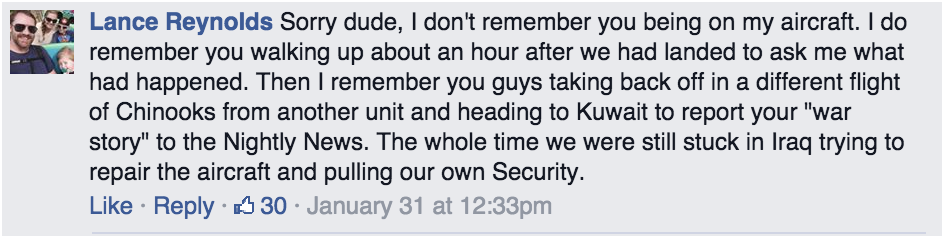
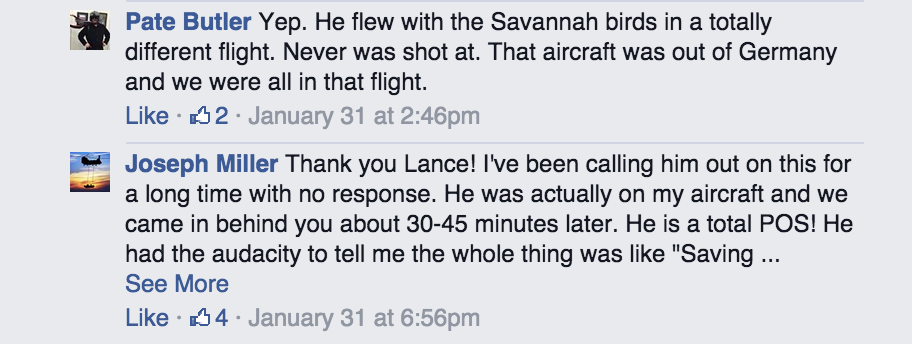
We know this: Williams told viewers on his evening news broadcast last week about an incident when he was covering the Iraq war, saying that a helicopter he was flying in was hit and forced down by an RPG. After the broadcast, soldiers began complaining on Facebook:
“Stars and Stripes” noticed, investigated Williams’ account and found it to be false. Williams quickly apologized, both on Facebook and in his Wednesday broadcast. Here is his Facebook recant:
“To Joseph, Lance, Jonathan, Pate, Michael and all those who have posted: You are absolutely right and I was wrong. In fact, I spent much of the weekend thinking I’d gone crazy. I feel terrible about making this mistake, especially since I found my OWN WRITING about the incident from back in ’08, and I was indeed on the Chinook behind the bird that took the RPG in the tail housing just above the ramp. Because I have no desire to fictionalize my experience (we all saw it happened the first time) and no need to dramatize events as they actually happened, I think the constant viewing of the video showing us inspecting the impact area — and the fog of memory over 12 years — made me conflate the two, and I apologize. I certainly remember the armored mech platoon, meeting Capt. Eric Nye and of course Tim Terpak. Shortly after they arrived, so did the Orange Crush sandstorm, making virtually all outdoor functions impossible. I honestly don’t remember which of the three choppers Gen. Downing and I slept in, but we spent two nights on the stowable web bench seats in one of the three birds. Later in the invasion when Gen. Downing and I reached Baghdad, I remember searching the parade grounds for Tim’s Bradley to no avail. My attempt to pay tribute to CSM Terpak was to honor his 23+ years in service to our nation, and it had been 12 years since I saw him. The ultimate irony is: In writing up the synopsis of the 2 nights and 3 days I spent with him in the desert, I managed to switch aircraft. Nobody’s trying to steal anyone’s valor. Quite the contrary: I was and remain a civilian journalist covering the stories of those who volunteered for duty. This was simply an attempt to thank Tim, our military and Veterans everywhere — those who have served while I did not.”
Research has revealed that Williams has been telling various versions of the story for over a decade, sometimes saying he was in a helicopter behind the one hit by fire, sometimes saying, as he did on the David Letterman show last year, that he was actually a passenger on the helicopter forced down. Thus his Facebook apology is misleading, and the one he gave last night even moreso. At Powerline, John Hinderaker explains:
This is the statement that Williams read on-air tonight:
“After a groundfire incident in the desert during the Iraq war invasion, I made a mistake in recalling the events of 12 years ago….”
No: Williams has been telling the false story since shortly after the incident occurred. He told it for the last time, not the first, last week.
“It did not take long to hear from some brave men and women in the air crews who were also in that desert….”
Not since last Friday, but it took a decade or more since Williams first told the false story.
“I want to apologize. I said I was traveling in an aircraft that was hit by [rocket-propelled grenade] fire. I was instead in a following aircraft. . . .”
Again, Williams tries to mislead: his “following aircraft” landed an hour after the one that took the hit from the RPG.
“This was a bungled attempt by me to thank one special veteran and, by extension, our brave military men and women, veterans everywhere, those who have served while I did not…”
A bungled attempt last Friday evening at the Rangers game. Williams implies, once again, that this was the first time he has told the false story. But he is on video telling the same story at least 13 times since 2003.
Williams’s on-air apology, like the Facebook version, was disingenuous. I doubt that it will help him in the long term.
Hinderaker, a prominent conservative political blogger, believes that Williams is certain to be fired as a result of the controversy, the convoluted details of which you can read about here, here, and here in addition to the Washington Post story linked above.
“With all due respect, what the hell are you talking about?”
—Actor and Wounded Warrior ally Gary Senise, in an open letter responding to Howard Dean’s statement that the audience for “American Sniper” consisted of “angry people.”
Good question. What are the vicious and anti-military critics of Clint Eastwood’s box-office busting bio-pic about Navy Seal Chris Kyle talking about?
I saw the film yesterday. It’s not pro-war, pro-Iraq invasion, or political in any way. The various critics of the film out themselves as hateful and so biased against combat, the military and, I don’t know—life?Reality?—that they can’t even keep their minds open a crack for a thought-provoking piece of popular art. Dean had said, turning his review (I’ll bet anything that he hasn’t seen the film) into a gratuitous attack on tea party supporters:
“There’s a lot of anger in this country, and the people who go see this movie are people who are very angry. And this guy basically says ‘I’m going to fight on your side.’ … I bet you if you looked at a cross-section of the Tea Party and the people who go to see this movie, there’s a lot of intersection.”
In the same forum–his weekly HBO conservative-bashing fest–Bill Maher called Kyle a “psychopath patriot” (there is nothing whatsoever in the film that supports that diagnosis). Seth Rogen compared “American Sniper” to a Nazi propaganda film. Michael Moore used the film–which he couldn’t possibly have seen–to make the ridiculous observation that snipers were “cowards.” Kyle, the most effective sniper in U.S. military history, was wounded repeatedly and awarded two Silver Stars and five Bronze stars. For him to be smeared as a coward by the likes of Michael Moore is grotesque.
The film, among other things, shows just what kind of horror our service men and women endured in Iraq, how they suffered (and suffer still), what it did to them and their families, and accords them well-deserved compassion and respect. How sad, bitter and rotten inside someone must be to resent that. As I watched the film, it occurred to me that this was probably exactly what John Wayne wanted “The Green Berets” to be during Vietnam, but had neither the discipline to avoid agitprop and sentimentality, nor Clint’s directing skills to pull it off.
After expressing his disgust at Dean’s outburst in a tweet, the stage and screen star, whose foundation works to help and recognize the soldiers and veterans he calls our “defenders,” wrote,
To Howard Dean,
I saw American Sniper and would not consider myself to be an angry person. You certainly have a right to make stupid blanket statements, suggesting that all people who see this film are angry, but how is that helpful sir? Do you also suggest that everyone at Warner Brothers is angry because they released the film? That Clint Eastwood, Jason Hall, Bradley Cooper, Sienna Miller and the rest of the cast and crew are angry because they made the film? Chris Kyle’s story deserved to be told. It tells a story of the stress that multiple deployments have on one military family, a family representative of thousands of military families. It helps to communicate the toll that the war on terror has taken on our defenders. Defenders and families who need our support. I will admit that perhaps somewhere among the masses of people who are going to see the film there may be a few that might have some anger or have been angry at some point in their lives, but, with all due respect, what the hell are you talking about?
My guess is that Dean is talking about his own estrangement from basic American values, its history, and its essential role in the world, including all the sacrifices, risks and difficult choices that role demands. He’s the angry one.
It’s all HIS fault, when you get right down to it…
Nancy Pelosi, like her counterpart in the Senate, Harry Reid, is an ethics corrupter of the vilest sort. The problem isn’t her party, ideology, policy positions or political objectives. What makes her an ethics corrupter is that from a place of high esteem, status and presumed trustworthiness, she constantly engages in unapologetic unethical conduct, encourages unethical reasoning and violates ethical values, all as if they are the right thing to do.
This statement is typically despicable. In saying this, she is denying the long-accepted duties of government, the successive acceptance of responsibility that is essential to the continuity of a democratically elected state, and the essence of leadership, thus misinforming the public and making them less civically competent, if that is possible.
When a future administration allows the economy to collapse because it also refuses to make the hard and responsible choices necessary to keep the nation’s debt from suffocating us but there is no more can to kick down the road, its leaders won’t be able to ethically blame Barack Obama or his predecessors. When you accept the role of leader, all problems, crises, and conditions in the nation become your responsibility, because you accepted the job. Failure is yours, not those who contributed to the conditions, seeded the crises or failed to solve the problems before, just as success is yours. Every competent, honorable, honest and fair leader understands and accepts this. President Obama and Nancy Pelosi, among others, do not. Obama always claims the successes (I’m sure there must be one or two) are his alone, and the failures are not his fault, but the fault of others. Continue reading →
Responding to according2grayson’s passionate defense of non-violence and the Golden Rule while encountering bullies (as well as while opposing despots on the march), Steve-O-in-NJ enriched Ethics Alarms with an epic response including historical perspective, ethics and personal experience.
I question this litany of life experiences, since it sounds a bit too pat and a bit too neat to be real, or at least it sounds sanitized/incomplete. Those with truly outstanding records usually don’t feel the need to trumpet them. That said, I wasn’t there, so maybe it is all true.
I know I tried the non-violent approach a few times, and it just lead to more bullying. I also tried the fight-back approach, smashing one bully’s head against the sidewalk and nearly strangling another, and it frankly didn’t get much more done beyond getting the bullies off my back temporarily. That said, a temporary respite from abuse is better than absorbing abuse every day without a respite. What really broke one group of problem people was a combination of finally going to the authorities and the people overreaching.Despite the justified criticism of Catholic schools (a whole separate discussion), they did have one very big thing going for them: no one who was enrolled had to be, or had any right to be, and dismissal or necessary discipline was easily accomplished. Continue reading →
You see, Harold, this is your integrity on bias. Yes, I know it looks yummy…
Back in the run-up to the Iraq invasion, I exchanged some e-mails with Harold Meyerson, the left-est of the Post’s op-ed liberals. He had been condemning the Bush administration’s decision to go to war against Iraq—we were technically still at war with Iraq, since no peace terms had ever been agreed upon from the previous war, and Saddam was blatantly violating the terms of a cease-fire, but never mind—saying, among other things, that this was the first time in American history that the nation had embarked on a “war of choice” rather than necessity. This was a popular, and ignorant, “talking point” used by the anti-war critics at the time, and I was thoroughly sick of it being shouted in CNN debates without any objective participant protesting that it was a lie. I pointed out to the columnist that this was historical fantasy clothed as fact, and that he owed his readers better.
Most U.S. wars have been “wars of choice,” I wrote, and presumably Meyerson knew this. Arguably only the War of 1812, World War II and Afghanistan didn’t fit that description. The Revolution wasn’t a “war of choice”? Of course it was….most of the country would have been happy to stay subjects of the Crown. The Mexican War was not merely a “war of choice” but a war of “let’s trump up a reason to take away all this land belonging to Mexico” war. Lincoln certainly didn’t have to oppose the secession of the Southern states and start the Civil War; indeed, the best Constitutional analysis is that he was acting beyond his authority to do so.The Spanish-American War? World War 1? Korea? Vietnam? Granada? Desert Storm? What country was Meyerson talking about?
To my surprise, Meyerson replied, politely and, I thought, a bit sheepishly. Yes, he said, of course you are right, but this war is more of a war of choice than those were. Translation: “I oppose this war, and the party of this President, so I’ll say whatever is necessary to get people to agree with me, and I’ll convince myself in the process.” I’ve never taken a Meyerson column seriously since. His reasoning process, like so many on the ends of either side of the political spectrum, is to frame reality in the way that most comfortably supports his ideological objective, and then to allow that warped reality to become part of his own world view. I think this kind of thought process by confirmation bias should disqualify any infected media pundits from commentary, as much as habitual dishonesty, dementia or insanity.
Today, Meyerson once again shows how his biases rot his reasoning and integrity. Continue reading →







 Ethics Alarms