Comment of the Day: “Unethical Quote of the Month: Patriots Quarterback Tom Brady”

––New England Quarterback Tom Brady, in the course of denying culpability in the latest New England Patriots cheating scandal.
Tom Brady now joins the Ethics Alarms Rationalization Spouter’s Hall of Fame, which I just started. You just can’t embody Rationalization #22, Comparative Virtue, or “It’s not the worst thing” any better than this obnoxious attempt to minimize the significance of Deflategate.
That’s the way to teach the kids to be fair competitors and good citizens, Tom! And does a star athlete whose attitude regarding cheating in his profession amounts to this fill you with trust in his integrity, honesty, and sportsmanship?
Not me.

This cartoon, which should cause editorial cartoonist Jack Ohman to hang his head in shame, has made me realize that there is an odd and pervasive parallel today with the familiar Clinton Derangement Syndrome and Bush Derangement Syndrome of yore, which caused the mouth-foaming political opponents of these polarizing Presidents to make ridiculous claims undermining the many more legitimate criticisms available to them. In the case of Barack Obama, it is Desperate Obama Defense Derangement (DODD) that we are seeing. So horrible is the prospect of having to admit that this President is an unequivocal, incompetent flop by almost every measure imaginable that disappointed, panicked partisans in the media, the President’s party and bitterly disappointed hope-and-changers are resorting to obvious rationalizations, absurd analogies and insane arguments to avoid facing the miserable, depressing truth.
This cartoon can stand as a graphic symbol of the malady. In order to preemptively duck accountability when yet another government agency, in this case the CDC, proves inept and another national policy–the measures designed to keep Ebola out of the U.S— proves ill-thought out and poorly managed like so many other agencies and national policies under this administration’s stewardship, DODD sufferers like Ohman and the sad Democrats posting it on Facebook are making the argument that Ebola is no big deal.
You know, like AIDS was no big deal. When the Reagan administration was being justly criticized for its tardy and in inadequate response to AIDS, I don’t recall any cartoonists listing the stats for all of the other causes of death to ridicule gays, humanitarians and sane people who were saying that this was a national crisis. But then, there aren’t very many conservative cartoonists, for which, in that instance, at least, we can be grateful.
Look at Ohman’s cartoon, and try to translate it into a coherent statement that makes any sense at all: Continue reading

This rationalization can be another variation on the Golden Rationalization, “Everybody does it,” like “It’s done all the time” and” “We’ve always done this,” but its intent is often different. The suggestion is that because an unethical act has been done before and presumably permitted, ignored, or endorsed, that presumptively ratifies the same or similar conduct as acceptable from now on. In fact, it does not. In fact, the argument is nonsensical.
An individual instance of bad conduct may have been tolerated or forgiven on the theory that a warning was sufficient, or that the circumstances prompting it were unlikely to occur again. That didn’t mean that the conduct was desirable, responsible, fair or something that would make a good societal norm. Moreover, “It’s not the first time” cuts the other way: if this conduct is happening repeatedly and with increasing frequency, that may make it worse, not more permissible.(“Hey, this isn’t the first shell that Hamas has shot into Israel! What are you getting so bent out of shape for?”) Continue reading

“Obamacare is a success, and even if it’s not, it’s not worse than nuclear war. So there.”
This is excellent: I always am looking for the most extreme example of any kind of misconduct, lie, rhetorical fallacy or rationalization, so I have something to measure all others against. Jamelle Bouie, the resident Obama flack at Slate, just delivered a dandy for my future scale of infamy for Rationalization #22 on the Ethics Alarms list, the Bottom of the Barrel, the favorite excuse of the shameless, the ethics-challenged and the desperate sociopath, “It’s not the worst thing,” or “The Comparative Virtue Excuse.”
It’s a deft turn, and a welcome one: so much attention is being lathered on the prisoner exchange fiasco that the parade of other Obama Administration-created ethics train wrecks are being ignored for the nonce…and perhaps that was the objective. The late Mike Kelly, the sharpest conservative political analyst the Washington Post has ever featured on its pages, half-seriously suggested that seeding so-called scandal fatigue was a conscious strategy of the ethically corrupt Clinton White House, and Obama has taken this to levels then unimagined. Among other, the Obamacare Ethics Train Wreck barrels on at an impressive clip. Yesterday, for example, it was revealed that yet another flaw in the enrollment process has left 2,000,000 Americans who think they have insurance at risk of finding themselves uncovered.
To unconscionable fake-journalists like Bouie, however (a real journalist is one who follows the facts to where they lead; a fake one cherry-picks the facts that take him where he wants to go), it doesn’t matter: the Affordable Care Act, he tells his gullible or retching readers…
“…looks like a success. Between the state exchanges, healthcare.gov, and the Medicaid expansion, an estimated 17.2 million people have received health insurance under the law. In turn, according to Gallup, the percentage of Americans without health insurance has dipped to 13.4 percent, down 3.7 percentage points from where it was at the end of last year.”
This species of argument, which has become the standard practice for the Obama Is A Great President Despite All Evidence To The Contrary League, is one of two things, and two things only: proof of mental deficiency, or conclusive evidence of dishonesty. Either one, I would argue, should disqualify someone from writing commentary in Slate, or for that matter, Weekly Reader. Continue reading

But remember: the trains ran on time!
It is a debate that erupts here periodically: Do you vote for the honest and trustworthy politician whose policies you despise, or the lying rogue who stands for all the “right” things? Washington Post editor Hilary Krieger raises the issue with gusto in the Sunday Washington Post, with an essay titled (in the print edition) “Is a little political corruption all that bad?”
Yes, Hilary, it is.
Next question?
But perhaps that’s not sufficient to kill this particular snake, so let’s delve a bit deeper into this truly fatuous, ethically obtuse article. Continue reading
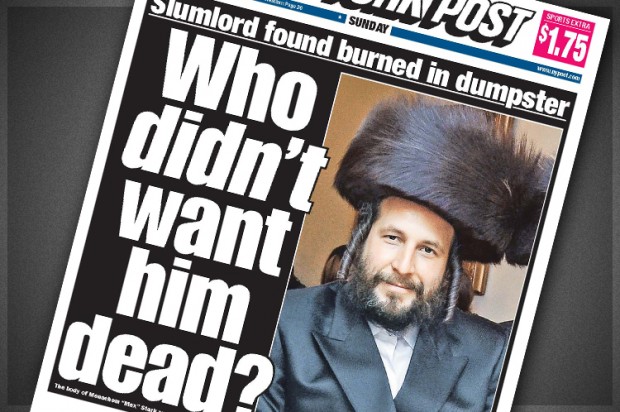
Let me dispense with the outrage over The New York Post’s brilliant (from their perspective, which is selling newspapers) and tasteless front page covering the death of Menachem Stark, a Hasidic real estate developer ( a.k.a. “slumlord”) who was found murdered and burned in a dumpster last Friday in Long Island.
The operative principle is not, as the reader who flagged the issue suggested, the Golden Rule. The Golden Rule does not often apply to the press, which is supposed to be truthful, not kind and diplomatic. There are provisions of most journalistic codes about avoiding unnecessary harm to third parties, which is pretty much a universal ethics rule in every field, from law to the military. When, however, you operate a tabloid, and not just any tabloid but a tabloid whose brand is defined by intentionally shocking, outrageous, assaultive and controversial headlines and photos, “Unnecessary harm to third parties” is almost an impossible principle to apply.
The headline is a perfect example of the Julie Principle, which I explained back in May. The Julie Principle comes into play when an undesirable or annoying characteristic or behavior pattern in a person or organization appears to be hard-wired and part of their essence. In judging such a person or entity, it is useful to keep the lyrics of Julie’s song from “Show Boat” (lyrics by Oscar Hammerstein Jr., music by Jerome Kern) firmly in mind, when she sings…
Fish gotta swim, birds gotta fly…
I’ve gotta love that man til I die
Can’t help lovin’ that man of mine! Continue reading
A few quick points, before I present Chris Marschner’s excellent Comment of the Day:
Here is his Comment of the Day on the post, “Ethics Dunce: Columbia, South Carolina Police Chief Ruben Santiago”: Continue reading

The face of police power abuse in Columbia, S.C.
If our culture did a minimally competent job communicating the essential right of free speech in the United States, people like Ruben Santiago wouldn’t think as the do—as they do being best described as ignorantly, censoriously, arrogantly and stupidly. Both the Left and the Right are to blame for the message not getting out to the public, and, consequently, members of the public who acquire governmental authority: the government can’t threaten you or harm you for mere speech…the Left through its attempts at political correctness, mind control and indoctrination in the schools, the Right in its efforts to use laws to curb expression involving sex and violence in the arts and entertainment.
In Columbia,Police Chief Ruben Santiago took to the Columbia Police Department Facebook page to announce that his officers had seized $40,000 in marijuana from an apartment after a successful drug investigation. Citizen Brandon Whitmer, on his own page, took note of the arrest and opined, “maybe (police) should arrest the people shooting people in 5 points instead of worrying about a stoner that’s not bothering anyone. It’ll be legal here one day anyway.” Santiago replied ominously to Whitmer, saying, “(W)e have arrested all of the violent offenders in Five points. Thank you for sharing your views and giving us reasonable suspicion to believe you might be a criminal, we will work on finding you.”
Somebody in the department with a working knowledge of the Constitution quickly got that post deleted, but Santiago defended it in a double-down post, writing, Continue reading

Earlier this week, Cher used her interview with USA to take some well-aimed pot-shots at Miley Cyrus’s universally loathed “twerking” antics on the MTV Awards show. She said of Cyrus
“”I’m not old fashioned. She could have come out naked, and if she’d just rocked the house, I would have said, ‘You go, girl.’ She could have come out naked, and if she’d just rocked the house, I would have said, ‘You go, girl.’ It just wasn’t done well. She can’t dance, her body looked like hell, the song wasn’t great, one cheek was hanging out. And, chick, don’t stick out your tongue if it’s coated. If you’re going to go that far, then think about it before you do it.“
These are wise words from a veteran and proven performing star to a young one on the way up, or heading for a crash. Essentially, Cher is stating the principles of professionalism: whatever you do, do it right, do it well, and respect your constituency. Cher has the bona fides to offer such an opinion since she has stretched the lines of sexual propriety on stage more than once, but it was always used as an additional enhancement on the way to her “rocking the house.”
The legendary pop diva was apparently surprised that her comments became a one-day sensation on the gossip websites and cable entertainment shows, and had second thoughts about them, which she communicated in a couple of tweets to the Twitterverse. In Cher-ese, they are all about ethics:
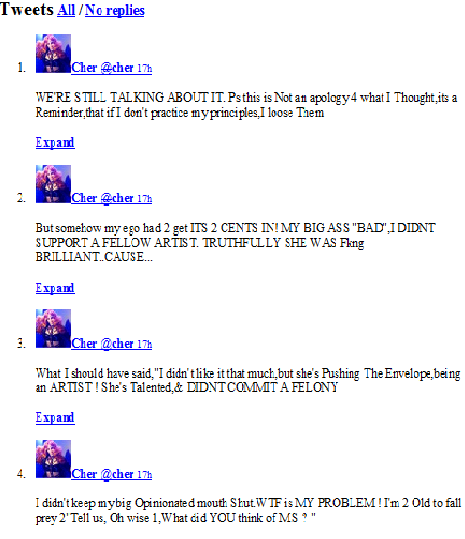
Translation: Continue reading
 Ethics Alarms
“Is this a deflated ball I see before me?”
“Inflategate”—-the developing NFL scandal about the New England Patriots’ under-inflated, more easily thrown footballs in the team’s last play-off win and perhaps others—is a big deal to 1) people who hate the Patriots; 2) football fans who care about whether their game has any integrity and 3) people like me, who think there is no justification for cheating, in sports, in business, or in life. Those who argue that it’s “much ado about nothing,” usually without being able to quote a line or explain a plot turn from the Shakespeare comedy they’re alluding to, do so because 1) they are Barry Bonds fans; 2) they don’t know the difference between a football and a plantain, and don’t care. except that they wouldn’t want to eat a football by mistake; 3) they are typical NFL football fans and want to “oh, pshaw!” anything that reflects badly on the sport that gives their brutal lives meaning, 4) they are John Edwards, or 5) they are members of the New England Patriots organization, and perhaps were involved in the ball deflation.
Pats quarterback Tom Brady (that’s how you know I’m from Boston: I call the team the “Pats”) gave a highly unconvincing press conference yesterday in which he maintained that he would never notice that the tool of his trade that he has plied approximately since he exited the womb felt different than usual, and, like his coach, the brilliant and soulless Bill Belichick, has no idea how the team’s balls got deflated. The credibility of that claim was severely undermined for me by Brady’s use (“This isn’t ISIS…”) of my least favorite rationalization of them all on the Ethics Alarms compendium, the infuriating #22:
(Or someone whose coach had the equipment guy deflate the footballs.)
Now comes blogger Windypundit to expand on my derision of Brady’s embrace of #22 from a different and useful perspective. Here is his Comment of the Day on the post, “Unethical Quote of the Month: Patriots Quarterback Tom Brady”: